1998 BMW CONVERTIBLE fuel
[x] Cancel search: fuelPage 115 of 179

11 4
We recommend winter tires (M+S radial
tires) for operation under inclement win-
ter driving conditions. Although all-sea-
son M+S tires provide better winter
traction than standard summer tires
with H, V, W and ZR speed ratings, they
generally fail to provide the same levels
of performance as standard snow tires
in winter driving.
If you fit winter tires, install radial tires
of the same tread configuration and
from a single manufacturer on all four
wheels (better still: on all five wheels).
This ensures safe tracking and steering
response.
Fit BMW-approved winter tires only.
Any BMW Retailer will be glad to pro-
vide you with information on the best
winter tires for your particular driving
conditions.Winter tires display a perceptible loss in
their ability to cope with winter driving
conditions once the tread wears to
below 0.16 in (4 mm), and should thus
be replaced.
Observe the specified tire inflation
pressures - and be sure to have the
wheel and tire assemblies balanced
every time you change the tires!
a
Never exceed the maximum speed
for which the tires are rated.
Unprofessional attempts by laymen to
service tires can lead to damage and ac-
cidents.
Have this work performed by skilled pro-
fessionals only. Your BMW Retailer will
be glad to assist you.c
Store tires in a cool, dry place, away
from light whenever possible. Protect
the tires from contact with oil, grease
and fuel.
Winter tires
Page 125 of 179

12 4
Headlamp washer
* and
windshield washer
Capacity approx. 2.65 US quarts
(2.5 liters) for the windshield washer or
5.3 US quarts (5 liters) in conjunction
with the headlamp cleaning system.
Fill with water and - if required - with
antifreeze (according to the manufac-
turer's recommendations).b
We recommend that you mix the
washer fluid before adding it to the res-
ervoir.c
Windshield washer spray
nozzles The spray from the nozzles should be
directed so as to ensure effective
cleaning, even at high speeds.
Use a needle to adjust the nozzles as
required, or have them adjusted by your
BMW Retailer.
Checking oil level As with fuel economy, oil consumption
is directly influenced by your driving
style and vehicle operating conditions.
Consequently you should check the oil
level regularly with the vehicle posi-
tioned on a level surface - approx. every
600 miles (1,000 km), or more fre-
quently if your vehicle is driven under
increased demands.
To obtain precise readings:
dCheck with engine cold, before start-
ing.
dWhen checking with the engine
warm, wait briefly for the oil to drain
back down into the oil pan (e.g.,
while refueling).
360de100
360de095
Washer fluids Engine oil
Page 133 of 179

13 2
Exterior finishTo provide effective corrosion protec-
tion, multilayer paintwork is applied at
the factory. Cataphoretic immersion
priming techniques are supplemented
using special body-cavity protectants,
with the application of specially-devel-
oped and extensively tested materials.
The entire underbody is sprayed with a
flexible PVC layer before final compre-
hensive application of a wax-based
protectant.
Regular maintenance makes an impor-
tant contribution to maintaining the
safety and value of your vehicle.
Increasing awareness of the effects of
harmful environmental factors on vehi-
cle finishes have led paint and vehicle
manufacturers to initiate ongoing pro-
grams designed to further improve the
durability of their finishes. Despite the
high quality of the resulting products,
local and regional factors can still have
a negative effect on your car's paint-
work. These should guide you in deter-
mining the frequency and extent of your
efforts to maintain the vehicle finish.
Depending upon material and type of
impact (perforation of paint layer), phys-
ical stresses from sand, road salt,
gravel, etc. can cause corrosion to start extending beneath the finish, starting at
the point of impact.
Road dirt, tar spots, dead insects, ani-
mal droppings (strong alkali effect) and
tree excretions (resins and pollen) all
contain substances capable of causing
damage when allowed to remain on
your car's finish for any period of time
(spots, etching, flaking, separation in
the top coat).
In industrial areas, deposits from ßy ash,
lime, oily soot, sulphur dioxide in pre-
cipitation (acid rain) and other environ-
mental pollutants will damage the car's
surface (usually limited to the external
horizontal surfaces) unless adequate
protection is provided.
In coastal regions, high levels of atmo-
spheric salt and humidity promote cor-
rosion.
In tropical zones, temperatures of over
100 5F (approx. 406) in the shade pre-
vail, in addition to heavy ultraviolet radi-
ation and high humidity. Under those
circumstances, light-colored paints
reach temperatures of up to 175 5F
(approx. 806) and dark paints up to
250 5F (approx. 1206).
Caring for the vehicle finishAs a precaution against damage result-
ing from exposure to aggressive sub-
stances, we recommend that you wash
the car weekly when it is used in an
area with high levels of air pollution or
aggressive natural substances (tree
resin, pollen).
Remove particularly aggressive sub-
stances immediately in order to prevent
changes to, and discoloration of, the
paint. Such substances are e.g., gaso-
line spilled during refueling, oil, grease,
brake fluid and bird droppings.
Any contamination remaining on the
surface of the vehicle will be especially
conspicuous after washing. Use clean-
ing fluid or alcohol with a clean cloth or
cotton pad to remove. You can use tar
remover to remove any spots on the fin-
ish of the vehicle, but should never
apply it or any other aggressive
cleanser to lenses or headlamp covers.
These areas should then be waxed to
maintain protection.b
A full range of car-care products is
available from your BMW Retailer.c
Caring for your car
Page 134 of 179

13 3
At a glanceControlsCar careRepairsTechnicalDataIndex
Waxing your carProtect the finish using carnauba or
synthetic-based waxes only.
The best way to determine when the
finish needs to be waxed is by noting
when water stops beading on the sur-
face.
You can use a glass cleaner to remove
any wax or silicone that may have been
left on the windows during waxing.b
A full range of car-care products is
available from your BMW Retailer.c
Paint damageYou can touch up small areas of dam-
age with BMW spray paint, a BWM
touch-up stick or BMW paint tape.
The paint color code for your car is pro-
vided on a sticker located next to the
type plate and on the first page of your
Service and Warranty Information book-
let.
Damage caused by flying stones,
scratches, etc. must be touched up
without delay to prevent rust from form-
ing.
If corrosion has started to form in an
area with paint damage, remove all rust
and clean the area, then prime the area
with a BMW Primer Stick. Finally, apply
the finish coat. Wait a few days, then
polish the repaired area. Finish by
applying a wax preservative.
More extensive paint damage should be
professionally repaired in accordance
with the manufacturer's instructions.
Your BMW Retailer uses original BMW
finish materials in accordance with offi-
cial repair procedures.
Caring for other vehicle compo-
nents and materialsLight-alloy wheels
* should be treated
with alloy wheel cleaner, particularly dur-
ing the winter months. Refrain from using
aggressive products containing acids,
strong alkalis or abrasives. Alloy wheels
should not be cleaned with a steam jet
operating at temperatures in excess of
140 5F (606) (note manufacturer's
instructions).
You can use window and glass cleaner to
clean inside window surfaces and mir-
rors without smearing and streaking.
Never use polishing pastes or abrasive
(quartz) cleansers on mirror lenses.
Clean plastic parts, imitation leather sur-
faces, the roof lining, the lenses of lamps,
the glass cover of the instrument panel
and all dull black sprayed parts with
water or products for the care of plastics.
Avoid soaking the headliner. Never use
solvents such as lacquer thinner, heavy-
duty grease remover, fuels, etc.
Rubber components should be cleaned
with water only; a rubber treatment or sil-
icone spray may also be applied.
Clean the wiper blades with soapy water.
The wiper blades should be replaced
twice a year, before and after the cold
season.
Caring for your car
Page 140 of 179

At a glance
Controls and featuresCare and maintenanceAdvanced technology
Technical data
Owner service procedure
At a glanceControlsCar careRepairsTechnicalDataIndex
Index
13 9
Replacement procedures:
Onboard tool kit140
Windshield wiper blades140
Lamp and bulbs141
Master key with battery lamp145
Changing tires146
Battery149
Fuses151
In case of electrical
malfunction:
Fuel filler door 152
Sliding/tilt sunroof 152
Assistance, giving and receiving:
Jump-starting153
Towing the vehicle154
Towing154
Page 153 of 179
15 2
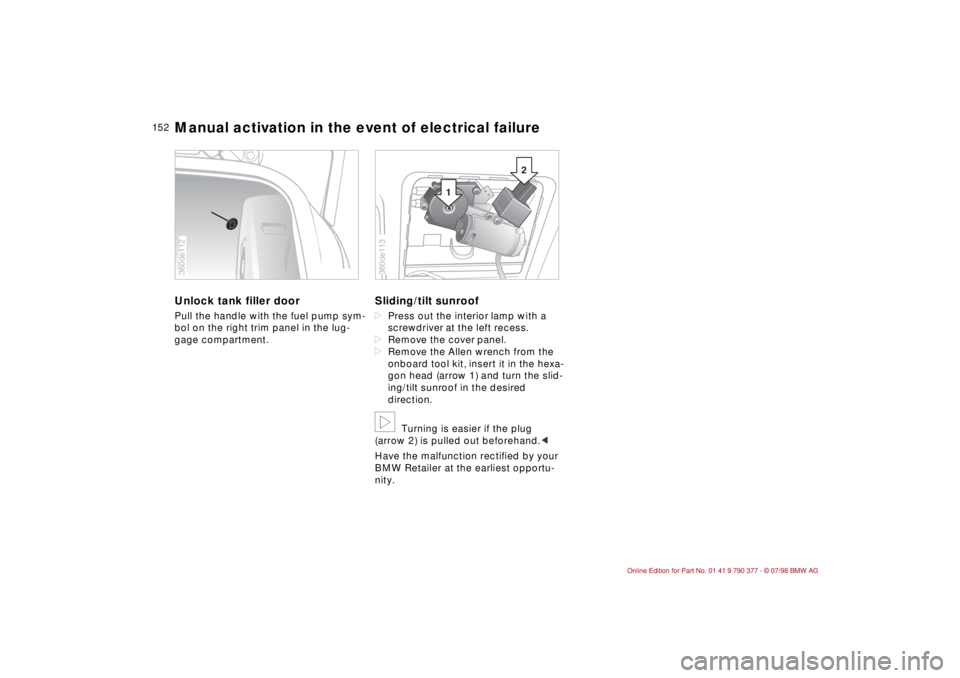
Unlock tank filler door Pull the handle with the fuel pump sym-
bol on the right trim panel in the lug-
gage compartment.
Sliding/tilt sunroof dPress out the interior lamp with a
screwdriver at the left recess.
dRemove the cover panel.
dRemove the Allen wrench from the
onboard tool kit, insert it in the hexa-
gon head (arrow 1) and turn the slid-
ing/tilt sunroof in the desired
direction.b
Turning is easier if the plug
(arrow 2) is pulled out beforehand.c
Have the malfunction rectified by your
BMW Retailer at the earliest opportu-
nity.
360de112
2
1
360de113
Manual activation in the event of electrical failure
Page 161 of 179

16 0
Engine speciÞcations
BMW 318i Sedan
BMW 318is Coupe
BMW 318i ConvertibleBMW 323is Coupe
BMW 323i ConvertibleBMW 328i Sedan
BMW 328is Coupe
BMW 328i Convertible
Displacement
Number of cylinderscu.in (cmm) 115.6 (1,895)
4152.2 (2,494)
6170.4 (2,793)
6
Maximum output
at engine speedhp
kW
rpm138
103
6,000168
125
5,500190
142
5,300
Maximum torque
at engine speedlb-ft (Nm)
rpm133 (180)
4,300181 (245)
3,950206 (280)
3,950
Compression ratioe10 10.5 10.2
Stroke
Borein. (mm)
in. (mm)3.29 (83.5)
3.35 (85)2.95 (75)
3.31 (84)3.31 (84)
3.31 (84)
Fuel-injection system Digital-electronic engine-management system
Page 164 of 179

At a glanceControls Car careRepairsTechnicalDataIndex
16 3
BMW 318i
SedanBMW 318is
CoupeBMW 318i
Convertible
Vehicle weight empty
(including driver, ready for operation, with full tank of fuel,
options not included)
with manual transmission
with automatic transmissionlbs (kg)
lbs (kg)2,954 (1,340)
3,042 (1,380)2,987 (1,355)
3,075 (1,395)3,153 (1,430)
3,230 (1,465)
Approved gross vehicle weight
with manual transmission
with automatic transmissionlbs (kg)
lbs (kg)3,924 (1,780)
4,012 (1,820)3,957 (1,795)
4,045 (1,835)3,990 (1,810)
4,068 (1,845)
Approved front axle load lbs (kg) 1,830 (830)
1,830 (830) 1,830 (830)
Approved rear axle load lbs (kg) 2,304 (1,045) 2,337 (1,060) 2,348 (1,065)
Maximum payload lbs (kg) 970 (440) 970 (440) 838 (380)
Approved roof load capacity lbs (kg) 165 (75) 165 (75) 88 (40)
Never exceed either the approved axle weights or the gross vehicle weight.
Luggage compartment capacity cu. ft. (liter) 15.4 (435) 14.3 (405) 8.1 (230)
Weights