1998 BMW CONVERTIBLE fuel
[x] Cancel search: fuelPage 32 of 179

31
At a glanceControls Car careRepairsTechnicalDataIndex
Operating central locking system
from outside the vehicle When the front doors are closed, the
activation of a door lock or of the lug-
gage compartment lock with a key
unlocks or locks the following:
dDoors
dLuggage compartment
dFuel filler door
dBMW Convertible: the glove com-
partment.
The double-lock system is engaged at
the same time. Both the door locks and
release handles remain locked.
a
Never use the keys or the remote
control* to lock an occupied vehicle, as
it would then be impossible to unlock it
from inside.c
Convenience closing
* for power win-
dows and sliding/tilt sunroof: after clos-
ing the doors, hold the key in the lock
position to close the windows and slid-
ing/tilt sunroof. The windows/sunroof
stop moving immediately when you
release the key. To be able to keep the
closing system in view, convenience
closing can only be activated via the
driver's door lock for safety reasons,
even on vehicles with remote control.
Emergency lock operation(in the event of electrical failure)
Turn the key to the end positions of the
door lock to unlock/lock the respective
door.
Activating the central locking
system from inside the vehiclePressing the lock button of a front door
unlocks/locks the doors and luggage
compartment, but does not arm the
alarm system.b
If the vehicle is locked from the
inside with this lock button, the fuel
filler door remains unlocked to allow
refueling. On the BMW Convertible, the
glove compartment also remains un-
locked to allow for its use.
It is also possible to unlock the car from
the inside by pulling on one of the front
door handles.c
To preclude accidental locking of the
vehicle
dit can not be locked with the lock
button when the driver's door is open
dthe safety button of the passenger
door activates the central locking
system only when both front doors
are locked.
360de011Doors
Page 33 of 179
32
a
Children can lock the doors from
inside. Therefore, you should always
remove the key and take it with you to
ensure that you can unlock the car from
the outside at all times.c
In an accident, the central locking sys-
tem automatically unlocks the doors
and the interior lamps switch on.
Depending on the version, the hazard
warning flashers are also activated.
a
Avoid using the inside lock buttons
to lock the rear doors while driving, as
these doors would then fail to unlock au-
tomatically in the event of an accident.c
Opening doors from the insidePull interior door handle of a front door
twice in succession (the initial pull
unlocks the door, the second opens it).
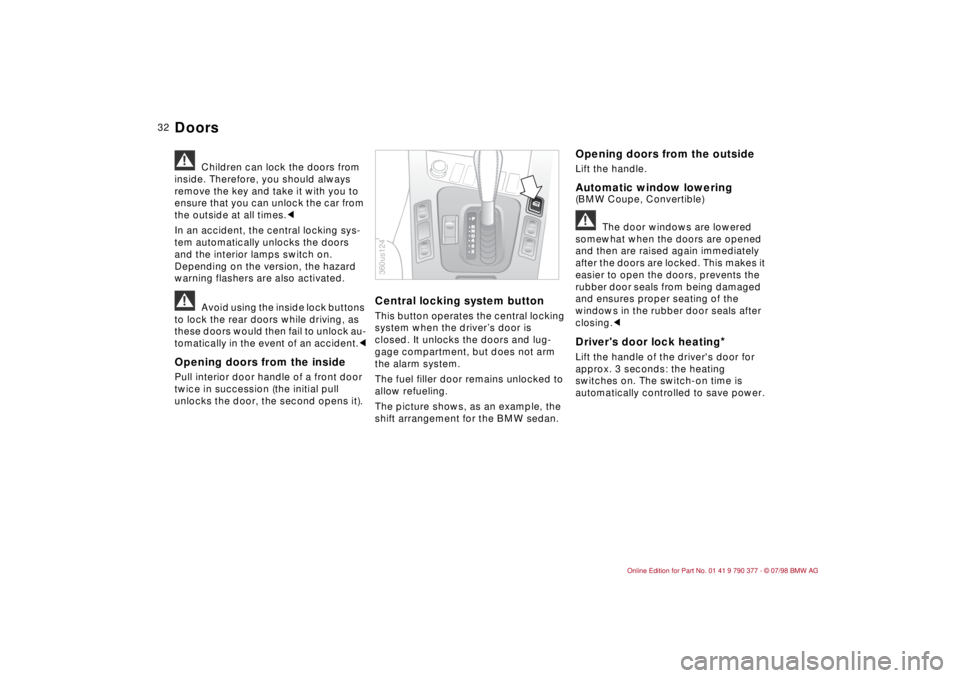
Central locking system buttonThis button operates the central locking
system when the driverÕs door is
closed. It unlocks the doors and lug-
gage compartment, but does not arm
the alarm system.
The fuel filler door remains unlocked to
allow refueling.
The picture shows, as an example, the
shift arrangement for the BMW sedan.
Opening doors from the outsideLift the handle.Automatic window lowering (BMW Coupe, Convertible)a
The door windows are lowered
somewhat when the doors are opened
and then are raised again immediately
after the doors are locked. This makes it
easier to open the doors, prevents the
rubber door seals from being damaged
and ensures proper seating of the
windows in the rubber door seals after
closing.c
Driver's door lock heating
*
Lift the handle of the driver's door for
approx. 3 seconds: the heating
switches on. The switch-on time is
automatically controlled to save power.
S
360us124
Doors
Page 64 of 179

63
At a glanceControls Car careRepairsTechnicalDataIndex
Records the total vehicle mileage
(registers distance in kilometers on
Canadian vehicles).Trip odometerRecords trip distances up to 999.9 miles
(kilometers).To reset to zeroPress button.
The displays appear from ignition key
position 1.
To display with ignition switched off:
Press the reset button (arrow).Never allow the engine to operate with
the needle in the red overspeed sector
of the gauge.
In this range the fuel supply is inter-
rupted to protect the engine, producing
the sensation of a loss of power.Indicates the current fuel consumption
in mpg (in liters per 100 km on Cana-
dian vehicles).
When the vehicle is stationary, the nee-
dle returns to zero (maximum reading
on Canadian models).
2040
120
140
km/h
240 220 200 180 160
140
120
100
80
60
40
20MPH
F360us320
360us030
360us031
Odometer Tachometer Energy control*
Page 65 of 179
64
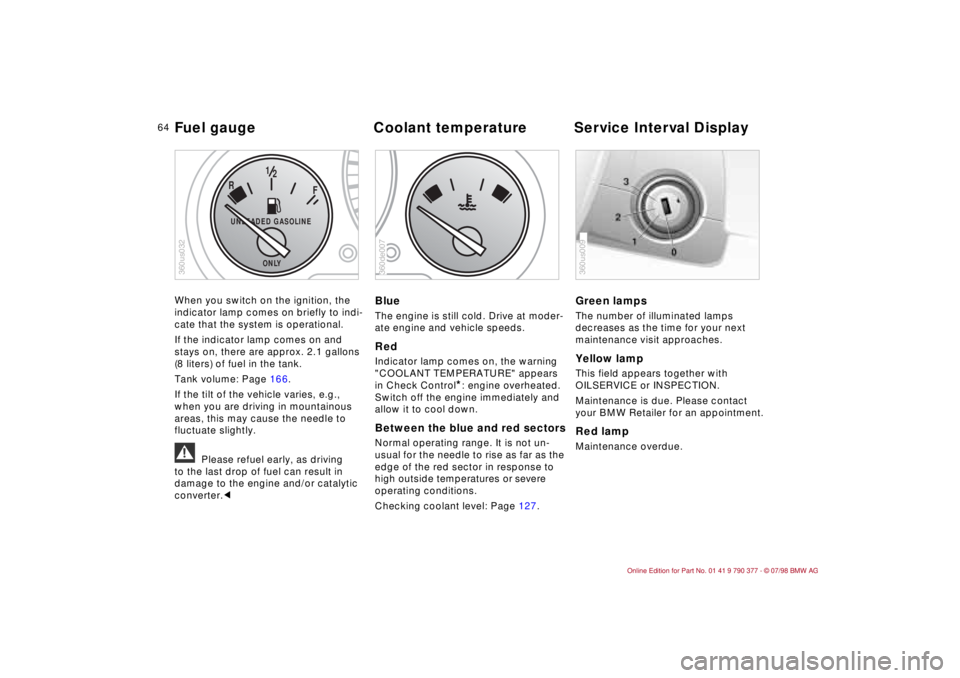
When you switch on the ignition, the
indicator lamp comes on briefly to indi-
cate that the system is operational.
If the indicator lamp comes on and
stays on, there are approx. 2.1 gallons
(8 liters) of fuel in the tank.
Tank volume: Page 166.
If the tilt of the vehicle varies, e.g.,
when you are driving in mountainous
areas, this may cause the needle to
fluctuate slightly.
a
Please refuel early, as driving
to the last drop of fuel can result in
damage to the engine and/or catalytic
converter.c
BlueThe engine is still cold. Drive at moder-
ate engine and vehicle speeds.RedIndicator lamp comes on, the warning
"COOLANT TEMPERATURE" appears
in Check Control
*: engine overheated.
Switch off the engine immediately and
allow it to cool down.
Between the blue and red sectorsNormal operating range. It is not un-
usual for the needle to rise as far as the
edge of the red sector in response to
high outside temperatures or severe
operating conditions.
Checking coolant level: Page 127.
Green lampsThe number of illuminated lamps
decreases as the time for your next
maintenance visit approaches.Yellow lamp This field appears together with
OILSERVICE or INSPECTION.
Maintenance is due. Please contact
your BMW Retailer for an appointment.Red lampMaintenance overdue.
F
R
12
UNLEADED GASOLINE
ONLY
360us032
360de007
360us009
Fuel gauge Coolant temperature Service Interval Display
Page 80 of 179
79
At a glanceControls Car careRepairsTechnicalDataIndex
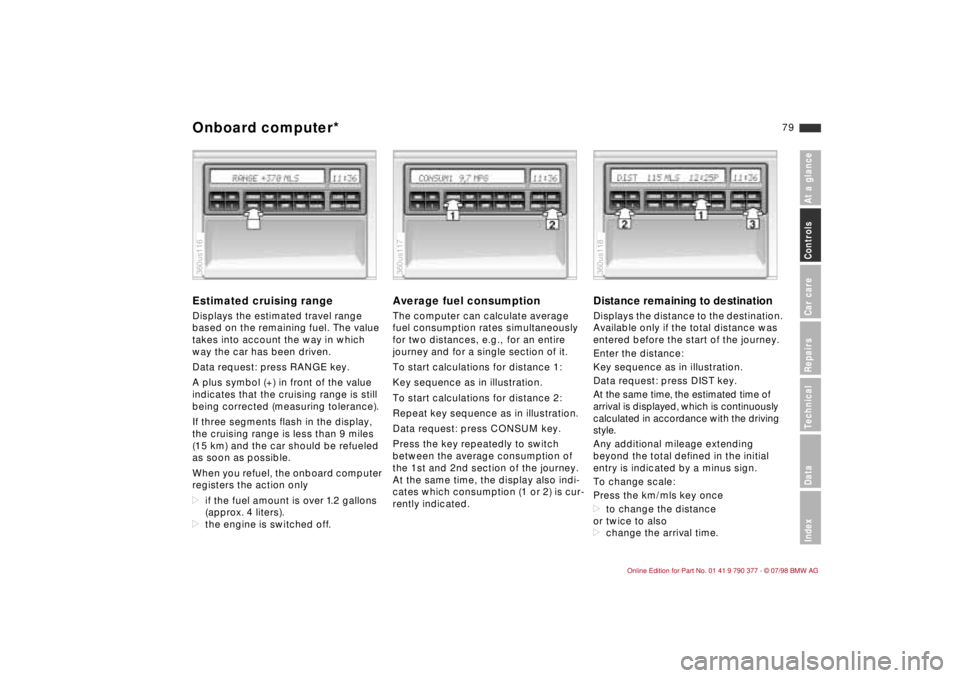
Estimated cruising rangeDisplays the estimated travel range
based on the remaining fuel. The value
takes into account the way in which
way the car has been driven.
Data request: press RANGE key.
A plus symbol (+) in front of the value
indicates that the cruising range is still
being corrected (measuring tolerance).
If three segments flash in the display,
the cruising range is less than 9 miles
(15 km) and the car should be refueled
as soon as possible.
When you refuel, the onboard computer
registers the action only
dif the fuel amount is over 1.2 gallons
(approx. 4 liters).
dthe engine is switched off.
Average fuel consumptionThe computer can calculate average
fuel consumption rates simultaneously
for two distances, e.g., for an entire
journey and for a single section of it.
To start calculations for distance 1:
Key sequence as in illustration.
To start calculations for distance 2:
Repeat key sequence as in illustration.
Data request: press CONSUM key.
Press the key repeatedly to switch
between the average consumption of
the 1st and 2nd section of the journey.
At the same time, the display also indi-
cates which consumption (1 or 2) is cur-
rently indicated.
Distance remaining to destinationDisplays the distance to the destination.
Available only if the total distance was
entered before the start of the journey.
Enter the distance:
Key sequence as in illustration.
Data request: press DIST key.
At the same time, the estimated time of
arrival is displayed, which is continuously
calculated in accordance with the driving
style.
Any additional mileage extending
beyond the total defined in the initial
entry is indicated by a minus sign.
To change scale:
Press the km/mls key once
dto change the distance
or twice to also
dchange the arrival time.
360us116
360us117
360us118
Onboard computer*
Page 84 of 179
83
At a glanceControls Car careRepairsTechnicalDataIndex
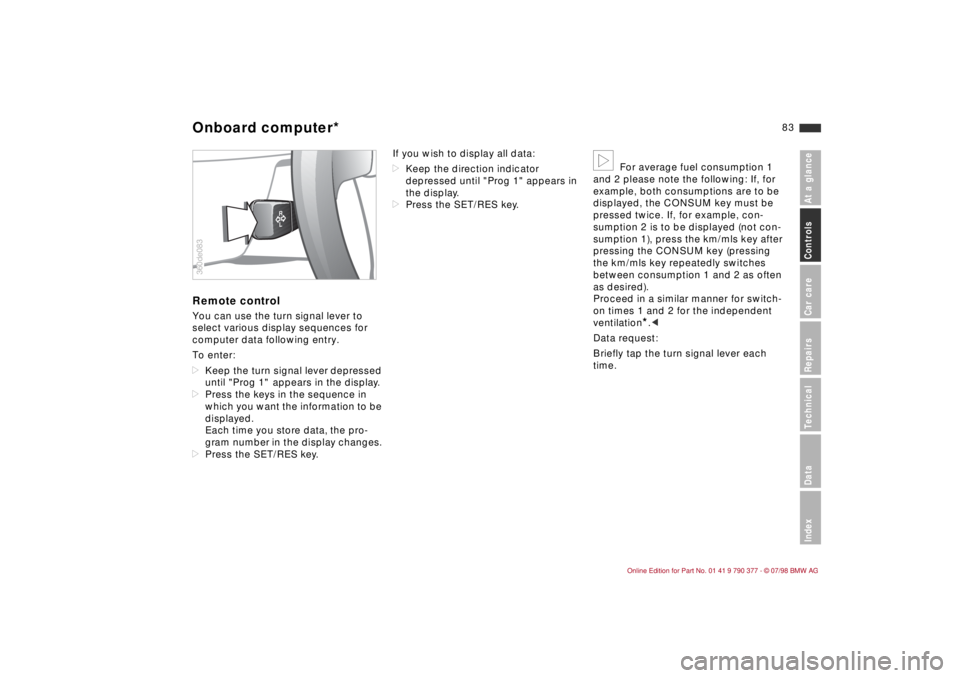
Remote controlYou can use the turn signal lever to
select various display sequences for
computer data following entry.
To enter:
dKeep the turn signal lever depressed
until "Prog 1"
appears in the display.
dPress the keys in the sequence in
which you want the information to be
displayed.
Each time you store data, the pro-
gram number in the display changes.
dPress the SET/RES key.If you wish to display all data:
dKeep the direction indicator
depressed until "Prog 1" appears in
the display.
dPress the SET/RES key.
b
For average fuel consumption 1
and 2 please note the following: If, for
example, both consumptions are to be
displayed, the CONSUM key must be
pressed twice. If, for example, con-
sumption 2 is to be displayed (not con-
sumption 1), press the km/mls key after
pressing the CONSUM key (pressing
the km/mls key repeatedly switches
between consumption 1 and 2 as often
as desired).
Proceed in a similar manner for switch-
on times 1 and 2 for the independent
ventilation
*.c
Data request:
Briefly tap the turn signal lever each
time.
R
L
360de083Onboard computer*
Page 103 of 179

10 2
The catalytic converter reduces harmful
exhaust emissions.
It is designed for use with unleaded fuel
only.
Even minute quantities of lead would be
enough to permanently damage both
the catalytic converter and the system's
oxygen sensor.
To ensure efficient, trouble-free engine
operation and avoid potential damage:
dAlways have your car serviced in
accordance with maintenance
instructions.
dNever continue driving until the fuel
tank is empty.
dRespond to engine miss by switching
off the engine at once.
dNever tow-start the car unless the
engine is cold, or else unburned fuel
may reach the catalytic converter.
Better yet: use jumper cables!
dAvoid other situations in which the
fuel would not be (completely)
burned, for instance:
Frequent, extended, or repeated
starting attempts during which the
engine fails to start. (Switching off
and restarting a healthy engine
causes no damage).
Never let the engine run with any of
the spark-plug cables disconnected.
a
Always observe the above points
to prevent unburned mixture from
entering the catalytic converter. This
could result in overheating, leading to
serious damage.
High temperatures occur on all vehicles
equipped with a catalytic converter.
Heat shields are installed adjacent to
some sections of the exhaust system.
Never remove these shields; do not
apply undercoating to their surfaces.
When driving, standing at idle or park-
ing the vehicle, take care to avoid con-
tact between the exhaust system and
flammable materials (e.g., grass, hay,
leaves, etc.). Such contact could lead to
a fire, resulting in personal injury and
property damage.c
Traveling abroadAlways make sure that unleaded fuel
meeting your engineÕs octane require-
ments will be available when planning
trips outside the country. The use of
fuel failing to meet the official octane
requirements could result in engine
damage.
If you are considering traveling to a
country in which unleaded fuel is not
readily available, please remember that
leaded fuel will destroy the lambda oxy-
gen sensor and the catalytic converter
on your BMW. After operation on
leaded fuel, your vehicle will no longer
meet American and Canadian exhaust
emission standards, and there will also
be a loss of fuel economy. Upon your
return to the US or Canada, you will be
expected to comply with legal ordi-
nances requiring that you replace both
the oxygen sensor and the catalytic
converter, and to have the fuel system
flushed to remove any traces of leaded
fuel.
Catalytic converter
Page 108 of 179
10 7
At a glanceControlsCar careRepairsTechnicalDataIndex
A special luggage system is available as
an option for your BMW. Please
observe the precautions included with
the installation instructions.
Because roof racks raise the center of
gravity of the car when loaded, they
exercise a major effect on its handling
and steering response.
You should therefore always remember
not to exceed the approved roof weight,
the approved gross vehicle weight or
the axle weights when loading the rack.
For specifications refer to "Technical
data", page 163ff.
Make sure that the load is not too heavy,
and attempt to distribute it evenly.
Always load the heaviest items first (on
the bottom).
Make sure there is sufficient space to
raise the sliding/tilt sunroof.Secure the roof luggage correctly and
securely to prevent it from shifting or
being lost during driving (danger to fol-
lowing traffic).
Drive smoothly: avoid sudden accelera-
tion and braking maneuvers; corner
gently.
The roof load increases the surface
area exposed to the wind: increased
fuel consumption and stress on the roof
are the immediate results.Roof-mounted luggage rack*