1998 BMW 740I tire pressure
[x] Cancel search: tire pressurePage 134 of 211

133n
RepairsIndexOverview Controls Car care Technology Data
Tire replacement Tire rotationTo maintain good handling and vehicle
response, use only tires of a single
tread configuration from a single manu-
facturer. BMW tests and approves
wheel/tire combinations. Refer to
page 136.
Do not use retreaded tires, since
driving safety may be impaired by
their use. This is due to the possible
variations in casing structures and, in
some cases, to their extreme age,
which can lead to a decrease in their
durability.< Tire ageThe date on which the tire was manu-
factured is indicated by the code on the
sidewall:
DOT ... 178 means that the tires were
manufactured in the 17th week of 1998.
BMW recommends the replacement of
all tires when the tires are no more than
6 years old, even if a tire life of 10 years
is possible.
Spare tires over 6 years old should be
used only in case of emergency. Such a
tire should be replaced by a new tire
immediately, and should not be
mounted together with new tires.
Between the axlesThe tread wear patterns at the front end
differ from those at the rear - the actual
patterns will vary according to individ-
ual driving conditions. In the interests of
safety and maintaining optimal handling
characteristics, tire rotation is not rec-
ommended.
If a proposed interaxle rotation of tires
is based on economic considerations,
one should consider whether the costs
for the rotation are likely to be recap-
tured by any increase in the service life
of the tires which might be realized. Ro-
tation should always be carried out at
short intervals, with a maximum of
3,000 miles (5,000 km). Consult your
authorized BMW center for more infor-
mation.
Should you decide to rotate the tires, it
is essential to comply with the follow-
ing:
Rotate tires on the same side only,
since braking characteristics and road
grip could otherwise be adversely af-
fected.
Following rotation, correct the tire infla-
tion pressure.If different tire sizes are mounted
on the front and rear axles
(page 136), the tires may not be rotated
from one axle to the other.<
Page 136 of 211

135n
RepairsIndexOverview Controls Car care Technology Data
Winter tires Snow chains
*
Choosing the right tireBMW recommends winter tires (M+S
radial tires) for driving in adverse winter
road conditions. While tires known as
all-season tires (M+S designation) pro-
vide better winter traction than summer
tires with load ratings H, V, W and ZR,
they generally do not achieve the per-
formance of winter tires.
In the interests of sure tracking and safe
steering response at all four wheels,
mount winter tires which are made by
the same manufacturer and which have
the same tread configuration.
Mount only winter tires which have
been approved by BMW. Any BMW
center will be glad to provide you with
information on the best winter tires for
your particular driving conditions.
Do not exceed specified
maximum speeds
Never exceed the maximum
speed for which the tires are
rated.
Unprofessional attempts by laymen to
service tires can lead to damage and
accidents.
Have this work performed by skilled
professionals only. Any BMW center
has the required technical knowledge
and the proper equipment and will be
happy to assist you.<
Tire condition, tire pressureWinter tires display a perceptible loss in
their ability to cope with winter driving
conditions once the tread wears to be-
low 0.16 in (4 mm), and should thus be
replaced.
Comply with the specified tire inflation
pressures - and be sure to have the
wheel and tire assemblies balanced ev-
ery time you change the tires.StorageStore tires in a cool, dry place, away
from light whenever possible. Protect
the tires against contact with oil, grease
and fuel.
Use narrow-link BMW snow chains on
summer or winter tires only in pairs and
only on the rear wheels. Comply with all
manufacturer's safety precautions when
mounting the chains.
Page 151 of 211

150n
Caring for your carWashing your carYou can have your new BMW washed
in an automatic car wash. Car wash
systems that do not employ brushes are
preferable.
Wipe away tough dirt and loosen and
remove dead insects before washing
the car.
To prevent spots, avoid washing when
the hood is still warm, or immediately
after and during exposure to strong
sunlight.
When using an automatic car wash, be
sure that:
>The car wash system is suited for the
dimensions of your vehicle
>No damage will occur on vehicles
with attached body accessories (such
as spoilers or antennas). If you are
uncertain, consult the manager of the
car wash
>The wheels and tires of your vehicle
cannot be damaged by the convey-
ance devices of the car wash system
>The vehicle is cleaned with minimum
brush pressure, and that ample water
is available for washing and rinsing.Vehicles with rain sensor
*:
Clean the windshield regularly. Wax
from automatic car washes or insects,
for example, can cause malfunctions in
the function of the rain sensor.
Turn the rain sensor off in auto-
matic car washes. If you do not,
damage may occur if the wipers switch
on unintentionally.<
Parts of the car which are inaccessible
to the automatic washer - such as door
sills, door and hood edges, etc. -
should be cleaned by hand.
In the winter months, it is especially im-
portant to ensure that the car is washed
on a regular basis. Large quantities of
dirt and road salt are difficult to remove,
and they also cause damage to the ve-
hicle.
If spray wands or high-pressure
washers are used, be sure to
maintain an adequate distance between
the spray source and the vehicle's sur-
face.
Inadequate distance and excessive
pressure can damage or weaken the
finish, making it more susceptible to
subsequent attack. In addition, mois-
ture could penetrate to vehicle compo-
nents, leading to long-term damage.<
When cleaning the headlamps,
please observe the following:
>Do not clean by wiping with a dry
cloth (scratches). Never use abra-
sives or strong solvents to clean the
covers
>Remove dirt and contamination
(such as insects) by soaking with
BMW Car Shampoo and then rinsing
with plenty of water
>Always use a deicer spray to remove
accumulated ice and snow – never
use a scraper.<
After washing the car, apply the
brakes briefly to dry them. Braking
efficiency might otherwise be reduced
by the moisture, and the brake rotors
could also be corroded.<
Page 173 of 211

172n
Changing tires10 Take the alignment tool from the
onboard tool kit and insert it to-
gether with the plastic insert into
one of the bolt sockets (arrow)
11 Position on the spare wheel. Secure
it by screwing at least two lug bolts
into opposite sockets. Remove the
alignment tool
12 Screw in the remaining lug bolts.
Tighten all the bolts securely
13 Lower the jack and remove it from
beneath the car
14 Tighten the lug bolts, alternating
between bolts positioned opposite
one another
15 Wheels with hub covers: Position
the hub cover and press on tightly390de093
16 If equipped with lug bolt covers:
Align the arrow on the cover with
the line in the wheel and press the
cover into place
17 Check and correct the air pressure
as soon as possible.
The vehicle jack is designed for
changing tires only. Do not at-
tempt to raise another vehicle model
with it or to raise any load of any kind.
To do so could cause accidents and
personal injury.
Have the lug bolts checked for proper
tightness with a calibrated torque
wrench at the earliest possibility (torque
specification: 72 lb.ft./100 Nm).<
When storing the wheel, take care to
ensure that you do not damage the re-
taining pin in the spare tire recess.
When light-alloy wheels other than
Original BMW light-alloy wheels are fit-
ted to the car, it may be necessary to
use different lug bolts.
Replace the defective tire as soon as
possible and have the new wheel/tire
balanced.
Page 184 of 211
Overview
Controls and features
Operation, care
and maintenance
Owner service procedures
Technical data
Index Advanced technology
183n
RepairsIndexOverview Controls Car care Technology Data
Airbags184
Adaptive Transmission Control
(ATC ) 184
Automatic Stability Control plus
Traction (ASC+T)/Dynamic Sta-
bility Control (DSC) 185
Radio reception186
BMW Active Seat 186
Safety belt tensioner187
DSP sound system 187
Rearview mirror with automatic
dimmer188
Tire Pressure Control (RDC ) 189
Xenon lamps 190
Water and dirt repelling
windshield 191
Page 186 of 211

185n
RepairsIndexOverview Controls Car care Technology Data
In order to take driving conditions into
account, ATC registers corners and
both uphill and downhill gradients. For
example, if you maintain speed through
a curve, the transmission does not up-
shift.
On uphill gradients, it shifts only when
the engine speed increases in order to
make more efficient use of power re-
serves. On downhill gradients ATC
downshifts when the speed of the vehi-
cles increases causing the driver to
step on the brakes.
With respect to road conditions, ATC
monitors the friction between the tires
and the road. The system responds to
slippery road surfaces (snow and ice)
by activating the winter program.
Second gear is used when moving
away from a standstill, upshifts occur
sooner, and on descents downshifting
does not occur in spite of the applica-
tion of brakes. This enables you to
"feel" the road as you drive and pro-
duces greater dynamic stability. If the
friction between the tires and the road
is adequate, the normal system is again
activated. The system also leaves the
winter program when you shift from
drive position "D" to "S," "3" or "2," or if
the ASC+T/DSC
* is deactivated.By recognizing traffic conditions, ATC
can retain maximum driving comfort.
For instance, the system recognizes
stop-and-go traffic and then proceeds
only in second gear until it encounters
higher starting loads.
Of course the selector lever can still be
used to select specific gear ratios. Per-
formance-oriented driving is enabled by
shifting from drive position "D" to "S,"
"3" or "2." Positions "3" and "2" each
limit upshifts to the next gear. Position
"2" is best for driving on steep mountain
slopes with a heavy load.Precision sensors monitor the number
of revolutions of the wheels. When
equipped with DSC, they also monitor
steering angle, lateral acceleration,
brake pressure and the movement of
the vehicle around its vertical axis.
If differences in the wheel speeds oc-
cur, the system counteracts the danger
of wheelspin by reducing torque. If nec-
essary, the system also responds with
additional applications of the brakes at
the rear wheels.
If the system detects an instability in the
vehicle's condition, the braking action
can also be directed to the front wheels
by the DSC in order to stabilize the ve-
hicle.
You may need some time to become
accustomed to this system intervention.
However, it helps provide optimum pro-
pulsive force and driving stability.
The braking intervention may be ac-
companied by a certain degree of
noise.
ATC ASC+T/DSC
*
Page 190 of 211
189n
RepairsIndexOverview Controls Car care Technology Data
Tire Pressure Control (RDC)
*
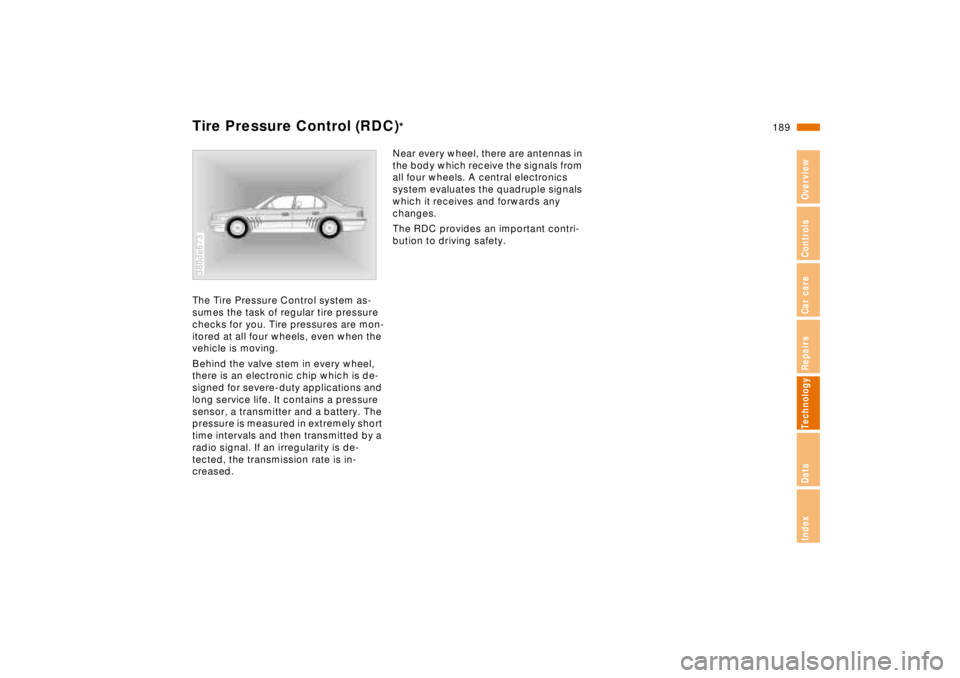
The Tire Pressure Control system as-
sumes the task of regular tire pressure
checks for you. Tire pressures are mon-
itored at all four wheels, even when the
vehicle is moving.
Behind the valve stem in every wheel,
there is an electronic chip which is de-
signed for severe-duty applications and
long service life. It contains a pressure
sensor, a transmitter and a battery. The
pressure is measured in extremely short
time intervals and then transmitted by a
radio signal. If an irregularity is de-
tected, the transmission rate is in-
creased.380de673
Near every wheel, there are antennas in
the body which receive the signals from
all four wheels. A central electronics
system evaluates the quadruple signals
which it receives and forwards any
changes.
The RDC provides an important contri-
bution to driving safety.
Page 203 of 211

Everything from A to ZAABS125
Accessories6
Activated-charcoal filter105
Active seat48
Adaptive Transmission
Control (ATC)63
Adding engine oil143
Adding washer fluid142
Adjust the backrest46
Adjusting steering wheel49
Air distribution102
Air flow103
Air jets100
Air pressure132
Airbags55
Alarm system40
Deactivating in an
emergency41
Antenna diversity186
Antifreeze146
Antifreeze, radiator128, 146
Antilock Brake System
(ABS)125
Anti-theft alarm system
32,40
Approved gross vehicle
weight196
Aquaplaning123,132
Armrest111
ASC+T (Automatic Stability
Control plus Traction)92Ashtray114
AUC (Automatic recirculated-
air control)103
Audio System78
Automatic car washes150
Automatic climate
control100
Automatic climate control,
removing window
condensation102
Automatic recirculated-air
control (AUC)103
Automatic Soft-Close
feature38
Automatic Stability Control
plus Traction (ASC+T)92
Automatic steering wheel
adjustment49
Automatic transmission62
Automatic transmission with
Steptronic65
Automatic windshield
washer69
Average fuel consumption 85
Average speed86
Axle loads196
BBackup lamps, bulb
replacement166
Battery173,198
Battery capacity198Battery change, radio remote
control168
Battery charge current20
Battery, discharged179
Battery, removal and
installation175
Belts54
Beverage holders113
Blower103
Body-cavity protectant151
Brake faults128
Brake fluid147
Brake hydraulic system20
Brake lamps, bulb
replacement166
Brakes126
Break-in procedure122
Break-resistant security
glass, care153
Bulb replacement163
CCar jack170
Car Memory53
Car radio reception131, 186
Car telephone113
Car wash150
Care, exterior152
Care, interior154
Caring for the vehicle
finish152
Caring for your car150Catalytic converter124
Cellular phone131
Center (high-mount) brake
lamp166
Central locking system32
Central locking system,
button36
Changing a wheel170
Charge indicator lamp20
Charging the battery174
Check Control75
CHECK key75
Checking the engine oil143
Checking tire pressure26
Child restraints57
Childproof door locks58
Cigarette lighter115
Clock,
refer to Digital clock79
Code88
Refer to the Radio Owner's
Manuel
Codes, tires134
Coin tray113
Cold start60
Comfort seats47
Connecting a car vacuum
cleaner115
Consumption display73
Contour seat48