Page 139 of 198
139
3. Remove the wheel ornament.
Pry off the wheel ornament, using the bev-
eled end of the wheel nut wrench asshown.
Do not try to pull the ornament by
hand. Take due care in handling the
ornament to avoid unexpected
personal injury.
CAUTION
!
4. Loosen all the wheel nuts. Always l
oosen the wheel nuts before rais-
ing the vehicle.
The nuts turn counterclockwise to loosen.
To get maximum leverage, fit the wrench
to the nut so that the handle is on the right
side, as shown above. Grab the wrench
near the end of the handle and pull up on
the handle. Be careful that the wrench
does not slip off the nut.
Do not remove the nuts yetÐjust unscrew
them about one-half turn.5. Position the jack at the following
jack points
1 Front suspension arm rear mounting
2 Rear suspension arm
Make sure the jack is positioned on a l evel
and solid place.
ÐLoosening wheel nuts ÐPositioning the jack
Page 140 of 198
140
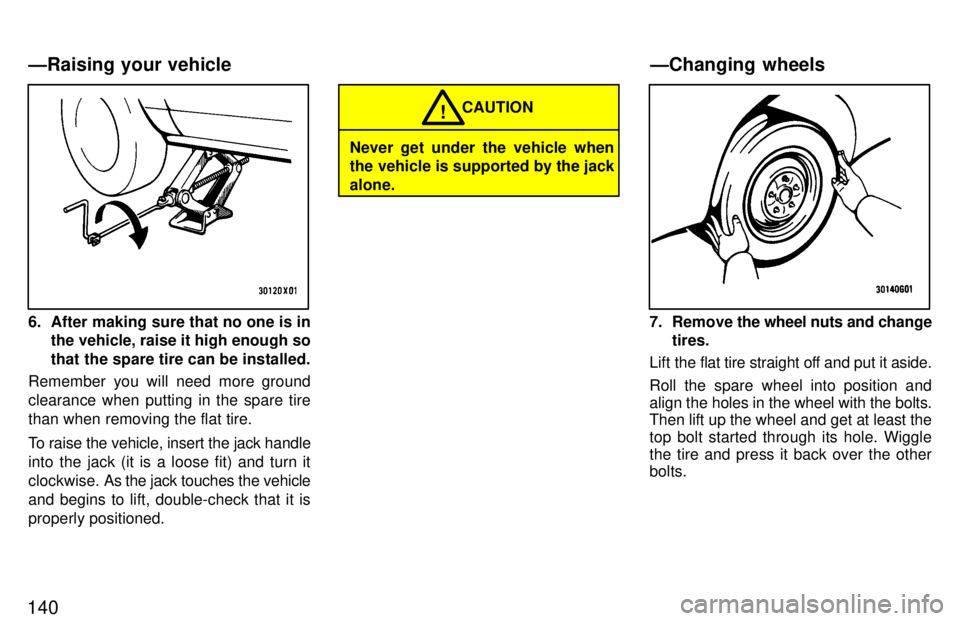
6. After making sure that no one is inthe vehicle, raise it high enough so
that the spare tire can be installed.
Remember you will need more ground
clearance when putting in the spare tirethan when removing the flat tire.
To raise the vehicle, insert the jack handle
into the jack (it is a loose fit) and turn it
clockwise. As the j ack touches the vehicle
and begins to lift, double-check that it is
properly positioned.
Never get under the vehicle when
the vehicle is supported by the jack alone. CAUTION
!
7. Remove the wheel nuts and change
tires.
Lift the flat tire straight off and put it aside.
Roll the spare wheel into position and
align the holes in the wheel with the bolts.
Then lift up the wheel and get at least thetop bolt started through its hole. Wigglethe tire and press it back over the other bolts. ÐChanging wheels
ÐRaising your vehicle
Page 141 of 198

141
Before putting on wheels, remove any
corrosion on the mounting surfaces with a
wire brush or such. Installation of wheels
without good metal-to-metal contact at
the mounting surface can cause wheel
nuts to loosen and eventually cause a
wheel to come off while driving. Therefore
after the first 1600 km (1000 miles), check
to see that the wheel nuts are tight.8. Reinstall all the wheel nuts finger
tight.
Reinstall the wheel nuts (tapered end in-
ward) and tighten them as much as youcan by hand. Press back on the tire back and see if you can tighten them more.9. Lower the vehicle completely and tighten the wheel nuts.
Turn the jack handle counterclockwise to lower the vehicle.
Use only the wheel nut wrench and turn it
clockwise to tighten the nuts. Do not use other tools or any additional leverage oth-
er than your hands, such as a hammer,
pipe or your foot. Make sure the wrench is
securely engaged over the nut.
Tighten each nut a little a time in the order
shown. Repeat the process until all the
nuts are tight.
ÐReinstalling wheel nuts ÐLowering your vehicle
Page 168 of 198

172line. This brings the fluid to the correct
level when you put the cover back on.
Use only newly opened brake fluid. Once
opened, brake fluid absorbs moisture
from the air, and excess moisture can cause a dangerous loss of braking.
CAUTION!
Take care when filling the reservoir
because brake fluid can harm your
eyes and damage painted surfaces.
If fluid gets in your eyes, flush your
eyes with clean water.
If you spill the fluid, be sure to wash it off with water to prevent it from
damaging the parts or paint.
NOTICE
Check the fluid level through the reser-
voir. If necessary, add automatic trans-
mission fluid DEXRON [
-II or III.
If the vehicle has been driven around
80 km/h (50 mph) for 20 minutes (a little more in frigid temperatures), the fluid is
hot (60 C ' 80 C or 140 F ' 175 F). You
may also check the level when the fluid is cold (about room temperature, 10 C
' 30 C or 50 F ' 85 F) if the engine has
not been run for about five hours. Clean all dirt from outside of the reservoirtank and look at the fluid level. If the fluid is cold, the level should be in the COLDº
range. Similarly, if it is hot, the fluid level
should be in the HOTº range. If the level
is at the low side of either range, add auto-
matic transmission fluid DEXRON
[
-II or
III to bring the level within range.
To remove the filler cap, turn it counter-
clockwise and lift up. To reinstall it, turn it
clockwise. After replacing the filler cap,
visually check the steering box case, vane
pump and hose connections for leaks or damage.
CAUTION!
The reservoir tank may be hot so be
careful not to burn yourself.
Avoid overfilling, or the power steering could be damaged.
NOTICE
Checking power steering fluid
Page 183 of 198
187
1. Open the hood. Unplug the con-nector. Turn the plastic cover coun-
terclockwise and remove it.
If the connector is tight, wiggle it.2. Remove the rubber cover.3. Release the bulb retaining spring and remove the bulb. Install a new
bulb and the bulb retaining spring.
To install a bulb, align the tabs of the bulb with the cutout of the mounting hole.
ÐHeadlights
Page 184 of 198
188
4. Install the rubber cover andsnuggle on the boss.
Make sure the rubber cover fits snugly on
the connector and the headlight body.5. Install the plastic cover with the TOPº mark upward and turn it
clockwise. Insert the connector.
Aiming is not necessary after replacing
the bulb. When aiming adjustment is nec-
essary, contact your Toyota dealer.Use a Philips-head screwdriver.
ÐParking and front turn signal lights
Page 195 of 198

199
Engine compartment (U.S.A.) Fuses (type A) 1 AM2 20A: Multiport fuel injection sys-
tem/sequential multiport fuel injection
system, charging system
2 DOME 15A: Personal lights, open door
warning light, clock 3 EFI 15A: Multiport fuel injection sys-
tem/sequential multiport fuel injection system 4 HAZ-HORN 15A: Emergency flashers,
horns
5 ALT-S 5A: Charging system
6 SPARE 15A: Spare fuse
7 SPARE 7.5A: Spare fuseEngine compartment (Canada) 8 H-LP LH 15A: Left-hand headlight
9 H-LP RH 15A: Right-hand headlight
10 DRL 7.5A: Daytime running light sys-
tem
11 H-LP LH-L 10A: Left-hand headlight
(low beam)
12 H-LP RH-L 10A: Right hand head-
light (low beam)
13 H-LP LH-H 10A: Left-hand headlight
(high beam)
14 H-LP RH-H 10A: Right-hand healight
(high beam)Engine compartment
15 TAIL 10A: Tail lights, parking lights, li-
cense plate lights, interior lights
16 GAUGE 10A: Gauges and meters,
service reminder indicators (except dis-
charge and open door warning lights),
back-up lights, air conditioning system,
power windows, rear window defogger,
center differential lock system, electroni-
cally controlled automatic transmission system
17 TURN 7.5A: Turn signal lights
18 CIG & RAD 15A: Cigarette lighter,
clock, car audio system, power rear view mirrors
Fuses