1997 TOYOTA PASEO automatic transmission
[x] Cancel search: automatic transmissionPage 135 of 182

133
Front
RearIf towing is necessary, we recommend
you to have it done by your Toyota
dealer or a commercial tow truck ser- vice.
If towing service is not available in an
emergency, your vehicle may be tem-
porarily towed by a cable or chain se-
cured to either emergency towing eye-
let under the front of the vehicle or the
left emergency towing eyelets under
the rear of the vehicle. Use extreme
caution when towing vehicles. A driver must be in the vehicle to steer it and operate the brakes.
Towing in this manner may be done only
on hard-surfaced roads for a short dis-
tance and at low speeds. Also, the
wheels, axles, drive train, steering and brakes must all be in good condition.
CAUTION!
Use extreme caution when towing
vehicles. Avoid sudden starts or
erratic driving maneuvers which
would place excessive stress on the
emergency towing eyelets and
towing cable or chain. The eyelets
and towing cable or chain may break and cause serious injury or damage.
NOTICE
Use only a cable or chain specifically intended for use in
towing vehicles. Securely fasten the
cable or chain to the towing eyelets provided.
Before towing, release the parking brake
and put the transmission in neutral
(manual) or Nº (automatic). The key must
be in ACCº (engine off) or ONº (enginerunning).
CAUTION!
If the engine is not running, the
power assist for the brakes and
steering will not work so steering
and braking will be much harder
than usual.
ÐEmergency towing
Page 136 of 182
134
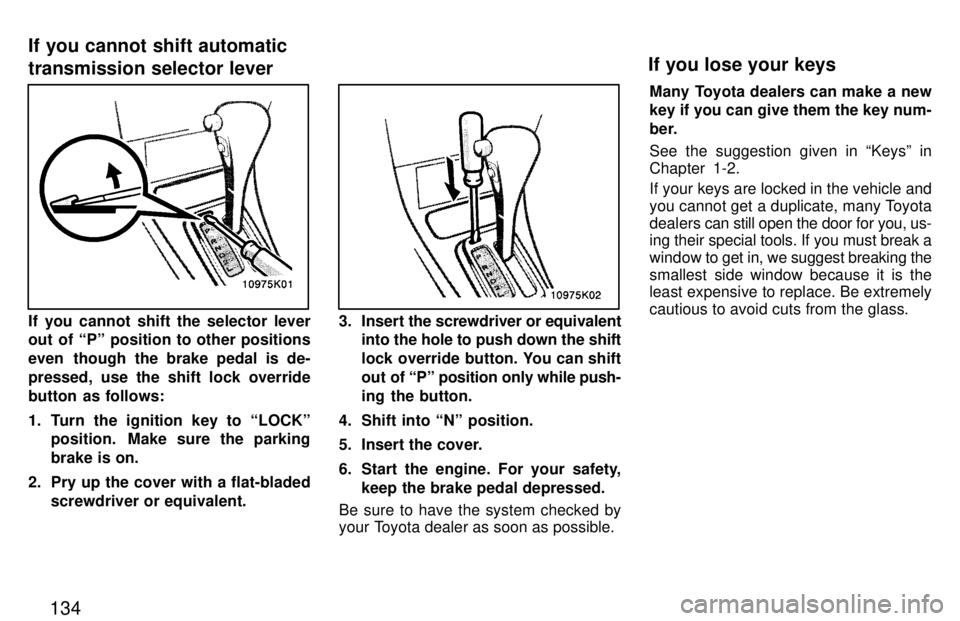
If you cannot shift the selector lever
out of Pº position to other positions
even though the brake pedal is de-pressed, use the shift lock override
button as follows:
1. Turn the ignition key to LOCKºposition. Make sure the parking brake is on.
2. Pry up the cover with a flat-bladed screwdriver or equivalent.3. Insert the screwdriver or equivalent
into the hole to push down the shift
lock override button. You can shift
out of Pº position only while push-
ing the button.
4. Shift into Nº position.
5. Insert the cover.
6. Start the engine. For your safety, keep the brake pedal depressed.
Be sure to have the system checked by
your Toyota dealer as soon as possible. Many Toyota dealers can make a new
key if you can give them the key num-
ber. See the suggestion given in Keysº in Chapter 1-2.
If your keys are locked in the vehicle and
you cannot get a duplicate, many Toyota
dealers
can still open the door for you, us-
ing their special tools. If you must break a
window to get in, we suggest breaking the
smallest side window because it is the least expensive to replace. Be extremely cautious to avoid cuts from the glass.
If you cannot shift automatic transmission selector lever
If you lose your keys
Page 145 of 182
143
Tire surface and wheel nuts Check the tires carefully
for cuts, damage
or excessive wear. See Chapter 7-2 for
additional information. When checking the tires, make sure no nuts are missing,
and check the nuts for looseness. T ighten
them if necessary.
Tire rotation
Rotate the tires every 12000 km (7500
miles). See Chapter 7-2 for additional in- formation.
Fluid leaks Check underneath for leaking fuel, oil, wa-
ter or other fluid after the vehicle has been
parked for a while. If you smell fuel fumes
or notice any leak, have the cause found
and corrected immediately. Doors and engine hood Check that all doors including trunk lid op-
erate smoothly and all latches lock se-
curely. M ake sure the engine hood secon-
dary latch secures the hood from opening
when the primary latch is released. INSIDE THE VEHICLE Items listed below should be checked
regularly, e.g. while performing peri-
odic services, cleaning the vehicle,etc. Lights Make sure the headlights, stop lights, tail lights, turn signal lights, and other lights are all working. Check headlight aim. Service reminder indicators and
warn-
ing buzzers Check that all service reminder indicators
and warning buzzers function properly. Steering wheel
Check that it has the specified freeplay.
Be alert for changes in steering condition, such as hard steering or strange noise. Seats Check that all front seat controls such as
seat adjusters, seatback recliner, etc. op- erate smoothly and that all latches lock
securely in any position. For folding-down
rear seat backs, check that the latches
lock securely. Seat belts
Check that the seat belt system such as
buckles, retractors and anchors operate
properly and smoothly. Make sure the belt
webbing is not cut, frayed, worn or dam- aged. Accelerator pedal Check
the pedal for smooth operation and
uneven pedal effort or catching. Clutch pedal Check the pedal for smooth operation. Brake pedal Check the pedal for smooth operation and
that the pedal has the proper clearance. Check the brake booster function. Brakes
At a safe place, check that the brakes do not pull to one side when applied. Parking brake Check that the lever has the proper travel and that, on a safe incline, your vehicle is
held securely with only the parking brake applied.
Automatic transmission Parkº mech-
anism
Check the lock release button of the se-
lector lever for proper and smooth opera-
tion. On a safe incline, check that your ve-
hicle is held securely with the selector lever in Pº position and all brakes re- leased.
Page 153 of 182

151
Be sure that the ignition is off if
you work near the electric cooling
fans or radiator grille. With the
ignition on, the electric cooling
fans will automatically start to run
if the engine coolant temperature
is high and/or the air conditioning
is on.
Use eye protection whenever you
work on or under you vehicle
where you may be exposed to fly-
ing or falling material, fluid spray,etc.
Used engine oil contains poten-
tially harmful contaminants which
may cause skin disorders such as
inflammation or skin cancer, so
care should be taken to avoid pro-
longed and repeated contact with
it. To remove used engine oil from
your skin, wash thoroughly with
soap and water.
Do not leave used oil within the reach of children.Dispose of used oil and filter only
in a safe and acceptable manner.
Do not dispose of used oil and fil-
ter in household trash, in sewers
or onto the ground. Call your deal- er or a service station for informa-
tion concerning recycling or dis- posal.
Remember that battery and igni- tion cable carry high currents or
voltages. Be careful of accidental-
ly causing a short circuit.
Add only demineralized or dis- tilled water to fill the radiator. And
if you spill some of the coolant, be sure to wash it off with water to
prevent it from damaging theparts or paint.
Do not allow dirt or anything elseto fall through the spark plug
holes.
Do not pry the outer electrode of aspark plug against the center elec-
trode.
Use only spark plugs of the speci- fied type. Using other types will
cause engine damage, loss of per-
formance or radio noise.
NOTICE
Do not overfill automatic trans-
mission fluid or the transmission
could be damaged.
Do not drive with the air cleaner fil-ter removed, or excessive engine
wear could result. Also backfiringcould cause a fire in the enginecompartment.
Be careful not to scratch the glass
surface with the wiper frame.
When closing the engine hood,check to see that you have not for-
gotten any tools, rags, etc.
Page 154 of 182
152Here is a list of parts and tools you will
need on performing do-it-yourself main-
tenance. Remember all Toyota parts are
designed in metric sizes, so your tools
must be metric. Checking the engine oil level Parts (if level is low):
Engine oil API SH, Energy-Conserv-
ing IIº multigrade or ILSAC multigrade
having viscosity proper for your cli- mate
Tools: Rag or paper towel
Funnel (only for adding oil)
Checking the engine coolant level Parts (if level is low): Ethylene-glycol antifreeze
Demineralized or distilled water
Tools: Funnel (only for adding coolant)
Checking brake fluid Parts (if level is low): SAE J1703 or FMVSS No. 116 DOT 3 brake fluid
Tools: Rag or paper towel
Funnel (only for adding fluid) Checking power steering fluid Parts (if level is low):
Automatic transmission fluid DEXRON [
-II or III
Tools: Rag or paper towel
Funnel (only for adding fluid)
Checking battery condition Non-maintenance batteriesÐ
Tools: Warm water
Baking soda
Grease
Conventional wrench (for terminal clamp bolts)
Maintenance type batteriesÐ Parts (if level is low): Distilled water
Tools: Warm water
Baking soda
Grease
Conventional wrench (for terminal clamp bolts)
Coin (for vent plugs)
Funnel (only for adding distilled water) Checking and replacing fuses Parts (if replacement is necessary):
Fuse with same amperage rating as original
Tools: Conventional wrench (for instrument
lower panel nut)
Adding washer fluid Parts: Water
Washer fluid containing antifreeze (for winter use)
Tools: Funnel
Replacing light bulbs Parts: Bulb with same number and wattage rating as original (See charts in Re-
placing light bulbsº in Chapter 7-3.)
Tools: Screwdriver
Parts and tools
Page 176 of 182

174
Fuel type:
Unleaded gasoline, Research Octane Number 91 (Octane rating 87) or higher
Fuel tank capacity, L (gal., Imp. gal.):
45 (11.9, 9.9) ENGINE
Valve clearance (engine cold), mm (in.)
Intake 0.15 '0.25 (0.006 '0.010)
Exhaust 0.31 '0.41 (0.012 '0.016).
Spark plug type: NIPPONDENSO K16TR11
NGK BKR5EKB11
Spark plug gap, mm (in.):
1.1 (0.043)
Drive belt tension measured with Bor-
oughs drive belt tension gauge No.
BT-33-73F (used belt), Ibf: 100 + 20
ENGINE LUBRICATION Oil capacity (drain and refill), L (qt., Imp. qt.): With filter 2.8 (3.0, 2.5)
Without filter 2.6 (2.7, 2.3) Oil grade:
API SH, Energy-Conserving IIº multi-
grade engine oil or ILSAC multigrade
engine oil is recommended.
Recommended oil viscosity (SAE):
Temperature range anticipated before next oil change. 60040K03
COOLING SYSTEM
Total capacity, L (qt., Imp. qt.): Automatic Transmission 5.3 (5.6, 4.7)
Manual transmission
Coupe 4.9 (5.2, 4.3)
Convertible 5.2 (5.5, 4.6)
Coolant type: With ethylene-glycol antifreeze(Do not use alcohol type.)
Fuel Service specifications
Page 177 of 182
175
BATTERY
Open voltage* at 20 5C (68 5F):
12.7 V Fully charged
12.3 V Half charged
11.9 V Discharged
*: Voltage that is checked 20 minutes af-
ter the key is removed with all the lights
turned off
Charging rates: 5 A max
CLUTCH
Pedal freeplay, mm (in.): 5' 15 (0.2 '0.6)
Fluid type:
SAE J1703 or FMVSS No. 116 DOT 3
MANUAL TRANSAXLE
Oil capacity, L (qt., Imp. qt.): 1.9 (2.0, 1.6)
Oil type:
Multipurpose gear oil API GL- 4
or GL- 5
Recommended oil viscosity: SAE 75W-90
AUTOMATIC TRANSAXLE Fluid capacity (drain and refill), L (qt., Imp. qt.): Up to 3.1 (3.3, 2.7) Fluid type:
Automatic transmission fluid D-II or DEXRON [
III (DEXRON [
II)
BRAKESMinimum pedal clearance when de- pressed with the pressure of 490 N (50
kgf, 110 lbf) with the engine running, mm (in.):
With anti-lock brake system55 (2.2)
Without anti-lock brake system 60 (2.4)
Pedal freeplay, mm (in.): 1Ð6 (0.04Ð0.24)
Pad wear limit, in. (mm): 1.0 (0.04)
Lining wear limit, in. (mm): 1.0 (0.04)
Parking brake adjustment when pulledwith the force of 196 N (20 kgf, 44 lbf): 5Ð8 clicks
Fluid type:
SAE J1703 or FMVSS No. 116 DOT 3
STEERINGWheel freeplay: Less than 30 mm (1.2 in.)
Power steering fluid type:
Automatic transmission fluid DEXRON [
II or III Tire size:
Spare tire
T115/70D14
Except spare tire
P185/60R14 82H
Tire pressure, kPa (kgf/cm 2
or bar,
psi): Spare tire
420 (4.2, 60)
Except spare tire
183 (1.83, 26)
Wheel size:
Spare tire 14 x 4T Except spare tire
Aluminum wheels 14 x 5.5JJ
Except aluminum wheels 14 x 5.5J
Wheel nut torque, N Vm (kg Vm, ft Vlbf):
103 (10.5, 76)
Tires