1997 TOYOTA LAND CRUISER check engine light
[x] Cancel search: check engine lightPage 38 of 159
63
(a) Brake System Warning Light This light has the following functions: Parking brake reminder
If this light is on, make sure the parking
brake is
fully released. The light should go
off.
Low brake fluid level warning
If this light comes on and stays on while
you are driving, slow down and pull off the
road. Then stop the vehicle carefully.There may be a problem somewhere in
the brake system. Check the fluid level of
the see-through reservoir.
To make sure the parking brake has not
caused the warning light to come on,
check to see that the parking brake is fully
released.
If the brake fluid level is low...
At a safe place, test your brakes by start-
ing and stopping. If you judge that the brakes still work
adequately, drive cautiously to yournearest dealer or shop for repairs.
If the brakes are not working, have the
vehicle towed in for repairs. (For tow-
ing information, see Part 4.)
It is dangerous to continue driving
normally when the brake fluid level
is low. CAUTION
!
If the brake fluid level is correct...
Have the warning system checked by
your Toyota dealer. (b) Seat Belt Reminder Light and Buzzer
Once the ignition key is turned to ONº or
STARTº, the reminder light and buzzer
come on if the driver's seat belt is not fas- tened. Unless the driver fastens the belt, the light stays on and the buzzer sounds for about 4 to 8 seconds.
(c) Discharge Warning Light
This light warns that the battery is being discharged.
If it comes on while you are driving, there
is a problem somewhere in the chargingsystem. The engine ignition will continue to oper-
ate, however, until the battery is dis-
charged. Turn off the air conditioning,
blower, ra
dio, etc., and drive directly to the
nearest Toyota dealer or repair shop.
NOTICE
Do not continue driving if the engine drive belt is broken or loose.
(d) Low Oil Pressure Warning Light
This light indicates that the engine oil level
needs to be checked. If the light comes on
while you are driving on rough roads orsteep inclines, take your vehicle to a level
spot to see whether the light goes off. If itremains on, check the oil level followingthe instructions of Checking the engine
oil levelº in Chapter 7-2.
NOTICE
Continued engine operation with low engine oil will damage the
engine.
Page 39 of 159
64(e) Malfunction Indicator Lamp
This lamp comes on in the following cases.
a. The fuel tank is completely empty. (See Fuel gaugeº in Chapter 1-5 for in- structions.)
b. If it comes on while you are driving in case c, have your vehicle checked/re-
paired by your Toyota dealer as soon aspossible.
(f) Low Fuel Level Warning Light
This light comes on when the fuel level in
the tank becomes nearly empty. Fill up the tank as soon as possible.
(g) ABSº Warning Light
This light warns that there is a problem
somewhere in your anti-lock brake sys-tem.
If it comes on while you are driving, have your
vehicle checked by your Toyota deal-
er as soon as possible.
The light will come on when the ignition
key is turned to the ONº position. After
about 3 seconds, the light will go off. When the ABSº warning light is on (and
the brake system warning light is off), the brake system
operates conventionally but
anti-lock brake system is not assisting brake performance so that the wheels can
lock-up during sudden braking or braking
on slippery road surfaces.
However, the anti-lock brake system
does not operate when the four-wheel
drive control lever is in the Lº position. It
is normal operation for the ABSº warning
light to be on at this time.
(h) Open Door Warning Light
This light remains on until all the side doors and back door are completely closed.
(i) Unengaged Parkº Warning Light
This light warns that the transmission
Parkº mechanism is not engaged. If the
four-wheel drive control lever is in the Nº
position while the selector lever is in the
Pº position, the transmission will disen-
gage and the wheels will not lock.
To restore the park function, shift the
four-wheel drive control out of Nº. CAUTION
! (j) Automatic Transmission Fluid
Temperature Warning Light
This light warns that the automatic trans- mission fluid temperature is too high.
If this light comes on while you are driving,
slow down and pull off the road. Stop the
vehicle at a safe place and put the selector
lever in Pº and leave the engine idling un-
til the light goes off. If the light goes off,
you can start the vehicle again. If the light
does not go off, call a Toyota dealer or
qualified repair shop for assistance.
NOTICE
Continued driving with the warning light on may damage the automatic
transmission.
(k) SRS Airbag Warning Light This light will come on when the igni-
tion key is turned to the ACCº or ONº
position. After about 6 seconds, the
light w ill go off. This means the airbag
system is operating properly.
Page 40 of 159

65
The warning light system monitors the air-
bag sensor assembly, inflators, warning
light, interconnecting wiring and powersources.
If either of the following conditions occurs, this indicates a malfunction somewhere inthe parts monitored by the warning light
system. Contact your Toyota dealer as
soon as possible to service the vehicle.
The light does not come on when the
ignition key is turned to the ACCº or
ONº position or remains on.
The light comes on while driving.
(l) Key Reminder Buzzer
This buzzer reminds you to remove the
key when you open the driver's door with the ignition key in the ACCº or LOCKºposition.
CHECKING SERVICE REMINDER INDI-
CATORS
1. Apply the parking brake.
2. Open one of the side doors or the back
door.
The open door warning light should come on. 3. Close the door.
The open door warning light should go off.
4. Place the four-wheel drive control le-
ver in
Nº position and the selector lever in Pº position.
5. Turn ignition key to ACCº.
The SRS airbag warning light should
come on. It goes off after about 6 sec-onds.
6. Turn the ignition key to ONº, but do not start the engine.
All the service reminder indicators except the open door warning light and SRS air-
bag warning light should come on. The
ABSº warning light goes off after about 3 seconds. If any service reminder indicator or warn-
ing buzzer does not function as described above, either the bulb is burned out or the
circuit is in need of repair. Have it checked
by your Toyota dealer as soon as pos- sible.
Page 46 of 159
71
Always keep your foot on the brake
pedal while stopped with the engine
running. This prevents the vehicle
from creeping.CAUTION
!
NOTICE
Do not hold the vehicle on an upgrade with the accelerator pedal.
It can cause the transmission tooverheat. Always use the brake
pedal or parking brake.
(g) Rocking your vehicle if stuck
If you rock your vehicle to make it
out when it becomes stuck in snow,
mud, sand, etc., first check that there are no objects or people
around the vehicle. During opera-
tion, the vehicle may suddenly move forward or backward as it be-
comes unstuck, causing injury or
damage to nearby people or ob- jects. CAUTION
!
NOTICE
If you rock your vehicle, observe the following precautions to prevent
damage to the transmission andother parts.
Do not depress the acceleratorpedal while shifting the selector
lever or before the transmission is
completely shifted to forward or
reverse gear.
Do not race the engine and avoidspinning the wheels.
If your vehicle remains stuck after
rocking the vehicle several times,consider other ways such as tow-ing.
(h) Driving in PWRº (Power) mode
In the PWRº mode, the transmission is shifted up and down at a higher vehicle
speed than in the Normal mode and a
more powerful acceleration is achieved.
To set the PWRº mode, push in the driv-
ing pattern selector button. The PWRº mode indicator light comes on.
For ordinary driving, Toyota recommends
using the Normal mode to improve fuel
economy. (i) If you cannot shift the selector lever
out of Pº position
If you cannot shift the selector lever fromPº position even though the brake pedal
is depressed, use the shift lock override
button. For instructions, see If you can- not shift automatic transmission selector leverº in Part 4.
(j) If the O/D OFFº indicator light flasher
Contact your Toyota dealer as soon as
possible. There may be trouble in the transmission system.
(k) Driving in 2nd STRTº (second start) mode.
In the 2nd STRTº (Second start) mode, the transmission system shifts up from
second gear. Use this mode when starting
your vehicle in sand, mud, ice or snow.
To set the 2nd STRTº mode, push the
2nd button. In the 2nd STRTº mode, the
2nd STRTº indicator light comes on.
The PWRº mode is automatically can-
celled when you push the 2ndº button.
Page 49 of 159
74
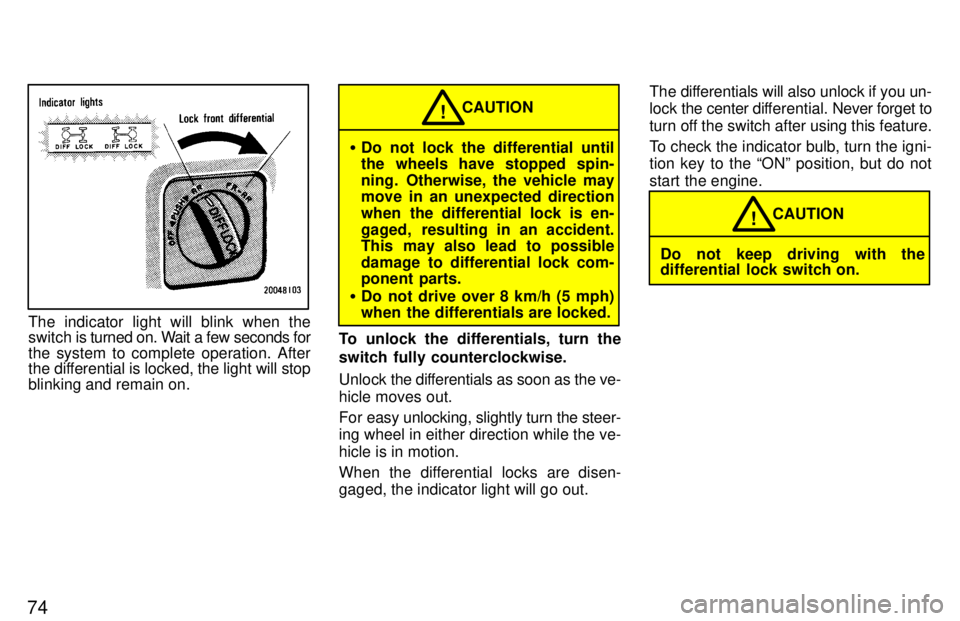
The indicator light will blink when the
switch is turned on. Wait a few seconds for
the system to complete operation. After
the differential is locked, the light will stop
blinking and remain on.
Do not lock the differential until
the wheels have stopped spin-
ning. Otherwise, the vehicle may
move in an unexpected direction
when the differential lock is en-
gaged, resulting in an accident.
This may also lead to possible
damage to differential lock com-
ponent parts.
Do not drive over 8 km/h (5 mph)
when the differentials are locked. CAUTION
!
To unlock the differentials, turn the
switch fully counterclockwise.
Unlock the dif ferentials as soon as the ve-
hicle moves out.
For easy unlocking, slightly turn the steer-
ing wheel in either direction while the ve- hicle is in motion.
When the differential locks are disen-
gaged, the indicator light will go out. The differentials will also unlock if you un-lock
the center dif ferential. Never forget to
turn off the switch after using this feature.
To check the indicator bulb, turn the igni-
tion key to the ONº position, but do not
start the engine.
Do not keep driving with the
differential lock switch on. CAUTION
!
Page 98 of 159
123
For detailed information on the oil level
check,
see Checking the engine oil levelº
in Chapter 7-2. Tandem master cylinder brake system
The tandem master cylinder brake sys-
tem is a hydraulic system with two sepa-
rate sub-systems. If either sub-system
should fa
il, the other will still work. Howev-
er, the pedal will be harder to press, and
your stopping distance will be longer.
Also, the brake system warning light may come on.
CAUTION!
Do not drive your vehicle with only
a single brake system. Have your
brakes fixed immediately.
Brake booster
The brake booster uses engine vacuum to
power-assist the brakes. If the engine
should quit while you are driving, you can
bring the vehicle to a stop with normal
pedal pressure. There is enough reserve
vacuum for one or two stops - but no more!
CAUTION!
Do not pump the brake pedal if the
engine stalls. Each push on the
pedal uses up your vacuum re- serve.
Even if the power assist is com-
pletely lost, the brakes will still
work. But you will have to push
the pedal hard-much harder than
normal. And your braking dis- tance will be longer
ANTI-LOCK BRAKE SYSTEM (with ABSº warning light)
The anti- lock brake system is designed to
automatically help prevent lock- up of the
wheels during sudden braking or braking on
slippery road surfaces. This assists in pro-
viding directional stability and steering per -
formance of the vehicle under these cir -
cumstances.
The anti- lock brake system becomes op-
erative after the vehicle has accelerated to
a speed in excess of approximately 10 km/h
(6 mph). It stops operating when the vehicle
decelerates to a speed below approximate-
ly 5 km/h (3 mph).
You may hear a sound in the engine
compartment for a few seconds when the
engine is started or just after the vehicle is started. This means that the anti-lock
brake system is in the self check mode,
and does not indicate a malfunction.
Brake system
Page 104 of 159

Part 3How to start the engineÐ
(a) Before cranking
Before starting the engine
129
STARTING AND DRIVING
Before starting the engine
How to start the engine
Tips for driving in various condi- tions
Off-road driving precautions
Winter driving tips
Trailer towing
How to save fuel and make your
vehicle last longer, too
1. Check
the area around the vehicle be-
fore entering it.
2. Adjust seat position, seatback angle, head restraint height and steering
wheel angle.
3. Adjust inside and outside rear view mirrors.
4. Lock all doors.
5. Fasten seat belts. 1. Apply the parking brake firmly.
2. Turn off unnecessary lights and acces-
sories.
3. Put the selector lever in Pº. If you need to restart the engine while the ve-
hicle is moving, put the selector lever
in Nº. A starter safety device will pre-
vent the starter from operating if the selector lever is in any drive position.
4. Depress the brake pedal and hold it to the floor until driving off.
Page 105 of 159

130
Before starting the engine, be sure to fol-
low the instructions in (a) Before crank- ingº.
Normal starting procedure
The multiport fuel injection system/se-
quential multiport fuel injection system in
your engine automatically controls the
proper air-fuel mixture for starting. You can start a cold or hot engine as follows:
1. With your foot off the accelerator ped-
al, crank the engine by turning the key
to STARTº. Release it when the en-
gine starts.
2. After the engine runs for about 10 sec-
onds, you are ready to drive.
If the weather is below freezing, let the en-
gine warm up for a few minutes before driving.
If the engine stalls...
Simply restart it, using the correct proce- dure given in normal starting. If the engine will not startÐ
See If your vehicle will not startº in Part 4.
Do not crank for more than 30 sec-
onds at a time. This may overheat
the starter and wiring systems.
Do not race a cold engine.
If the engine becomes difficult to
start or stalls frequently, have theengine checked immediately.
NOTICE Always slow down in gusty cross- winds. This will allow you much better control.
Drive slowly onto curbs and, if pos-
sible, at a right angle. Avoid driving onto high, sharp-edged objects and
other road hazards. Failure to do so
can lead to severe tire damage result-
ing in tire bursts.
When parking on a hill, turn the front
wheels until they touch the curb so that
the vehicle will not roll. Apply the park-
ing brake, and place the transmission
in Pº. If necessary, block the wheels.
Washing your vehicle or driving
through deep water may get the
brakes wet. To see whether they are
wet, check that there is no traffic near
you, and then press the pedal lightly. If
you do not feel a normal braking force,
the brakes are probably wet. To dry
them, drive the vehicle cautiously
while lightly pressing the brake pedal
with the parking brake pulled. If they
still do not work safely, pull to the side
of the road and call a T oyota dealer for
assistance.
(b) Starting the engine
Tips for driving in various conditions