174
NOTICE
�Remember that battery and igni-tion cable carry high currents or
voltages. Be careful of accidental-ly causing a short circuit.
�Add only demineralized or dis-tilled water to fill the radiator. Andif you spill some of the coolant, besure to wash it off with water to
prevent it from damaging theparts or paint.
�Do not allow dirt or anything elseto fall through the spark plugholes.
�Do not pry the outer electrode of aspark plug against the center elec-
trode.
�Use only spark plugs of the speci- fied type. Using other types willcause engine damage, loss of per-
formance or radio noise.
�Do not reuse platinum-tipped
spark plugs by cleaning or regap-ping.
�Do not overfill automatic trans-
mission fluid, or the transmissioncould be damaged.
�Do not drive with the air cleaner fil-ter removed, or excessive engine
wear could result. Also backfiringcould cause a fire in the enginecompartment.
�Be careful not to scratch the glass
surface with the wiper frame.
�When closing the engine hood,check to see that you have not for-gotten any tools, rags, etc.
Here is a list of parts and tools you will
need on performing do-it-yourself main-
tenance. Remember all Toyota parts are
designed in metric sizes, so your tools
must be metric.
Checking the engine oil level
Parts (if level is low):
� Engine oil API SH, Energy-Conserv-
ing IIº multigrade or ILSAC multigrade
having viscosity proper for your cli-
mate
Tools:
� Rag or paper towel
� Funnel (only for adding oil)
Checking the engine coolant level
Parts (if level is low):
� Ethylene-glycol antifreeze
� Demineralized or distilled water
Tools:
� Funnel (only for adding coolant)
Checking brake fluid
Parts (if level is low):
� SAE J1703 or FMVSS No. 116 DOT 3
brake fluid
Tools:
� Rag or paper towel
� Funnel (only for adding fluid)
Parts and tools
ProCarManuals.com
Part 7Checking the engine oil level177
DO-IT-YOURSELF
MAINTENANCEÐ
Chapter 7-2
Engine and Chassis
�Checking the engine oil level
� Checking the engine coolant
level
� Checking brake fluid
� Checking power steering fluid
� Checking tire pressure
� Checking and replacing tires
� Rotating tires
� Installing snow tires and chains
� Replacing wheels
� Aluminum wheel precautions
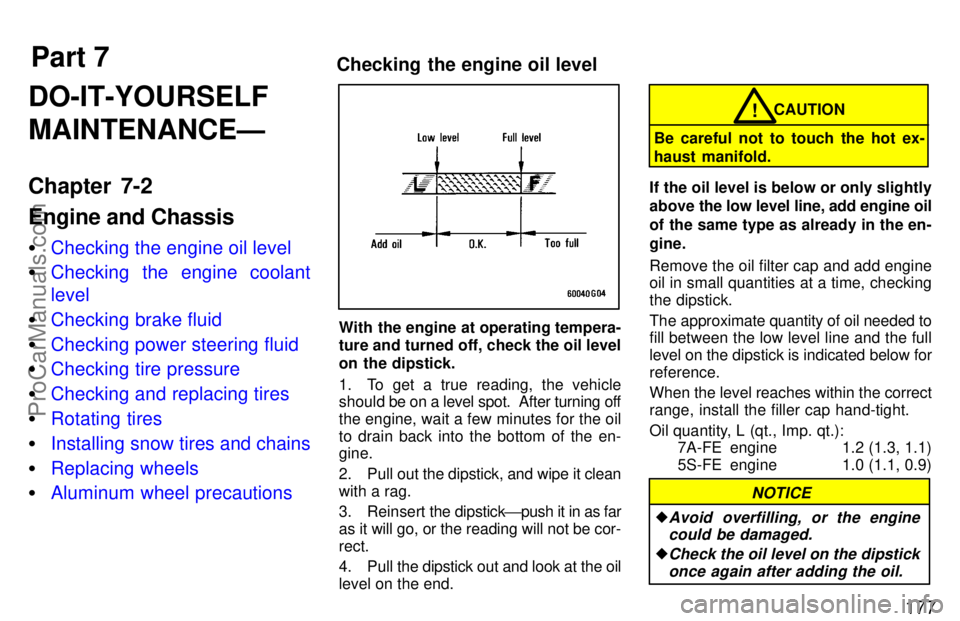
With the engine at operating tempera-
ture and turned off, check the oil level
on the dipstick.
1. To get a true reading, the vehicle
should be on a level spot. After turning off
the engine, wait a few minutes for the oil
to drain back into the bottom of the en-
gine.
2. Pull out the dipstick, and wipe it clean
with a rag.
3. Reinsert the dipstick'push it in as far
as it will go, or the reading will not be cor-
rect.
4. Pull the dipstick out and look at the oil
level on the end.
CAUTION
Be careful not to touch the hot ex-
haust manifold.!
If the oil level is below or only slightly
above the low level line, add engine oil
of the same type as already in the en-
gine.
Remove the oil filter cap and add engine
oil in small quantities at a time, checking
the dipstick.
The approximate quantity of oil needed to
fill between the low level line and the full
level on the dipstick is indicated below for
reference.
When the level reaches within the correct
range, install the filler cap hand-tight.
Oil quantity, L (qt., Imp. qt.): 7A-FE engine 1.2 (1.3, 1.1)
5S-FE engine 1.0 (1.1, 0.9)
�
Avoid overfilling, or the engine could be damaged.
�Check the oil level on the dipstick
once again after adding the oil.
NOTICE
ProCarManuals.com