Page 36 of 218
31
CAUTION!
�The SRS airbag system is designed
only as a supplement to the prima-
ry protection of the seat belt sys-
tems of the driver and front passen-
ger . The front seat occupants are
particularly susceptible to injury if
they do not wear their seat belts;
when sudden braking or a collision
occurs, they may be thrown for-
ward. To obtain maximum protec-
tion in an accident, the driver and
all passengers in the vehicle
should always wear their seat belts
when driving because serious in-
juries can result to unrestrained
occupants. For instructions and
precautions concerning the seat
belt systems, see Seat beltsº in
this chapter.
� A baby or small child who is too
small to use a seat belt should be
properly secured in a rear seat us-
ing a child restraint system.
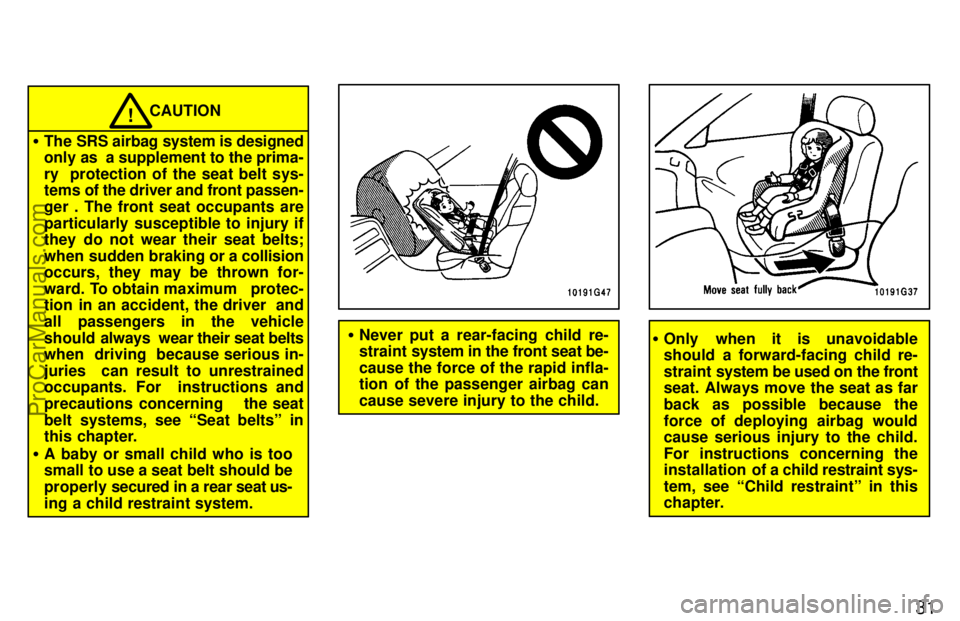
� Never put a rear-facing child re-
straint system in the front seat be-
cause the force of the rapid infla-
tion of the passenger airbag can
cause severe injury to the child.� Only when it is unavoidable
should a forward-facing child re-
straint system be used on the front
seat. Always move the seat as far
back as possible because the
force of deploying airbag would
cause serious injury to the child.
For instructions concerning the
installation of a child restraint sys-
tem, see Child restraintº in this
chapter.
ProCarManuals.com
Page 37 of 218
32
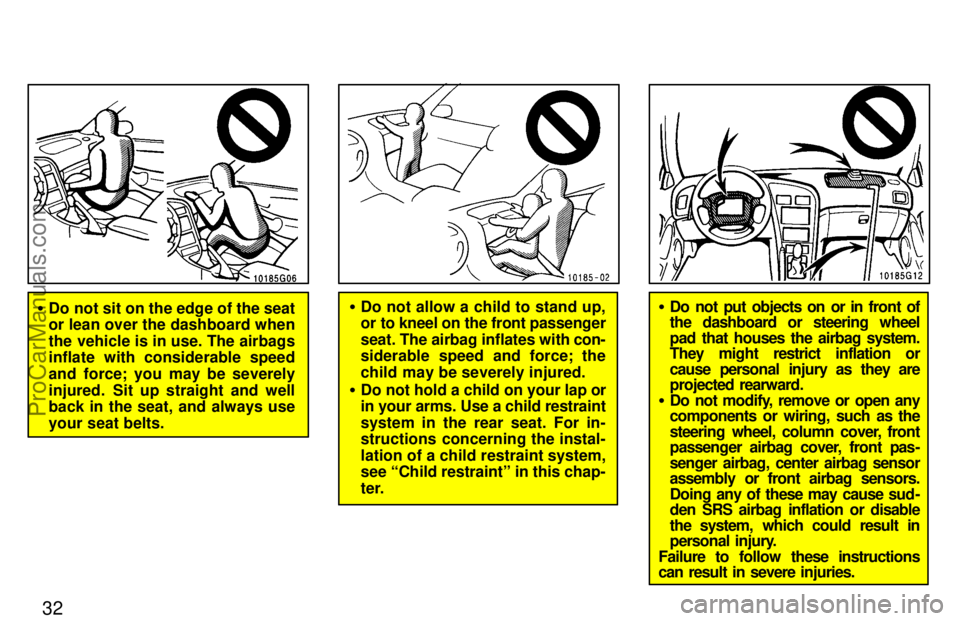
�Do not sit on the edge of the seat
or lean over the dashboard when
the vehicle is in use. The airbags
inflate with considerable speed
and force; you may be severely
injured. Sit up straight and well
back in the seat, and always use
your seat belts.�Do not allow a child to stand up,
or to kneel on the front passenger
seat. The airbag inflates with con-
siderable speed and force; the
child may be severely injured.
� Do not hold a child on your lap or
in your arms. Use a child restraint
system in the rear seat. For in-
structions concerning the instal-
lation of a child restraint system,
see Child restraintº in this chap-
ter.�Do not put objects on or in front of
the dashboard or steering wheel
pad that houses the airbag system.
They might restrict inflation or
cause personal injury as they are
projected rearward.
� Do not modify, remove or open any
components or wiring, such as the
steering wheel, column cover, front
passenger airbag cover, front pas-
senger airbag, center airbag sensor
assembly or front airbag sensors.
Doing any of these may cause sud -
den SRS airbag inflation or disable
the system, which could result in
personal injury.
Failure to follow these instructions
can result in severe injuries.
ProCarManuals.com
Page 38 of 218

33
Do not perform any of the followingchanges without consulting your
Toyota dealer. Such changes caninterfere with proper operation ofthe SRS airbag system in somecases.
�Installation of electronic itemssuch as a mobile two-way radio,
cassette tape player or compactdisc player
�Modification of the suspension
system
�Modification of the front endstructure
�Attachment of a grille guard (bullbar, kangaroo bar, etc.), snow-
plow, winches or any other equip-ment to the front end
�Repairs made on or near the frontend structure, console, steeringcolumn, steering wheel or dash-board near the front passenger
airbag
NOTICE
This SRS airbag system has a service re-
minder indicator to inform the driver of op-
erating problems. If either of the following
conditions occurs, this indicates a mal-
function of the airbags. Contact your To-
yota dealer as soon as possible to service
the vehicle.
� The light does not come on when the
ignition key is turned to the ACCº or
ONº position, or remains on.
� The light comes on while driving.In the following cases, contact your Toyo-
ta dealer as soon as possible:
�The SRS airbags have been inflated.
� The front part of the vehicle (shaded in
the illustration) was involved in an ac-
cident not of the extent to cause the
SRS airbags to inflate
� The pad section of the steering wheel
or front passenger airbag cover
(shaded in the illustration) is scratched,
cracked, or otherwise damaged.
ProCarManuals.com
Page 39 of 218
34
Toyota strongly urges the use of child
restraint systems for children small
enough to use them.
The laws of all fifty states in the U.S.A.
and Canada now require the use of a child
restraint system.
Your vehicle conforms to SAEJ1819.
If a child is too large for a child restraint
system, the child should sit in the rear seat
and must be restrained using the vehicle's
seat belt. See Seat beltsº for details.
CAUTION!
� For effective protection in automo-
bile accidents and sudden stops,
children must be properly re-
strained using a seat belt or child
restraint system depending on the
age and size of the child. Holding
a child in your arms is not a substi-
tute for a child restraint system. In
an accident, the child can be
crushed against the windshield, or
between you and the vehicle's in-
terior.
�Toyota strongly urges use of a
proper child restraint system
which conforms to the size of the
child and is put on the rear seat.
According to accident statistics,
the child is safer when properly re-
strained in the rear seat than in the
front seat.
� Never install a rea r-facing child re-
straint system on the front seat. In
the event of an accident, the force
of the rapid inflation of the airbag
can cause severe injury if a rear-
facing child restraint system is put
on the front seat.
� Unless it is unavoidable, do not
put a forward-facing child re-
straint system on the front seat.
� If you must install a forward-fac-
ing child restraint system on the
front seat, move the seat as far
back as possible.
� Make sure that you have complied
with all installation instructions
provided by the child restraint
manufacturer and that the system
is properly secured. A child restraint system for a small
child or baby must itself be properly
restrained on the seat with the lap por-
tion of the lap/shoulder belt. You must
carefully consult the manufacturer's
instructions which accompany your
child restraint system.
To provide proper restraint, use a
child re-
straint system following the manufactur-
er's instructions about the appropriate
age and size of the child for the child re-
straint system.
Install the child restraint system correctly
following the instructions provided by its
manufacturer of the system. General di-
rections are also provided under the fol-
lowing illustrations.
The child restraint system should be
installed on the rear seat. According to ac-
cident statistics, the child is safer when
properly restrained in the rear seat than in
the front seat.
Child restraintÐ
ÐChild restraint precautions ÐChild restraint system
ProCarManuals.com
Page 40 of 218
35
CAUTION!
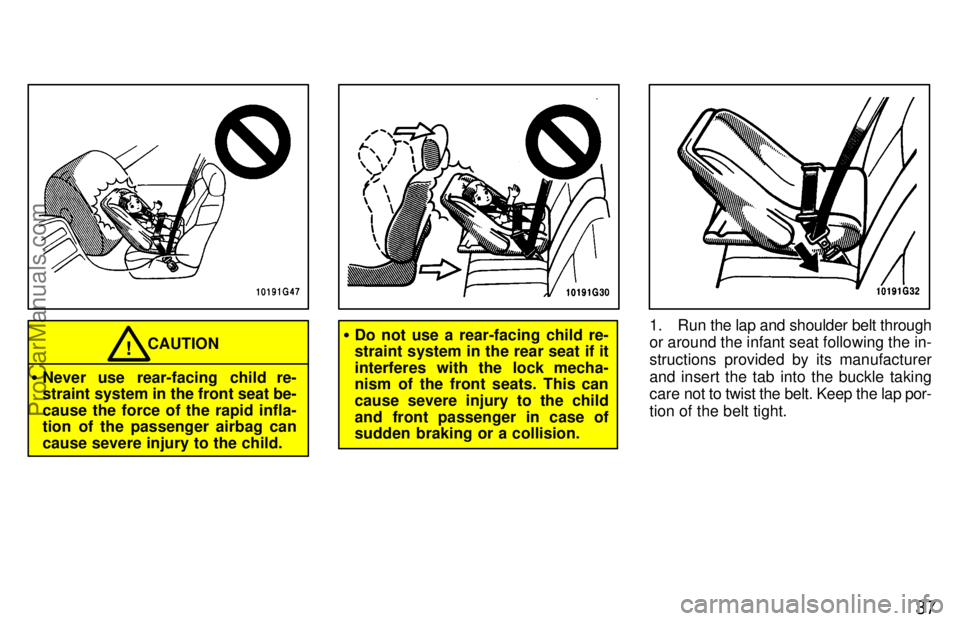
�Never install a rea r-facing child re-
straint system on the front seat. In
the event of an accident, the force
of the rapid inflation of the airbag
can cause severe injury if a rear-
facing child restraint system is
installed on the front seat.
� Unless it is unavoidable, do not
install a forward-facing child re-
straint system on the front seat.
� If you must install a forward-fac-
ing child restraint system on the
front seat, move the seat as far
back as possible.
� After installing the child restraint
system, make sure it is secured in
place following the manufactur-
er's instructions. If it is not re-
strained securely, it may cause in-
jury to the child in the event of a
sudden stop or accident. When not using the child restraint system,
keep it secured with the seat belt. This
will
prevent it injuring passengers in the event
of a sudden stop or accident.
Coupe and liftback onlyÐYour vehicle
has anchors for securing the top strap of
a child restraint system. The anchor nuts
are welded beneath the sheet metal to
permit installation of an anchor bracket for
a child restraint system.
To install an anchor bracket, use an 8 mm
X 30 mm X 1.25 mm coarse thread metric
bolt and 15 mm (0.6 in.) spacer. Note that
the bolts accompanying many child re-
straint systems are not metric. You can
damage the anchor nuts on our vehicle if
you force bolts with different thread into
the anchor nuts.
For instructions about how to install the
anchor bracket, see Top strap anchors
and locations.º
If your child restraint system does not pro-
vide any of the necessary parts, you can
purchase the following items from your
Toyota dealer.
* CRS installation kit (Part No. 04731-22012)
Ðcontains 1 bolt, 3 types of spacers
and 1 locking clip.
* Bolt (Part No. 91511-60830) Child restraint systems are classified into
the following 3 types depending on the
child's age and size.
(A) Infant seat
(B) Convertible seat
(C) Booster seat
Install the child restraint system following
the instructions provided by its manufac-
turer.
ÐTypes of child restraint
system
ProCarManuals.com
Page 42 of 218
37
CAUTION!
�Never use rear-facing child re-
straint system in the front seat be-
cause the force of the rapid infla-
tion of the passenger airbag can
cause severe injury to the child.
�Do not use a rear-facing child re-
straint system in the rear seat if it
interferes with the lock mecha-
nism of the front seats. This can
cause severe injury to the child
and front passenger in case of
sudden braking or a collision.1. Run the lap and shoulder belt through
or around the infant seat following the in-
structions provided by its manufacturer
and insert the tab into the buckle taking
care not to twist the be lt. Keep the lap por-
tion of the belt tight.
ProCarManuals.com
Page 45 of 218
40
CAUTION!
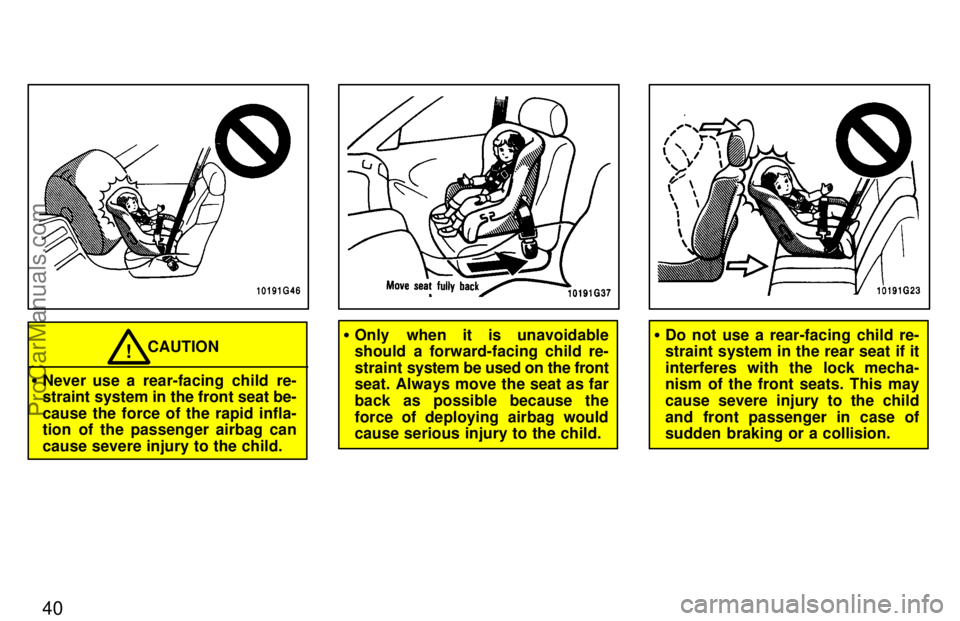
�Never use a rear-facing child re-
straint system in the front seat be-
cause the force of the rapid infla-
tion of the passenger airbag can
cause severe injury to the child.
�Only when it is unavoidable
should a forward-facing child re-
straint system be used on the front
seat. Always move the seat as far
back as possible because the
force of deploying airbag would
cause serious injury to the child.� Do not use a rear-facing child re-
straint system in the rear seat if it
interferes with the lock mecha-
nism of the front seats. This may
cause severe injury to the child
and front passenger in case of
sudden braking or a collision.
ProCarManuals.com
Page 48 of 218
43
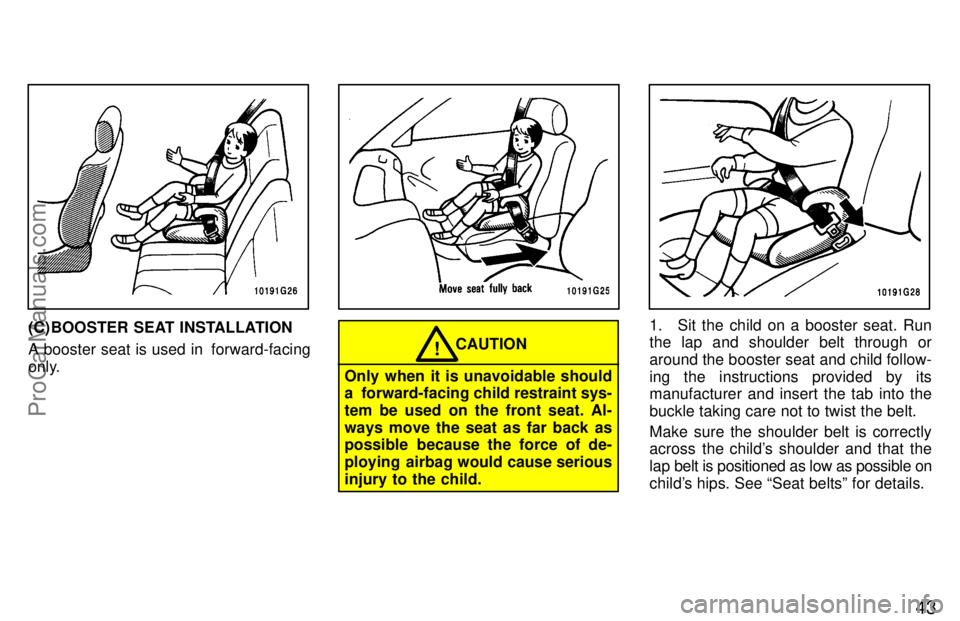
(C) BOOSTER SEAT INSTALLATION
A booster seat is used in forward-facing
only.
Only when it is unavoidable should
a forward-facing child restraint sys-
tem be used on the front seat. Al-
ways move the seat as far back as
possible because the force of de-
ploying airbag would cause serious
injury to the child.
CAUTION!
1. Sit the child on a booster seat. Run
the lap and shoulder belt through or
around the booster seat and child follow-
ing the instructions provided by its
manufacturer and insert the tab into the
buckle taking care not to twist the belt.
Make sure the shoulder belt is correctly
across the child's shoulder and that the
lap belt is positioned as low as possible on
child's hips. See Seat beltsº for details.
ProCarManuals.com