1997 PONTIAC GRAND AM service interval
[x] Cancel search: service intervalPage 270 of 371
When to i- -- ~
Check your tires once a month or more.
Don’t forget your compact spare tire. It should be at
60 psi (420 Pa).
How to Check
Use a good quality pocket-type gage to check tire
pressure.
You can’t tell if your tires are properly inflated
simply by looking at them. Radial tires may look
properly inflated even when they’re underinflated.
Be sure to put the valve caps back on the valve stems.
.They help prevent leaks by keeping out dirt and moisture.
Tire Inspection and Rotation
Tires should be rotated every 6,000 to 8,000 miles (10
000 to 13 000 km). Any time you notice unusual wear,
rotate your tires as soon as possible and check wheel
alignment. Also check for damaged tires or wheels. See
“When It’s Time for New Tires” and “Wheel
Replacement” later in this section for more information.
The purpose of regular rotation
is to achieve more
uniform wear for all tires on the vehicle. The first
rotation is the most important. See “Scheduled
Maintenance Services’’ in the Index for scheduled
rotation intervals.
0
I
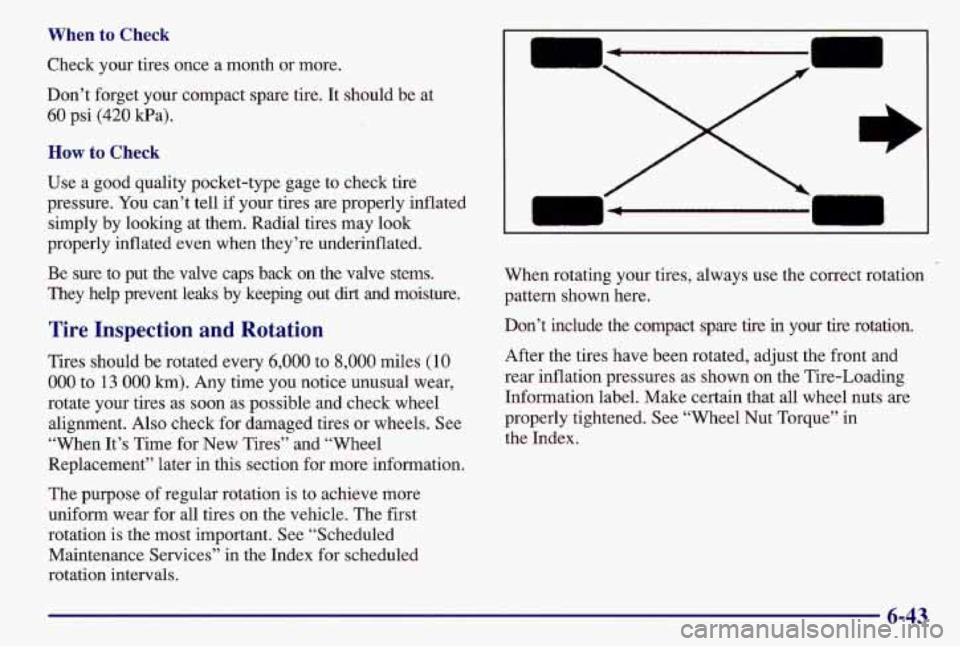
When rotating your tires, always use the correct rotation
pattern shown here.
Don’t include the compact spare tire
in your tire rotation.
After the tires have been rotated, adjust the front
and
rear inflation pressures as shown on the Tire-Loading
Information label. Make certain that all wheel nuts are
properly tightened. See “Wheel Nut Torque” in
the Index.
6-43
Page 298 of 371
Maintenance Schedule
Short Trip/City Definition
Follow the Short Trip/City Maintenance Schedule if any
one of these conditions is true for your vehicle:
Most trips are less than 5 to 10 miles (8 to 16 km).
This is particularly important when outside
temperatures are below freezing.
0 Most trips include extensive idling (such as frequent
driving in stop-and-go traffic).
0 Most trips are through dusty areas.
You frequently tow a trailer or use a carrier on top of
your vehicle. (With some models, you should never
tow a trailer. See “Towing a Trailer” in the Index.)
If the vehicle is used for delivery service, police, taxi
or other commercial application.
One of the reasons you should follow this schedule
if you operate your vehicle under any of these
conditions is that these conditions cause engine oil
to break down sooner.
Short Trip/City Intervals
Every 3,000 Miles (5 000 km): Engine Oil and Filter
Change (or
3 months, whichever occurs first).
Every 6,000 Miles (10 000 km): Chassis Lubrication
(or
6 months, whichever occurs first). Tire Rotation.
Every 15,000 Miles (25 000 km): Air Cleaner Filter
Inspection, if driving in dusty conditions.
Every 30,000 Miles (50 000 km): Air Cleaner Filter
Replacement. Fuel Tank, Cap and Lines Inspection.
Every 50,000 Miles (83 000 km): Automatic Transaxle
Service (severe conditions only).
Every 60,000 Miles (100 000 km): Engine Accessory
Drive Belt Inspection.
Every 100,000 Miles (166 000 km): Spark Plug Wire
Inspection. Spark Plug Replacement.
Every 150,000 Miles (240 000 km): Cooling System
Service (or every
60 months, whichever occurs first).
These intervals only summarize maintenan.ce services.
Be sure to follow
the complete maintenance schedule on
the following pages.
7-5
Page 299 of 371
Maintenance Schedule
Long Trip/Highway Definition Long TriplHighway Intervals
Follow this maintenance schedule only if none of the
conditions from the Short Trip/City Maintenance
Schedule is true. Do not use this schedule if the vehicle
is used for trailer towing, driven in a dusty area or used
off paved roads. Use the Short Trip/City schedule for
these conditions.
Driving a vehicle with a fully warmed engine
under highway conditions causes engine oil to
break down slower.
Every 7,500 Miles (12 500 km): Engine Oil and Filter
Change (or every
12 months, whichever occurs first).
Chassis Lubrication
(or every 12 months, whichever
occurs first). Tire Rotation.
Every 30,000 Miles (50 000 km): Air Cleaner Filter
. Replacement. Fuel Tank, Cap and Lines Inspection.
Every 50,000 Miles (83 000 km): Automatic Transaxle
Every 60,000 Miles (100 000 km): Engine Accessory
Every 100,000 Miles (166 000 km): Spark Plug Wire
Every 150,000 Miles (240 000 km): Cooling System
These intervals only summarize maintenance services.
Be sure
to follow the complete maintenance schedule ov
the following pages.
Service (severe conditions only).
Drive Belt Inspection.
Inspection. Spark Plug Replacement. Service (or every
60 months, whichever occurs first).
7-6
Page 300 of 371
Short TriplCity Maintenance Schedule
The services shown in this schedule up to 100,000 miles
(166 000 km) should be performed after 100,000 miles
(166 000 km) at the same intervals. The services shown
at
150,000 miles (240 000 krn) should be performed at
the same interval after
150,000 miles (240 000 km).
See “Owner’s Checks and Services” and “Periodic
Maintenance Inspections’’ following.
Footnotes
The U.S. Environmental Protection Agency or the
California
Air Resources Board has determined that the
failure to perform this maintenance item will not nullify
the emission warranty or limit recall liability prior to the
completion of the vehicle’s useful life. We, however,
urge that all recommended maintenance services be
performed at the indicated intervals and the maintenance
be recorded.
# Lubricate the suspension and steering linkage.
+ A good time to check your brakes is during tire
rotation. See “Brake System Inspection” under “Periodic Maintenance Inspection’’ in Part
C of
this schedule.
++ If you drive in a highly corrosive environment,
your brake calipers may require additional inspection
and service, at every other tire rotation. See
“Caliper/Knuckle Maintenance Inspection” under
“Periodic Maintenance Inspections” in
Part C of
this schedule.
7-7
Page 322 of 371
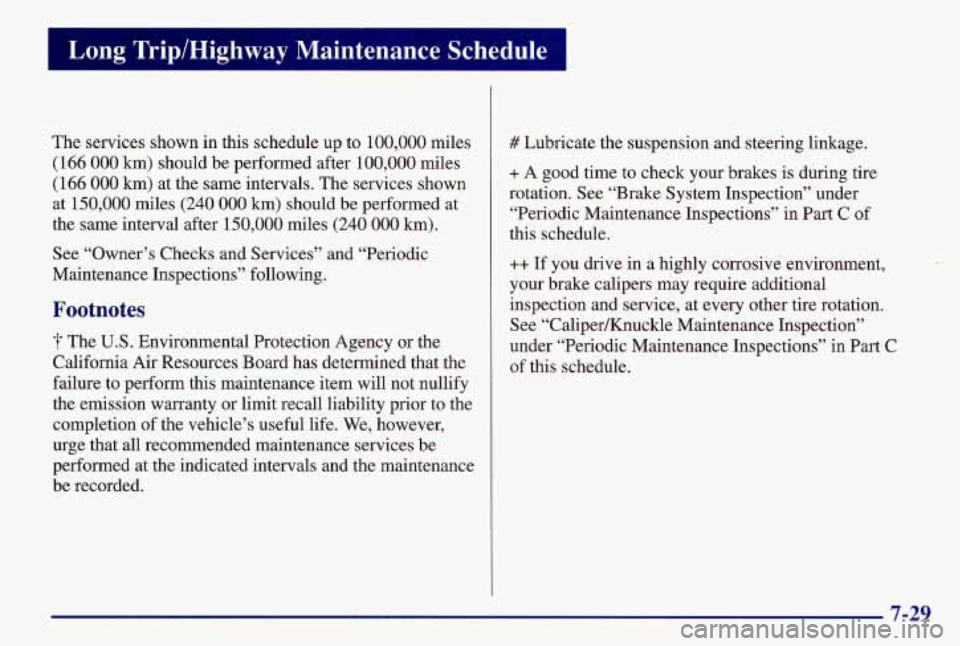
The services shown in this schedule up to 100,000 miles
(166
000 km) should be performed after 100,000 miles
(166
000 km) at the same intervals. The services shown
at 150,000 miles
(240 000 km) should be performed at
the same interval after
150,000 miles (240 000 km).
See “Owner’s Checks and Services” and “Periodic
Maintenance Inspections” following.
Footnotes
The U.S. Environmental Protection Agency or the
California Air Resources Board has determined that the
failure to perform this maintenance item will not nullify
the emission warranty or limit recall liability prior to the
completion of the vehicle’s useful life. We, however,
urge that all recommended maintenance services be
performed at the indicated intervals and the maintenance
be recorded.
# Lubricate the suspension and steering linkage.
+ A good time to check your brakes is during tire
rotation. See “Brake System Inspection” under “Periodic Maintenance Inspections” in
Part C of
this schedule.
++ If you drive in a highly corrosive environment,
your brake calipers may require additional
inspection and service, at every other tire rotation.
See “Caliper/Knuckle Maintenance Inspection”
under “Periodic Maintenance Inspections” in Part C
of this schedule.
7-29
Page 334 of 371
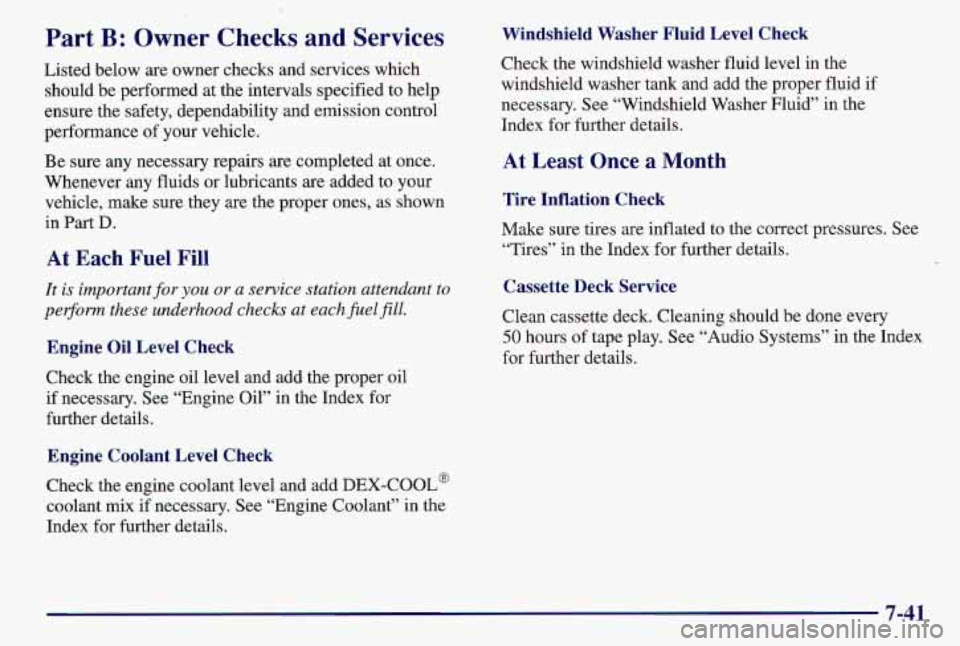
Part B: Owner Checks and Services
Listed below are owner checks and services which
should be performed at the intervals specified to help
ensure the safety, dependability and emission control
performance
of your vehicle.
Be sure any necessary repairs are completed at once.
Whenever any fluids or lubricants are added to your
vehicle, make sure they
are the proper ones, as shown
in
Part D.
At Each Fue- - --II
It is important for you or a service station attendant to
per$orm these underhood checks at each fie1
fill.
Engine Oil Level Check
Check the engine oil level and add the proper oil
if necessary, See “Engine Oil” in the Index for
further details.
Engine Coolant Level Check
Check the engine coolant level and add DEX-COOL@
coolant mix if necessary. See “Engine Coolant’’ in the
Index for further details.
Windshield Washer Fluid Level Check
Check the windshield washer fluid level in the
windshield washer tank and add the proper fluid
if
necessary. See “Windshield Washer Fluid” in the
Index for further details.
At Least Once a Month
Tire Inflation Check
Make sure tires are inflated to the correct pressures. See
“Tires” in the Index for further details.
Cassette Deck Service
Clean cassette deck. Cleaning should be done every
50 hours of tape play. See “Audio Systems” in the Index
for further details.
7-41
Page 342 of 371
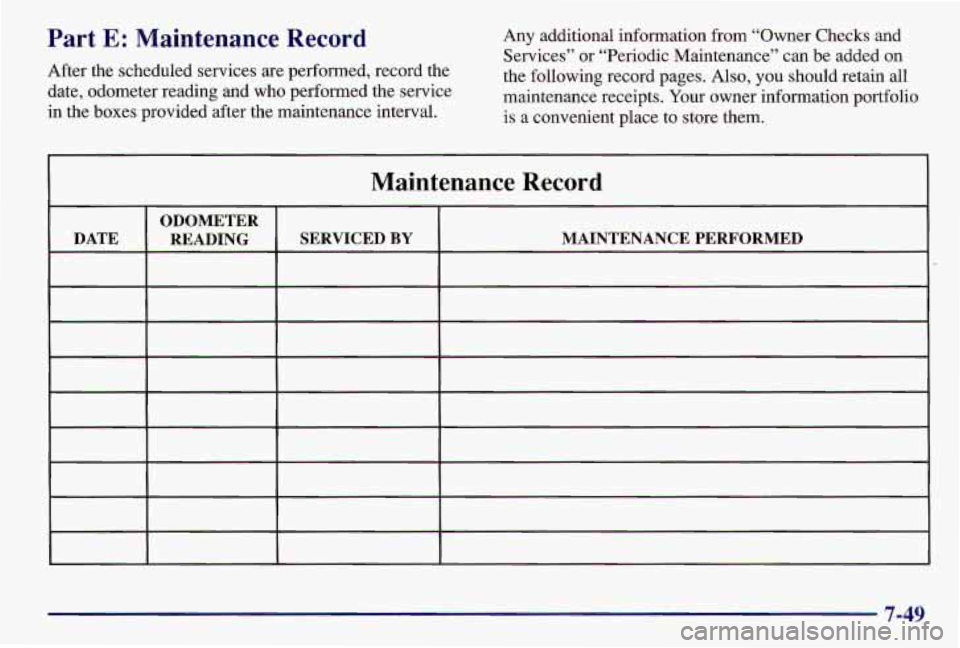
Part E: Maintenance Record
After the scheduled services are performed, record the
date, odometer reading and who performed the service
in the boxes provided after the maintenance interval. Any
additional information from “Owner Checks and
Services” or “Periodic Maintenance” can be added on
the following record pages. Also, you should retain all
maintenance receipts. Your owner information portfolio
is a convenient place to store them.
Maintenance Record
ODOMETER
I DATE I READING I SERVICED BY I MAINTENANCE PERFORMED
7-49
Page 364 of 371

Labels Certification
................................. 4-33
Service Parts Identification
..................... 6-58
Tire-Loading Information
...................... 4-33
Vehicle Identification Number
................... 6-58
Lamps
........................................ 2-43
Exterior
.................................... 2-43
Fog
........................................ 2-45
Interior
..................................... 2-45
On Reminder
................................ 2-43
Latches. Seatback
................................ 1-5
Leaving Your Vehicle
............................. 2-6
Leaving Your Vehicle with the Engine Running
....... 2-30
Lights Lighter
....................................... 2-51
Air Bag Readiness ....................... 1-22, 2-59
Anti-Lock Brake System Warning
............ 2-61, 4-7
Brake System Warning
.................... 2-60, 6-31
Charging System Indicator ...................... 2-60
CheckEngine
................................ 2-65
Check Oil
.............................. 2-68, 6-12
Enhanced Traction System Active
............ 2-63, 4-9
ETS Active
.............................. 2-63, 4-9
ETS Warning
........................... 2-62, 4-10
Interior
..................................... 2-45
Low Coolant Warning
.................... 2-64, 6-27
Oil Pressure Warning
.......................... 2-67
PasslockWarning
............................. 2-69
Safety Belt Reminder
...................... 1-8, 2-59
Upshift
.................................... 2-69
Litter Bag Hook
................................ 2-52
Loading Your Vehicle ........................... 4-33
Enhanced
Traction System Warning Light
.... 2-62, 4-10 Locks
Automatic Door
....................... 2-5
Cylinders
................................... 7-42
Door
........................................ 2-4
Key Lock Cylinder Service
..................... 7-42
PowerDoor
.................................. 2-5
Rear Door Security
............................. 2-6
Steering Column Lock Check
................... 7-44
Trunk
...................................... 2-10
Low Coolant Warning Light
................. 2-64, 6-27
Lubricants and Fluids
.......... .............. 7-47
Lubrication Service. Body
... .............. 7-42
Maintenance, Normal Replacement Parts
........... 6-65
Maintenance Record
............................ 7-49
Maintenance Schedule
............................ 7-1
Introduction
.................................. 7-2
Long Tripmighway Definition
................... 7-6
Long Tripmighway Intervals
..................... 7-6
Owner Checks and Services
..................... 7-41
Periodic Maintenance Inspections
................ 7-45
Recommended Fluids and Lubricants
............. 7-47
Scheduled Maintenance Services
.................. 7-4
Short Trip/City Definition
....................... 7-5
Short Trip/City Intervals ........................ 7-5
Maintenance, Underbody
......................... 6-56
Maintenance When Trailer Towing
................. 4-41
Making
Turns When Towing a Trailer ............... 4-40
Malfunction Indicator Lamp
...................... 2-65
Manual Front Seat
............................... 1-2
Manual Lumbar Support
........................ 1-3
Manual Remote Control Mirror
. . ... . . 2-49
9-6