Page 212 of 371
1 A CAUTION:
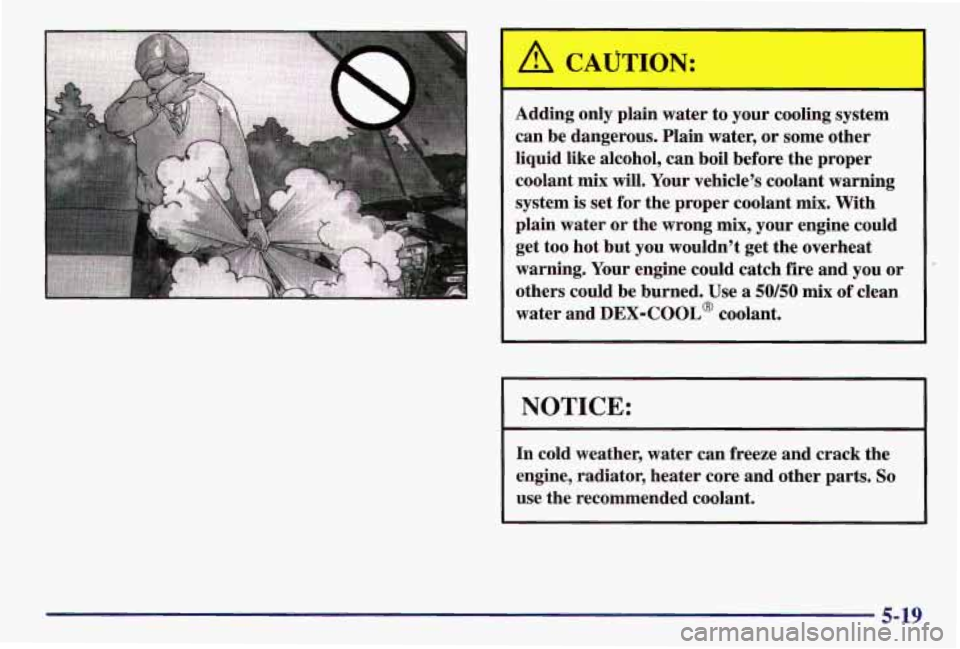
Adding only plain water to your cooling system
can be dangerous. Plain water, or some other
liquid like alcohol, can boil before the proper
coolant mix will. Your vehicle’s coolant warning
system is set for the proper coolant mix. With
plain water or the wrong mix, your engine could
get too hot but you wouldn’t get the overheat
warning. Your engine could catch fire and you or
others could be burned, Use
a 50/50 mix of clean
~ water and DEX-COOL@ coolant.
NOTICE:
r
In cold weather, water can freeze and crack the
engine, radiator, heater core and other parts,
So
use the recommended coolant. 1
5-19
Page 219 of 371
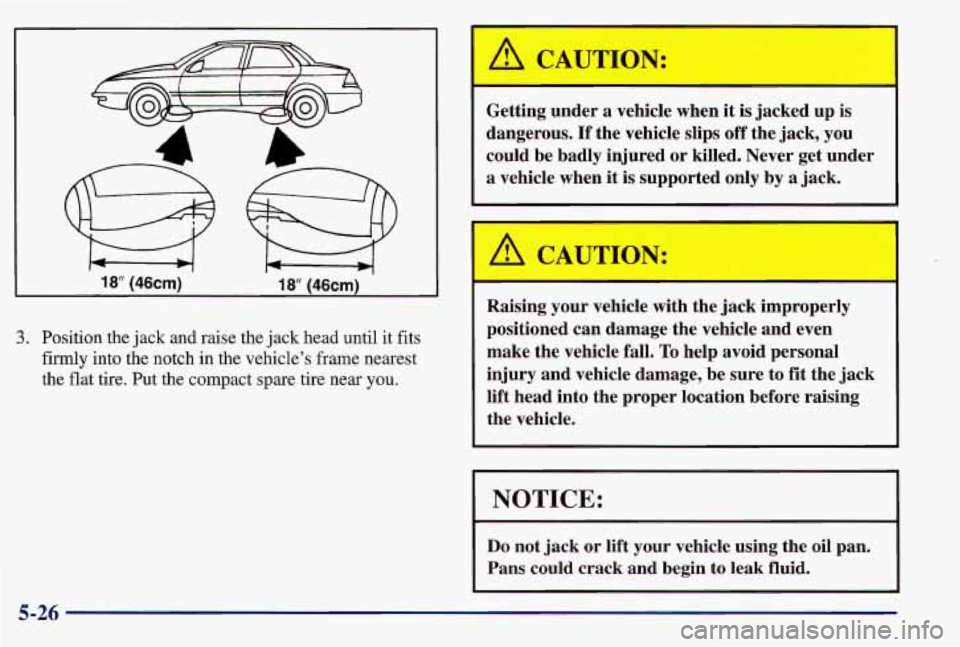
3. Position the jack and raise the jack head until it fits
firmly into the notch in the vehicle’s frame nearest
the flat tire. Put the compact spare tire near you.
A CAUTION:
Getting under a vehicle when it is jacked up is
dangerous.
If the vehicle slips off the jack, you
could be badly injured or killed. Never get under
a vehicle when it is supported only by a jack.
A CAUTION:
Raising your vehicle with the jack improperly
positioned can damage the vehicle and even
make the vehicle fall.
To help avoid personal
injury and vehicle damage, be sure to
fit the jack
lift head into the proper location before raising the vehicle.
NOTICE:
Do not jack or lift your vehicle using the oil pan.
Pans could crack and begin to leak fluid.
5-26
Page 221 of 371
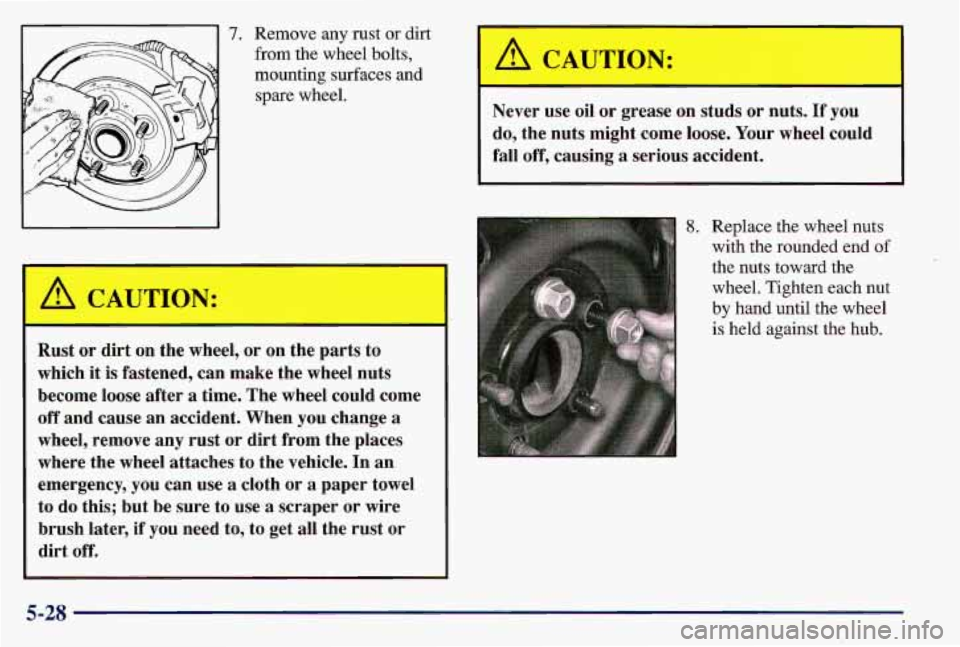
7. Remove any rust or dirt
from the wheel bolts,
mounting surfaces and spare wheel.
A CAUTION:
Rust or dirt on the wheel, or on the pa
which
it is fastened, can make the wheel nuts
become loose after
a time. The wheel could come
off and cause an accident. When
you change a
wheel, remove any rust or dirt from the places
where the wheel attaches to the vehicle. In an
emergency, you can use
a cloth or a paper towel
to do this; but be sure to use
a scraper or wire
brush later, if
you need to, to get all the rust or
dirt off.
I A CAUTION:
Never use oil or grease on studs or nuts. If you
do, the nuts might come loose. Your wheel could
fall off, causing a serious accident. 1
8. Replace the wheel nuts
with the rounded end
of
the nuts toward the
wheel. Tighten each nut
by hand until the wheel
is held against the hub.
5-28 1
Page 228 of 371

Section 6 Service and Appearance Care
Here you will find information about the care of your Pontiac. This section begins with service and fuel information,
and then it shows how to check important fluid and lubricant levels. There is also technical information about your
vehicle, and a part devoted to its appearance care.
6-2
6-3
6-4
6-5
6-8
6- 12
6-18
6- 19
6-2 1
6-23
6-24
6-28
6-28
6-28
6-29
6-30
6-34 Service
Fuel
Fuels in Foreign Countries
Filling Your Tank
Checking Things Under the Hood
Engine Oil
Air Cleaner
Automatic Transaxle Fluid
Manual Transaxle Fluid
Hydraulic Clutch
Engine Coolant
Surge Tank Pressure Cap
Thermostat
Power Steering Fluid
Windshield Washer Fluid
Brakes
Battery Bulb
Replacement
Halogen Bulbs
Appearance Care
Cleaning the Inside of Your Pontiac
Cleaning the Outside of Your Pontiac
Aluminum Wheels
(If Equipped)
Cleaning Tires
Sheet Metal Damage
Finish Damage
Appearance Care Materials Chart
Vehicle Identification Number (VIN)
Electrical System
Replacement Bulbs
Capacities and Specifications
Air Conditioning Refrigerants
Normal Maintenance Replacement Parts
Dimensions
6-35
6-35
6-49
6-50
6-54 6-55
6-55
6-55
6-56
6-57
6-5
8
6-5 8
6-63
6-64
6-65
6-65
6-65
6-1
Page 231 of 371
Some gasolines that are not reformulated for low
emissions contain an octane-enhancing additive called
methylcyclopentadienyl manganese tricarbonyl (MMT); ask your service station operator whether or not his fuel
contains MMT. General Motors does not recommend the
use of such gasolines.
If fuels containing MMT are used,
spark plug life may be reduced and your emission
control system performance may be affected. The
malfunction indicator lamp on your instrument panel
may turn on.
If this occurs, return to your authorized
Pontiac dealer for service.
To provide cleaner air, all gasolines in the United States
are now required to contain additives that will help
prevent deposits from forming in your engine and fuel
system, allowing your emission control system to
function properly. Therefore, you should not have to add
anything to the fuel. In addition, gasolines containing
oxygenates, such as ethers and ethanol, and
reformulated gasolines may be available in your area to
help clean the air. General Motors recommends that you
use these gasolines if they comply with the
specifications described earlier.
I NOTICE:
Your vehicle was not designed for fuel that
contains methanol. Don’t use it. It can corrode
metal parts in your fuel system and also damage
plastic and rubber parts. That damage wouldn’t
be covered under your warranty.
Fuels in Foreign Countries
If you plan on driving in another country outside the United ”
States or Canada, the proper fuel may be hard to find. Never \
use leaded gasoline or any other fuel not recommended
in the
previous text
on fuel. Costly repairs caused by use of
improper fuel wouldn’t be covered by your warranty.
To check on fuel availability, ask an auto club, or
contact a major oil company that does business in the
country where you’ll be driving.
You can also write us at the following address for
advice. Just tell us where you’re going and give your
Vehicle Identification Number (VIN).
General Motors International Product Center
1908 Colonel Sam Drive
Oshawa, Ontario
LlH 8P7
6-4
Page 235 of 371
Checking Things Under the Hood
I
' A CAUTION:
An electric fan under the hood can start up and
injure
you even when the engine is not running.
Keep hands, clothing and tools away from any
underhood electric fan.
A CAUTION:
Things that burn can get on hot engine parts and
start a fire. These include liquids like gasoline,
oil, coolant, brake fluid, windshield washer and
other fluids, and plastic or rubber.
You or others
could be burned. Be careful not to drop or spill
things
that will burn onto a hot engine.
Hood Release
The following sections tell you how to check fluids,
lubricants and important parts underhood.
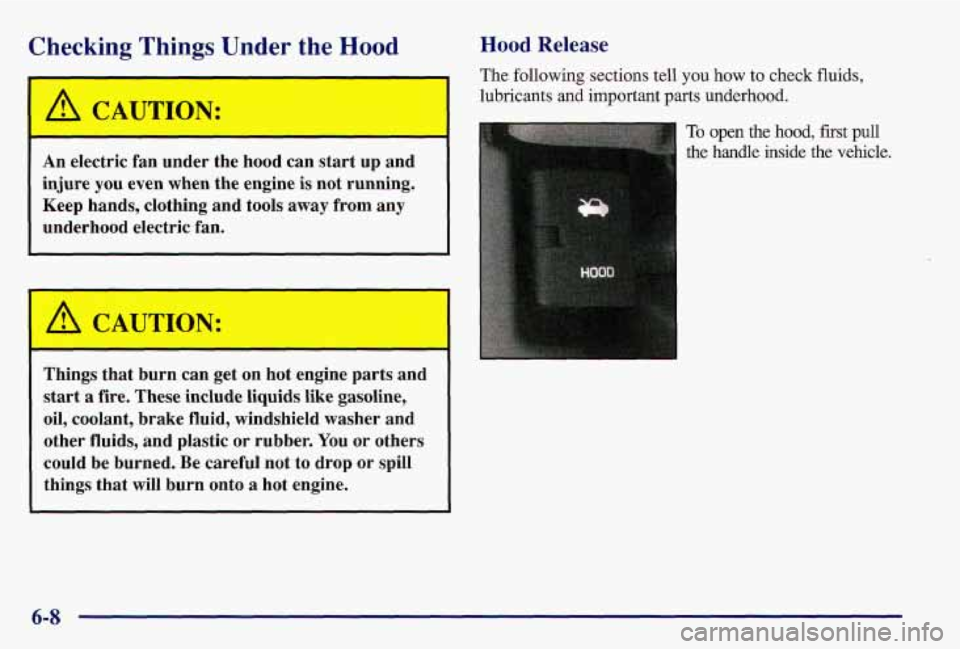
To open the hood, first pull
the handle inside the vehicle.
6-8
Page 237 of 371
2.4L (CODE T) Engine
When you open the hood, you’ll see:
A. Engine Coolant Surge Tank
B. Engine Oil Fill Cap
C. Engine Oil Dipstick
D. Automatic Transaxle Dipstick
(If Equipped) E.
Power Steering Fluid Reservoir
E Brake Fluid Reservoir
G. Windshield Washer Fluid
Reservoir
H. Hydraulic Clutch Fluid
Reservoir
(If Equipped)
I. Air Cleaner
J. Battery
6-10
Page 238 of 371
3100 (CODE M) Engine
When you open the hood, you’ll see:
A. Engine Coolant Surge Tank
B. Power Steering Fluid Reservoir
C. Engine Oil Fill Cap
D. Engine Oil Dipstick
E. Automatic Transaxle
F. Brake Fluid Reservoir Fluid Dipstick G.
Windshield Washer Fluid
Reservoir
H. Air Cleaner
I. Battery
6-11