1997 OLDSMOBILE CUTLASS light
[x] Cancel search: lightPage 152 of 353
Avoid needless heavy braking. Some people dnve in
spurts
-- heavy acceleration followed by heavy
braking
-- rather than keeping pace with traffic. This is a
mistake. Your brakes may not have time to cool between
hard stops. Your brakes will wear out much faster
if you
do
a lot of heavy braking. If you keep pace with the
traffic and allow realistic following distances, you will eliminate a lot of unnecessary braking. That means
better braking and longer brake life.
If your engine ever stops while you’re driving, brake
normally but don’t pump your brakes. If you do, the
pedal may get harder to push down.
If your engine
stops, you will still have some power brake assist. But
you
will use it when you, brake. Once the power assist is
used up, it may take longer to stop and the brake pedal
will be harder to push.
Anti-Lock Brakes (ABS)
Your vehicle has anti-lock brakes (ABS). ABS is an
advanced electronic braking system that will help
prevent a braking skid.
If there’s a problem with the
anti-lock brake system,
this
warning light will stay on.
See “Anti-Lock Brake
System Warning Light” in
the Index.
4-7
ProCarManuals.com
Page 160 of 353

Here are some tips on night driving.
0
0
0
0
0
0 0
Drive defensively.
Don’t drink and drive.
Adjust your inside rearview mirror to reduce the
glare from headlamps behind you.
Since you can’t see as well, you may need to slow
down and keep more space between you and
other vehicles.
Slow down, especially on higher speed roads. Your
headlamps can light up only so much road ahead.
In remote areas, watch for animals.
If you’re tired, pull off the road in a safe place
and rest.
Night Vision
No one can see as well at night as in the daytime. But as
we get older these differences increase. A 50-year-old
driver may require at least twice as much light
to see the
same thing at night as a 20-year-old.
What you do in the daytime can also affect your night vision. For example, if you spend the day in bright sunshine you are wise to wear sunglasses. Your eyes will
have less trouble adjusting to night. But
if you’re
driving, don’t wear sunglasses at night. They may cut down on glare from headlamps, but they also make
a lot
of things invisible.
You can be temporarily blinded by approaching
headlamps. It can take a second or
two, or even several
seconds, for your eyes to readjust to the dark. When you
are faced with severe glare (as from a driver who
doesn’t lower the high beams, or a vehicle with
misaimed headlamps), slow down a little. Avoid staring
directly into the approaching headlamps.
Keep your windshield and all the glass on your vehicle
clean
-- inside and out. Glare at night is made much
worse by dirt on the glass. Even the inside
of the glass
can build up a film caused by dust. Dirty glass makes
lights dazzle and flash more than clean glass would,
making the pupils of your eyes contract repeatedly.
Remember that your headlamps light
up far less of a
roadway when you are in a turn or curve. Keep your
eyes moving; that way, it’s easier to pick out dimly
lighted objects. Just as your headlamps should be
checked regularly
for proper aim, so should your eyes
be examined regularly. Some drivers suffer from night
blindness
-- the inability to see in dim light -- and
aren’t even aware of it.
4-15
ProCarManuals.com
Page 163 of 353

Hydroplaning
Hydroplaning is dangerous. So much water can build up
under your tires that they can actually ride on the water.
This can happen if the road is wet enough and you’re
going fast enough. When your vehicle is hydroplaning,
it has little or no contact with the road.
Hydroplaning doesn’t happen often. But it can if your
tires do not have much tread or
if the pressure in one or
more is low. It can happen
if a lot of water is standing on
the road. If you can see reflections from trees, telephone
poles or other vehicles, and raindrops “dimple” the water’s surface, there could be hydroplaning.
Hydroplaning usually happens at higher speeds. There
just isn’t a hard and fast rule about hydroplaning. The
best advice is to slow down when
it is raining.
Driving Through Deep Standing Water
NOTICE:
If you drive too quickly through deep puddles or
standing water, water can come in through your
engine’s air intake and badly damage your
engine. Never drive through water that is slightly
lower than the underbody
of your vehicle. If you
can’t avoid deep puddles or standing water, drive
through them very slowly.
Some Other Rainy Weather Tips
0 Turn on your low-beam headlamps -- not just your
parking laps
-- to help make you more visible to others.
0 Besides slowing down, allow some extra following
distance. And be especially careful when you pass
another vehicle. Allow yourself more clear room
ahead, and be prepared to have your view restricted
by road spray.
“Tires” in the Index.)
Have good tires with proper tread depth: (See
4-18
ProCarManuals.com
Page 164 of 353
City Driving
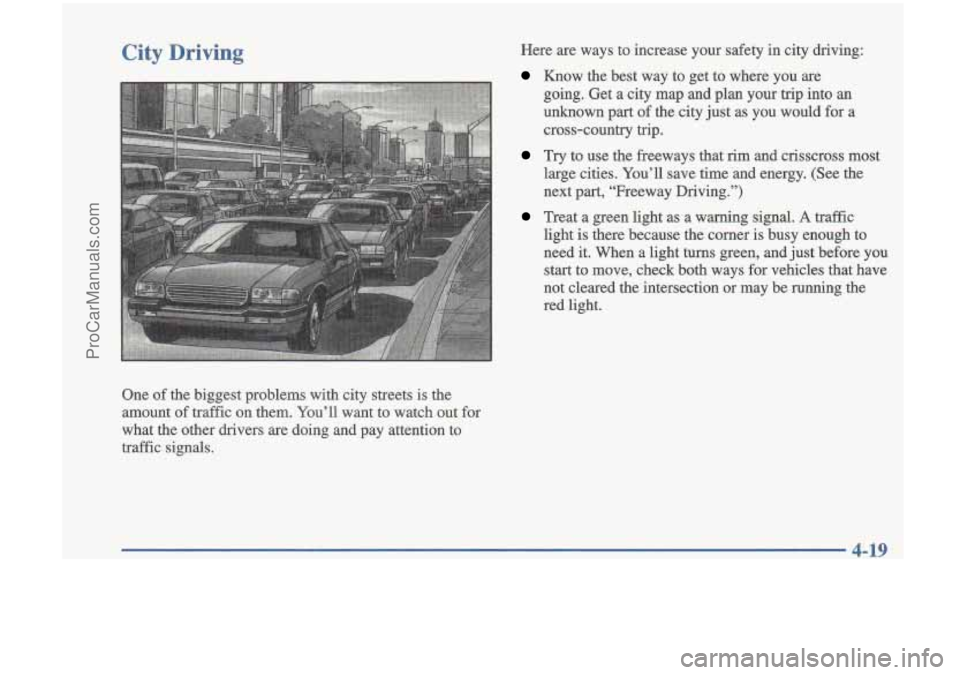
One of the biggest problems with city streets is the
amount
of traffic on them. You'll want to watch out for
what the other drivers are doing and pay attention to traffic signals. Here are ways to increase your safety in city driving:
Know the best way to get to where you are
going. Get a city map and plan your
trip into an
unknown part
of the city just as you would for a
cross-country trip.
Try to use the freeways that rim and crisscross most
large cities. You'll save time and energy. (See the
next
part, "Freeway Driving.")
Treat a green light as a warning signal. A traffic
light is there because the corner
is busy enough to
need it. When a light turns green, and just before you
start to move, check both ways
for vehicles that have
not cleared the intersection or may be running the
red light.
4-19
ProCarManuals.com
Page 169 of 353

Winter Driving
Here are some tips for winter driving:
0 Have your vehicle in good shape for winter.
0 You may want to put winter emergency supplies in
your trunk. Include an
ice scraper, a small brush or broom, a supply
of windshield washer fluid, a rag, some winter outer
clothing, a small shovel, a flashlight,
a red cloth and a
couple
of reflective warning triangles. And, if you will
be driving under severe conditions, include a small bag
of sand, a piece of old carpet or a couple of burlap bags
to help provide traction. Be sure you properly secure these items
in your vehicle.
4-24
ProCarManuals.com
Page 173 of 353

Run your engine only as long as you must. This saves fuel. When you run the engine, make it go a little faster
than just idle. That is, push the accelerator slightly. Ths
uses less fuel for the heat that you get and it keeps the
battery charged. You will need a well-charged battery to
restart the vehicle, and possibly for signaling later on
with your headlamps. Let the heater run for a while.
Then, shut the engine
off and close the window almost
all the way to preserve the heat. Start the engine again
and repeat this only when you feel really uncomfortable
from the cold. But do it as little as possible. Preserve the
fuel as long as you can. To help keep warm, you can get
out of the vehicle and do some fairly vigorous exercises
every half hour or
so until help comes.
Recreational Vehicle Towing
You can tow your vehicle behind another vehicle for use
at your destination. Be sure to use the proper towing
equipment designed for recreational towing. Follow the
instructions for the towing equipment.
Towing Your Vehicle from the Front
There are two ways to tow your vehicle from the front.
€
m
To tow your vehicle with a dolly, follow these steps:
1. Put the front wheels on a dolly.
2. Put the vehicle in PARK (P).
3. Set the parking brake and then remove the key.
4. Clamp the steering wheel in a straight-ahead position
with a clamping device designed for towing.
5. Release the parking brake.
ProCarManuals.com
Page 191 of 353

1. Check the other vehicle. It must have a 12-volt
battery with a negative ground system.
NOTICE:
If the other system isn’t a 12-volt system with a
negative ground, both vehicles can be damaged.
2. Get the vehicles close enough so the jumper cables
can reach, but be sure the vehicles aren’t touching
each other.
If they are, it could cause a ground
connection you don’t want. You wouldn’t be able to
start your Oldsmobile, and the bad grounding could
damage the electrical systems.
You could be injured
if the vehicles roll. Set the
parking brake firmly on each vehicle. Put the
transaxle in
PARK (P).
unnecessary accessories plugged into the cigarette
lighter or the accessory power outlet. Turn
off all
lamps that aren’t needed, as well as radios. This will avoid sparks and help save both batteries.
In
addition, it could save your radio.
3. Turn off the ignition on both vehicles. Unplug
I
NOTICE:
Do not leave your radio on while trying to jump
start your vehicle. The radio could be badly
damaged and the repairs wouldn’t be covered by
your warranty. Be sure to turn
off your radio
before following this procedure.
4. Open the hoods and locate the batteries.
I
An electric fan can start up even when the engine
is not running and can injure you. Keep hands,
clothing and tools away from any underhood
electric fan.
5-4
ProCarManuals.com
Page 199 of 353
Engine Overheating
You will find a coolant temperature gage on your
Oldsmobile’s instrument panel. See “Engine Coolant
Temperature Gage” in the Index.
You will also find a
low coolant level warning light on your Oldsmobile’s
instrument panel. See “Low Coolant Warning Light”
in the Index.
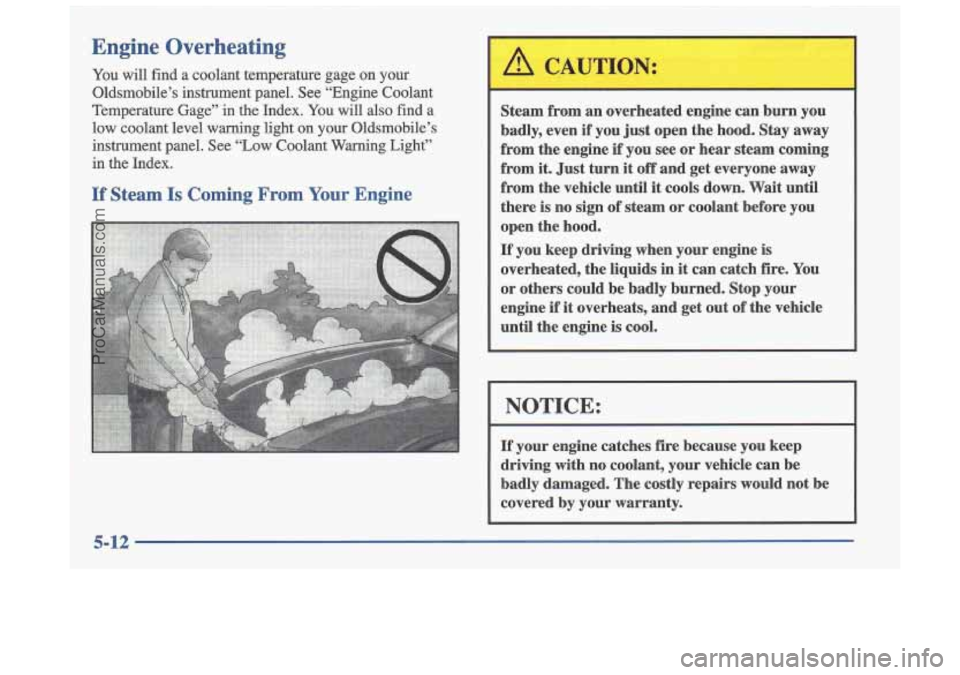
If Steam Is Coming From Your Engine
Steam from an overheated engine can burn you
badly, even if you just open the hood. Stay away
from the engine
if’ you see or hear steam coming
from it. Just turn it
off and get everyone away
from the vehicle until it cools down. Wait until
there
is no sign of steam or coolant before you
open the hood.
If you keep driving when your engine is
overheated, the liquids in it can catch fire. You
or others could be badly burned. Stop your
engine if
it overheats, and get out of the vehicle
until the engine is cool.
I NOTICE:
If your engine catches fire because you keep
driving with no coolant, your vehicle can be
badly damaged. The costly repairs would not be
covered by your warranty.
ProCarManuals.com