Page 229 of 353

The cap is behind a hinged door on the right side of your
vehicle.
To open the door, insert your finger into the
finger depression
in the fuel door.
While refueling, hang the tethered cap inside the
‘fuel door.
To take off the cap, turn it slowly to the left
(counterclockwise). The cap has a spring
in it; if you let
go
of the cap too soon, it will spring back to the right.
If you get gasoline on yourself and then
something ignites it, you could be badly burned.
Gasoline can spray out
on you if you open the
fuel filler cap too quickly. This spray can happen
if your tank is nearly fnll, and is more likely in
hot weather. Open the fuel filler cap slowly and
wait for any “hiss” noise to stop. Then unscrew
the cap all the way.
Be careful not to spill gasoline. Clean gasoline
from
painted surfaces~ as soon as possible. See “Cleaning the
Outside of Your Oldsmobile” in the Index.
When you put the cap back on, turn it to the right (clockwise) until you hear a clicking sound. Make sure
you fully install the cap. The diagnostic system can
determine if the fuel cap has been left
off or improperly
installed.
This would allow fuel to evaporate into the
atmosphere. See “Malfunction Indicator Lamp” in
the Index.
6-6
ProCarManuals.com
Page 230 of 353

NOTICE:
If you need a new cap, be sure to get the right
type. Your retailer can get one
for you. If you get
the wrong type, it may not fit properly. This may
cause your malfunction indicator lamp to light and your fuel tank and emissions system may be
damaged. See “Malfunction Indicator Lamp” in
the Index.
Checking Things Under the Hood
An electric fan under the hood can start up and
injure you even when the engine
is not running.
Keep hands, clothing and tools away from any
underhood electric fan. Things
that burn can get on hot engine parts and
start a fire. These include liquids like gasoline,
oil, coolant, brake fluid, windshield washer and
other fluids, and plastic or rubber. You or others
could be burned. Be careful not to drop
OF spill
things that will burn onto a hot engine.
The following sections tell you how to check fluids,
lubricants and important parts under the hood.
Hood Release
To open the hood, first pull
the hood release handle
inside the vehicle.
ProCarManuals.com
Page 233 of 353
Engine Oil
CHECK
OIL
If the CHECK OIL
light on the instrument
panel comes on, it
means you need to
check your engine oil level right away.
For more information, see “Check Oil Light” in the
Index. You should check your engine
oil level regularly;
this is an added reminder.
It’s
a good idea to check your engine oil every time you
get
fuel. In order to get an accurate reading, the oil must
be
warm and the vehicle must be on level ground.
The engine oil dipstick
handle is yellow ,and
located on the front of
the engine.
Turn off the engine and give the oil a few minutes
to drain back into the oil pan.
If you don’t, the oil
dipstick might not show the actual level.
ProCarManuals.com
Page 256 of 353
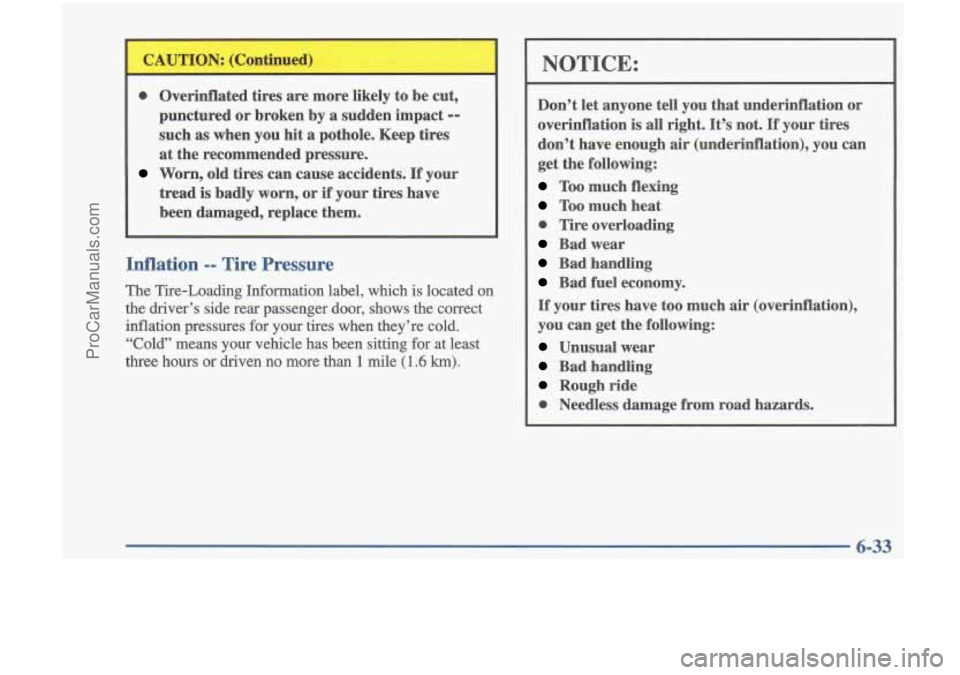
0 Overinflated tires are more likely to be cut,
punctured
or broken by a sudden impact --
such as when you hit a pothole. Keep tires
at the recommended pressure.
Worn, old tires can cause accidents. If your
tread is badly worn, or
if your tires have
been damaged, replace them.
Inflation -- Tire Pressure
The Tire-Loading Information label, which is located on
the driver’s side rear passenger door, shows the correct
inflation pressures for your tires when they’re cold.
“Cold” means your vehicle has been sitting for at least
three hours
or driven no more than 1 mile (1.6 km).
NOTICE:
Don’t let anyone tell you that underinflation or
overinflation is all right.
It’s not. If your tires
don’t have enough air (underinflation), you can
get the following:
Too much flexing
Too much heat
0 Tire overloading
Bad wear
Bad handling
Bad fuel economy.
If your tires have too much air (overinflation),
you can get the following:
Unusual wear
Bad handling
Rough ride
0 Needless damage from road hazards.
6-33
ProCarManuals.com
Page 270 of 353
Sheet Metal Damage
If your vehicle is damaged and requires sheet metal
repair or replacement, make sure the body repair shop
applies anti-corrosion material to the parts repaired or
replaced to restore corrosion protection.
Finish Damage
Any stone chips, fractures or deep scratches in the finish
should be repaired right away. Bare metal will corrode
quickly and may develop into a major repair expense.
Minor chips and scratches can be repaired with touch-up
materials available from your retailer
or other service
outlets. Larger areas of finish damage can be corrected
in your retailer’s body and paint shop.
Underbody Maintenance
Chemicals used for ice and snow removal and dust control
can collect on the underbody.
If these are not removed,
accelerated corrosion (rust) can occur on the underbody
parts such
as fuel lines, frame, floor pan and exhaust
system even though they have corrosion protection.
At least every spring, flush these materials from the
underbody with plain water. Clean any areas where mud and other debris can collect.
Dirt packed in closed areas
of the frme should be loosened before being flushed.
Your retailer or an underbody car washing system can
do this for you.
Chemical Paint Spotting
Some weather and atmospheric conditions can create a
chemical fallout. Airborne pollutants can fall upon and
attack painted surfaces on your vehicle. This damage
can take two forms: blotchy, ringlet-shaped
discolorations, and small irregular dark spots etched into
the paint surface.
Although no defect in the paint job causes
this,
Oldsmobile will repair, at no charge to the owner, the
surfaces of new vehicles damaged by this fallout
condition within
12 months or 12,000 miles (20 000 km)
of purchase, whichever occurs first.
6-47
ProCarManuals.com
Page 278 of 353
Fuse
Maxi-Fuses
4)
Usage
Right-hand Electrical Center-Fog
Lamps, Radio, Body Function Control Module, Interior Lamps
Ignition Switch
Not Used
Anti-Lock Brakes
Cooling Fans
Rear Defog
Not Used
Anti-Lock Brakes Cooling Fan
HVAC Blower (Climate Control)
Cooling Fans
Cooling Fans 35)
36)
37)
Usage
Air Conditioning Compressor
Not Used
Fuel
Pump
Automatic Light Control
Automatic Light Control
Horn
Daytime Running Lamps
Spare Fuses
Rear Defog
Accessory Power Outlets, Cigar Lighter
Anti-Lock Brakes
Anti-Lock Brakes
Air Conditioning Compressor,
Body Function Control Module
Automatic Transaxle
ProCarManuals.com
Page 279 of 353
Fuse
Mini-Fuses
39)
40)
41)
42)
43)
44)
Usage
Powertrain Control
Module, Ignition
Anti-Lock Brakes
Ignition System
Back-up Lamps, Brake-Transaxle
Shift Interlock
Horn
Powertrain Control Module
Parking
Lamps
Rear Defog, Daytime Running
Lamps, Climate Control System
Fuse
Mini-Fuses
47)
Usage
Canister Purge Valve, Powertrain
Control Module, Exhaust
Gas
Recirculation, Heated 02 Sensor
Fuel Pump, Injectors Generator
Right-Hand Headlamp
Left-Hand Headlamp
Cooling
Fan
WAC Blower (Climate Control )
Fuse Puller for Mini-Fuses
Tach Test Point for
Diagnostic Testing
6-56
ProCarManuals.com
Page 280 of 353

Replacement Bulbs
High-Beam Headlamp .................... 9005
Outside Lamps Bulb
Low-Beam Headlamp .................... 9006
Front
Park/Turn ...................... 3 157 NA
Back-up
............................... 3057
Rear Turn Signal
........................ 3357
Center High Mounted Stop Lamp
(CHMSL) ... 921
TaiUStoplarnp
........................... 3057
Inside Lamps Bulb
Dome .................................. 561
Capacities and Specificatio,ns
Cooling System ............. 13.6 quarts (12.9 L)
Engine Crankcase ............ 4.5 quarts (4.3 L)
Refrigerant, Air Conditioning ..... See refrigerant
charge label under the hood.
Fuel Tank ................ ._ 15.2 gallons (57.5 L)
Tire Pressures, Sizes ........... See Tire-Loading
Information label on the driver’s
side rear passenger door.
Wheel Nut Torque .......... 100 lb-ft (140 N-m)
NOTE: All capacities are approximate. When adding, be
sure to fill to the appropriate level or as recommended
in
this manual.
See “Recommended Fluids and Lubricants”
in
the Index.
6-57
ProCarManuals.com


