1997 OLDSMOBILE BRAVADA oil change
[x] Cancel search: oil changePage 113 of 358

Have you recently changed brands of fuel‘?
If so, be sure to fuel your vehicle with quality fuel (see
“Fuel” in the Index). Poor fuel quality will cause your
engine not
to run as efficiently as designed. You may
notice this as stalling after start-up, stalling when you
put the vehicle into gear, misfiring, hesitation
on
acceleration or stumbling on acceleration. (These
conditions may go away once the engine is warmed up.)
This will
be detected by the system and cause the light
to turn on.
If you experience one or more of these conditions,
change the fuel brand you use.
It will require at least one
full tank of the proper fuel to turn the light off.
If none of the above steps have made the light turn off,
have your retailer or qualified service center check the
vehicle. Your retailer has
the proper test equipment and
diagnostic tools to fix any mechanical
or electrical
problems that may have developed.
Engine Oil Pressure Gage
OIL 0-
The oil pressure gage shows
the engine oil pressure
in
psi (pounds per square inch)
when the engine is running.
Oil pressure may vary with engine speed, outside
temperature and
oil viscosity, but readings above the
low pressure zone indicate the normal operating range.
2-59
ProCarManuals.com
Page 230 of 358
When to Add Oil
If the oil is at or below the ADD line, then you’ll need
to add some oil. But you must use the right kind. This
part explains what kind
of oil to use. For crankcase
capacity,
see “Capacities and Specifications” in
the Index.
NOTICE:
Don’t add too much oil. If your engine has so
much oil that the oil level gets above the
cross-hatched area that shows the proper
operating range, your engine could be damaged.
Just fill it enough to put the level somewhere in the
proper operating range. Push the dipstick all the way
back
in when you’re through.
What Kind of Oil to Use
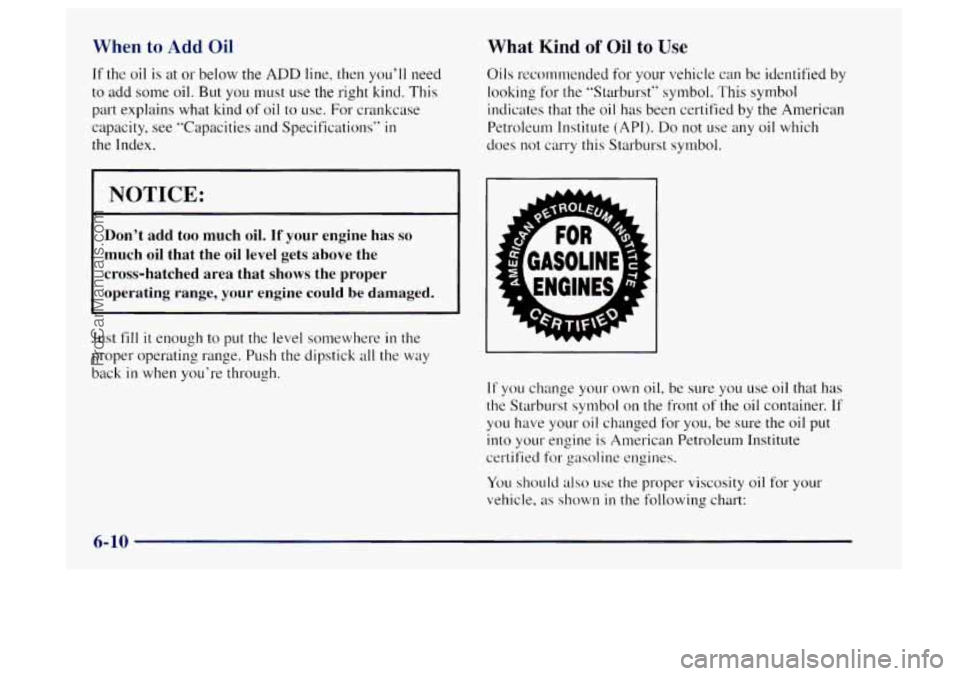
Oils recom~nended for your vehicle can be identified by
looking
for the ”Starburst” symbol. This symbol
indicates that the oil has been certified by the American
Petroleum Institute
(API). Do not use any oil which
does not carry this Starburst symbol.
If you change your own oil, be sure you use oil that has
the Starburst symbol on the front of the oil container.
If
you have your oil changed for you, be sure the oil put
into your engine is American Petroleum Institute
certified for gasoline engines.
You should also use the proper viscosity oil for your
vehicle,
as shown in the following chart:
6-10
ProCarManuals.com
Page 232 of 358
Engine Oil Additives
Don’t add anything to your oil. Your Oldsrnobile retailer
is ready to advise
if you think something should
be added.
When to Change Engine Oil
If any one of these is true for you, use the short tripkity
maintenance schedule:
a
a
a
a
a
Most trips are less than 5 to 10 miles (8 to 16 km).
This
is particularly important when outside
temperatures are below freezing.
Most trips include extensive idling (such
as frequent
driving
in stop-and-go traffic).
You operate your vehicle in dusty areas or
off-road frequently.
You frequently tow a trailer or use a carrier on top of
your vehicle.
The vehicle is used for delivery service, police, taxi
or other commercial application. Driving under these conditions causes
engine
oil to
break down sooner.
If any one of these is true for your
vehicle, then you need
to change your oil and filter
every
3,000 miles (5 000 km) or 3 months -- whichever
occurs first.
If none of them is true, use the long trip/highway
maintenance schedule. Change the oil and filter every
7,500 miles (1 2 500 km) or 12 months -- whichever
occurs first. Driving a vehicle with a
fully warmed
engine under highway conditions causes engine oil to
break down slower.
Remote Oil Filter
The access door for the remote oil filter is in the steering
linkage shield assembly located under the radiator
support. Twist the screw to unlock
or lock the door.
Make sure
if you open the door, it is securely closed
when
you are finished.
ProCarManuals.com
Page 233 of 358
What to Do with Used Oil
Did you know that used engine oil contains certain
elements that may be unhealthy for your skin and could
even cause cancer? Don‘t let used oil stay on your skin
for very long. Clean your skin and nails with soap
and
water, or a good hand cleaner. Wash or properly throw
away clothing or rags containing used engine oil. (See
the manufacturer’s warnings about the use and disposal
of oil products.)
Used
oil can be a real threat to the environment. If you
change your own oil, be sure to drain all free-flowing oil
from the filter before disposal. Don’t ever dispose of oil
by putting
it in the trash, pouring it on the ground, into
sewers, or into streams or bodies of water. Instead,
recycle
it by taking it to a place that collects used oil. If
you have a problem properly disposing of your used oil,
ask your retailer, a service station or a local recycling
center for help.
Air Cleaner
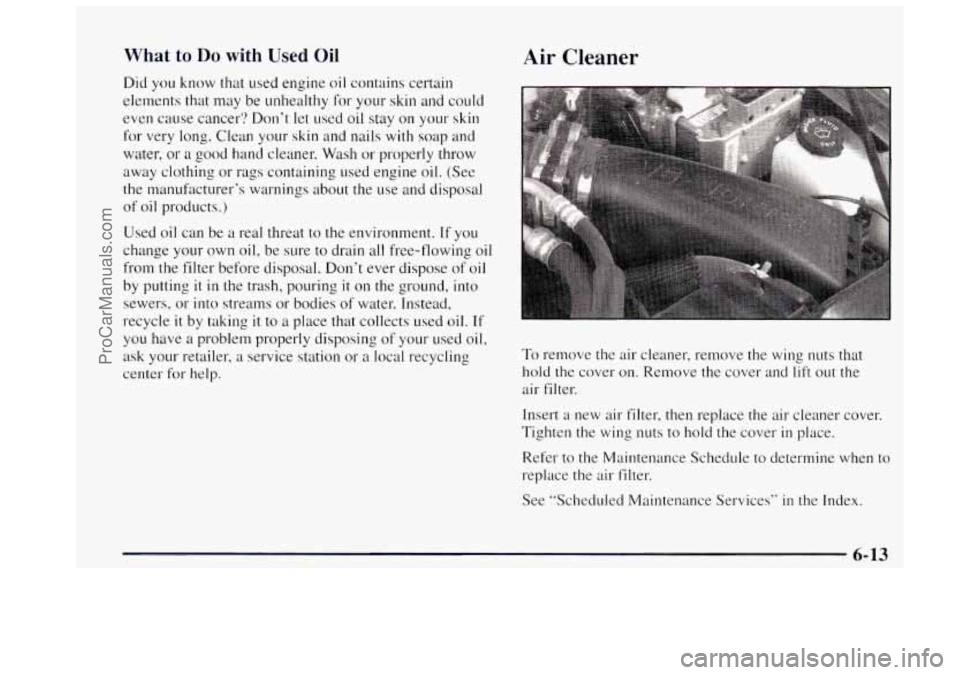
To remove the air cleaner, remove the wing nuts that
hold the cover on. Remove the cover and
lift out the
air filter.
Insert
a new air filter, then replace the air cleaner cover.
Tighten the wing nuts to hold the cover
in place.
Refer to the Maintenance Schedule to determine when to
replace the air filter.
See “Scheduled Maintenance Services” in the Index.
6-13
ProCarManuals.com
Page 234 of 358

Operating the enge with the air cleaner off can
cause you or others to be burned. The air cleaner
not only cleans the air, it stops flame
if the engine
backfires. If it isn’t there, and the engine
backfires, you could be burned. Don’t drive with
it
off, and be careful working on the engine with
the air cleaner
off.
NOTICE:
If the air cleaner is off, a backfire can cause a
damaging engine fire. And, dirt can easily get
into your engine, which will damage it. Always
have the air cleaner
in place when you’re driving.
Automatic Transmission Fluid
When to Check and Change
A good time to check your automatic transmission fluid
level is when the engine oil is changed.
Change both the
fluid and filter every 50,000 miles
(83 000 km) if the vehicle is mainly driven under one or
more
of these conditions:
In heavy city traffic where the outside temperature
regularly reaches
90°F (32°C) or higher.
In hilly or mountainous terrain.
0 When doing frequent trailer towing.
0 Uses such as found in taxi, police or delivery service.
If you do not use your vehicle under any of these
conditions, the fluid and filter do not require changing.
See “Scheduled Maintenance Services“
in the Index.
6-14
ProCarManuals.com
Page 240 of 358
1
; What to Use
I Refer to the Maintenance Schedule to determine what
’ kind of lubricant to use. See “Recommended Fluids and
i Lubricants” in the Index.
1 , I Engine Coolant
; The cooling system in your vehicle is filled with new
1 DEX-COOL” engine coolant. This coolant is designed
I to remain in your vehicle for 5 years or 150,000 miles
I (240 000 km), whichever occurs first, if you add only
~ DEX-COOL” extended life coolant.
I i The following explains your cooling system and how to
i
~
i
add coolant when it is low. If you have a problem with
engine overheating, see “Engine Overheating” in
the Index.
I
A 50/50 mixture of water and the proper coolant for
1 your Oldsmobile will:
’ 0 Give freezing protection down to -34°F (-37°C).
~ 0 Give boiling protection up to 265 “F (129°C). I
~ 0 Protect against rust and corrosion.
0 Help keep the proper engine temperature.
0 Let the warning lights and gages work as
they should.
NOTICE:
When adding coolant, it is important that you use
only
DEX-COOL TM (silicate-free) coolant.
If silicated coolant is added to the system,
premature engine, heater core or radiator
corrosion may result. In addition, the engine
coolant will require change sooner
-- at
30,000 miles (50 000 km) or 24 months,
whichever occurs first.
What to Use
Use a mixture of one-half clean water (preferably
distilled) and one-half DEX-COOL
TM coolant which
won’t damage aluminum parts. Use GM Engine Coolant
Supplement (sealer) (GM Part
No. 3634621) with any
complete coolant change.
If you use this mixture, you
don’t need to add anything else.
ProCarManuals.com
Page 280 of 358
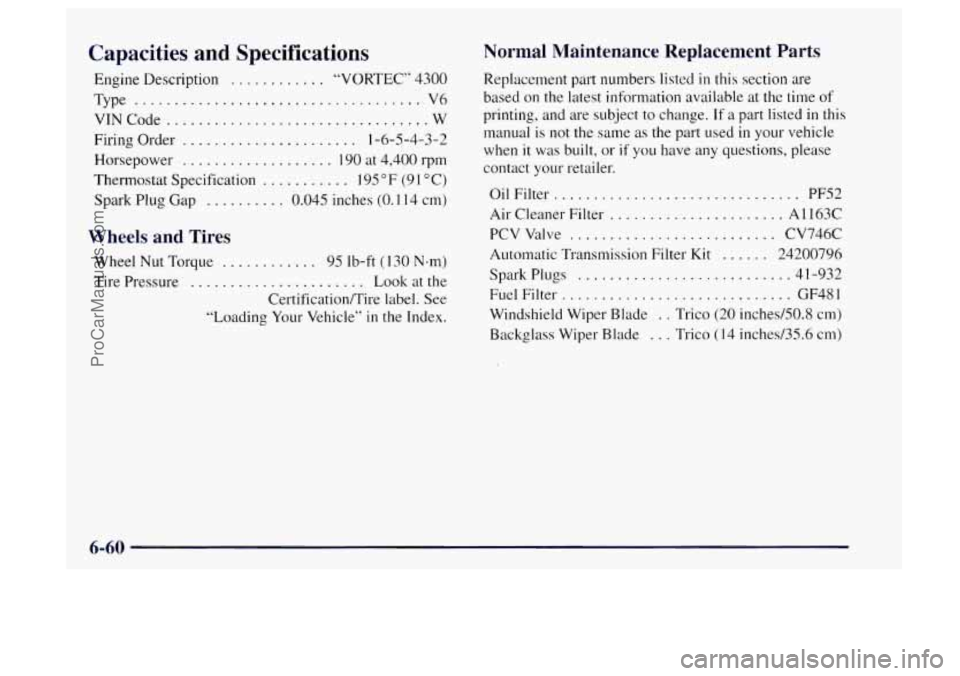
Capacities and Specifications
Engine Description ............ “VORTEC” 4300
Type
.................................... V6
VINCode ................................. W
Horsepower
................... 190 at 4,400 rpm
Thermostat Specification
........... 195 “F (9 1 “C)
Spark Plug
Gap .......... 0.045 inches (0.1 I4 cm)
Firing Order
...................... 1-6-5-4-3-2
Wheels and Tires
Wheel Nut Torque ............ 95 lb-ft (130 N-m)
Tire Pressure ...................... Look at the
Certificationnire label. See
“Loading Your Vehicle” in the Index.
Normal Maintenance Replacement Parts
Replacement part numbers listed in this section are
based
on the latest information available at the time of
printing, and are subject to change.
If a part listed in this
manual is not the same as the part used in your vehicle
when
it was built, or if you have any questions, please
contact your retailer.
Oil Filter.
.............................. PFS2
Air Cleaner Filter ...................... A1163C
PCV Valve
.......................... CV746C
Automatic Transmission Filter Kit
...... 24200796
Spark Plugs
.......................... ,41-932
Fuel Filter
............................. GF48 1
Windshield Wiper Blade . . Trico (20 inched50.8 cm)
Backglass Wiper Blade
... Trico (14 inched35.6 cm)
6-60
ProCarManuals.com
Page 284 of 358
Introduction
IMPORTANT-
KEEP ENGINE OIL
AT THE PROPER
LEVEL AND CHANGE A!
RECOMMENDED
protection I
Your Vehicle and the Environment
Proper vehicle maintenance not only helps to keep your
vehicle
in good working condition, but also helps the
environment.
All recommended maintenance procedures
are important. Improper vehicle maintenance can even
affect the quality
of the air we breathe. Improper fluid
levels or the wrong tire inflation can increase the level
of emissions from your vehicle. To help protect our
environment, and to keep your vehicle in good
condition, please maintain your vehicle properly.
7-2
ProCarManuals.com