Page 183 of 358
Driving On Grades
Reduce speed and shift to a lower gear before you start
down a long or steep downgrade.
If you don’t shift
down, you might have to use your brakes
so much that
they would get hot and no longer work well.
On a long uphill grade, shift down and reduce your
speed to around
45 mph (70 km/h) to reduce the
possibility of engine and transmission overheating.
You should use THIRD
(3) when towing a trailer.
Operating your vehicle in THIRD
(3) when towing a
trailer will minimize heat buildup and extend the life of
your transmission.
Parking on Hills
You really should not park your vehicle, with a trailer
attached, on a hill. If something goes wrong, your rig
could start to move. People can be injured, and both
your vehicle and the trailer can be damaged.
But if
YOU ever have to park your rig on a hill, here’s
how to do it:
1. Apply your regular brakes, but don’t shift into
PARK
(I?) yet. Then turn your wheels into the curb if
facing downhill or into traffic if facing uphill.
2. Have someone place chocks under the trailer wheels.
3. When the wheel chocks are in place, release the
regular brakes until the chocks absorb the load.
4. Reapply the regular brakes. Then apply your parking
brake and shift into PARK
(P).
5. Release the regular brakes.
4-51
ProCarManuals.com
Page 184 of 358
When You Are Ready to Leave After
Parking on a Hill
1. Apply your regular brakes and hold the pedal down
while you:
0 Start your engine;
0 Shift into a gear; and
0 Release the parking brake.
2. Let up on the brake pedal.
3. Drive slowly until the trailer is clear of the chocks.
4. Stop and have someone pick up and store the chocks.
Maintenance When Trailer Towing
Your vehicle will need service more often when you’re
pulling a trailer. See the Maintenance Schedule for more
on this. Things that are especially important
in trailer
operation are automatic transmission fluid (don’t
overfill), engine
oil, axle lubricant, belt, cooling system
and brake adjustment. Each of these
is covered in this
manual, and the Index will help you find them quickly.
If you’re trailering, it’s a good idea to review these
sections before you start your trip.
Check periodically to see that all hitch nuts and bolts
are tight.
4-52
ProCarManuals.com
Page 190 of 358
2. Get the vehicles close enough so the jumper cables
can reach, but be sure the vehicles aren’t touching
each other. If they are, it could cause a ground
connection you don’t want. You wouldn’t be able
to start your vehicle, and the bad grounding could
damage the electrical systems.
You could be injured if the vehicles roll. Set the
parking brake firmly on each vehicle. Put an
automatic transmission in
PARK (P). Put a
manual transmission in NEUTRAL (N).
I unnecessary accessories plugged into the cigarette
lighter, or accessory power outlets, if you have this
option. Turn
off all lamps that aren’t needed as well
as radios. This will avoid sparks and help to save
both batteries. In addition, it could save your radio!
3. Turn off the ignition on both vehicles. Unplug
NOTICE:
If you leave your radio on, it could be badly
damaged. The repair wouldn’t be covered by
your warranty.
An electric fan can start up even when the engine
is not running and can injure you. Keep hands,
clothing and tools away from any underhood
electric fan.
I ‘ 5-4
ProCarManuals.com
Page 193 of 358
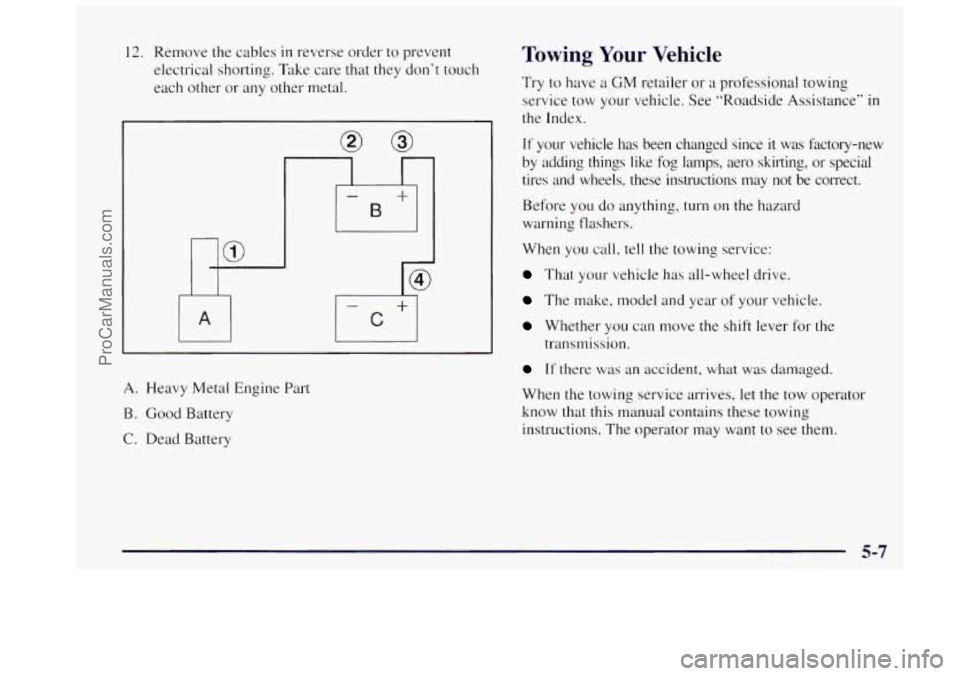
12. Remove the cables in reverse order to prevent
electrical shorting. Take care that they don’t touch
each other or any other metal. Towing Your Vehicle
Try to have a GM retailer or a professional towing
service tow your vehicle. See “Roadside Assistance”
in
the Index.
If your vehicle has been changed since it was factory-new
by adding things like
fog lamps, aero skirting, or special
tires and wheels, these instructions may not be conect.
Before you do anything, turn on the hazard
warning flashers.
When you call, tell the towing service:
That your vehicle has all-wheel drive.
The make, model and year of your vehicle.
Whether you can move the shift lever for the
transmission.
A. Heavy Metal Engine Part
B. Good Battery
C. Dead Battery
If there was an accident, what was damaged.
When the towing service arrives, let the tow operator
know that this manual contains these towing
instructions.
The operator may want to see them.
5-7
ProCarManuals.com
Page 194 of 358

-
To help avoid injury to you or others:
0 Never let passengers ride in a vehicle that is
0 Never tow faster than safe or posted speeds.
Never tow with damaged parts not fully secured.
0 Never get under your vehicle after it has
0 Always use separate safety chains on each
0 Never use J-hooks. Use T-hooks instead.
being towed.
been lifted
by the tow truck.
side when towing a vehicle.
A vehicle can fall from a car carrier if it isn’t
adequately secured. This can cause
a collision,
serious personal injury and vehicle damage. The
vehicle should be tightly secured with chains
or
steel cables before it is transported.
Don’t use substitutes (ropes, leather straps,
canvas webbing, etc.) that can be cut by sharp
edges underneath the towed vehicle. Always use
T-hooks inserted in the T-hook slots. Never use
J-hooks. They will damage drivetrain and
suspension components.
When your vehicle is being towed, have
the ignition key
turned
to the OFF position. The steering wheel should
be clamped
in a straight-ahead position with a clamping
device designed for
towing service. Do not use the
vehicle’s steering column lock for this.
The transmission
should
be in NEUTRAL (N). The parking brake should
be released.
5-8
ProCarManuals.com
Page 195 of 358
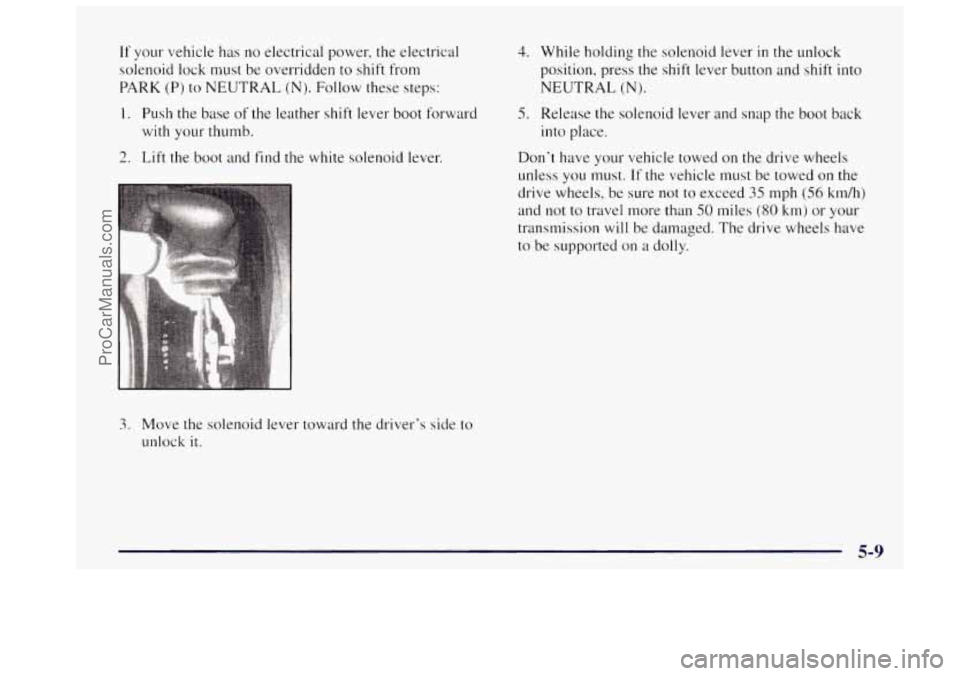
If your vehicle has no electrical power, the electrical
solenoid lock must be overridden to shift from
PARK (P) to NEUTRAL
(N). Follow these steps:
1. Push the base
of the leather shift lever boot forward
with your thumb.
1. Lift the boot and find the white solenoid lever.
3. Move the solenoid lever toward the driver’s side to
unlock
it.
4. While holding the solenoid lever in the unlock
position, press the shift lever button and shift into
NEUTRAL
(N).
5. Release the solenoid lever and snap the boot back
into place.
Don’t have your vehicle towed on the drive wheels
unless you must.
If the vehicle l-nust be towed on the
drive wheels, be sure not to exceed
35 mph (56 km/h)
and not to travel more than
50 miles (80 krn) or your
transmission
will be damaged. The drive wheels have
to be supported on a dolly.
5-9
ProCarManuals.com
Page 217 of 358
NOTICE:
When the compact spare is installed, don’t take
your vehicle through an automatic
car wash with
guide rails. The compact spare can get caught on
the rails. That can damage the tire and wheel,
and maybe other parts
of your vehicle.
Don’t use your compact spare on other vehicles.
And don’t
mix your compact spare tire or wheel with
other wheels or tires. They won’t fit. Keep your spare
tire and its wheel together.
NOTICE:
Tire chains won’t fit your compact spare. Using
them can damage your vehicle and can damage
the chains too. Don’t use tire chains on your
compact spare.
If You’re Stuck: In Sand, Mud,
Ice or Snow
What YOU don’t want to do when your vehicle is stuc
to spin your wheels too fast. The method known
as
:k is
“rocking” can help you get out when you’re stuck, but
you must use caution.
If you let your tires spin at high speed, they can
explode, and
you or others could be injured.
And, the transmission or other parts
of the
vehicle can overheat. That could cause an engine
compartment fire or other damage. When you’re
stuck, spin the wheels as little as possible. Don’t
spin the wheels above
35 mph (55 km/h) as shown
on the speedometer.
I
5-31
ProCarManuals.com
Page 218 of 358
NOTICE:
Spinning your wheels can destroy parts of your
vehicle as well as the tires. If you spin the wheels
too fast while shifting your transmission back
and forth, you can destroy your transmission.
For information about using tire chains on your vehicle,
see "Tire Chains''
in the Index.
Rocking Your Vehicle To Get It Out
First, turn your steering wheel left and right. That will
clear the area around your front wheels. Then shift back
and forth between REVERSE
(R) and a forward gear,
spinning the wheels as little as possible. Release the
accelerator pedal while you shift, and press lightly on
the accelerator pedal when the transmission is
in gear.
If that doesn't get you out after a few tries, you may
need to
be towed out. Or, you can use your recovery
hooks
if your vehicle has them. If you do need to be
towed out,
see "Towing Your Vehicle" in the Index.
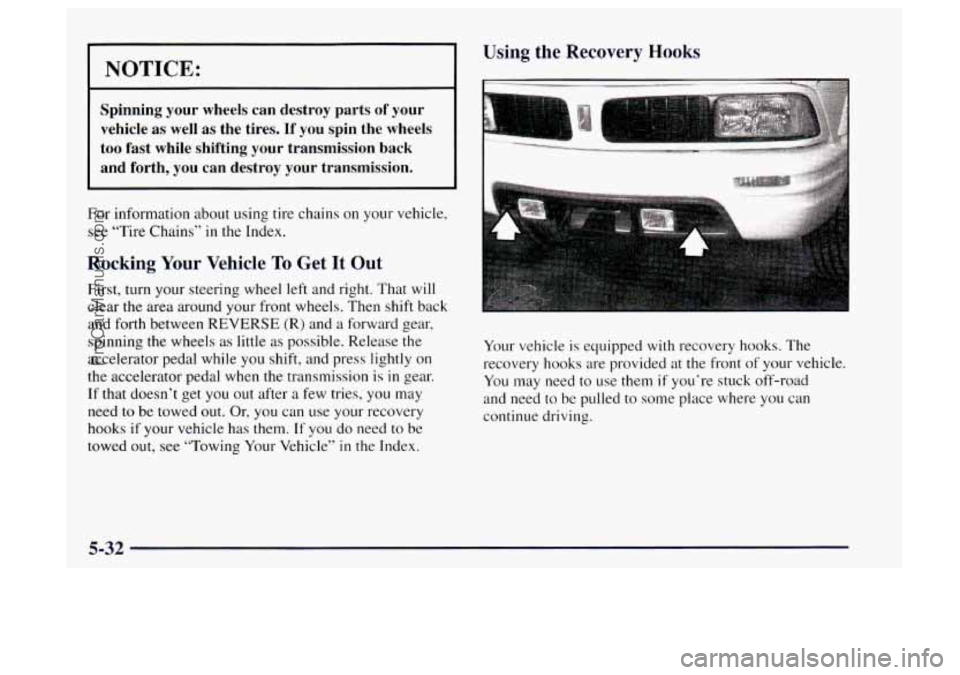
Using the Recovery Hooks
Your vehicle is equipped with recovery hooks. The
recovery hooks are provided at the front
of your vehicle.
You may need to use them
if you're stuck off-road
and need to be pulled to some place where you can
continue driving.
ProCarManuals.com