1997 OLDSMOBILE BRAVADA engine
[x] Cancel search: enginePage 70 of 358

It is dangerous to get out of your vehicle if the
shift lever is not fully in
PARK (P) with the
parking brake firmly set. Your vehicle can roll.
Don’t leave your vehicle when the engine
is
running unless you have to. If you have left the
engine running, the vehicle can move suddenly.
You or others could be injured.
To be sure your
vehicle won’t move, even when you’re on fairly
level ground, always set your parking brake and
move the shift lever to
PARK (P).
Your vehicle will be free to roll -- even if your
shift lever is in
PARK (P) -- if your transfer case
is in
NEUTRAL (N). So, be sure the transfer case
is in a drive gear
-- not in NEUTRAL (N). See
“Shifting Into
PARK (P)” in the Index. If you’re
pulling
a trailer, see “Towing a Trailer” in
the Index. Ensure the shift lever
is fully in
PARK (P) range before
starting the engine.
Your vehicle has a
brake-transmission shift interlock. You have to fully
apply your regular brakes before you can
shift from
PARK (P) when the ignition key is in the RUN position.
If you cannot shift
out of PARK (P), ease pressure on
the shift lever
-- press the button on the shift lever and
push the shift lever all the way into PARK (P) as you
maintain brake application. Then move the shift lever
into the gear you wish. See “Shifting Out of PARK (P)”
in the Index.
REVERSE (R): Use this gear to back up.
NOTICE:
Shifting to REVERSE (R) while your vehicle is
moving forward could damage your
transmission. Shift to
REVERSE (R) only after
your vehicle is stopped.
To rock your vehicle back and forth to get out of snow,
ice or sand without damaging your transmission, see
“Stuck: In
Sand, Mud, Ice or Snow” in the Index.
ProCarManuals.com
Page 71 of 358
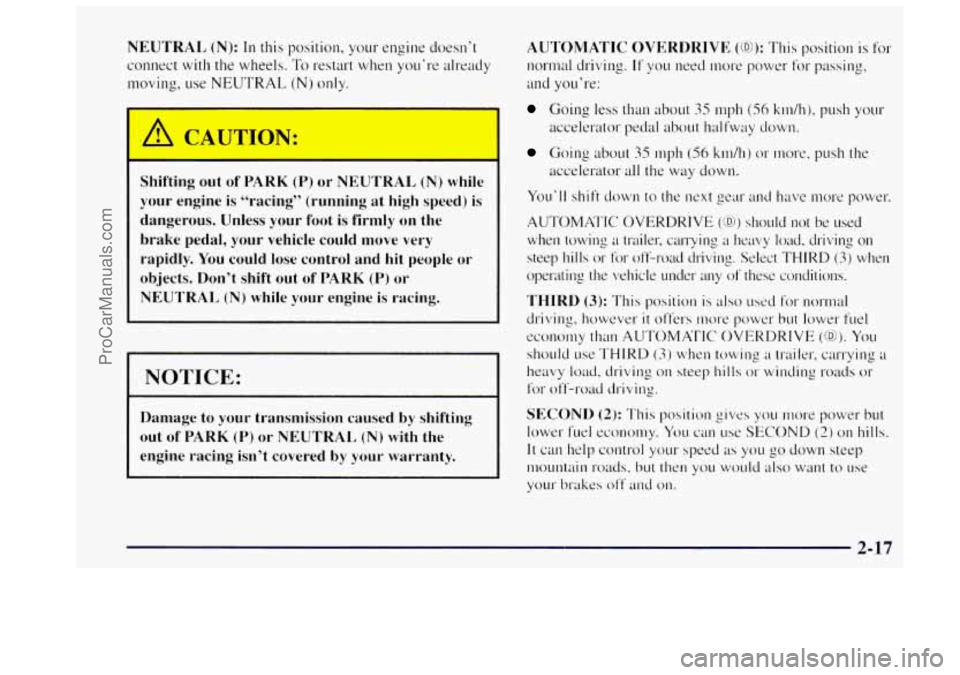
NEUTRAL (N): In this position, your engine doesn’t
connect with
the wheels. To restart when YOLI’I-~ already
moving, use
NEUTRAL (N) only.
Shifting out of PARK (P) or NEUTRAL (N) while
your engine
is “racing” (running at high speed) is
dangerous. Unless your foot is firmly on the
brake pedal,
your vehicle could move very
rapidly.
You could lose control and hit people or
objects. Don’t shift out of PARK
(P) or
NEUTRAL
(N) while your engine is racing.
I NOTICE:
Damage to your transmission caused by shifting
out of PARK
(P) or NEUTRAL (N) with the
engine racing isn’t covered by your warranty. AUTOMATIC OVERDRIVE
(@): This position
is for
normal driving. If you need 111o1-e power for passing,
and you’re:
Going less than about 35 rnph (56 kidhj, push your
Going about 35 mph (56 kdhj or more, push the
accelerator
peclal about halfway
down.
accelerator all the way
down.
You’ll shift down to the next gear and have more power.
AUTOMATIC OVERDRIVE
(0) should not be used
when towing
a trailer, carrying a heavy load, driving on
steep hills 01- for off-road driving. Select THIRD (3) when
operating the vehicle under
any of these conditions.
THIRD
(3): This position is also used for normal
driving, however
it offers more power but lower fuel
economy than AUTOMATIC OVERDRIVE
(@I. You
should LIS~ THIRD (3) when towing ;I trailer, carrying a
heavy load, driving on steep hills or winding roads or
for off-road driving.
SECOND (2): This position gives you more power but
lower fuel economy. You can use SECOND (2) on hills.
It can help control your speed as you go down steep
mountain roads,
but then you would also want to use
your txakes off’ and on.
ProCarManuals.com
Page 72 of 358

You can also use SECOND (2) for starting your vehicle
from a stop on slippery road surfaces.
FIRST (1): This position gives you even more power
(but lower fuel economy) than
SECOND (2). You can
use
it on very steep hills, or in deep snow or mud. If the
selector lever is
put in FIRST (1) while the vehicle is
moving forward, the transmission won’t shift into
FIRST
(1) until the vehicle is going slowly enough.
NOTICE:
If your rear wheels can’t rotate, don’t try to
drive. This might happen if you were stuck in
very deep sand
or mud or were up against a solid
object. You could damage your transmission.
Also, if you stop when going uphill, don’t hold
your vehicle there with only the accelerator
pedal. This
could overheat and damage the
transmission. Use your brakes or shift into
PARK (P) to hold your vehicle in position
on a hill.
Locking Rear Axle
Your rear axle can give you additional traction on snow,
mud, ice,
sand or gravel. It works like a standard axle
most of the time, but when one of the rear wheels has no
traction and the other does, the locking feature will
allow the wheel
with traction to move the vehicle.
All-Wheel Drive
Your engine’s driving power is sent to all four wheels
for extra traction. All-wheel drive is like four-wheel
drive, but there
is no lever or switch to engage or
disengage the front axle. It is
fully automatic and adjusts
itself as needed
for road conditions.
Parking Brake
To set the parking brake, hold the regular brake pedal
down with your right foot. Push down the parking brake
pedal
with your left foot. If the ignition is on, the brake
system warning light
will come on.
To release the parking brake, hold the regular brake
pedal
down.
2-18
ProCarManuals.com
Page 73 of 358
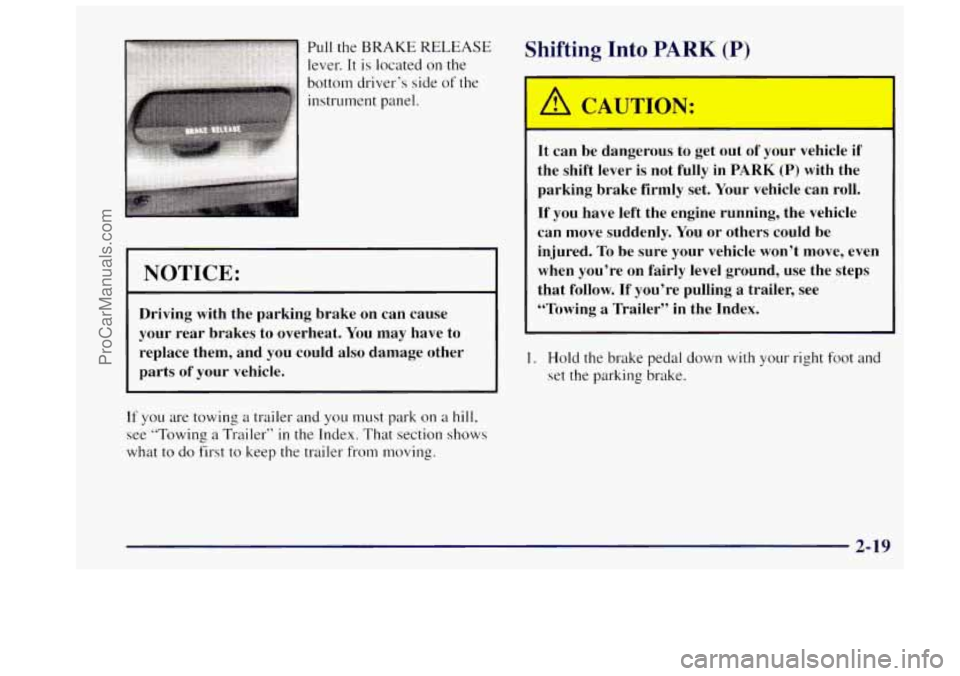
instrument panel.
NOTICE:
Driving with the parking brake on can cause
your rear brakes to overheat. You may have to
replace them, and you could also damage other
parts
of your vehicle.
If you are towing a trailer and you must park on a hill,
see ”Towing a Trailer” in the Index. That section shows
what to do first
to keep the trailer from moving.
Shifting Into PARK (P)
It can be dangerous to get out of your vehicle if
the shift lever is not fully in PARK (P) with the
parking brake firmly set. Your vehicle can roll.
If you have left the engine running, the vehicle
can move suddenly. You or others could be
injured.
To be sure your vehicle won’t move, even
when you’re on fairly level ground, use the steps
that follow.
If you’re pulling a trailer, see
“Towing a Trailer” in the Index.
I. Hold the brake pedal down with your right foot and
set the parking brake.
2-19
ProCarManuals.com
Page 74 of 358

2. hlove the shift lever into PARK (P) position like this: Leaving Your Vehicle With the
Engine Running
It can be dangerous to leave your vehicle with the
engine running.
Your vehicle could move
suddenly if the shift lever
is not fully in PARK (P)
with the parking brake firmly set. And, if you
leave the vehicle with the engine running, it could
overheat and even catch fire.
You or others could
be injured. Don’t leave your vehicle with the
engine running unless you have to.
0 Hold in the button on the lever.
Push the lever all the way toward the front of
the vehicle.
3. TLIIII the ignition key to LOCK.
4. Remove the key and take it with YOLI. If you can
remove the key and
leave your vehicle, your vehicle
is in PARK (P).
If you have to leave your vehicle. with the engine
running,
be s111-e to firndy set your parking brake and
shifi into PARK (P) before you leave it. After you’ve
n~oved the shift lever into the PARK (P) position, hold
the reg~~lar brake pedal ckwn. Then, see if you can move
the shift lever away from PARK (P) without first pulling
it toward you. If you can, it means that the shift lever
wasn’t
FLIIIY locked into PARK (P).
2-20
ProCarManuals.com
Page 76 of 358
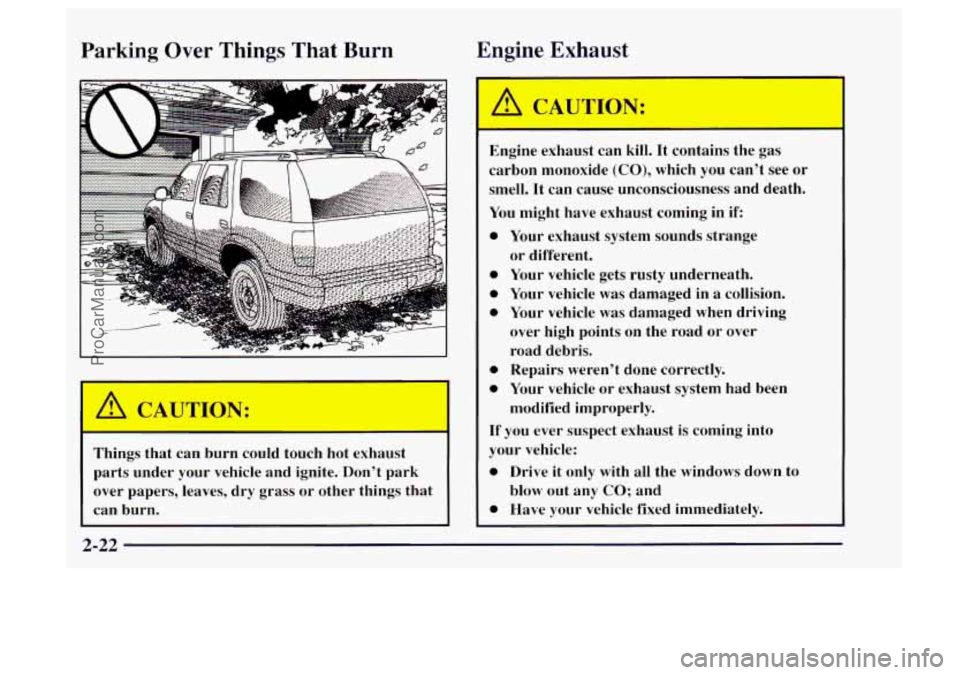
Parking Over Things That Burn Engine
Exhaust
Things that can burn could touch hot exha1
parts under your vehicle and ignite. Don't park
over papers, leaves, dry grass or other things that
can burn.
-1
Engine exhaust can kill. It contains the gas
carbon monoxide
(CO), which you can't see or
smell. It can cause unconsciousness and death.
You might have exhaust coming in if:
0
0
0
0
0
0
Your exhaust system sounds strange
or different.
Your vehicle gets rusty underneath.
Your vehicle was damaged in
a collision.
Your vehicle was damaged when driving
over high points on the road or over
road debris.
Repairs weren't done correctly.
Your vehicle or exhaust system had been
modified improperly.
If you ever suspect exhaust is coming into
your vehicle:
0 Drive it only with all the windows down to
0 Have your vehicle fixed immediately.
blow
out any
CO; and
2-22
ProCarManuals.com
Page 77 of 358
Running Your Engine While
You’re Parked
It’s better not to park with the engine running. But if
ever have to, here are SOT things to know.
Idling the engine with the air system control
off
could allow dangerous exhaust into your vehicle
(see the earlier Caution under “Engine Exhaust”).
Also, idling
in a closed-in place can let deadly
carbon monoxide (CO) into your vehicle even if
the fan switch is at the highest setting. One place
this can happen is
a garage. Exhaust -- with
CO
-- can come in easily. NEVER park in a
garage with the engine running.
Another closed-in place can be a blizzard. (See
“Blizzard” in the
Index.)
It can be dangerous to get out of your vehicle if
the shift lever is not fully in PARK
(P) with the
parking brake firmly set. Your vehicle can roll.
running unless you have to. If you’ve left the
engine running, the vehicle can move suddenly.
You
or others could be injured. To be sure your
vehicle won’t move, even when you’re on fairly
level ground, always set your parking brake and
move the shift lever to PARK (P).
~ Don’t leave your vehicle when the engine is
Follow the proper steps
to be sure your vehicle won’t
nove. See “Shifting Into
PARK (P)” in the Index.
If you’re pulling a trailer, see “Towing a Trailer” in
:he Index.
ProCarManuals.com
Page 100 of 358
Your vehicle’s engine should be turned off while
programming the transmitter.
Follow these steps to
program up to three channels:
1. If you have not previously programmed a universal
channel, proceed to Step
2. Otherwise, hold down
the two outside buttons
on the universal transmitter
until the red light begins to flash rapidly
(approximately
20 seconds). Then release the
buttons. This procedure initializes the memory and
erases any previous settings for all three channels.
2. Hold the end of the hand-held transmitter against the
bottom surface of the universal transmitter
so that
you can still see the red light.
3. Decide which one of the three channels you want to
program. Using both hands, press the hand-held
transmitter button and the desired button on the
universal transmitter. Continue to hold both buttons
through Step 4.
4. Hold down both buttons until you see the red light
on the universal transmitter flash rapidly. The rapid
flashing, which could take up to
90 seconds,
indicates that the universal transmitter has been
programmed. Release both buttons once the light
starts to flash rapidly.
If you have trouble programming the universal
transmitter, make sure that you have followed the
directions exactly as described and that the battery
in the
hand-held transmitter
is not dead. If you still cannot
program
it, rotate the hand-held transmitter end over end
and try again. The universal transmitter may not work
with older garage door openers that do not meet current
Federal Consumer Safety Standards.
If you cannot
program the transmitter after repeated attempts, consult
your Oldsmobile retailer.
Be sure to keep the original hand-held transmitter
in case
you need to erase and reprogram the universal transmitter.
Operating the Transmitter
Press and hold the appropriate button on the universal
transmitter. The red light comes on while the signal is
being transmitted.
Note that the effective transmission range
of the
universal transmitter may differ from
the hand-held
transmitter and from one channel to another.
2-46
ProCarManuals.com