Page 111 of 204
If you have a flat tire, follow the instructions
below:
Stopping the vehicle
1. Safely move the vehicle off the road and
away from traffic.
2. Turn on the hazard warning flashers.
3. Park on a level surface and apply the
parking brake. Shift the manual transmis-
sion into R (Reverse), or the automatic
transmission into P (Park).
WARNING
c
The transfer control lever
must be in the 2H, 4H or 4L position.
cNever place the transfer control le-
ver in the N position. Otherwise, the
vehicle could roll unexpectedly even
if the manual transmission is in gear
or the automatic transmission is in
the P position. This could result in
serious personal injury or property
damage.
4. Turn off the engine.
5. Raise the hood to warn other traffic and
to signal professional road assistancepersonnel that you require assistance.
6. Have all passengers get out of the ve-
hicle and stand in a safe place away from
traffic and clear of the vehicle.
WARNING
cMake sure that the parking brake is
securely applied and the manual
transmission is shifted into R (Re-
verse), or the automatic transmis-
sion into P (Park).
cNever change tires when the vehicle
is on a slope, ice or a slippery area.
This is hazardous.
cNever change tires if oncoming traf-
fic is close to your vehicle. Wait for
professional road assistance.
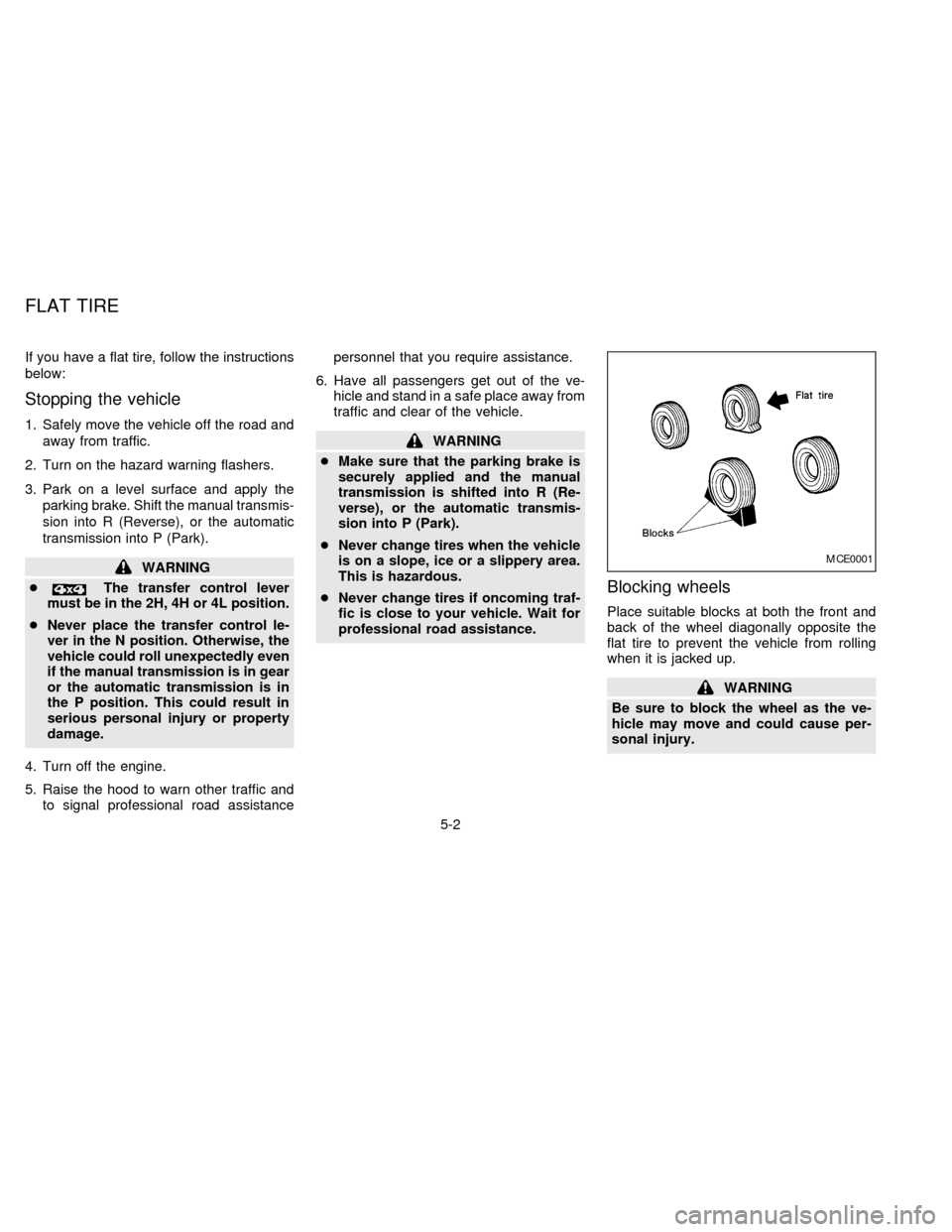
Blocking wheels
Place suitable blocks at both the front and
back of the wheel diagonally opposite the
flat tire to prevent the vehicle from rolling
when it is jacked up.
WARNING
Be sure to block the wheel as the ve-
hicle may move and could cause per-
sonal injury.
MCE0001
FLAT TIRE
5-2
ZX
Page 112 of 204

Getting the spare tire and tools
1.For King Cab models:
a. Move the driver's seat back fully for-
ward.
b. Remove the jack and wheel nut
wrench from the tool case from be-
hind the driver's seat.
c. Remove the jack rod from behind the
driver's seat.
For standard cab models:
a. Move the bench seat back fully for-
ward.
b. Remove the jack and jack rod from
behind the driver's side of the bench
seat.c. Remove the wheel nut wrench from
behind the passenger's side of the
bench seat.
2. Fit the square end of the jack rod into the
square hole of the wheel nut wrench to
form a handle.
3. Find the oval shaped opening under the
middle of the tailgate. Pass the T-shaped
end of the jack rod through the opening
and direct it towards the spare tire winch,
located directly above the spare tire.4. Seat the T-shaped end of the jack rod
into the T-shaped opening of the spare
tire winch, and turn the jack rod counter-
clockwise to lower the spare tire.
5. Once the spare tire is completely low-
ered, reach under the vehicle, remove
the retainer chain, and carefully slide the
tire from under the rear of the vehicle.
ACE1008SCE0043CE0141-A
5-3
ZX
Page 113 of 204
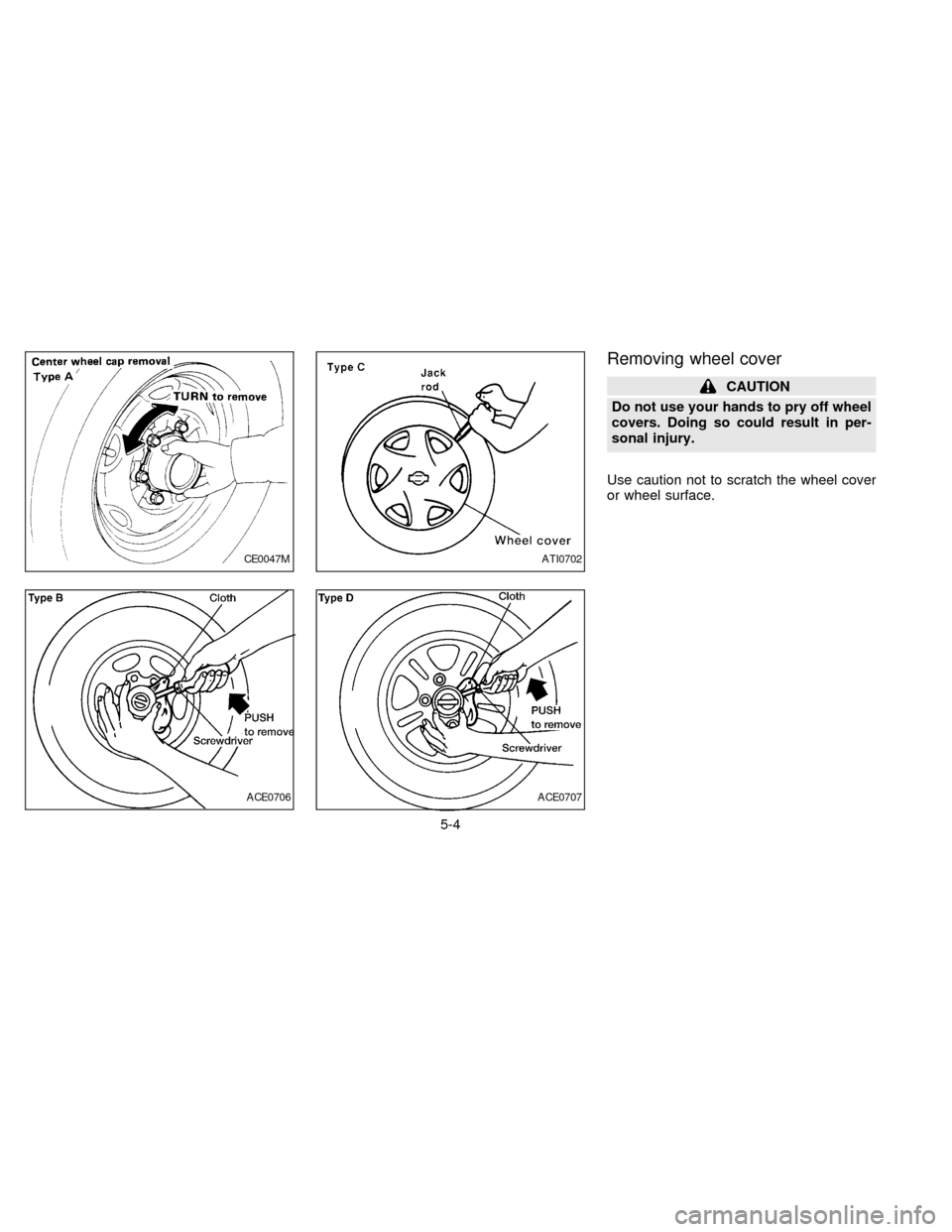
Removing wheel cover
CAUTION
Do not use your hands to pry off wheel
covers. Doing so could result in per-
sonal injury.
Use caution not to scratch the wheel cover
or wheel surface.
CE0047M
ACE0706
ATI0702
ACE0707
5-4
ZX
Page 114 of 204
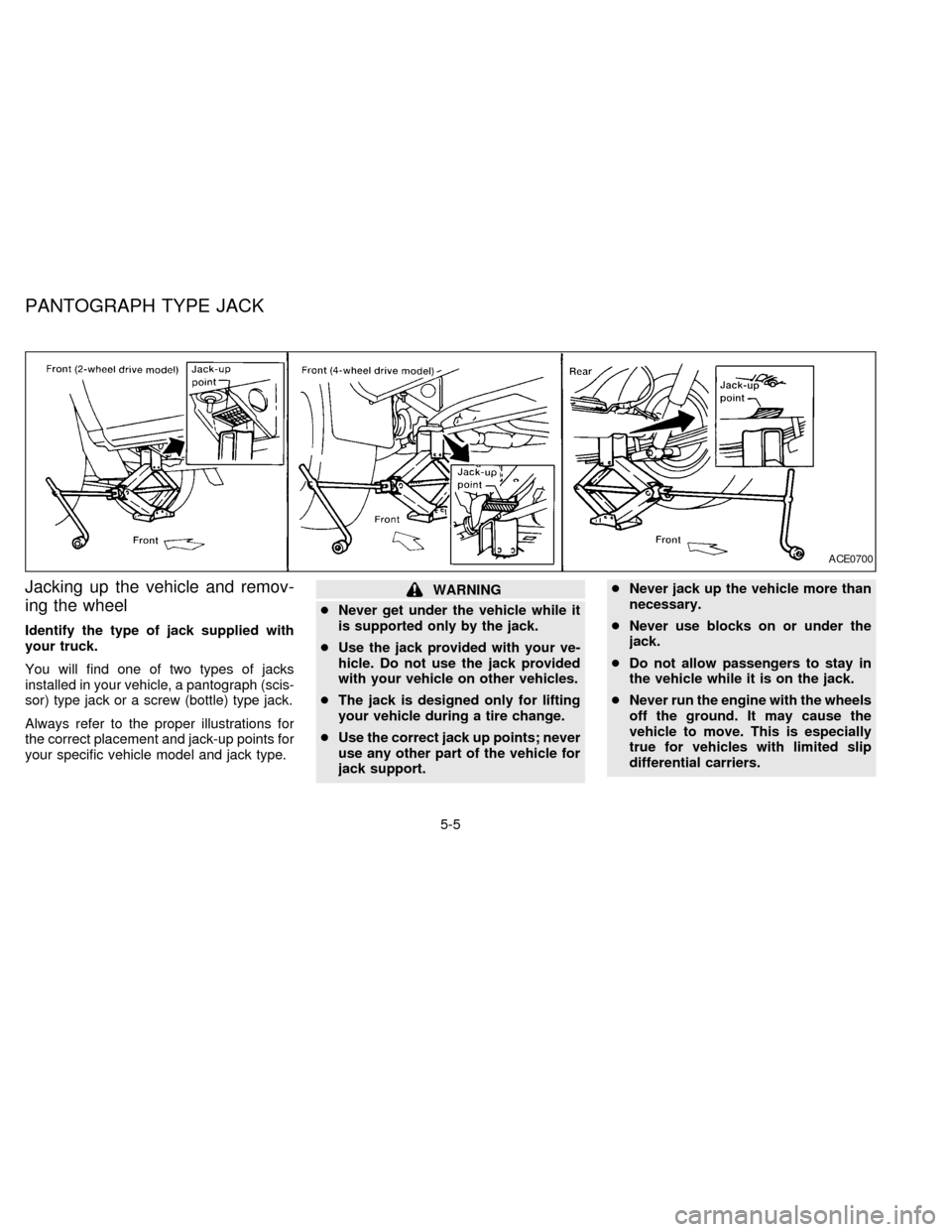
Jacking up the vehicle and remov-
ing the wheel
Identify the type of jack supplied with
your truck.
You will find one of two types of jacks
installed in your vehicle, a pantograph (scis-
sor) type jack or a screw (bottle) type jack.
Always refer to the proper illustrations for
the correct placement and jack-up points for
your specific vehicle model and jack type.
WARNING
cNever get under the vehicle while it
is supported only by the jack.
cUse the jack provided with your ve-
hicle. Do not use the jack provided
with your vehicle on other vehicles.
cThe jack is designed only for lifting
your vehicle during a tire change.
cUse the correct jack up points; never
use any other part of the vehicle for
jack support.cNever jack up the vehicle more than
necessary.
cNever use blocks on or under the
jack.
cDo not allow passengers to stay in
the vehicle while it is on the jack.
cNever run the engine with the wheels
off the ground. It may cause the
vehicle to move. This is especially
true for vehicles with limited slip
differential carriers.
ACE0700
PANTOGRAPH TYPE JACK
5-5
ZX
Page 115 of 204
Carefully read the following instructions.
1. On 4-wheel drive models with a screw
type jack, put the adapter stored in the
tool bag on the jack when jacking up the
front side.
Do not use the jack adapter for the
rear.
2. Place the jack directly under the jack-up
point.
The jack should be used on level, firm
ground.
3. Loosen each wheel nut on the flat tireone or two turns by turning counterclock-
wise with the wheel nut wrench.
Do not remove the wheel nuts until the
tire is off the ground.
4. Carefully raise the vehicle until the flat
tire clears the ground. Remove the wheel
nuts, and then remove the wheel. Do not
remove the brake drum with the wheel.
CE0046MA
SCREW TYPE JACK
5-6
ZX
Page 116 of 204
Installing wheel
The spare tire is designed for emergency
use. See specific instructions under the
heading ``Wheels and tires'' in the ``Do-
it-yourself operations'' section.
1. Clean any mud or dirt from the surface
between the wheel and hub.
2. Carefully put the spare tire on and tighten
the wheel nuts finger tight.
3. With the wheel nut wrench, tighten the
wheel nuts alternately and evenly until
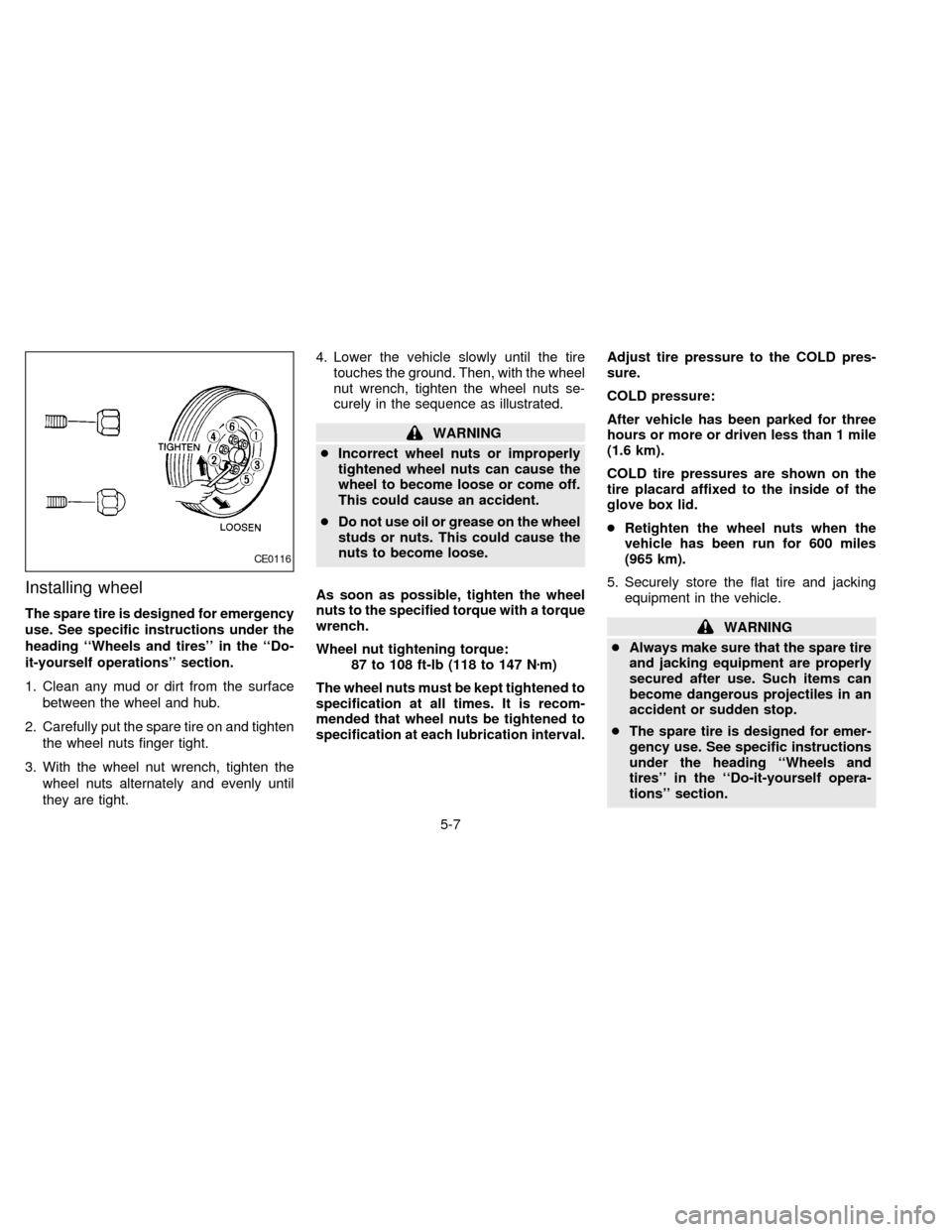
they are tight.4. Lower the vehicle slowly until the tire
touches the ground. Then, with the wheel
nut wrench, tighten the wheel nuts se-
curely in the sequence as illustrated.
WARNING
cIncorrect wheel nuts or improperly
tightened wheel nuts can cause the
wheel to become loose or come off.
This could cause an accident.
cDo not use oil or grease on the wheel
studs or nuts. This could cause the
nuts to become loose.
As soon as possible, tighten the wheel
nuts to the specified torque with a torque
wrench.
Wheel nut tightening torque:
87 to 108 ft-lb (118 to 147 Nzm)
The wheel nuts must be kept tightened to
specification at all times. It is recom-
mended that wheel nuts be tightened to
specification at each lubrication interval.Adjust tire pressure to the COLD pres-
sure.
COLD pressure:
After vehicle has been parked for three
hours or more or driven less than 1 mile
(1.6 km).
COLD tire pressures are shown on the
tire placard affixed to the inside of the
glove box lid.
cRetighten the wheel nuts when the
vehicle has been run for 600 miles
(965 km).
5. Securely store the flat tire and jacking
equipment in the vehicle.
WARNING
cAlways make sure that the spare tire
and jacking equipment are properly
secured after use. Such items can
become dangerous projectiles in an
accident or sudden stop.
cThe spare tire is designed for emer-
gency use. See specific instructions
under the heading ``Wheels and
tires'' in the ``Do-it-yourself opera-
tions'' section.
CE0116
5-7
ZX
Page 120 of 204
cWhen towing with the front wheels
on the ground:
Turn the ignition key to the OFF
position and secure the steering
wheel in a straight-ahead position
with a rope or similar device. Never
place the ignition key in the LOCK
position. This will result in damage
to the steering lock mechanism.
cWhen towing with the rear wheels on
the ground:
Release the parking brake and move
the gearshift lever to the Neutral po-
sition (N position).
On automatic transmission models,
to move the shift lever to Neutral (N
position), turn the ignition key to the
ACC position. After moving the shift
lever to neutral (N position), be sure
to turn the ignition key to the OFF
position.
cFor 4-wheel drive models:
Set the free-running hubs to the free
position. See ``
Auto-lock free-
running hubsº or ``Manual-lock
free-running hubsº as appropriate in
the ``Starting and driving'' section.Move the transfer case shift lever
into the 2H position and the trans-
mission shift lever into the Neutral
(N) position.
cAttach safety chains for all towing.
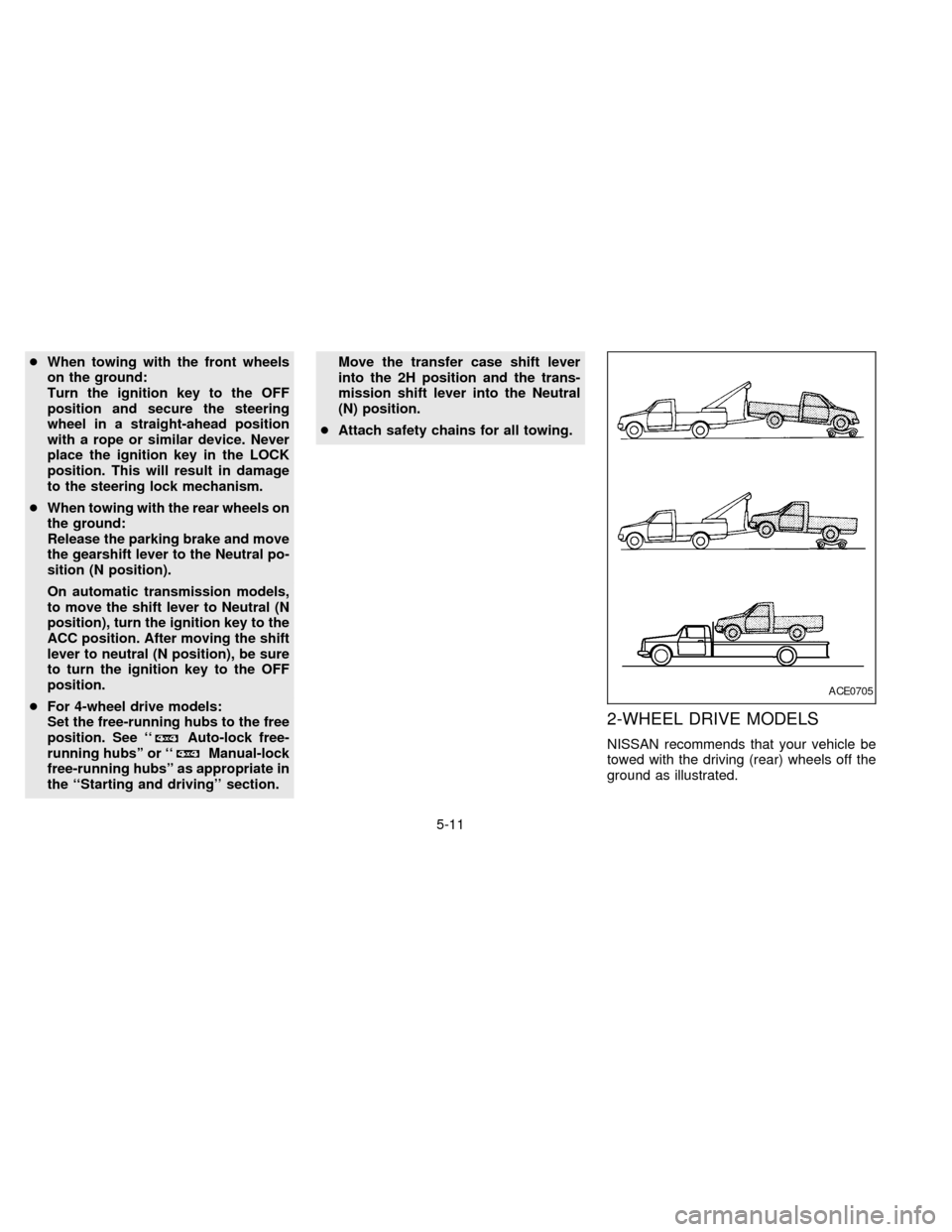
2-WHEEL DRIVE MODELS
NISSAN recommends that your vehicle be
towed with the driving (rear) wheels off the
ground as illustrated.
ACE0705
5-11
ZX
Page 121 of 204
CAUTION
If you have to tow your vehicle with four
wheels on the ground or with front
wheels raised (with rear wheels on the
ground), observe the following re-
stricted towing speeds and distances:
Automatic transmission model:
cSpeed: Below 30 MPH (48 km/h)
cDistance: Less than 40 miles (64 km)
Manual transmission model:
cSpeed: Below 60 MPH (97 km/h)
cDistance: Less than 500 miles (805
km)
If the speed or distance must necessarily be
greater, remove the propeller shaft before-
hand to prevent damage to the transmis-
sion.
CAUTION
Never tow your vehicle from the rear
(i.e., backward) with four wheels on the
ground, as this may cause serious and
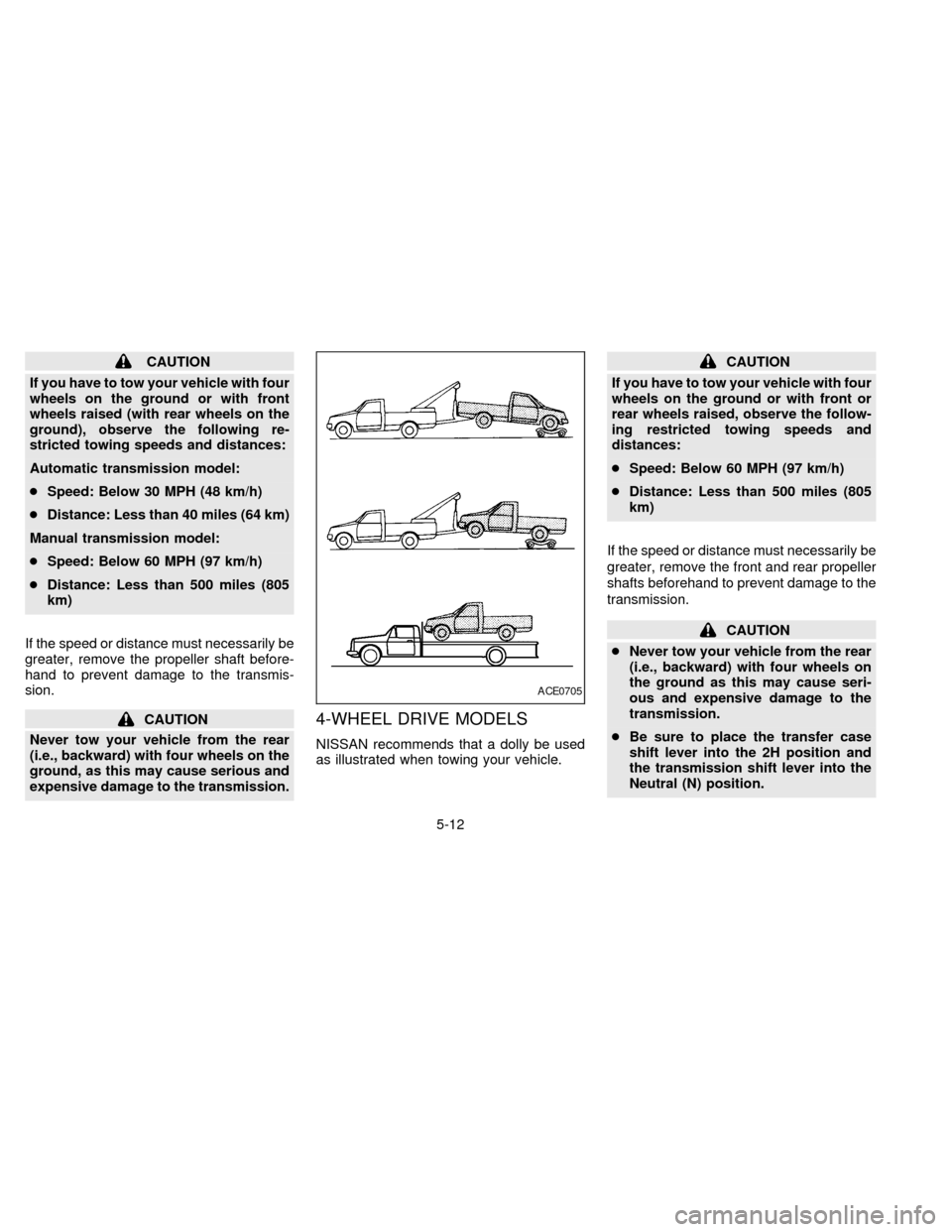
expensive damage to the transmission.4-WHEEL DRIVE MODELS
NISSAN recommends that a dolly be used
as illustrated when towing your vehicle.
CAUTION
If you have to tow your vehicle with four
wheels on the ground or with front or
rear wheels raised, observe the follow-
ing restricted towing speeds and
distances:
cSpeed: Below 60 MPH (97 km/h)
cDistance: Less than 500 miles (805
km)
If the speed or distance must necessarily be
greater, remove the front and rear propeller
shafts beforehand to prevent damage to the
transmission.
CAUTION
cNever tow your vehicle from the rear
(i.e., backward) with four wheels on
the ground as this may cause seri-
ous and expensive damage to the
transmission.
cBe sure to place the transfer case
shift lever into the 2H position and
the transmission shift lever into the
Neutral (N) position.
ACE0705
5-12
ZX