Page 3472 of 4133
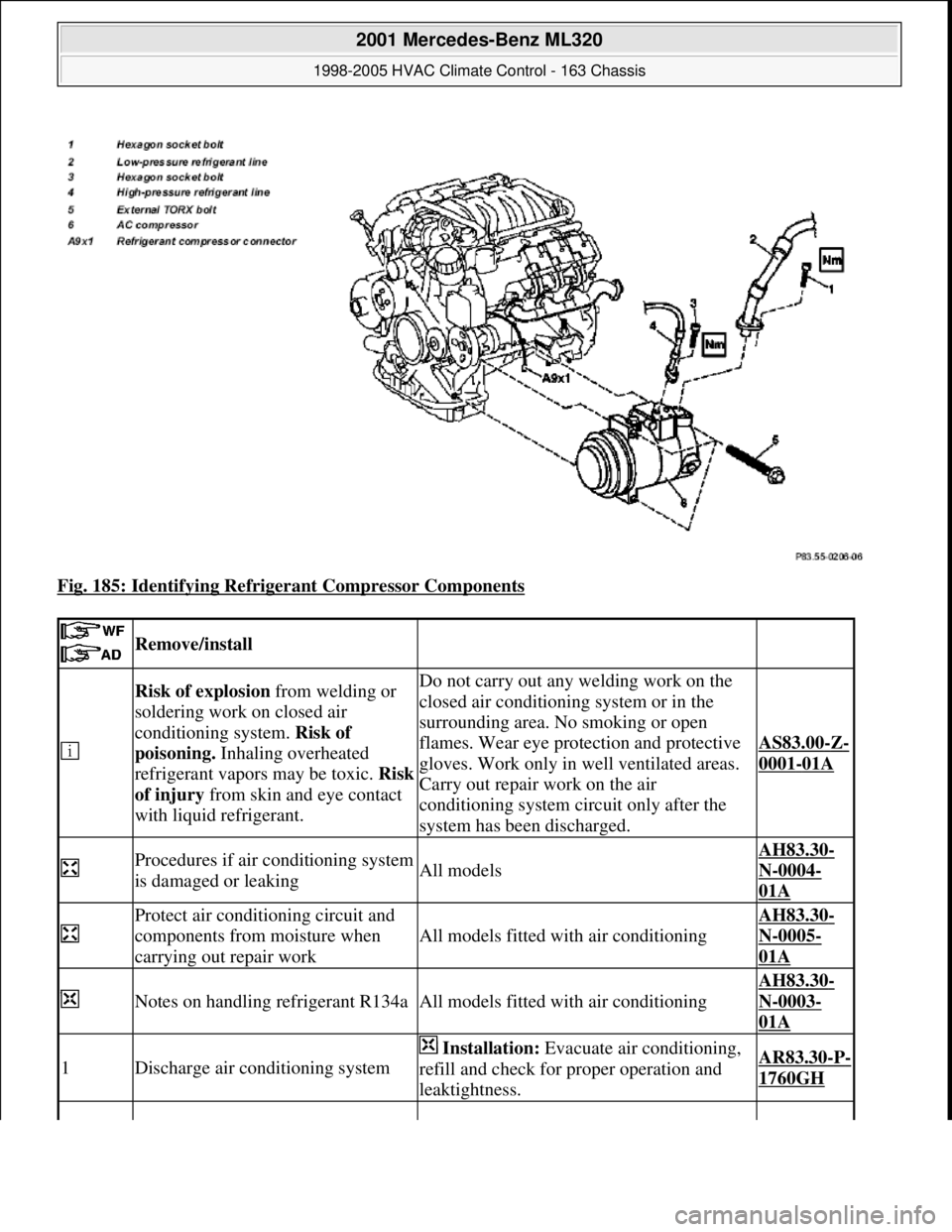
Fig. 185: Identifying Refrigerant Compressor Components
Remove/install
Risk of explosion from welding or
soldering work on closed air
conditioning system. Risk of
poisoning. Inhaling overheated
refrigerant vapors may be toxic. Risk
of injury from skin and eye contact
with liquid refrigerant.Do not carry out any welding work on the
closed air conditioning system or in the
surrounding area. No smoking or open
flames. Wear eye protection and protective
gloves. Work only in well ventilated areas.
Carry out repair work on the air
conditioning system circuit only after the
system has been discharged.
AS83.00-Z-
0001-01A
Procedures if air conditioning system
is damaged or leakingAll models
AH83.30-
N-0004-
01A
Protect air conditioning circuit and
components from moisture when
carrying out repair work
All models fitted with air conditioning
AH83.30-
N-0005-
01A
Notes on handling refrigerant R134aAll models fitted with air conditioning
AH83.30-
N-0003-
01A
1Discharge air conditioning system
Installation: Evacuate air conditioning,
refill and check for proper operation and
leaktightness.AR83.30-P-
1760GH
2001 Mercedes-Benz ML320
1998-2005 HVAC Climate Control - 163 Chassis
me
Saturday, October 02, 2010 3:23:19 PMPage 228 © 2006 Mitchell Repair Information Company, LLC.
Page 3594 of 4133

MODEL all
CLEAN INSTRUMENT CLUSTER, STEERING WHEEL AND GEARSHIFT LEVER (STANDARD VERSION) - AP68.10-P-
1000-01A
all
Work procedure
Wipe off with moist, lent-free rag.
Do not use scouring agent to prevent scratching surfaces.
Do not bring Plexiglas cover on instrument cluster and Mercedes Star in steering wheel into contact with
solvent or cleaning agents containing solvents (danger of tension cracking).
Do not apply liquids to Plexiglas cover on instrument cluster.
Repair materials
Cleaning vehicle headliners of textile material (prefabricated headliners), floor
coverings, rear shelf coverings, and other textiles AP68.00-P-
1000-01A
Cleaning synthetic leather vehicle headliners (tensioned headliners) AP68.00-P-
1000-02A
Cleaning seat belts AP91.40-P-
1000-01A
Cleaning instrument cluster, steering wheel and gearshift lever (standard version) AP68.10-P-
1000-01A
Cleaning leather upholstery, leather steering wheel, and leather gearshift lever AP91.18-P-
1000-01A
Cleaning plastic covering parts AP68.30-P-
1000-01A
Cleaning MB Tex upholstery AP91.18-P-
1000-02A
Cleaning fabric upholstery AP91.18-P-
1000-03A
Cleaning velours upholstery AP91.18-P-
1000-04A
Cleaning amaretta upholstery AP91.18-P-
1000-05A
NumberDesignationOrder number
BR00.45-Z-1002-04ACar shampooA 001 986 41 71
2001 Mercedes-Benz ML320
1998-2005 ACCESSORIES & BODY, CAB Interior Equipment - 163 Chassis
me
Saturday, October 02, 2010 3:35:22 PMPage 76 © 2006 Mitchell Repair Information Company, LLC.
Page 3602 of 4133
GF54.30-P-3015A
Liquid crystal display (LCD), location/task/function
7.7.99
MODEL
129, 140 as of 1.6.96,
163, 168, 170,
202 as of 1.8.96,
208,
210 as of 1.6.96,
215, 220
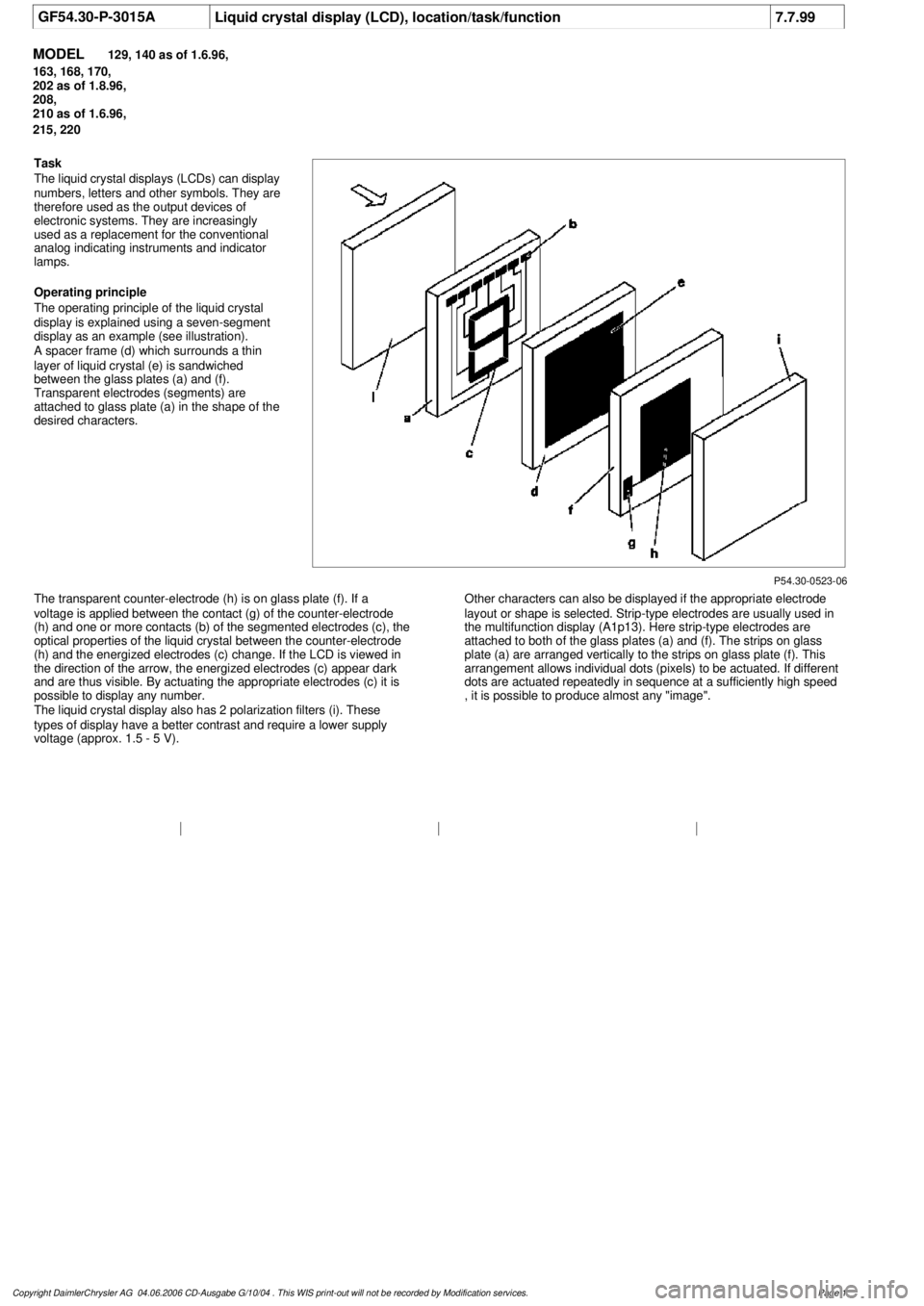
P54.30-0523-06
Task
The liquid crystal displays (LCDs) can display
numbers, letters and other symbols. They are
therefore used as the output devices of
electronic systems. They are increasingly
used as a replacement for the conventional
analog indicating instruments and indicator
lamps.
Operating principle
The operating principle of the liquid crystal
display is explained using a seven-segment
display as an example (see illustration).
A spacer frame (d) which surrounds a thin
layer of liquid crystal (e) is sandwiched
between the glass plates (a) and (f).
Transparent electrodes (segments) are
attached to glass plate (a) in the shape of the
desired characters.
The transparent counter-electrode (h) is on glass plate (f). If a
voltage is applied between the contact (g) of the counter-electrode
(h) and one or more contacts (b) of the segmented electrodes (c), the
optical properties of the liquid crystal between the counter-electrode
(h) and the energized electrodes (c) change. If the LCD is viewed in
the direction of the arrow, the energized electrodes (c) appear dark
and are thus visible. By actuating the appropriate electrodes (c) it is
possible to display any number.
The liquid crystal display also has 2 polarization filters (i). These
types of display have a better contrast and require a lower supply
voltage (approx. 1.5 - 5 V).
Other characters can also be displayed if the appropriate electrode
layout or shape is selected. Strip-type electrodes are usually used in
the multifunction display (A1p13). Here strip-type electrodes are
attached to both of the glass plates (a) and (f). The strips on glass
plate (a) are arranged vertically to the strips on glass plate (f). This
arrangement allows individual dots (pixels) to be actuated. If different
dots are actuated repeatedly in sequence at a sufficiently high speed
, it is possible to produce almost any "image".
Copyright DaimlerChrysler AG 04.06.2006 CD-Ausgabe G/10/04 . This WIS print-out will not be recorde
d by Modification services.
Page 1