1997 MERCEDES-BENZ ML320 width
[x] Cancel search: widthPage 1452 of 4133

The aim of using the torque converter lockup clutch is to reduce the fuel consumption and exhaust gas
emissions of the vehicle by reducing torque converter slip. See Fig. 159
. This stands in contradiction to the ride
comfort demands made on the drive train with regard to its vibration behavior. The task of the electronic
transmission control is therefore to close the clutch in all driving situations relevant to fuel consumption, if
possible, and ensure that the engine vibrations are isolated from the drive train.
The characteristic curves shown in the diagram illustrate the different operating states of the torque converter
lockup clutch in relation to the accelerator pedal position and transmission output speed, plotted for one
transmission gear.
In addition to the evaluation of these characteristics, the status of the torque converter lockup clutch is also
determined by other variables.
Variables influencing the states of the torque converter lockup clutch:
Accelerator Pedal Movement
Uphill And Down Hill Gradients
Transmission Shift Functions
ATF Temperature
Durability Requirements
Load Condition
Engine Control Influences
Torque Converter Lockup Clutch Control Pressure, Function
See TORQUE CONVERTER LOCKUP CLUTCH CONTROL PRESSURE, FUNCTION
.
Torque Converter Lockup Clutch Control Pressure, Function
Apart from extreme states of open or closed, it is possible to operate the torque converter lockup clutch with
preset slip speeds. To enable this variable control pressure must be applied to the torque converter lockup clutch
regulating valve.
The torque converter lockup clutch control pressure is adapted to each operating state via the pulse-width
modulated torque converter lockup solenoid valve (Y3/6y6) which is actuated by the ETC control unit (N15/3).
Torque Converter Lockup Clutch PWM Solenoid Valve, Location/Task/Design/Function
See LOCATION/TASK/DESIGN/FUNCTION OF PWM SOLENOID VALVE, TORQUE
CONVERTER LOCKUP CLUTCH.
Torque Converter Lockup Clutch, Location/Task/Design/Function
See TORQUE CONVERTER LOCK
-UP CLUTCH, LOCATION/TASK/DESIGN/FUNCTION.
Torque Converter Lockup Clutch Regulating Valve, Location/Task/Function
2001 Mercedes-Benz ML320
1998-03 AUTOMATIC TRANSMISSIONS Complete Transmissions - ML 320 - 722.662
me
Saturday, October 02, 2010 3:15:29 PMPage 283 © 2006 Mitchell Repair Information Company, LLC.
Page 1852 of 4133
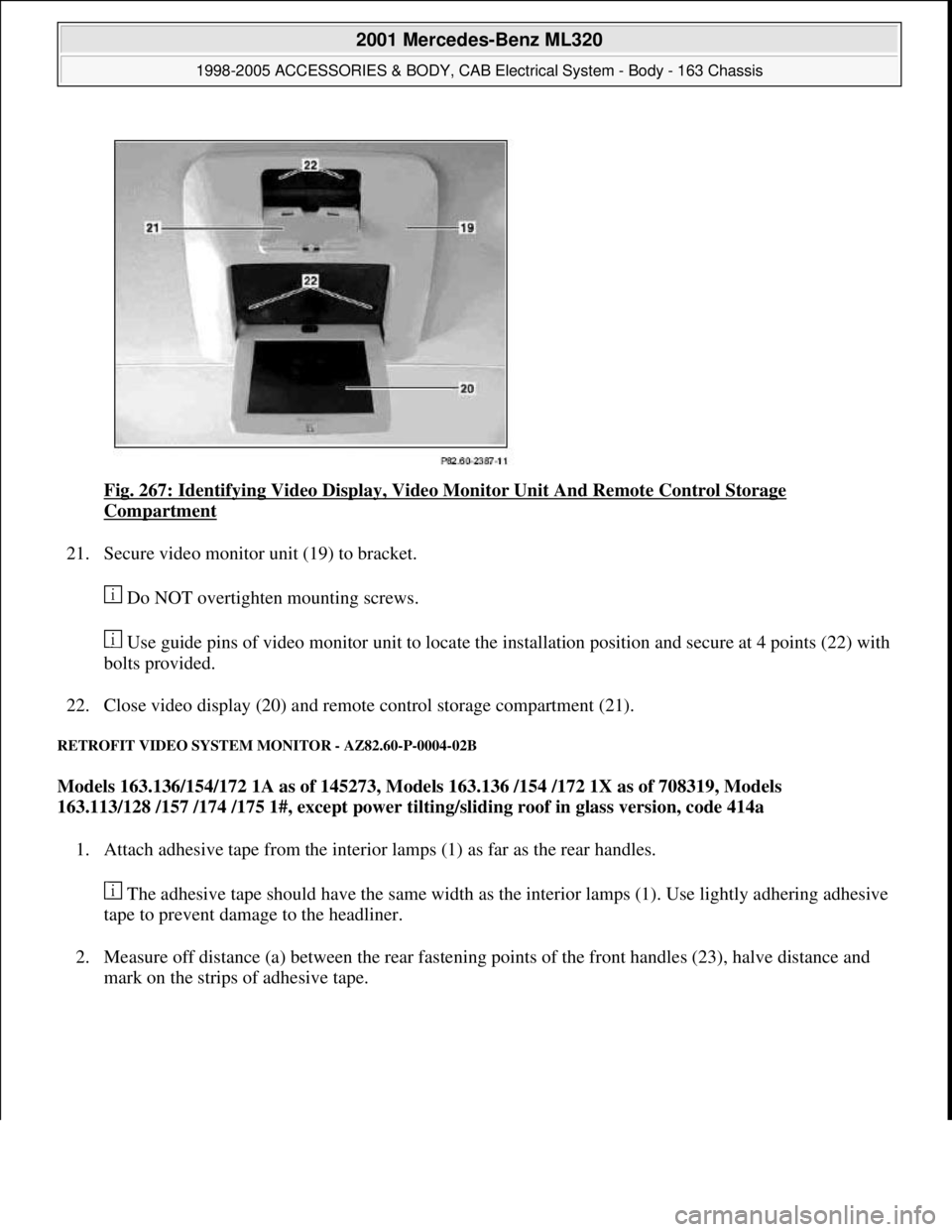
Fig. 267: Identifying Video Display, Video Monitor Unit And Remote Control Storage
Compartment
21. Secure video monitor unit (19) to bracket.
Do NOT overtighten mounting screws.
Use guide pins of video monitor unit to locate the installation position and secure at 4 points (22) with
bolts provided.
22. Close video display (20) and remote control storage compartment (21).
RETROFIT VIDEO SYSTEM MONITOR - AZ82.60-P-0004-02B
Models 163.136/154/172 1A as of 145273, Models 163.136 /154 /172 1X as of 708319, Models
163.113/128 /157 /174 /175 1#, except power tilting/sliding roof in glass version, code 414a
1. Attach adhesive tape from the interior lamps (1) as far as the rear handles.
The adhesive tape should have the same width as the interior lamps (1). Use lightly adhering adhesive
tape to prevent damage to the headliner.
2. Measure off distance (a) between the rear fastening points of the front handles (23), halve distance and
mark on the strips of adhesive tape.
2001 Mercedes-Benz ML320
1998-2005 ACCESSORIES & BODY, CAB Electrical System - Body - 163 Chassis
me
Saturday, October 02, 2010 3:30:11 PMPage 357 © 2006 Mitchell Repair Information Company, LLC.
Page 1864 of 4133
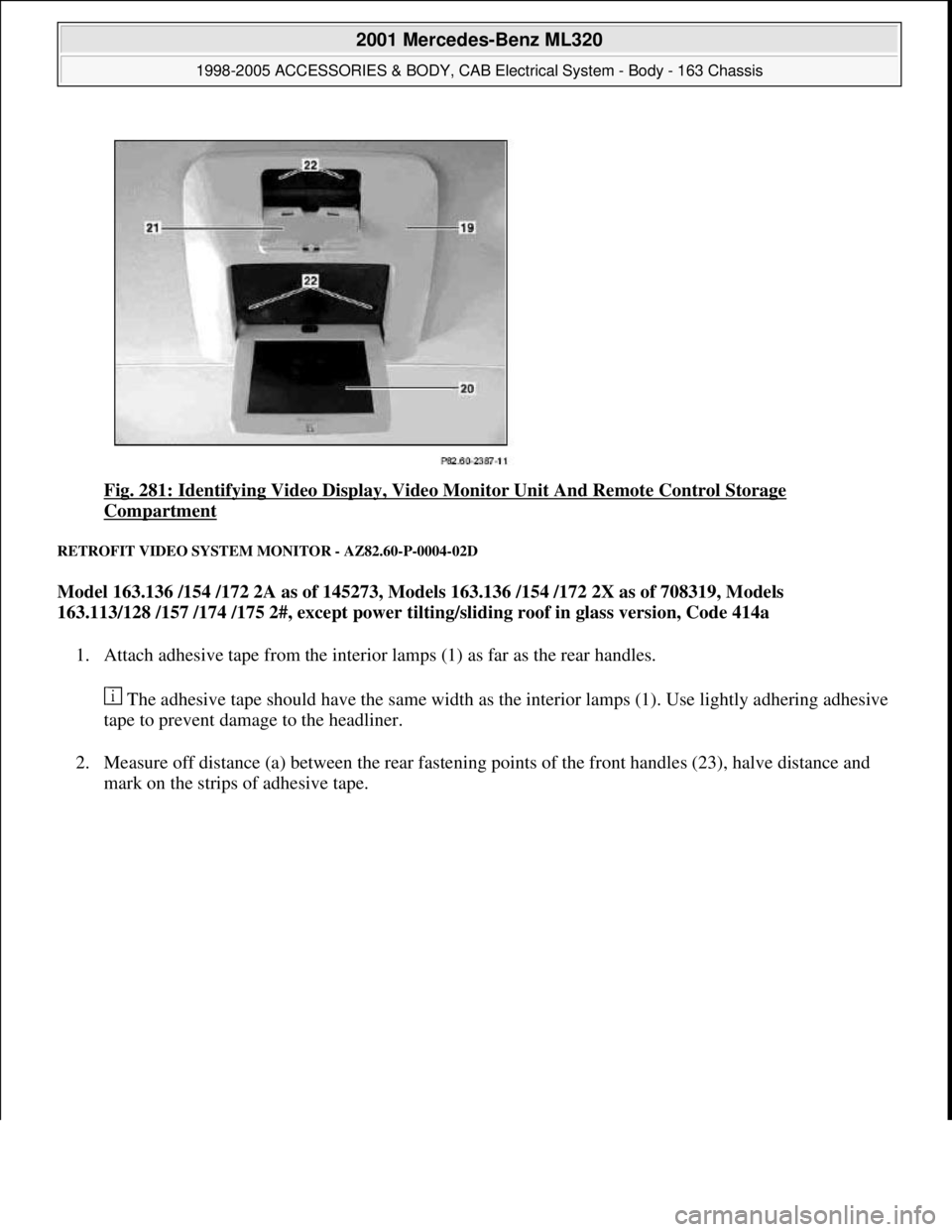
Fig. 281: Identifying Video Display, Video Monitor Unit And Remote Control Storage
Compartment
RETROFIT VIDEO SYSTEM MONITOR - AZ82.60-P-0004-02D
Model 163.136 /154 /172 2A as of 145273, Models 163.136 /154 /172 2X as of 708319, Models
163.113/128 /157 /174 /175 2#, except power tilting/sliding roof in glass version, Code 414a
1. Attach adhesive tape from the interior lamps (1) as far as the rear handles.
The adhesive tape should have the same width as the interior lamps (1). Use lightly adhering adhesive
tape to prevent damage to the headliner.
2. Measure off distance (a) between the rear fastening points of the front handles (23), halve distance and
mark on the strips of adhesive tape.
2001 Mercedes-Benz ML320
1998-2005 ACCESSORIES & BODY, CAB Electrical System - Body - 163 Chassis
me
Saturday, October 02, 2010 3:30:11 PMPage 369 © 2006 Mitchell Repair Information Company, LLC.
Page 2162 of 4133
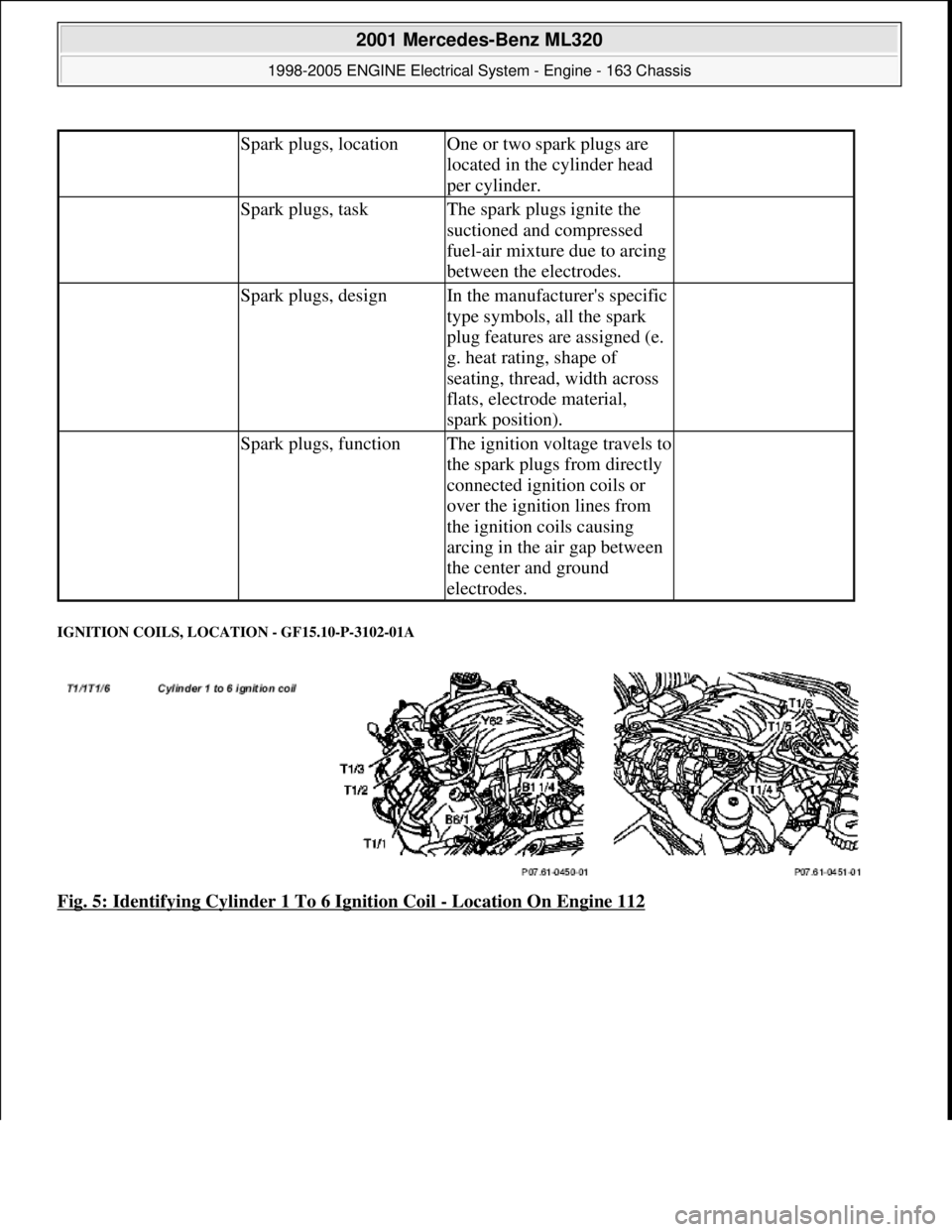
IGNITION COILS, LOCATION - GF15.10-P-3102-01A
Fig. 5: Identifying Cylinder 1 To 6 Ignition Coil - Location On Engine 112
Spark plugs, locationOne or two spark plugs are
located in the cylinder head
per cylinder.
Spark plugs, taskThe spark plugs ignite the
suctioned and compressed
fuel-air mixture due to arcing
between the electrodes.
Spark plugs, designIn the manufacturer's specific
type symbols, all the spark
plug features are assigned (e.
g. heat rating, shape of
seating, thread, width across
flats, electrode material,
spark position).
Spark plugs, functionThe ignition voltage travels to
the spark plugs from directly
connected ignition coils or
over the ignition lines from
the ignition coils causing
arcing in the air gap between
the center and ground
electrodes.
2001 Mercedes-Benz ML320
1998-2005 ENGINE Electrical System - Engine - 163 Chassis
me
Saturday, October 02, 2010 3:18:54 PMPage 8 © 2006 Mitchell Repair Information Company, LLC.
Page 2353 of 4133
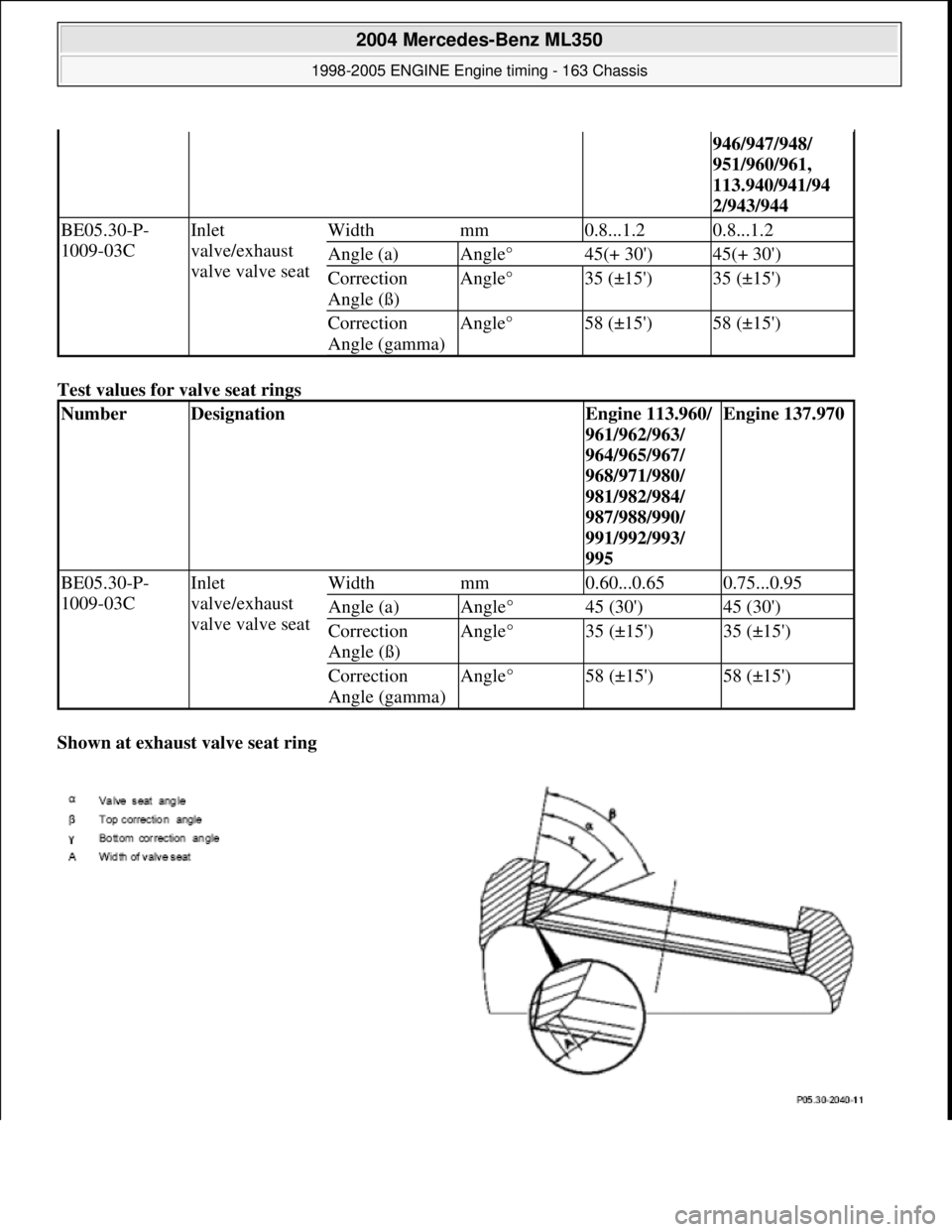
Test values for valve seat rings
Shown at exhaust valve seat ring
946/947/948/
951/960/961,
113.940/941/94
2/943/944
BE05.30-P-
1009-03CInlet
valve/exhaust
valve valve seatWidthmm0.8...1.20.8...1.2
Angle (a)Angle°45(+ 30')45(+ 30')
Correction
Angle (ß)Angle°35 (±15')35 (±15')
Correction
Angle (gamma)Angle°58 (±15')58 (±15')
NumberDesignationEngine 113.960/
961/962/963/
964/965/967/
968/971/980/
981/982/984/
987/988/990/
991/992/993/
995Engine 137.970
BE05.30-P-
1009-03CInlet
valve/exhaust
valve valve seatWidthmm0.60...0.650.75...0.95
Angle (a)Angle°45 (30')45 (30')
Correction
Angle (ß)Angle°35 (±15')35 (±15')
Correction
Angle (gamma)Angle°58 (±15')58 (±15')
2004 Mercedes-Benz ML350
1998-2005 ENGINE Engine timing - 163 Chassis
me
Saturday, October 02, 2010 3:39:39 PMPage 112 © 2006 Mitchell Repair Information Company, LLC.
Page 2355 of 4133
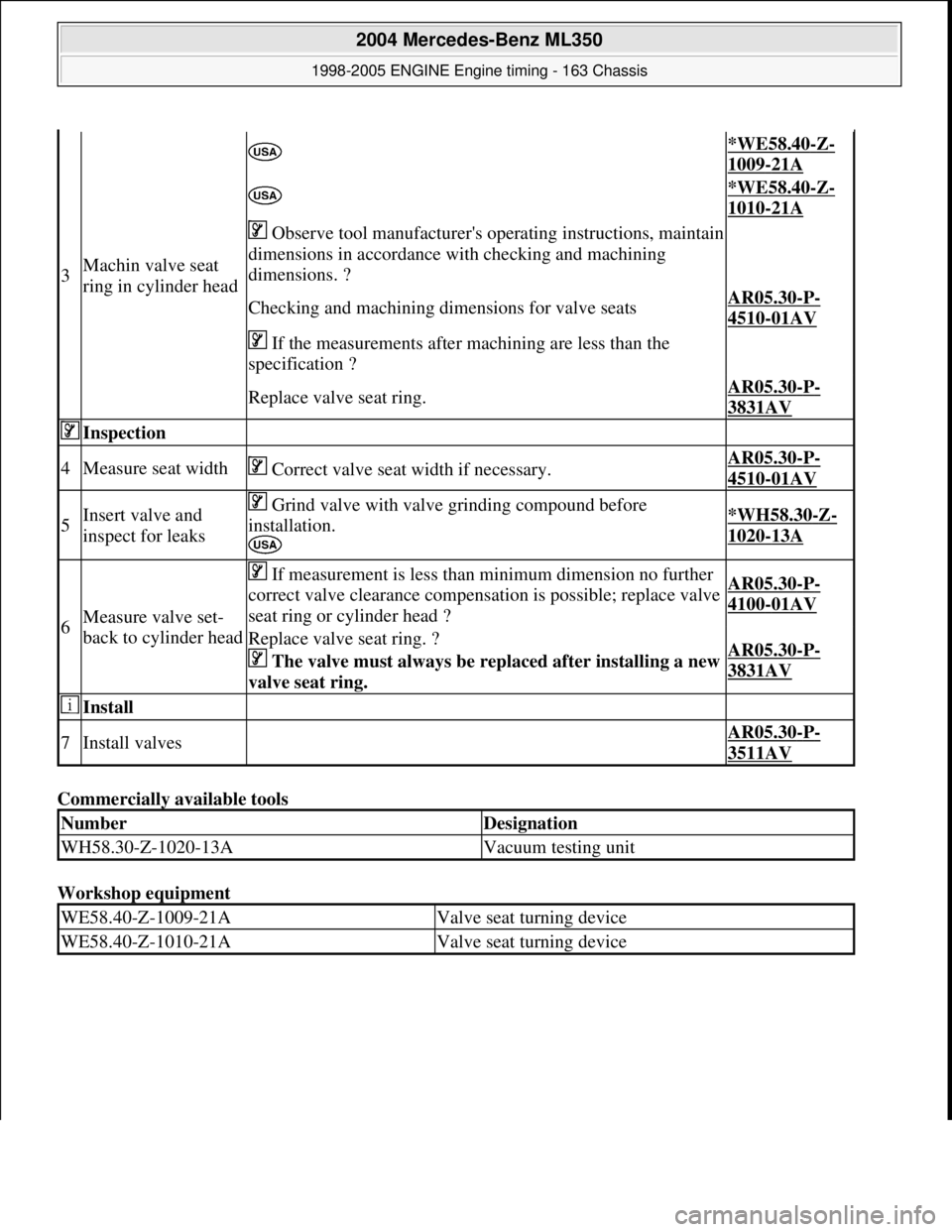
Commercially available tools
Workshop equipment
3Machin valve seat
ring in cylinder head
*WE58.40-Z-
1009-21A
*WE58.40-Z-
1010-21A
Observe tool manufacturer's operating instructions, maintain
dimensions in accordance with checking and machining
dimensions. ?
Checking and machining dime nsions for valve seatsAR05.30-P-
4510-01AV
If the measurements after machining are less than the
specification ?
Replace valve seat ring.AR05.30-P-
3831AV
Inspection
4Measure seat width Correct valve seat width if necessary.AR05.30-P-
4510-01AV
5Insert valve and
inspect for leaks Grind valve with valve grinding compound before
installation.
*WH58.30-Z-
1020-13A
6Measure valve set-
back to cylinder head
If measurement is less than minimum dimension no further
correct valve clearance compensation is possible; replace valve
seat ring or cylinder head ?AR05.30-P-
4100-01AV
Replace valve seat ring. ?
The valve must always be rep laced after installing a new
valve seat ring. AR05.30-P-
3831AV
Install
7Install valves AR05.30-P-
3511AV
NumberDesignation
WH58.30-Z-1020-13AVacuum testing unit
WE58.40-Z-1009-21AValve seat turning device
WE58.40-Z-1010-21AValve seat turning device
2004 Mercedes-Benz ML350
1998-2005 ENGINE Engine timing - 163 Chassis
me
Saturday, October 02, 2010 3:39:39 PMPage 114 © 2006 Mitchell Repair Information Company, LLC.
Page 2461 of 4133
1002-01M
*BA20.10-P-
1003-01C
*BA20.10-P-
1003-01M
*BA20.10-P-
1004-01C
*BA20.10-P-
1004-01M
*BA46.30-P-
1010-01A
*BA46.30-P-
1010-01C
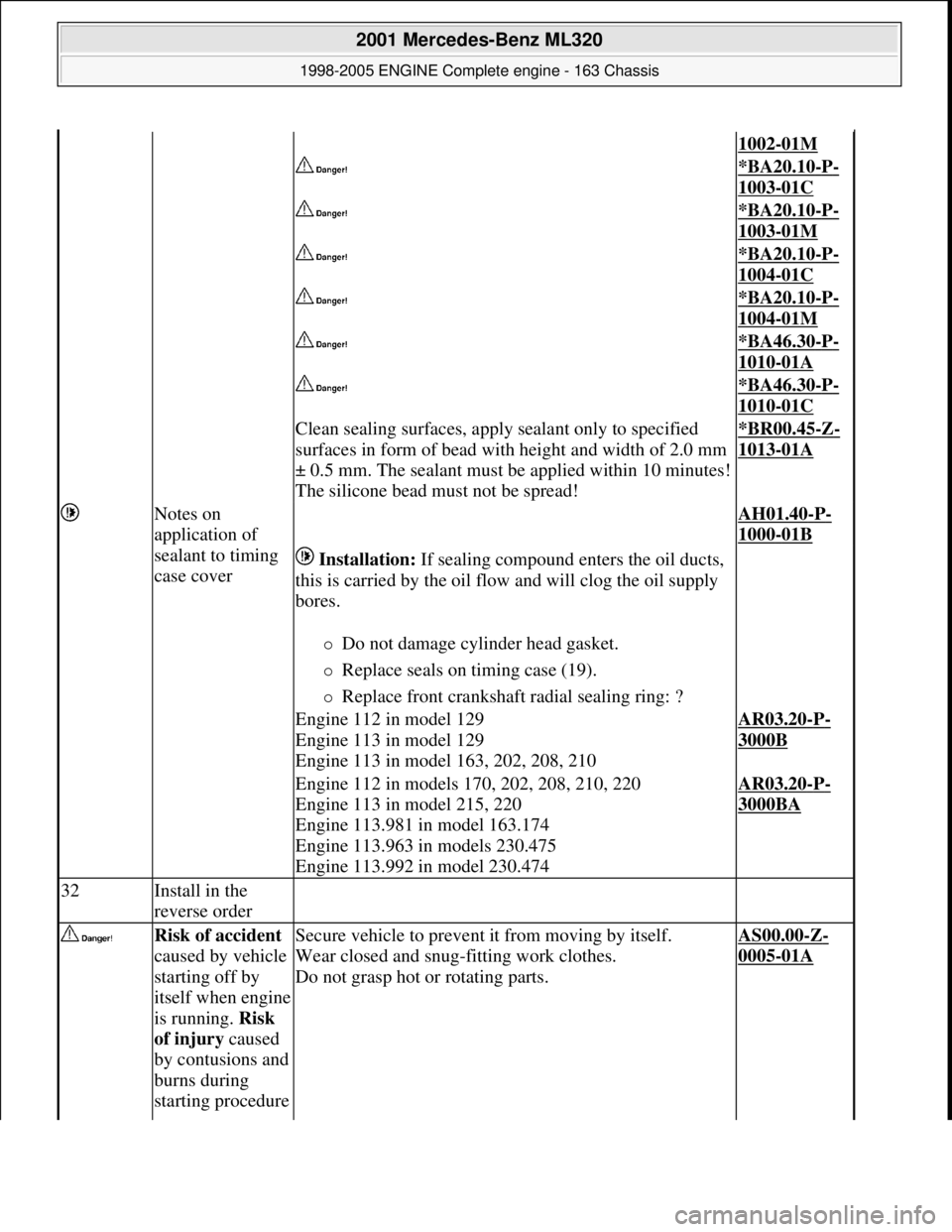
Clean sealing surfaces, appl y sealant only to specified
surfaces in form of bead with height and width of 2.0 mm
± 0.5 mm. The sealant must be applied within 10 minutes!
The silicone bead must not be spread!*BR00.45-Z-
1013-01A
Notes on
application of
sealant to timing
case cover AH01.40-P-
1000-01B
Installation: If sealing compound enters the oil ducts,
this is carried by the oil flow and will clog the oil supply
bores.
Do not damage cylinder head gasket.
Replace seals on ti ming case (19).
Replace front crankshaft radial sealing ring: ?
Engine 112 in model 129
Engine 113 in model 129
Engine 113 in model 163, 202, 208, 210AR03.20-P-
3000B
Engine 112 in models 170, 202, 208, 210, 220
Engine 113 in model 215, 220
Engine 113.981 in model 163.174
Engine 113.963 in models 230.475
Engine 113.992 in model 230.474AR03.20-P-
3000BA
32Install in the
reverse order
Risk of accident
caused by vehicle
starting off by
itself when engine
is running. Risk
of injury caused
by contusions and
burns during
starting procedure
Secure vehicle to prevent it from moving by itself.
Wear closed and snug-fitting work clothes.
Do not grasp hot or rotating parts.AS00.00-Z-
0005-01A
2001 Mercedes-Benz ML320
1998-2005 ENGINE Complete engine - 163 Chassis
me
Saturday, October 02, 2010 3:17:57 PMPage 105 © 2006 Mitchell Repair Information Company, LLC.
Page 2842 of 4133
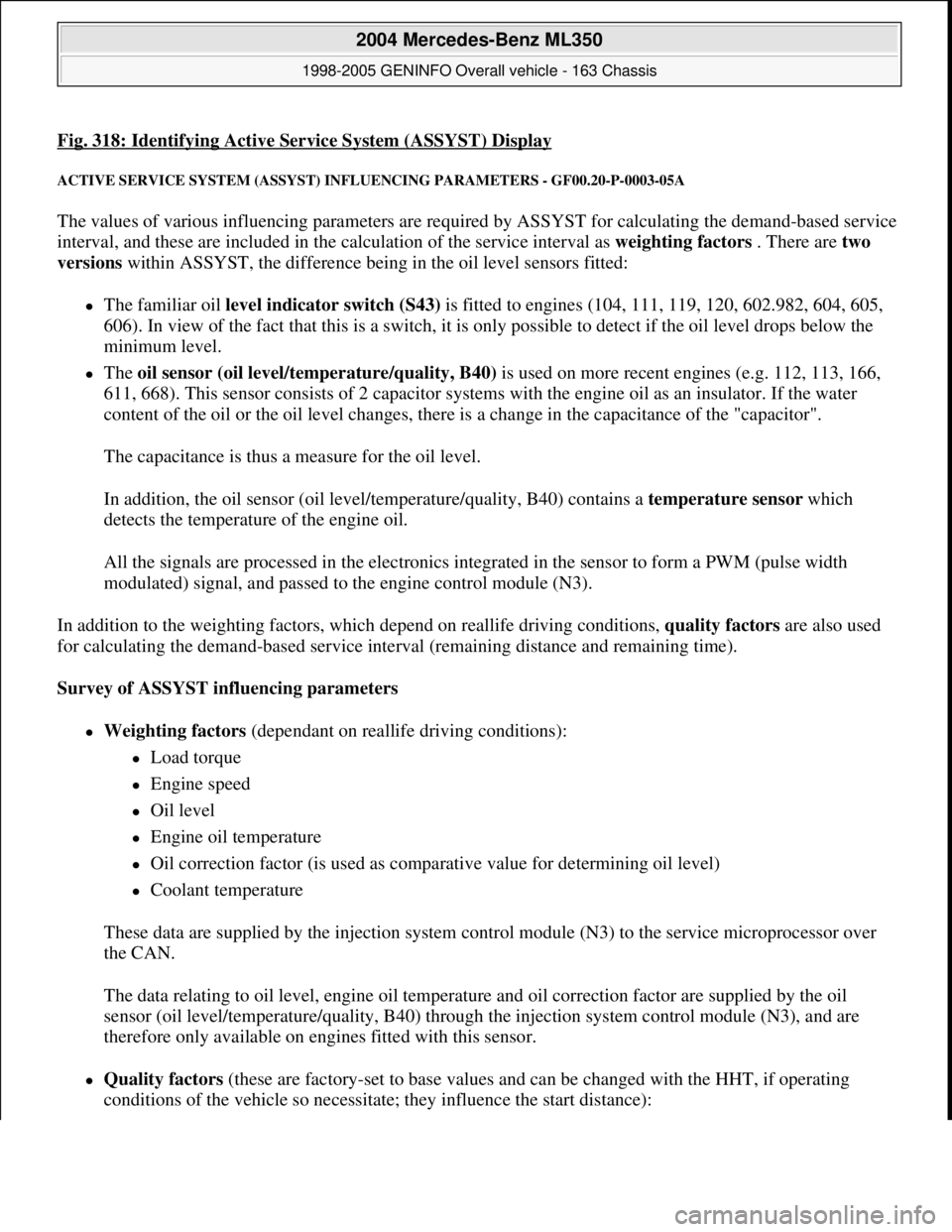
Fig. 318: Identifying Active Service System (ASSYST) Display
ACTIVE SERVICE SYSTEM (ASSYST) INFLUENCING PARAMETERS - GF00.20-P-0003-05A
The values of various influencing parameters are required by ASSYST for calculating the demand-based service
interval, and these are included in the calculation of the service interval as weighting factors . There are two
versions within ASSYST, the difference being in the oil level sensors fitted:
The familiar oil level indicator switch (S43) is fitted to engines (104, 111, 119, 120, 602.982, 604, 605,
606). In view of the fact that this is a switch, it is only possible to detect if the oil level drops below the
minimum level.
The oil sensor (oil level/temperature/quality, B40) is used on more recent engines (e.g. 112, 113, 166,
611, 668). This sensor consists of 2 capacitor systems with the engine oil as an insulator. If the water
content of the oil or the oil level changes, there is a change in the capacitance of the "capacitor".
The capacitance is thus a measure for the oil level.
In addition, the oil sensor (oil level/temperature/quality, B40) contains a temperature sensor which
detects the temperature of the engine oil.
All the signals are processed in the electronics integrated in the sensor to form a PWM (pulse width
modulated) signal, and passed to the engine control module (N3).
In addition to the weighting factors, which depend on reallife driving conditions, quality factors are also used
for calculating the demand-based service interval (remaining distance and remaining time).
Survey of ASSYST influencing parameters
Weighting factors (dependant on reallife driving conditions):
Load torque
Engine speed
Oil level
Engine oil temperature
Oil correction factor (is used as comparative value for determining oil level)
Coolant temperature
These data are supplied by the injection system control module (N3) to the service microprocessor over
the CAN.
The data relating to oil level, engine oil temperature and oil correction factor are supplied by the oil
sensor (oil level/temperature/quality, B40) through the injection system control module (N3), and are
therefore only available on engines fitted with this sensor.
Quality factors (these are factory-set to base values and can be changed with the HHT, if operating
conditions of the vehicle so necessitate; they influence the start distance):
2004 Mercedes-Benz ML350
1998-2005 GENINFO Overall vehicle - 163 Chassis
me
Saturday, October 02, 2010 3:47:47 PMPage 197 © 2006 Mitchell Repair Information Company, LLC.