1997 MAZDA MIATA service
[x] Cancel search: servicePage 304 of 514
Fig. 1: Exploded View Of Heater Unit
Courtesy of MAZDA MOTORS CORP.
ADJUSTMENTS
AIRFLOW MODE DOOR
Set airflow mode control lever at vent position. Disconnect control cable at airflow mode door lever. See Fig.
1 . Extend airflow mode door lever until it stops. Attach control cable to door lever. Secure cable using clip.
Ensure control lever slides freely between defrost and vent positions.
AIR-MIX (TEMPERATURE BLEND) DOOR
Set temperature control lever at maximum hot setting. Disconnect control cable at air-mix door lever. See Fig.
1 . Extend air-mix door lever until it stops. Attach control cable to door lever. Secure cable using clip. Ensure
control lever slides freely between hot and cold settings.
FRESH/RECIRCULATED AIR DOOR
Set fresh/recirculated air control lever at fresh air setting. Disconnect control cable at fresh/recirculated air door
lever. Retract recirculated/fresh air door lever until it stops. Attach control cable to door lever. Secure cable
using clip. Ensure control lever slides freely between recirculated air and fresh air settings.
TESTING
BLOWER MOTOR CIRCUIT
1. Check 30-amp HEATER fuse in passenger compartment fuse block. If fuse is okay, go to next step. If
fuse is burnt, check for short circuit in wiring harness and repair as necessary. Replace fuse.
2. Turn ignition on. Turn blower switch to 4th position (high). Using voltmeter, backprobe Blue wire
terminal of blower motor connector on bottom of blower case. If battery voltage exists, go to next step. If
battery voltage is not present, repair wiring harness between circuit breaker or fuse and blower motor.
3. Ensure ignition is on. Backprobe Blue wire terminal of blower resistor 1-pin connector. If battery voltage
exists, go to next step. If battery voltage is not present, replace blower motor.
4. Backprobe Blue/White wire terminal, Blue/Red wire terminal, Blue/Green wire terminal and Blue/Yellow
wire terminal of blower resistor 4-pin connector. If battery voltage exists, go to next step. If battery
voltage is not present at any terminal, replace blower resistor.
5. Turn blower switch to 4th position (high). Backprobe Black wire terminal of blower switch connector. If
battery voltage is not present, go to next step. If battery voltage exists, repair Black wire between blower
switch and chassis
ground. WARNING:To avoid injury from accidental air bag deployment, read and follow all
SERVICE PRECAUTIONS and DISABLING & ACTIVATING AIR BAG
SYSTEM procedures in AIR BAG RESTRAINT SYSTEM article in the
ACCESSORIES/SAFETY EQUIPMENT section.
1997 Mazda MX-5 Miata
HEATER SYSTEM 1997 Heater System
Microsoft
Sunday, July 05, 2009 1:46:56 PMPage 2 © 2005 Mitchell Repair Information Company, LLC.
Page 306 of 514
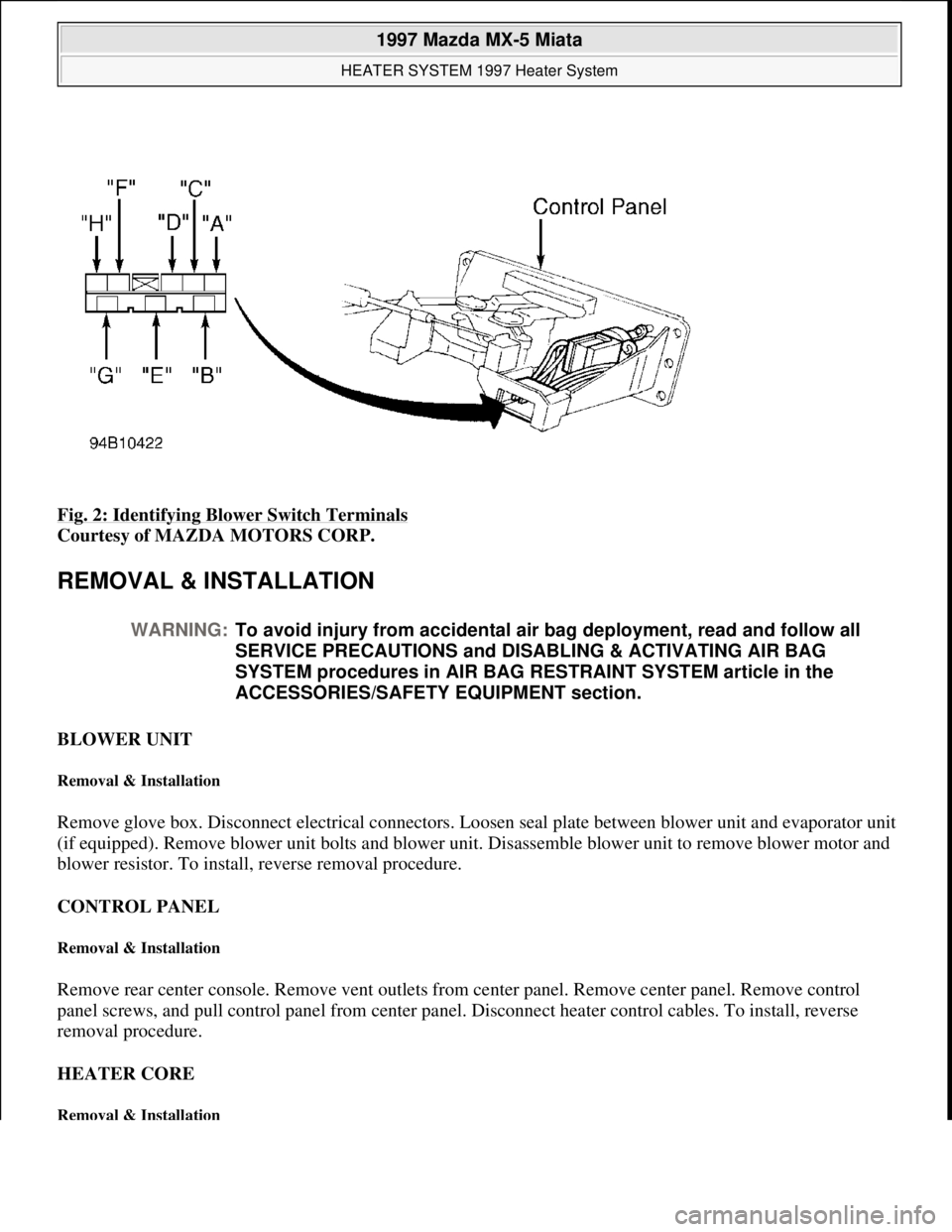
Fig. 2: Identifying Blower Switch Terminals
Courtesy of MAZDA MOTORS CORP.
REMOVAL & INSTALLATION
BLOWER UNIT
Removal & Installation
Remove glove box. Disconnect electrical connectors. Loosen seal plate between blower unit and evaporator unit
(if equipped). Remove blower unit bolts and blower unit. Disassemble blower unit to remove blower motor and
blower resistor. To install, reverse removal procedure.
CONTROL PANEL
Removal & Installation
Remove rear center console. Remove vent outlets from center panel. Remove center panel. Remove control
panel screws, and pull control panel from center panel. Disconnect heater control cables. To install, reverse
removal procedure.
HEATER CORE
Removal & Installation
WARNING:To avoid injury from accidental air bag deployment, read and follow all
SERVICE PRECAUTIONS and DISABLING & ACTIVATING AIR BAG
SYSTEM procedures in AIR BAG RESTRAINT SYSTEM article in the
ACCESSORIES/SAFETY EQUIPMENT section.
1997 Mazda MX-5 Miata
HEATER SYSTEM 1997 Heater System
Microsoft
Sunday, July 05, 2009 1:46:56 PMPage 4 © 2005 Mitchell Repair Information Company, LLC.
Page 310 of 514
A/C-HEATER SYSTEM - MANUAL
1997 Manual A/C-Heater System
A/C SYSTEM SPECIFICATIONS
A/C SYSTEM SPECIFICATIONS
DESCRIPTION
Blower assembly, mounted under right side of instrument panel, contains blower motor, blower resistor and
fresh/recirculated air door. Evaporator unit, located left of blower case, contains evaporator, evaporator
thermoswitch and expansion valve. Heater unit, located left of evaporator case, contains heater core, airflow
mode door and air-mix (temperature blend) door.
ELECTRICAL COMPONENT LOCATIONS WARNING:To avoid injury from accidental air bag deployment, read and follow all
SERVICE PRECAUTIONS and DISABLING & ACTIVATING AIR BAG
SYSTEM procedures in AIR BAG RESTRAINT SYSTEM article in the
ACCESSORIES/SAFETY EQUIPMENT section.
CAUTION: When battery is disconnected, radio will go into anti-theft protection
mode. Obtain radio anti-theft protection code from owner prior to
servicing vehicle.
ApplicationSpecifications
Compressor TypeNippondenso TV12 Rotary
Vane
Compressor Belt Deflection (1)
New5/16-23/64" (8-9 mm)
Used23/64-25/64" (9-10 mm)
Compressor Oil Capacity (2) 4.4-5.7 ozs.
Refrigerant Capacity21.2 ozs.
System Operating Pressures
High Side200-227 psi (14.0-16.0
kg/cm
2 )
Low Side22-35 psi (1.5-2.5
kg/cm
2 )
(1)Measure with 22-lb. (10 kg) pressure applied halfway between crankshaft pulley and Power Steering
(P/S) pulley or idler pulley (without P/S).
(2)Use ND-Oil 9 refrigerant oil.
1997 Mazda MX-5 Miata
A/C-HEATER SYSTEM - MANUAL 1997 Manual A/C-Heater System
1997 Mazda MX-5 Miata
A/C-HEATER SYSTEM - MANUAL 1997 Manual A/C-Heater System
Microsoft
Sunday, July 05, 2009 1:41:48 PMPage 1 © 2005 Mitchell Repair Information Company, LLC.
Microsoft
Sunday, July 05, 2009 1:41:59 PMPage 1 © 2005 Mitchell Repair Information Company, LLC.
Page 311 of 514

ELECTRICAL COMPONENT LOCATIONS
OPERATION
All air control doors are controlled manually by cable from control panel. Blower resistor determines blower
speed. With blower switch in high position, blower motor is grounded directly through blower switch. With
blower switch in all other positions, blower motor is grounded through blower resistor and blower switch.
A/C compressor clutch circuit is completed when A/C relay is energized and pressure switch is closed. A/C
relay is energized when Powertrain Control Module (PCM) grounds the solenoid circuit of the relay. The PCM
energizes A/C relay if evaporator thermoswitch is closed and A/C and blower switches are on. The PCM also
controls A/C relay operation according to engine load.
ADJUSTMENTS
TESTING
A/C SYSTEM PERFORMANCE
1. Connect manifold gauge set. Operate engine at 1500 RPM. Operate A/C at maximum cooling, recirculate,
fan on high, vent mode. Close all doors and windows. Place thermometer at center vent outlet.
2. Allow A/C to stabilize. Ensure high pressure is 200-227 psi (14.0-16.0 kg/cm
2 ). Read temperature at
center vent outlet. Ensure temperature is within 39-43°F (3-6°C)
A/C COMPRESSOR CLUTCH CIRCUIT
ComponentLocation
A/C RelayRight Front Corner Of Engine Compartment
Condenser FanRight Front Corner Of Engine Compartment
Blower ResistorBottom Of Blower Case
Evaporator ThermoswitchOn Evaporator Upper Case
Pressure SwitchIn High-Pressure Line, Between Receiver-Drier &
Evaporator
NOTE: For door control cable adjustments, see ADJUSTMENTS in HEATER SYSTEM
article.
WARNING:To avoid injury from accidental air bag deployment, read and follow all
SERVICE PRECAUTIONS and DISABLING & ACTIVATING AIR BAG
SYSTEM procedures in AIR BAG RESTRAINT SYSTEM article in the
ACCESSORIES/SAFETY EQUIPMENT section.
NOTE: For test procedures not covered in this article, see TESTING in HEATER
SYSTEM article.
1997 Mazda MX-5 Miata
A/C-HEATER SYSTEM - MANUAL 1997 Manual A/C-Heater System
Microsoft
Sunday, July 05, 2009 1:41:48 PMPage 2 © 2005 Mitchell Repair Information Company, LLC.
Page 316 of 514
COMPRESSOR
Removal & Installation
1. Before disconnecting negative battery cable, obtain radio anti-theft code from vehicle owner. Disconnect
negative battery cable.
2. Raise and support front of vehicle with safety stands. Discharge A/C system using approved refrigerant
recovery/recycling equipment. Remove splash shield and air guide.
3. Disconnect compressor clutch connector. Disconnect refrigerant lines from compressor, and plug open
fittings. Remove compressor drive belt. Remove compressor bolts and compressor. To install, reverse
removal procedure. Adjust drive belt deflection. Apply clean compressor oil to "O" ring before
connecting fittings. DO NOT apply compressor oil to fitting nuts. Evacuate and charge A/C system.
Check for leaks.
CONDENSER & RECEIVER-DRIER
Removal
Raise and support front of vehicle with safety stands. Discharge A/C system using approved refrigerant
recovery/recycling equipment. Remove splash shield and air guide. Remove condenser. Remove receiver-drier.
Plug open fittings.
Installation
To install, reverse removal procedure. Apply clean compressor oil to "O" rings before connecting fittings. DO
NOT apply compressor oil to fitting nuts. If installing new condenser, add 1.0 ounce of compressor oil to A/C
compressor. If installing new receiver-drier, add .3 ounce of compressor oil to A/C compressor. Evacuate and
charge A/C system. Check for leaks.
EVAPORATOR UNIT
Removal
1. Discharge A/C system using approved refrigerant recovery/recycling equipment. Disconnect refrigerant
pipes from evaporator tubes at engine compartment firewall and plug open fittings. Remove passenger-
side instrument panel undercover. Remove glove box.
2. Disconnect electrical connectors. Loosen seal plates between evaporator unit, heater unit and blower unit.
Remove evaporator unit. Disassemble evaporator unit to remove evaporator core and thermo-switch. See WARNING:To avoid injury from accidental air bag deployment, read and follow all
SERVICE PRECAUTIONS and DISABLING & ACTIVATING AIR BAG
SYSTEM procedures in AIR BAG RESTRAINT SYSTEM article in the
ACCESSORIES/SAFETY EQUIPMENT section.
NOTE: For removal and installation procedures not covered in this article, see HEATER
SYSTEM article.
1997 Mazda MX-5 Miata
A/C-HEATER SYSTEM - MANUAL 1997 Manual A/C-Heater System
Microsoft
Sunday, July 05, 2009 1:41:48 PMPage 7 © 2005 Mitchell Repair Information Company, LLC.
Page 322 of 514
MAINTENANCE SERVICE INFORMATION
SEVERE & NORMAL SERVICE DEFINITIONS
Service is recommended at mileage intervals based on vehicle operation. Service schedules are based on
following primary operating conditions:
Normal Service
Driven More Than 10 Miles Daily
No Operating Conditions From Severe Service Schedule
Severe Service (Unique Driving Conditions)
Repeated Short Distance Driving
Dusty Conditions
Extended Use Of Brakes
Salt Or Other Corrosive Materials On The Roads
Rough Or Muddy Roads
Extended Idling Or Low Speed Operation
Extended Operation In Extreme Temperatures
CAMSHAFT TIMING BELT
Replace camshaft timing belt at 60,000 mile intervals.
The condition of camshaft drive belts should always be checked on vehicles which have more than 50,000
miles. Although some manufacturers do not recommend belt replacement at a specified mileage, others require
it at 60,000-100,000 miles. A camshaft drive belt failure may cause extensive damage to internal engine
components on most engines, although some designs do not allow piston-to-valve contact. These designs are
often called "Free Wheeling".
Many manufacturers changed their maintenance and warranty schedules in the mid-1980's to reflect timing belt
inspection and/or replacement at 50,000-60,000 miles. Most service interval schedules in this manual reflect
these changes.
Belts or components should be inspected and replaced if any of the following conditions exist: NOTE: Use the Severe Service schedule if the vehicle to be serviced is operated under
ANY (one or more) of these conditions:
CAUTION: Failure to replace a faulty camshaft timing belt may result in serious
engine damage.
1997 Mazda MX-5 Miata
MAINTENANCE INFORMATION 1997 MAINTENANCE Mazda Maintenance Information
Microsoft
Sunday, July 05, 2009 1:41:19 PMPage 2 © 2005 Mitchell Repair Information Company, LLC.
Page 323 of 514
Cracks Or Tears In Belt Surface
Missing, Damaged, Cracked Or Rounded Teeth
Oil Contamination
Damaged Or Faulty Tensioners
Incorrect Tension Adjustment
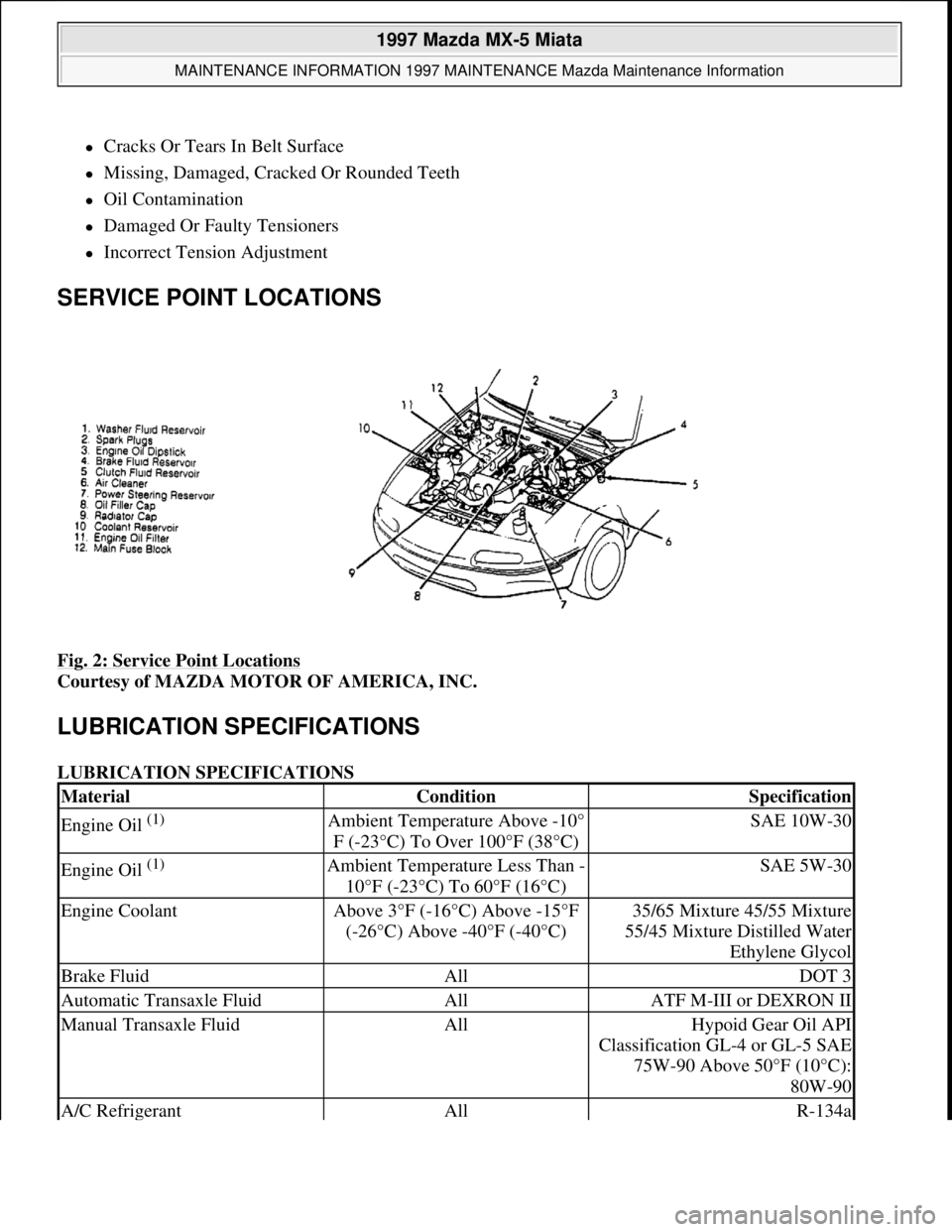
SERVICE POINT LOCATIONS
Fig. 2: Service Point Locations
Courtesy of MAZDA MOTOR OF AMERICA, INC.
LUBRICATION SPECIFICATIONS
LUBRICATION SPECIFICATIONS
MaterialConditionSpecification
Engine Oil (1) Ambient Temperature Above -10°
F (-23°C) To Over 100°F (38°C)SAE 10W-30
Engine Oil (1) Ambient Temperature Less Than -
10°F (-23°C) To 60°F (16°C)SAE 5W-30
Engine CoolantAbove 3°F (-16°C) Above -15°F
(-26°C) Above -40°F (-40°C)35/65 Mixture 45/55 Mixture
55/45 Mixture Distilled Water
Ethylene Glycol
Brake FluidAllDOT 3
Automatic Transaxle FluidAllATF M-III or DEXRON II
Manual Transaxle FluidAllHypoid Gear Oil API
Classification GL-4 or GL-5 SAE
75W-90 Above 50°F (10°C):
80W-90
A/C RefrigerantAllR-134a
1997 Mazda MX-5 Miata
MAINTENANCE INFORMATION 1997 MAINTENANCE Mazda Maintenance Information
Microsoft
Sunday, July 05, 2009 1:41:19 PMPage 3 © 2005 Mitchell Repair Information Company, LLC.
Page 325 of 514
water when cleaning the horn pad. Solvents or cleaners could adversely affect the air bag cover and cause
improper deployment of the system.
AIR CONDITIONING SERVICING
ANTI-LOCK BRAKE SYSTEM
On models equipped with anti-lock brake systems, ALWAYS observe the following cautions:
DO NOT attempt to bleed hydraulic system without first referring to the appropriate ANTI-LOCK
BRAKE SYSTEM article in the BRAKES Section.
DO NOT mix tire sizes. As long as tires remain close to the original diameter, increasing the width is
acceptable. Rolling diameter must be identical for all 4 tires. Some manufacturers recommend tires of the
same brand, style and type. Failure to follow this precaution may cause inaccurate wheel speed readings.
Use ONLY recommended brake fluids. DO NOT use silicone brake fluids in an ABS-equipped vehicle.
BATTERY WARNING WARNING:To avoid injury from accidental air bag deployment, read and carefully
follow all warnings and service precautions. See appropriate AIR BAG
RESTRAINT SYSTEM article in ACCESSORIES/SAFETY EQUIPMENT.
CAUTION: Disconnect negative battery cable before servicing any air bag system,
steering column or passenger side dash component. After any repair, turn
ignition key to the ON position from passenger's side of vehicle in case of
accidental air bag inflation
CAUTION: Avoid breathing R-134a refrigerant and PAG lubricant vapors, exposure
may irritate eyes, nose and throat. To remove R-134a from system use R-
134a recycling equipment that meets SAE J2210 specifications. If
accidental system discharge occurs, ventilate work area before resuming
service.
WARNING:R-134a service equipment or vehicle A/C systems SHOULD NOT be
pressure tested or leak tested with compressed air. Some mixtures of
air/R134a have shown to be combustible at elevated pressures. These
mixtures are dangerous and may cause fire and/or explosions. See AIR
CONDITIONING SERVICE article in GENERAL INFORMATION section.
CAUTION: The anti-lock brake system contains electronic equipment that can be
susceptible to interference caused by improperly installed or high output
radio transmitting equipment. Since this interference could cause the
possible loss of the anti-lock braking capability, such equipment should
be installed by qualified professionals.
1997 Mazda MX-5 Miata
MAINTENANCE INFORMATION 1997 MAINTENANCE Mazda Maintenance Information
Microsoft
Sunday, July 05, 2009 1:41:19 PMPage 5 © 2005 Mitchell Repair Information Company, LLC.