Page 85 of 305
81
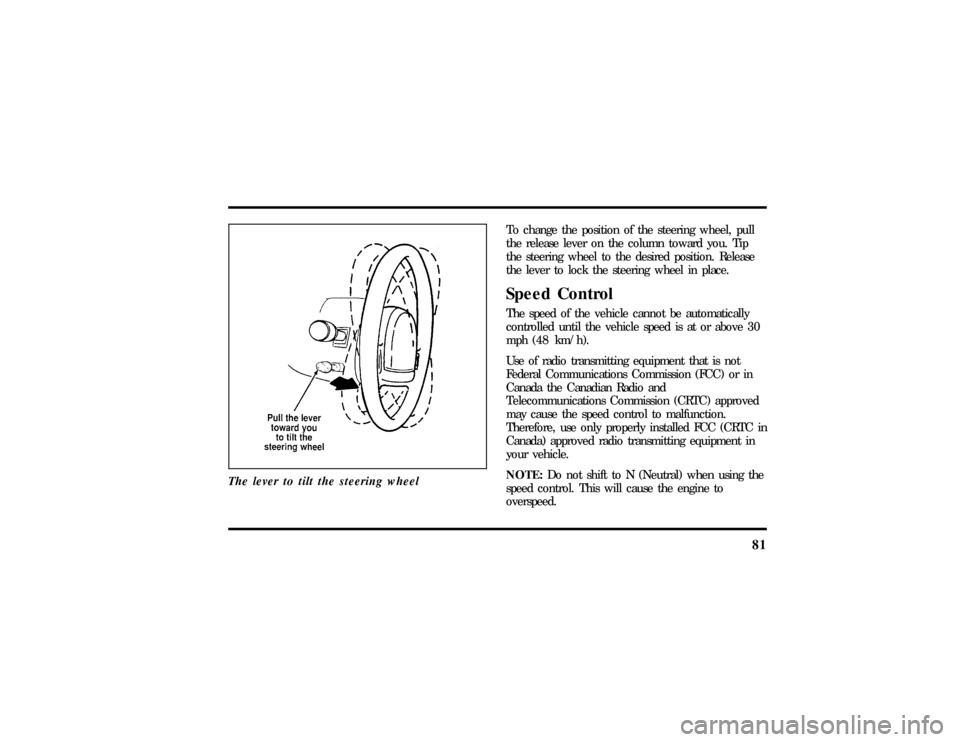
The lever to tilt the steering wheel
To change the position of the steering wheel, pull
the release lever on the column toward you. Tip
the steering wheel to the desired position. Release
the lever to lock the steering wheel in place.Speed ControlThe speed of the vehicle cannot be automatically
controlled until the vehicle speed is at or above 30
mph (48 km/h).
Use of radio transmitting equipment that is not
Federal Communications Commission (FCC) or in
Canada the Canadian Radio and
Telecommunications Commission (CRTC) approved
may cause the speed control to malfunction.
Therefore, use only properly installed FCC (CRTC in
Canada) approved radio transmitting equipment in
your vehicle.
NOTE:Do not shift to N (Neutral) when using the
speed control. This will cause the engine to
overspeed.
File:05fncft.ex
Update:Mon Jun 17 13:49:49 1996
Page 86 of 305
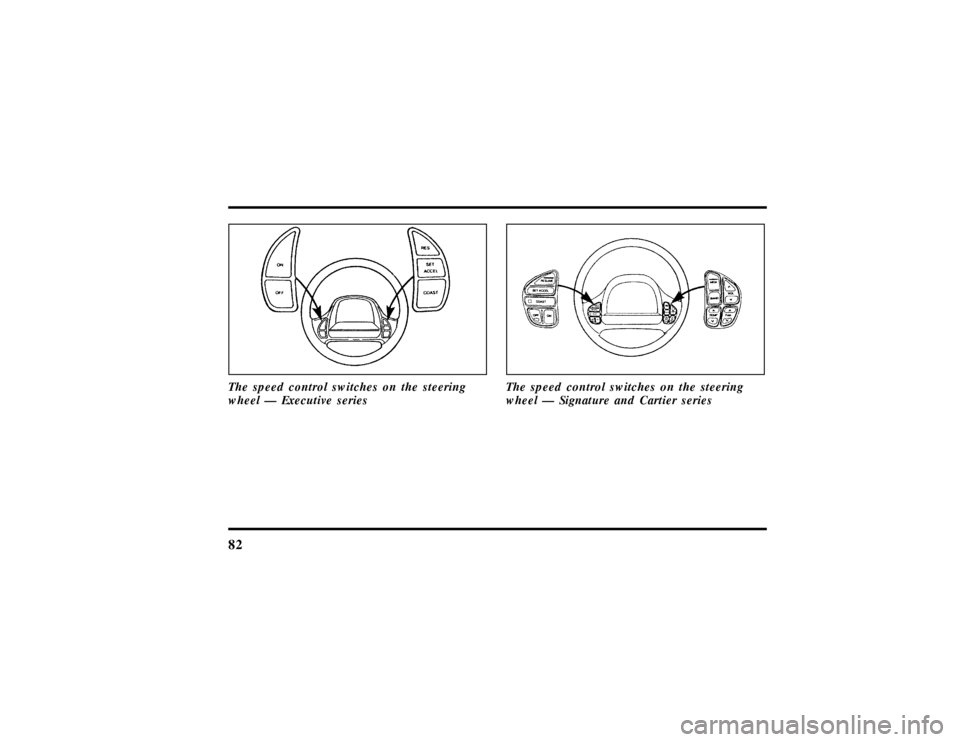
82The speed control switches on the steering
wheel Ð Executive series
The speed control switches on the steering
wheel Ð Signature and Cartier series
File:05fncft.ex
Update:Mon Jun 17 13:49:49 1996
Page 89 of 305
85
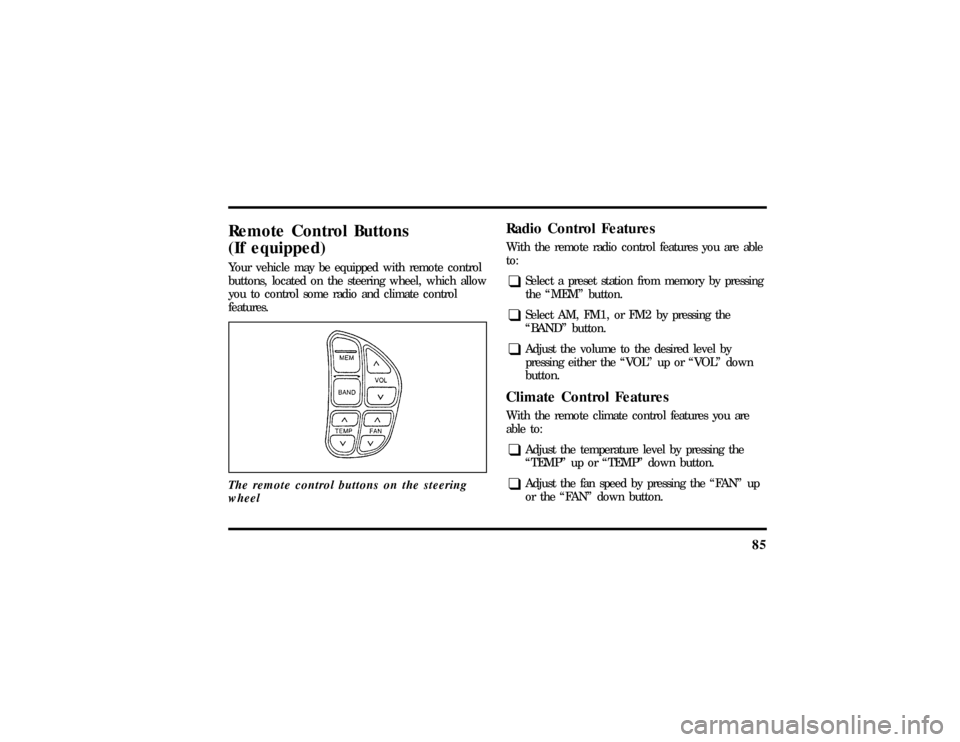
Remote Control Buttons
(If equipped)Your vehicle may be equipped with remote control
buttons, located on the steering wheel, which allow
you to control some radio and climate control
features.
The remote control buttons on the steering
wheel
Radio Control FeaturesWith the remote radio control features you are able
to:q
Select a preset station from memory by pressing
the ªMEMº button.
q
Select AM, FM1, or FM2 by pressing the
ªBANDº button.
q
Adjust the volume to the desired level by
pressing either the ªVOLº up or ªVOLº down
button.
Climate Control FeaturesWith the remote climate control features you are
able to:q
Adjust the temperature level by pressing the
ªTEMPº up or ªTEMPº down button.
q
Adjust the fan speed by pressing the ªFANº up
or the ªFANº down button.
File:05fncft.ex
Update:Mon Jun 17 13:49:49 1996
Page 165 of 305

1623. Make sure that the gearshift is in P (Park) and
the parking brake is set before you turn the
key.
Before you start your vehicle, you should test the
warning lights on the instrument panel to make
sure that they work. Refer to theInstrumentation
chapter.Starting Your EngineTo start your engine:
1. Follow the steps underPreparing to Start Your
Vehicleat the beginning of this section.
2. Turn the ignition key to the ON position.
3. DO NOT depress the accelerator pedal when
starting your engine. DO NOT use the
accelerator while the vehicle is parked.4. Turn the key to the START position (cranking)
until the engine starts. Allow the key to return
to the ON position after the engine has started.
If you have difficulty in turning the key, rotate
the steering wheel slightly because it may be
binding.
For a cold engine:
q
At temperatures10ÊF(-12ÊC) andbelow:If
the engine does not start infifteen (15)
secondson the first try, turn the key to OFF,
wait approximately ten (10) seconds so you do
not flood the engine, then try again.
q
At temperaturesabove10ÊF(-12ÊC):If the
engine does not start infive (5) secondson
the first try, turn the key to OFF, wait
approximately ten (10) seconds so you do not
flood the engine, then try again.
File:08fntot.ex
Update:Mon Jun 17 13:51:45 1996
Page 175 of 305
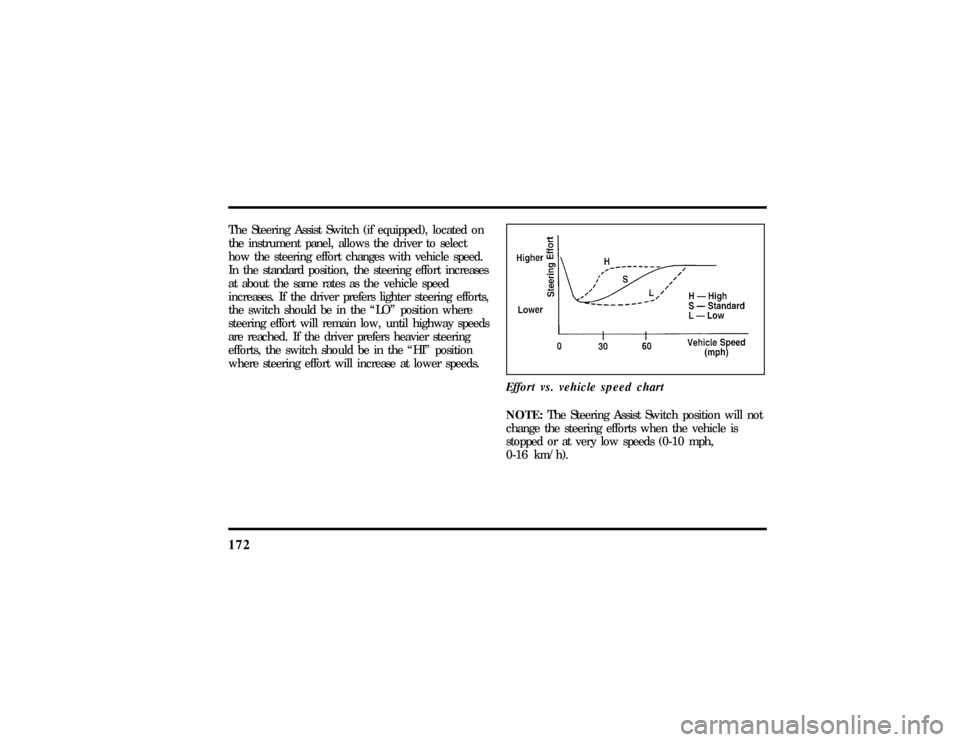
172The Steering Assist Switch (if equipped), located on
the instrument panel, allows the driver to select
how the steering effort changes with vehicle speed.
In the standard position, the steering effort increases
at about the same rates as the vehicle speed
increases. If the driver prefers lighter steering efforts,
the switch should be in the ªLOº position where
steering effort will remain low, until highway speeds
are reached. If the driver prefers heavier steering
efforts, the switch should be in the ªHIº position
where steering effort will increase at lower speeds.
Effort vs. vehicle speed chart
NOTE:The Steering Assist Switch position will not
change the steering efforts when the vehicle is
stopped or at very low speeds (0-10 mph,
0-16 km/h).
File:09fngft.ex
Update:Mon Jun 17 13:52:03 1996
Page 178 of 305

175
R (Reverse)With the gearshift in the R (Reverse) position, the
vehicle will move backward. You should always
come to a complete stop before shifting into or out
of R (Reverse).N (Neutral)With the gearshift in the N (Neutral) position, the
vehicle can be started and is free to roll. Hold the
brake pedal down while in this position.DrivingYour vehicle's gearshift is on the steering column.
The Transmission Control Switch (TCS) is located
on the end of the gearshift lever. The Transmission
Control Indicator Light (OVERDRIVE OFF) is
located on the instrument panel. You can put the
gearshift lever in any of the several positions.
The OVERDRIVE OFF light is off (not illuminated)
during normal vehicle operation. This allows the
transmission to upshift and downshift from 1stthrough 4th gears. When the TCS is pressed, the
Transmission Control Indicator Light will illuminate
(OVERDRIVE OFF) on the instrument panel. When
this OVERDRIVE OFF is illuminated the
transmission will upshift and downshift from 1st
through 3rd gears.
If OVERDRIVE OFF light does not come ªONº
when TCS is depressed or if the light flashes when
you are driving, have your vehicle serviced at the
first opportunity. If this condition persists, damage
could occur to the transmission.
To return the transmission to normal operation (1st
through 4th gear) depress the TCS again. This
switch may be used to cancel overdrive any time
the vehicle is being driven. Each time your vehicle
is started, the overdrive system will automatically be
in the normal overdrive mode and the light will not
be illuminated.
File:09fngft.ex
Update:Mon Jun 17 13:52:03 1996
Page 192 of 305
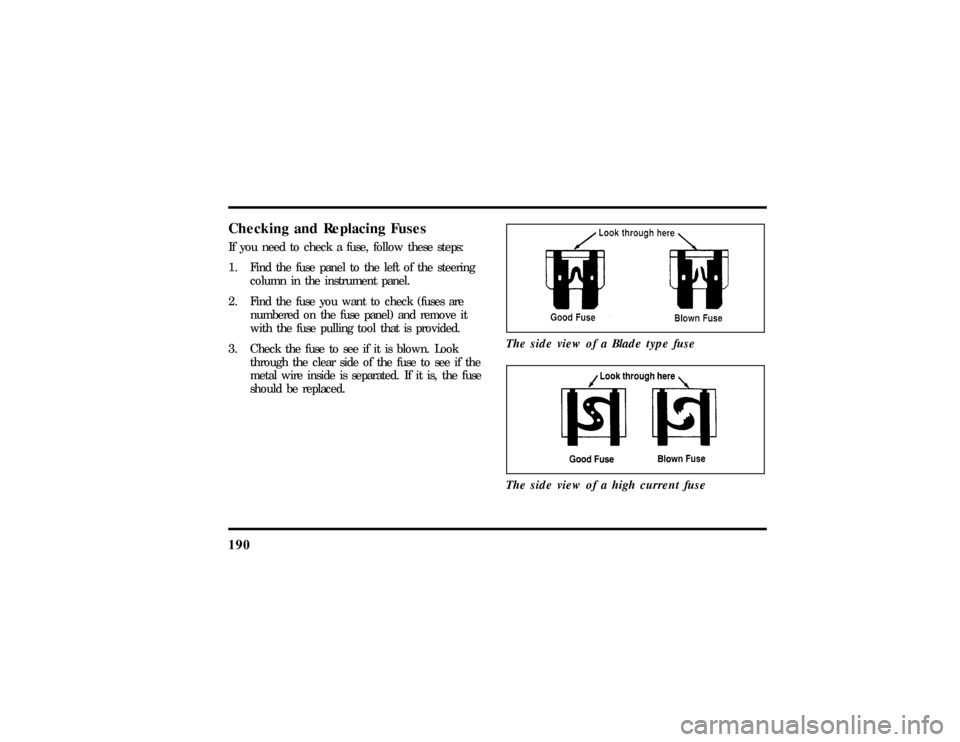
190Checking and Replacing FusesIf you need to check a fuse, follow these steps:
1. Find the fuse panel to the left of the steering
column in the instrument panel.
2. Find the fuse you want to check (fuses are
numbered on the fuse panel) and remove it
with the fuse pulling tool that is provided.
3. Check the fuse to see if it is blown. Look
through the clear side of the fuse to see if the
metal wire inside is separated. If it is, the fuse
should be replaced.The side view of a Blade type fuse
The side view of a high current fuse
File:10fnert.ex
Update:Thu Jun 20 15:16:36 1996
Page 231 of 305
229
Power Steering FluidCheck the level of the power steering fluid at least
twice a year (i.e., every Spring and Fall).Checking and Adding Power Steering
Fluid1. Start the engine and let it run until the power
steering fluid reaches normal operating
temperature. The power steering fluid will be at
the right temperature when the engine coolant
temperature gauge in the instrument cluster is
near the center of the NORMAL operating
temperature range.
2. While the engine idles, turn the steering wheel
back and forth several times. Make sure that
the cap assembly is installed at this time.
3. Turn the engine off and check the level on the
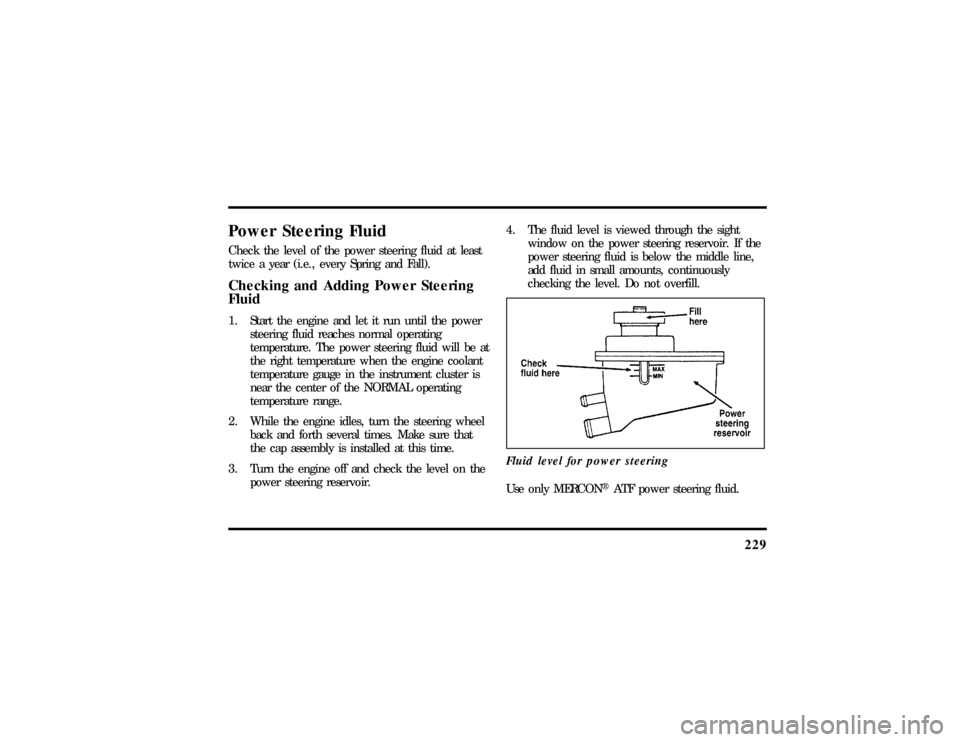
power steering reservoir.4. The fluid level is viewed through the sight
window on the power steering reservoir. If the
power steering fluid is below the middle line,
add fluid in small amounts, continuously
checking the level. Do not overfill.
Fluid level for power steering
Use only MERCONHATF power steering fluid.
File:11fnmct.ex
Update:Mon Jun 17 13:54:56 1996