Page 176 of 321

174You have an automatic release for the parking
brake. The parking brake should automatically
unlock when you move the gearshift to any forward
gear while the engine is running. However, the
automatic release does not work when the gearshift
is in reverse, neutral or park.
To manually release the parking brake, pull the
BRAKE RELEASE handle located on the lower left
corner of the instrument panel. The Brake Warning
Light will illuminate if the parking brake is not fully
released when the engine is running.
The parking brake is not designed to stop a moving
vehicle, but you can use the parking brake to stop
your vehicle in an emergency if the normal brakes
fail. However, since the parking brake applies only
the rear brakes, the stopping distance will increase
greatly and the handling of your vehicle will be
adversely affected.Always check the Brake Warning Light each time
you start your engine. Driving with the parking
brake on will cause the brakes to wear out quickly
and will reduce the fuel economy.
Traction Control
TM
Your vehicle is be equipped with the Traction
Control
TM
system. This system helps prevent wheel
spin in order to improve tire traction and is an
especially useful feature when you drive in hilly
areas or on slippery, icy or snowy roads.
When the Traction Control system is controlling
wheelspin, an electric motor sound may be heard
from the engine compartment and engine
acceleration may seem slower. This is normal.
Traction Control
TM
works automatically by rapidly
applying and releasing the brakes and reducing
engine torque to prevent one or both of the front
drive wheels from spinning during acceleration.
File:09fngfc.ex
Update:Fri Sep 6 08:48:49 1996
Page 177 of 321

175
During the Traction Control
TM
function, which most
often occurs during low speed acceleration on
slippery surfaces, a noise may be heard coming from
the engine compartment. This is normal and may
last for a few seconds during the acceleration of the
vehicle.
In general, this system improves your vehicle's
stability and acceleration performance when road
conditions warrant. Traction Control
TM
is fully
effective at all vehicle speeds.
If the Traction Control
TM
system is cycled
excessively, the brake portion of the system will
shut down to prevent the front brakes from
overheating. A limited Traction Control
TM
function
using engine torque will still control wheels from
spinning. A cooling down period is required to
prevent damage to the brakes. This time periodvaries and depends on brake usage during the
cooling down period. Anti-Lock braking is not
affected and will function normally during the cool
down period.
After the cool down period, the full Traction
Control
TM
function is restored.
Rear Air Suspension Adaptive
Ride Control SystemYour vehicle has an air suspension system with
automatic rear load leveling and automatic ride
control. This system keeps the rear of your vehicle
at a constant level by adding air or releasing air
from the springs. Ride and handling is enhanced by
firming shock absorber performance during certain
road conditions, steering maneuvers, braking, and
accelerations and is returned to the driver selected
ride calibration when driver or road surface induced
motion changes are completed.
File:09fngfc.ex
Update:Fri Sep 6 08:48:49 1996
Page 183 of 321

181
The console-mounted gearshift thumb button and
brake pedal must be depressed to move the
gearshift lever out of P (Park). The thumb button
pops out automatically when the gearshift latches
into position. Once the gearshift is secure, gradually
release the brake pedal and use the accelerator as
necessary.Gear Selection (Column- and
Console-Mounted Control)R (Reverse)With the gearshift in the R (Reverse) position, the
vehicle will move backward. You should always
come to a complete stop before shifting into or out
of R (Reverse).N (Neutral)With the gearshift in the N (Neutral) position, the
vehicle can be started and is free to roll. Hold the
brake pedal down while in this position.
DrivingWhen to usej(Overdrive)j(Overdrive) is the usual driving position for an
automatic overdrive transaxle. It works the same
way D (Drive) works, automatically upshifting or
downshifting as the vehicle speeds or slows.
However,j(Overdrive) also shifts into a fourth
gear Ð an overdrive gear Ð when your vehicle
cruises at a consistent speed for any length of time.
This fourth gear will increase your fuel economy
when you travel at cruising speeds.
j(Overdrive) may not be appropriate for certain
terrain. If the transaxle shifts back and forth
between third and fourth gears while you are
driving on hilly roads or if your vehicle requires
additional power for climbing hills, shift to D
(Drive).
File:09fngfc.ex
Update:Fri Sep 6 08:48:49 1996
Page 184 of 321

182When to use D (Drive)D (Drive) eliminates the excessive shifting between
third and fourth gears that your vehicle sometimes
does when you are traveling through hilly terrain in
jOverdrive. It also gives more engine braking to
slow your vehicle on downgrades thanj
Overdrive.When to use 1 (First)Use 1 (First) when added engine braking is desired
when descending steep hills.
The automatic transaxle will shift to the proper gear
to ascend any grade without any need to shift to 1
(First).
P (Park)Always come to a complete stop before you shift
into P (Park). Make sure that the gearshift is
securely latched in P (Park). This locks the transaxle
and prevents the front wheels from rotating.
Always set the parking brake fully and make sure
the gearshift is latched in P (Park). Turn off the
ignition whenever you leave your vehicle.
You can tell a column-mounted gearshift is securely
latched in P (Park) if the lever is adjacent to the P
(Park) and you cannot move it without pulling it
toward you and rotating it downward.
You can tell a console-mounted gearshift is securely
latched in P (Park) if the lever is adjacent to the P
(Park) and you cannot move it without pushing in
the thumb button.
File:09fngfc.ex
Update:Fri Sep 6 08:48:49 1996
Page 190 of 321
188
Connectingth e trailer' sbrakesWARNING
D o no tconnec ta trailer' shydraulic
Page 191 of 321

189
Driving While You TowBe especially careful when driving while you tow a
trailer. Never drive faster than 45 mph (70 km/h)
when you tow in hilly country on hot days. Also,
anticipate stops so that you can brake gradually.
Towing a trailer increases the load on the engine
and transaxle, particularly in hilly country and with
heavier trailers. Under these conditions you may
experience an excessive amount of shifting between
Overdrive and Third gears. Moving the shift selector
to D (Overdrive Lockout) will keep this from
happening and will provide better engine braking.
When driving in less hilly country or with a lighter
trailer load, you may move the gearshift selector
lever toj(Overdrive) without experiencing
excessive shifting.When driving down steep hills, you should put the
gearshift selector lever in the 1 (First) position to
shift the transaxle into second gear. This will
provide additional engine braking.
The automatic transaxle will automatically
downshift to the proper gear for driving up a grade.
If you use the speed control while you are towing
on very long, steep grades, the speed control may
shut off.
Servicing Your Vehicle If You TowIf you tow a trailer for a long distance, your vehicle
will need to be serviced more frequently than usual.
Refer to theMaintenance Schedulebooklet for
additional information.
File:09fngfc.ex
Update:Fri Sep 6 08:48:49 1996
Page 214 of 321
213
Preparing Your Vehicle1. Your vehicle has a 12-volt starting system, so
you need to use a 12-volt jumper system. You
will damage your starting motor, ignition
system, and other electrical parts if you connect
them to a 24-volt power supply (either two
12-volt batteries in series or a 24-volt generator
set).
2. Do not disconnect the battery of the disabled
vehicle. You could damage the vehicle's
electrical system.3. Park the booster vehicle close to the hood of
the disabled vehicle.Make sure the vehicles
do not touch each other.Set the parking
brake on both vehicles and stay clear of the
engine cooling fan and other moving parts.
4. Check all battery terminals and remove any
excessive corrosion before you attach the
jumper cables.
5. Turn on the heater fan in both vehicles. Press
the DEFROST button. Turning on the fan helps
protect the electrical system from voltage
surges. Turn off all other switches and gauges.
File:10fnerc.ex
Update:Fri Sep 6 08:49:57 1996
Page 228 of 321
227
Checking and Adding Engine OilSince the proper amount of engine oil is important
for safe engine operation, check the oil using the
dipstick each time you put fuel in your vehicle.
Remember the engine must be off, the oil must be
warm and the vehicle must be parked on level
ground.
Checking the engine oil level:
1. Turn the engine off after it has warmed up and
allow a few minutes for the engine oil to drain
back into the oil pan.
2. Set the parking brake, making sure the gearshift
is securely latched in P (Park).
3. Open the hood. Protect yourself from engine
heat.
4. Locate the engine oil dipstick (highlighted in
yellow) and carefully pull it out of the engine.5. Wipe the dipstick clean and put it back into
position, making sure it is fully seated.
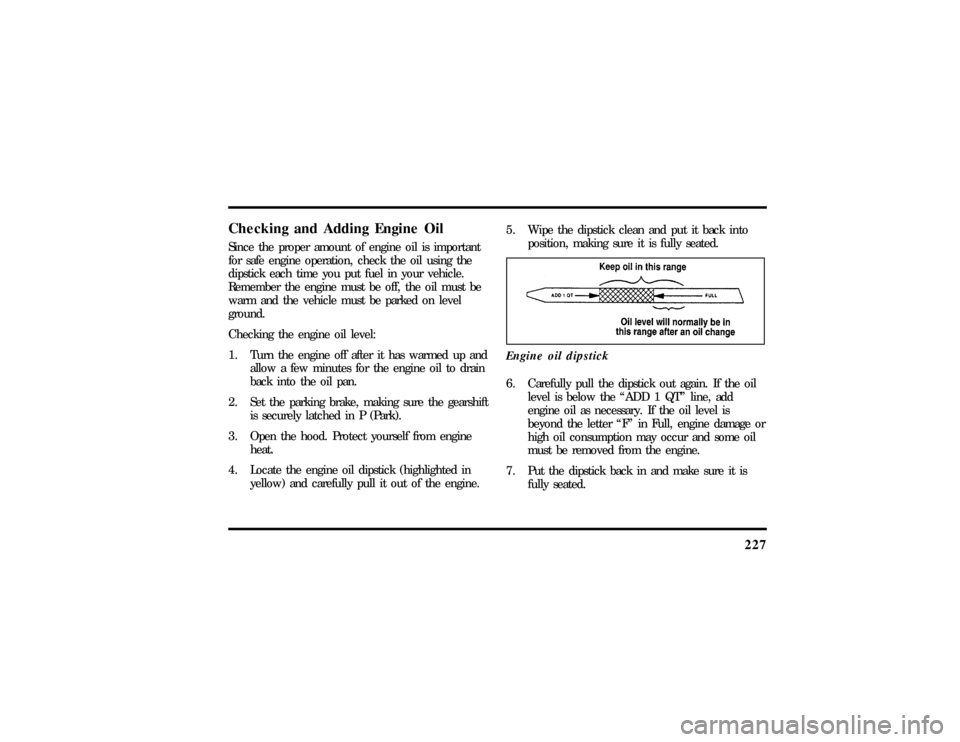
Engine oil dipstick
6. Carefully pull the dipstick out again. If the oil
level is below the ªADD 1 QTº line, add
engine oil as necessary. If the oil level is
beyond the letter ªFº in Full, engine damage or
high oil consumption may occur and some oil
must be removed from the engine.
7. Put the dipstick back in and make sure it is
fully seated.
File:11fnmcc.ex
Update:Fri Sep 6 08:51:16 1996