DRIVING TIPS
153
TRAILER TOWING
Your vehicle is designed primarily as a passenger±carrying
vehicle. Towing a trailer will have an adverse effect on
handling, performance, braking, durability and driving
economy (fuel consumption, etc.). For your safety and the
safety of others, you must not overload your vehicle or trailer.
Lexus warranties do not apply to damage or malfunction
caused by towing a trailer for commercial purposes. Ask
your Lexus dealer for further details before towing.
NOTICE
When towing a trailer, be sure to consult your Lexus
dealer for further information on additional
requirements.
Weight limits
Before towing, make sure the total trailer weight, gross
vehicle weight, gross axle weight and trailer tongue
load are all within the limits.
The total trailer weight and tingue load can be measured with
platform scales found at a highway weighing station, building
supply company, trucking company, junk yard, etc.
�Certification label
CAUTION!
�The total trailer weight (trailer weight plus its
cargo load) must not exceed 907 kg (2000 lb.).
Exceeding this weight is dangerous.
�The gross ehicle weight must not exceed the
Gross Vehicle Weight Rating (GVWR) indicated
on the Certification Label The gross vehicle
weight is the sum weight of the unloaded vehicle,
driver, passengers, luggage, hitch adn trailer
tongue load. It also includes the weight of any
special equipment installed on your vehicle.
�The load on either the front or rear axle resulting
from distribution of the gross vehicle weight on
both axles must not exceed the Gross Axle
Weight Rating (GAWR) listed on the Certification
Label.
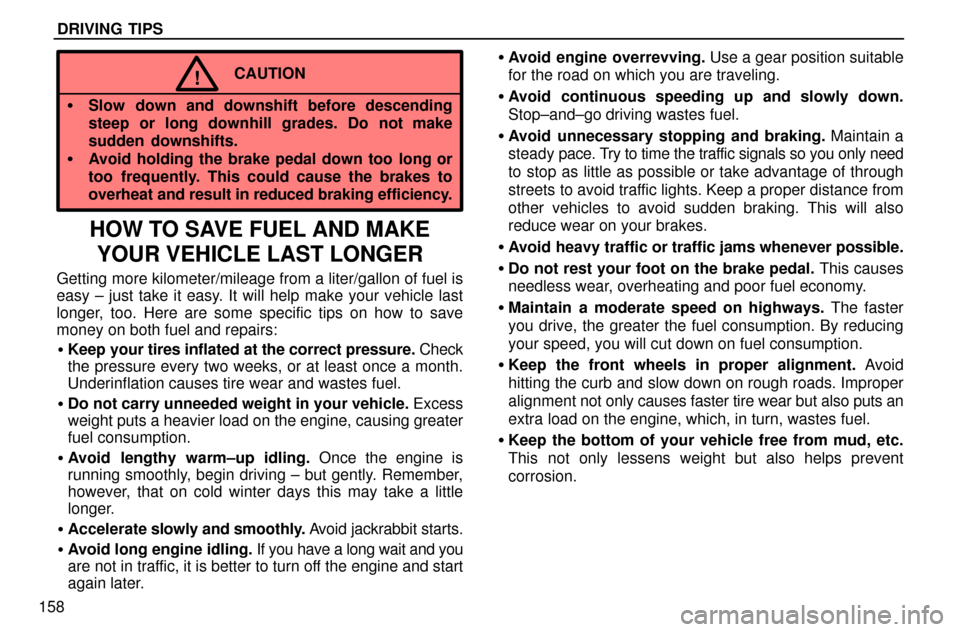
DRIVING TIPS
158
CAUTION!
�Slow down and downshift before descending
steep or long downhill grades. Do not make
sudden downshifts.
�Avoid holding the brake pedal down too long or
too frequently. This could cause the brakes to
overheat and result in reduced braking efficiency.
HOW TO SAVE FUEL AND MAKE
YOUR VEHICLE LAST LONGER
Getting more kilometer/mileage from a liter/gallon of fuel is
easy ± just take it easy. It will help make your vehicle last
longer, too. Here are some specific tips on how to save
money on both fuel and repairs:
�Keep your tires inflated at the correct pressure. Check
the pressure every two weeks, or at least once a month.
Underinflation causes tire wear and wastes fuel.
�Do not carry unneeded weight in your vehicle. Excess
weight puts a heavier load on the engine, causing greater
fuel consumption.
�Avoid lengthy warm±up idling. Once the engine is
running smoothly, begin driving ± but gently. Remember,
however, that on cold winter days this may take a little
longer.
�Accelerate slowly and smoothly. Avoid jackrabbit starts.
�Avoid long engine idling. If you have a long wait and you
are not in traffic, it is better to turn off the engine and start
again later.�Avoid engine overrevving. Use a gear position suitable
for the road on which you are traveling.
�Avoid continuous speeding up and slowly down.
Stop±and±go driving wastes fuel.
�Avoid unnecessary stopping and braking. Maintain a
steady pace. Try to time the traffic signals so you only need
to stop as little as possible or take advantage of through
streets to avoid traffic lights. Keep a proper distance from
other vehicles to avoid sudden braking. This will also
reduce wear on your brakes.
�Avoid heavy traffic or traffic jams whenever possible.
�Do not rest your foot on the brake pedal. This causes
needless wear, overheating and poor fuel economy.
�Maintain a moderate speed on highways. The faster
you drive, the greater the fuel consumption. By reducing
your speed, you will cut down on fuel consumption.
�Keep the front wheels in proper alignment. Avoid
hitting the curb and slow down on rough roads. Improper
alignment not only causes faster tire wear but also puts an
extra load on the engine, which, in turn, wastes fuel.
�Keep the bottom of your vehicle free from mud, etc.
This not only lessens weight but also helps prevent
corrosion.