1997 JAGUAR XJ6 body
[x] Cancel search: bodyPage 50 of 227

11 Cylinder head-
removal and refitting
4
Note:The engine must be completely cool
before beginning this procedure.
Removal
1Disconnect the battery negative cable.
Caution: If the stereo in your vehicle is
equipped with an anti-theft system, make
sure you have the correct activation code
before disconnecting the battery.
2Drain the coolant from the engine block and
radiator (see Chapter 1).
3Drain the engine oil and remove the oil filter
(see Chapter 1).
4Remove the bonnet for easier access, if
necessary (see Chapter 11).
5Remove the intake manifold (see Section 5).
6Remove the exhaust manifolds (Section 6).
7Remove the valve cover (see Section 4).
8Refer to Section 3 and Position the engine
at TDC for cylinder number 1. Remove the
distributor (see Chapter 5).
9Remove the camshafts and sprockets (see
Section 10). Place the upper chain between
the two upper chain guides and wrap a large
rubber band around the two guides, retaining
the chain and guides.
10Remove the coolant housing from the
cylinder head (see illustration).
11Remove the cylinder head-to-front cover
bolts (see illustration).
12Using a socket and breaker bar, loosen
the cylinder head bolts in quarter-turn
increments until they can be removed by
hand. Loosen the cylinder head bolts using
the opposite of the recommended tightening
sequence (see illustration 11.23)to avoid
warping or cracking the cylinder head.
13Lift the cylinder head off the engine block.
If it’s stuck, very carefully pry up at the
transmission end, beyond the gasket surface.
Caution: Though the cylinder head is
aluminium, it is still heavy, large andawkward to handle. To avoid damaging the
body during removal, use an engine hoist
to lift the cylinder head out of the engine
compartment, or have an assistant help
you.
14With the cylinder head on a workbench,
remove all external components from the
cylinder head to allow for thorough cleaning
and inspection. See Chapter 2, Part B, for
cylinder head servicing procedures.
Refitting
15The mating surfaces of the cylinder head
and engine block must be perfectly clean
when the cylinder head is installed.
16Use a gasket scraper to remove all traces
of carbon and old gasket material, then clean
the mating surfaces with lacquer thinner or
acetone. If there’s oil on the mating surfaces
when the cylinder head is installed, the gasket
may not seal correctly and leaks could
develop. When working on the engine block,
stuff the cylinders with clean workshop rags
to keep out debris. Use a vacuum cleaner to
remove material that falls into the cylinders.
Caution: Use care when cleaning the
cylinder head gasket surface. The cylinder
head and engine block are aluminium and
can be easily damaged by using sharpscraping tools. Gasket removal solvents
are available from car accessory outlets
and may be useful for safe removal of
gasket material.
17Check the engine block and cylinder head
mating surface for nicks, deep scratches and
damage from coolant corrosion. If damage is
slight, it can be removed with a file; if it’s
excessive, machining may be the only
alternative. See Part B of this Chapter for
procedures and criteria concerning the repair
of corrosion damage.
18Use a tap of the correct size to chase the
threads in the cylinder head bolt holes, then
clean the holes with compressed air - make
sure that nothing remains in the holes.
Warning: Wear eye protection
when using compressed air!
19Remove the rear cover from the cylinder
head. Clean the gasket surface and refit the
cover with a new gasket (see illustration).
Place the side of the gasket with the sealer
bead against the cylinder head, do not use
sealant on this gasket.
20Fabricate two alignment studs from the
old head bolts. Cut off the heads, then slot the
ends with a hacksaw (see illustration). New
cylinder head bolts must be used when
refitting the head.
Engine in-car repair procedures 2A•13
2A
11.19 Remove the rear cover from the
cylinder head, clean the gasket surfaces
and refit the cover with a new gasket
(arrowed) - note that the printed-on sealer
bead is placed against the cylinder head11.20 Fabricate two alignment studs from
old cylinder head bolts and refit them in
the engine block - after the cylinder head
is installed, remove the two studs
3261 Jaguar XJ6 11.10 Disconnect the hoses and remove the bolts to separate the
coolant housing (arrowed) from the cylinder head
11.11 Remove the bolts (arrowed) securing the cylinder head
to the front cover
Page 52 of 227

Refitting
5Remove all traces of old gasket material
and sealant from the engine block and sump.
Clean the mating surface with lacquer thinner
or acetone.
Caution: Do not use a sharp scraping tool.
Both the sump and the engine block are
aluminium and could be easily damaged.
6Make sure the threaded bolt holes in the
engine block and bellhousing are clean.
7Inspect the flange of the sump for any
cracks, pits or scratches that could cause an
oil leak.
8Remove the baffle plate at the rear of the
sump (see illustration). Clean the sump area
and the baffle, then refit the baffle.
9Inspect the oil pump pickup tube for
cracks, or foreign material blocking the screen
(see illustration).
10Apply a bead of RTV sealant to the sump
flange(see illustration). Note:The sump
must be installed within 5 minutes of sealer
application.
11Carefully position the sump on the engine
block and push it toward the transmission
adapter plate as you press it against the
engine block. Loosely refit four bolts, two on
each side of the sump. Tighten the four bolts
in a criss-cross pattern to the torque listed in
this Chapter’s Specifications, then loosen
each bolt 90°.
12Refit the two engine adapter-to-sump
bolts. Tighten the two bolts to the torque
listed in this Chapter’s Specifications, then
loosen each one 180°.
13Refit the remainder of the sump-to-engine
block bolts hand tight until all are installed,
then tighten them to the torque listed in this
Chapter’s Specifications. Lastly, tighten the
two adapter-to-sump bolts to the torque
listed in this Chapter’s Specifications.
Caution: Failure to follow this tightening
procedure could stress or possibly crack
the adapter plate.
14The remainder of refitting is the reverse of
removal. Be sure to add oil and refit a new oil
filter.
15Run the engine and check for oil pressure
and leaks.13 Oil pump- removal,
inspection and refitting
4
Removal
1Remove the sump (see Section 12).
2Unbolt the oil pickup tube and oil transfer
housing from the engine block (see
illustration). Note:Have a drain pan under the
transfer housing, as oil may drip out when the
housing is loosened from the engine block.
3Carefully pull the transfer housing and
transfer tubes to the rear to separate them
from the oil pump body.
4Bend back the locking tabs and remove thethree bolts retaining the oil pump drive
sprocket to the oil pump (see illustration).
Pull the chain and sprocket from the front of
the pump. Note:There are shims between the
sprocket and the pump. Collect them while
pulling off the sprocket.
5Remove the bolts and detach the oil pump
from the engine.
6Remove all traces of sealant and old gasket
material from the oil pump body and engine
block, then clean the mating surfaces with
lacquer thinner or acetone.
7Remove the screws and separate the front
and rear pump covers from the body. Lift out
the drive and driven rotors (see illustrations).
Note:Mark the front face of each rotor before
removing them.
Engine in-car repair procedures 2A•15
2A
12.8 Remove the bolts (arrowed) and the
sheetmetal baffle plate - clean the sump
area of the sump with the baffle removed12.9 Lubrication system components
A Oil pump
B Transfer tubesC Transfer housing
D Oil pump pickup12.10 Apply a bead of RTV sealant around
the perimeter of the sump mounting
flange, be sure to run the bead around the
outside all bolt the holes
13.7a Remove the bolts and separate the
front and rear pump covers13.7b Remove the outer rotor (A)
and inner rotor (B)
13.2 Unbolt the oil pump pickup (A) and
the bolts (B) retaining the transfer
assembly (C) to the engine block13.4 Pry back the locking tabs and remove
the three bolts retaining the oil pump drive
sprocket to the pump
3261 Jaguar XJ6
Page 53 of 227

Inspection
8Clean and dry the pump body and both
rotors. Measure the outside diameter of the
outer rotor and thickness of both rotors.
9Place the outer rotor into the pump body
and use feeler gauges to measure the
clearance between the outer rotor and the
body (see illustration).
10Place a straightedge across the pump
body and measure between the straightedge
and the rotors to check the over-the-rotor
clearance (see illustration). Compare your
measurements to this Chapter’s Specifications
and renew the oil pump if any are beyond the
maximum allowable.
11Remove the oil pressure relief valve cap.
Remove and clean the relief valve components
(see illustration).
12Clean all components with solvent and
inspect them for wear and damage. If
excessive wear, damage or if any clearance is
beyond the Specifications, renew the entire
pump as an assembly.
13Check the oil pressure relief valve piston
sliding surface and valve spring. If either the
spring or the valve is damaged, they must be
renewed as a set.
Refitting
14Lubricate the drive and driven rotors with
clean engine oil and place them in the casewith the marks facing out. Apply a thin coat
of anaerobic sealant (Loctite 510 or 518) to
the gasket flange and refit the cover (see
illustration).
15Lubricate the oil pressure relief valve
piston with clean engine oil and refit the valve
components into the oil pump body (see
illustration 13.11).
16Apply a thin coat of anaerobic sealant
(Loctite 510 or 518) to the oil pump-to-engine
block-mounting surface, position the oil pump
body against the engine block and refit the
mounting bolts, tightening the bolts to the
torque listed in this Chapter’s Specifications.
Follow a criss-cross pattern when tightening
the bolts to avoid warping the oil pump body.
17If using the original oil pump, refit the
original sprocket shim pack (see illustration).
If a new pump is installed, start off with a
0.38 mm (0.015-inch) thick shim pack, refit the
drive sprocket and align the sprocket as
follows.
18Use a straightedge to check the alignment
of the oil pump sprocket with the crankshaft
sprocket (see illustration). If they are not
aligned, increase or decrease the shim pack at
the oil pump sprocket until alignment is correct,
then secure the oil pump sprocket bolts by
bending up the sheetmetal tabs. Note:You
may be able to use all or part of the original
shim pack from the original oil pump (if a new
pump is being fitted). If required, shims areavailable in 0.127 mm (0.005 inch), 0.254 mm
(0.010 inch) and 0.508 mm (0.020 inch) sizes.
19Fit new O-rings to each end of the transfer
tubes and refit the tubes into the transfer
housing. Note:Use petroleum jelly to lubricate
the O-rings.
20Apply a thin coat of RTV sealant to the
engine block-mounting surface of the transfer
housing. Lift the transfer housing and tubes
into place and push the front of the tubes
in the back of the oil pump, until you can start
the transfer housing-to-engine block bolts.
Tighten the bolts to the torque listed in this
Chapter’s Specifications.
21Refit the remaining parts in the reverse
order of removal.
22Add oil, start the engine and check for oil
pressure and leaks.
23Recheck the engine oil level.
14 Driveplate-
removal and refitting
4
Removal
1Raise the car and support it securely on
axle stands, then refer to Chapter 7 and
remove the transmission. If it’s leaking, now
would be a very good time to renew the front
pump seal/O-ring.
2A•16 Engine in-car repair procedures
13.9 Measure the outer rotor-to-body
clearance with feeler gauges (arrowed)13.10 With a straightedge held tight to the
pump surface, measure the clearance over
the rotors with feeler gauges13.11 Oil pressure relief valve components
A Relief valve cap
B TubeC Spring
D Valve
13.14 Apply a thin coat anaerobic sealant
(Loctite 510 or 518) to the pump cover
sealing surface
13.17 Refit the original shim pack
(arrowed) if the original pump is being
used - if a new pump is being installed,
refit a 0.38 mm (0.015-inch) shim pack
3261 Jaguar XJ6
13.18 Check the oil pump and crankshaft
sprocket alignment with a straightedge -
add or subtract shims until the sprockets
are aligned for smooth chain operation
Page 55 of 227

6Slowly and carefully press the seal and
retainer squarely onto the crankshaft (see
illustration). The plastic sleeve may be
pushed out as the retainer seats on the engine
block. Remove the plastic sleeve.
7Refit and tighten the retainer bolts to the
torque listed in this Chapter’s Specifications.
8The remaining steps are the reverse of
removal.
16 Engine mounts-
check and renewal
3
1Engine mounts seldom require attention,
but broken or deteriorated mounts should be
renewed immediately or the added strain
placed on the driveline components may
cause damage or wear.
Check
2During the check, the engine must be
raised to remove the weight from the mounts.3Raise the car and support it securely on
axle stands, then position a jack under the
engine sump. Place a large wood block
between the jack head and the sump, then
carefully raise the engine just enough to take
the weight off the mounts. Do not position the
wood block under the drain plug.
Warning: DO NOT place any part
of your body under the engine
when it’s supported by a jack!
4Check the front mounts to see if the rubber
is cracked, hardened or separated from the
metal plates. Sometimes the rubber will split
down the centre.
5Check for relative movement between the
mount plates and the engine or frame (use a
large screwdriver or pry bar to attempt to
move the mounts). If movement is noted,
lower the engine and tighten the mount
fasteners.
6Rubber preservative should be applied to
the mounts to slow deterioration.
Renewal
7Disconnect the battery negative cable.
Caution: If the stereo in your vehicle is
equipped with an anti-theft system, make
sure you have the correct activation code
before disconnecting the battery.
8Raise the car and support it securely on
axle stands. Support the engine as described
in paragraph 3.
Caution: Ensure the cooling fan doesn’t hit
the shroud as the engine is raised.
9To remove either engine mount, remove the
nut from the engine bracket, then raise the
engine (see illustration).
10From underneath the car, lower the
steering gear (see Chapter 10) for access to
the nut retaining the insulator to the chassis
bracket.
11Refitting is the reverse of removal. Use
thread-locking compound on the mount
bolts/nuts and be sure to tighten them
securely.
12See Chapter 7 for transmission mount
renewal.
2A•18 Engine in-car repair procedures
3261 Jaguar XJ6 15.6 Refit the retainer and oil seal onto the crankshaft
16.9 Front engine mount (A)
and retaining nut to engine bracket (B)
Page 58 of 227
rebuilt engine or short block, some rebuilders
will not warranty their engines unless the
radiator has been professionally flushed. Also,
we don’t recommend overhauling the oil
pump - always refit a new one when an engine
is rebuilt.
Before beginning the engine overhaul, read
through the entire procedure to familiarise
yourself with the scope and requirements of
the job. Overhauling an engine isn’t difficult,
but it is time-consuming. Plan on the vehicle
being tied up for a minimum of two weeks,
especially if parts must be taken to an
automotive machine workshop for repair or
reconditioning. Check on availability of parts
and make sure that any necessary special
tools and equipment are obtained in advance.
Most work can be done with typical hand
tools, although a number of precision
measuring tools are required for inspecting
parts to determine if they must be renewed.
Often an automotive machine workshop will
handle the inspection of parts and offer
advice concerning reconditioning and
renewal. Note:Always wait until the engine
has been completely dismantled and all
components, especially the engine block,
have been inspected before deciding what
service and repair operations must be
performed by an automotive machine
workshop. Since the engine block’s condition
will be the major factor to consider when
determining whether to overhaul the original
engine or buy a rebuilt one, never purchase
parts or have machine work done on other
components until the engine block has been
thoroughly inspected. As a general rule, time
is the primary cost of an overhaul, so it
doesn’t pay to refit worn or substandard
parts.
If it turns out that a number of major
components are beyond reconditioning, it
may be cost effective to buy a factory-rebuilt
engine from a Jaguar dealership.
As a final note, to ensure maximum life and
minimum trouble from a rebuilt engine,
everything must be assembled with care in a
spotlessly-clean environment.
3 Vacuum gauge
diagnostic checks
2
A vacuum gauge provides valuable
information about what is going on in the
engine at a low cost. You can check for worn
rings or cylinder walls, leaking cylinder head or
intake manifold gaskets, incorrect carburettor
adjustments, restricted exhaust, stuck or
burned valves, weak valve springs, improper
ignition or valve timing and ignition problems.
Unfortunately, vacuum gauge readings are
easy to misinterpret, so they should be used
with other tests to confirm the diagnosis.
Both the absolute readings and the rate of
needle movement are important for accurate
interpretation. Most gauges measure vacuumin inches of mercury (in-Hg). As vacuum
increases (or atmospheric pressure decreases),
the reading will decrease. Also, for every
1000 foot increase in elevation above sea level;
the gauge readings will decrease about one
inch of mercury.
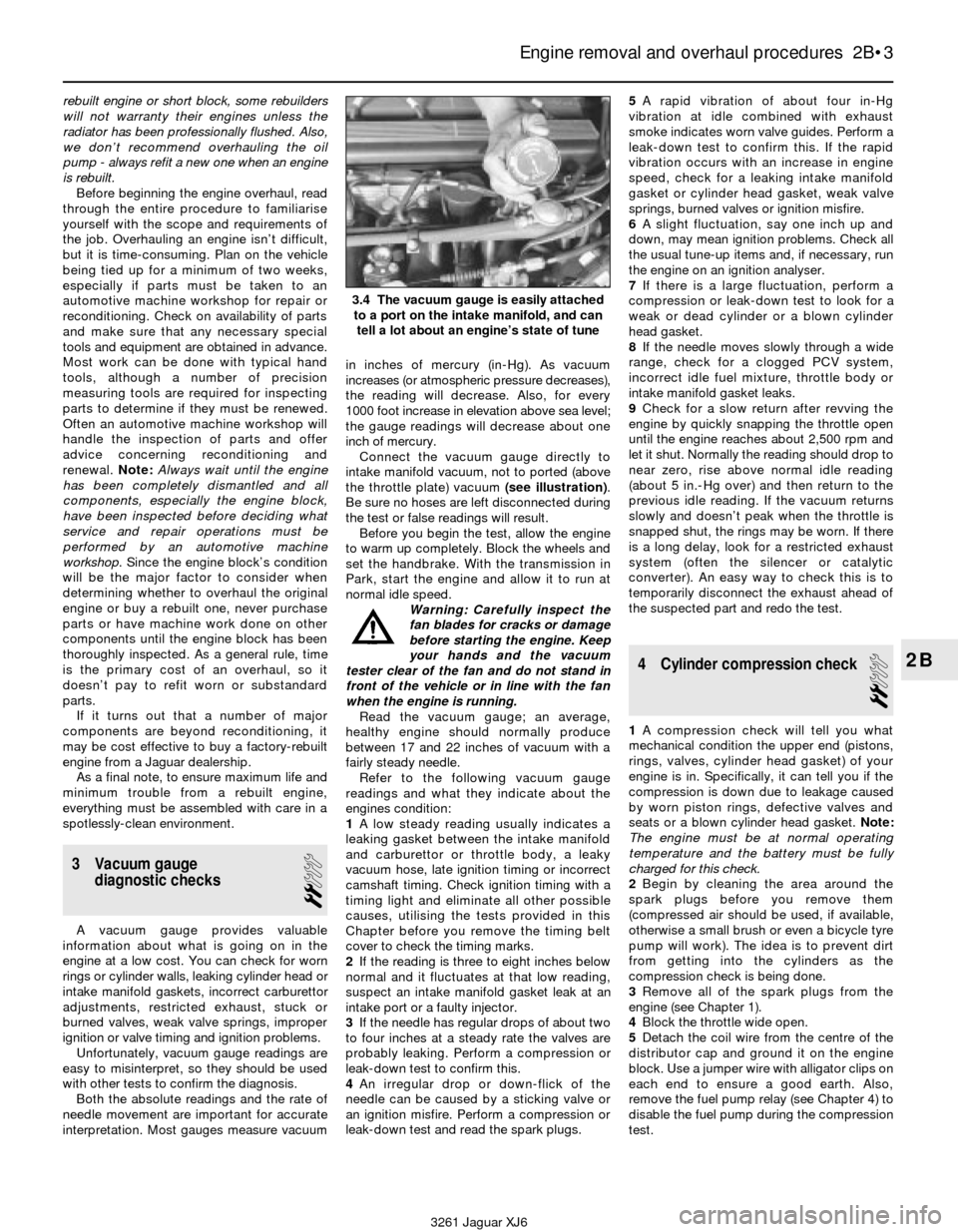
Connect the vacuum gauge directly to
intake manifold vacuum, not to ported (above
the throttle plate) vacuum (see illustration).
Be sure no hoses are left disconnected during
the test or false readings will result.
Before you begin the test, allow the engine
to warm up completely. Block the wheels and
set the handbrake. With the transmission in
Park, start the engine and allow it to run at
normal idle speed.
Warning: Carefully inspect the
fan blades for cracks or damage
before starting the engine. Keep
your hands and the vacuum
tester clear of the fan and do not stand in
front of the vehicle or in line with the fan
when the engine is running.
Read the vacuum gauge; an average,
healthy engine should normally produce
between 17 and 22 inches of vacuum with a
fairly steady needle.
Refer to the following vacuum gauge
readings and what they indicate about the
engines condition:
1A low steady reading usually indicates a
leaking gasket between the intake manifold
and carburettor or throttle body, a leaky
vacuum hose, late ignition timing or incorrect
camshaft timing. Check ignition timing with a
timing light and eliminate all other possible
causes, utilising the tests provided in this
Chapter before you remove the timing belt
cover to check the timing marks.
2If the reading is three to eight inches below
normal and it fluctuates at that low reading,
suspect an intake manifold gasket leak at an
intake port or a faulty injector.
3If the needle has regular drops of about two
to four inches at a steady rate the valves are
probably leaking. Perform a compression or
leak-down test to confirm this.
4An irregular drop or down-flick of the
needle can be caused by a sticking valve or
an ignition misfire. Perform a compression or
leak-down test and read the spark plugs.5A rapid vibration of about four in-Hg
vibration at idle combined with exhaust
smoke indicates worn valve guides. Perform a
leak-down test to confirm this. If the rapid
vibration occurs with an increase in engine
speed, check for a leaking intake manifold
gasket or cylinder head gasket, weak valve
springs, burned valves or ignition misfire.
6A slight fluctuation, say one inch up and
down, may mean ignition problems. Check all
the usual tune-up items and, if necessary, run
the engine on an ignition analyser.
7If there is a large fluctuation, perform a
compression or leak-down test to look for a
weak or dead cylinder or a blown cylinder
head gasket.
8If the needle moves slowly through a wide
range, check for a clogged PCV system,
incorrect idle fuel mixture, throttle body or
intake manifold gasket leaks.
9Check for a slow return after revving the
engine by quickly snapping the throttle open
until the engine reaches about 2,500 rpm and
let it shut. Normally the reading should drop to
near zero, rise above normal idle reading
(about 5 in.-Hg over) and then return to the
previous idle reading. If the vacuum returns
slowly and doesn’t peak when the throttle is
snapped shut, the rings may be worn. If there
is a long delay, look for a restricted exhaust
system (often the silencer or catalytic
converter). An easy way to check this is to
temporarily disconnect the exhaust ahead of
the suspected part and redo the test.
4 Cylinder compression check
2
1A compression check will tell you what
mechanical condition the upper end (pistons,
rings, valves, cylinder head gasket) of your
engine is in. Specifically, it can tell you if the
compression is down due to leakage caused
by worn piston rings, defective valves and
seats or a blown cylinder head gasket. Note:
The engine must be at normal operating
temperature and the battery must be fully
charged for this check.
2Begin by cleaning the area around the
spark plugs before you remove them
(compressed air should be used, if available,
otherwise a small brush or even a bicycle tyre
pump will work). The idea is to prevent dirt
from getting into the cylinders as the
compression check is being done.
3Remove all of the spark plugs from the
engine (see Chapter 1).
4Block the throttle wide open.
5Detach the coil wire from the centre of the
distributor cap and ground it on the engine
block. Use a jumper wire with alligator clips on
each end to ensure a good earth. Also,
remove the fuel pump relay (see Chapter 4) to
disable the fuel pump during the compression
test.
Engine removal and overhaul procedures 2B•3
2B
3.4 The vacuum gauge is easily attached
to a port on the intake manifold, and can
tell a lot about an engine’s state of tune
3261 Jaguar XJ6
Page 60 of 227

11Disconnect the throttle linkage,
transmission linkage (and dipstick tube) and
speed control cable, if equipped, from the
engine (see Chapters 4 and 7).
12Refer to Part A of this Chapter and
remove the intake and exhaust manifolds.
13Unbolt the power steering pump (see
Chapter 10). Tie the pump aside without
disconnecting the hoses. Refer to Part A for
removal of the hydraulic pump (if equipped)
from the timing chain cover.
14On air-conditioned models, unbolt the
compressor and set it aside. Do not
disconnect the refrigerant hoses. Note:Wire
the compressor out of the way with a coat
hanger, don’t let the compressor hang on the
hoses.
15Refer to Part A of this Chapter and
remove the drivebelts, water pump pulley and
crankshaft pulley.
16Attach a lifting sling to the engine.
Position a hoist and connect the sling to it.
Take up the slack until there is slight tension
on the hoist.
17With a trolley jack and piece of wood
supporting the bottom of the transmission
sump, refer to Chapter 8 and remove the
driveshaft and rear transmission mount.
Warning: Do not place any part
of your body under the
engine/transmission when it’s
supported only by a hoist or
other lifting device.
18With the hoist taking the weight of the
engine, unbolt the engine mounts (see Part A
of this Chapter).
19Recheck to be sure nothing is still
connecting the engine or transmission to the
vehicle. Disconnect and label anything still
remaining.
20Slowly lift the engine/transmission out of
the vehicle (see illustration). It may be
necessary to pry the mounts away from the
frame brackets.21Move the engine away from the vehicle
and carefully lower the hoist until the
engine/transmission can be set on the floor.
Refer to Chapter 7 and remove the
transmission and converter. Refer to Part A of
this Chapter for removal of the flywheel. With
the flywheel removed, remove the four large
bolts and the transmission adapter plate from
the engine (see illustration).
22Refer to Part A of this Chapter for removal
of the rear main seal retainer plate from the
back of the engine, then lift the engine to a
position where it can be attached to a sturdy
engine stand.
Refitting
23Check the engine/transmission mounts. If
they’re worn or damaged, renew them.
24Attach the hoist and remove the engine
from the stand. Refer to Part A of this Chapter
and renew the rear main seal and retainer
plate, then reattach the transmission adapter
plate and refer to Chapter 7 for mounting the
converter and transmission.
25Carefully lower the engine into the vehicle
with the hoist. An assistant is helpful to guide
the engine clear of accessories in the engine
compartment as the engine is lowered into
place.
26Refit the engine mount bolts and tighten
them securely. Raise the back of the
transmission with the trolley jack and reattach
the transmission mount, driveshaft and shift
linkage.
27Refit the remaining components and
fasteners in the reverse order of removal.
28Add coolant, oil, power steering and
transmission fluids as needed (see Chapter 1).
29Run the engine and check for proper
operation and leaks. Shut off the engine and
recheck the fluid levels.
7 Engine rebuilding
alternatives
The do-it-yourselfer is faced with a number
of options when performing an engine
overhaul. The decision to renew the engine
block, piston/connecting rod assemblies and
crankshaft depends on a number of factors,
with the number one consideration being the
condition of the engine block. Other
considerations are cost, access to machine
workshop facilities, parts availability, time
required to complete the project and the
extent of prior mechanical experience on the
part of the do-it-yourselfer.
Some of the rebuilding alternatives include:
Individual parts- If the inspection
procedures reveal that the engine block and
most engine components are in reusable
condition, purchasing individual parts may be
the most economical alternative. The engine
block, cylinder head, crankshaft, and
piston/connecting rod assemblies should all
be inspected carefully. Even if the engine
block shows little wear, the cylinder bores
should be surface honed.
Short block- A short block consists of an
engine block with a crankshaft and
piston/connecting rod assemblies already
installed. All new bearings are incorporated
and all clearances will be correct. The existing
camshafts, valve train components, cylinder
head and external parts can be bolted to the
short block with little or no machine workshop
work necessary.
Long block- A long block consists of a
short block plus an oil pump, sump, cylinder
head, valve cover, camshaft and valve train
components, timing sprockets and chain or
gears and timing cover. All components are
installed with new bearings, seals and gaskets
Engine removal and overhaul procedures 2B•5
2B
3261 Jaguar XJ6 6.20 Lift the engine high enough to clear the vehicle, tilting it up
at the front to clear the front crossmember, then move it away
and lower the hoist
6.21 With the engine on the floor but still supported by the hoist,
remove the four large bolts (arrowed) and pull off the
transmission adapter plate
Page 76 of 227

pull loose, tap it with a soft-faced hammer. Do
not use a screwdriver between the cover and
the thermostat housing.
8Remove the thermostat, noting the
direction in which it was installed in the
housing, and thoroughly clean the sealing
surfaces.
9Refit a new O-ring onto the thermostat (see
illustration). Make sure it is evenly fitted all
the way around.
10Apply a bead of RTV sealant to the
thermostat housing. Refit the thermostat and
housing, positioning the jiggle pin at the
highest point. Note:The thermostat is usually
marked TOP on the radiator side for proper
orientation.
11Tighten the cover fasteners to the torque
listed in this Chapter’s Specifications.
12Refill the cooling system, run the engine
and check for leaks and proper operation.
4 Engine cooling fans-
check and renewal
3
Mechanical fan
(1988 to 1992 models)
Warning: Keep hands, hair, tools
and clothing away from the fan
when the engine is running. Toavoid injury or damage DO NOT operate
the engine with a damaged fan. Do not
attempt to repair fan blades - renew a
damaged fan .
Check
Warning: In order to check the
fan clutch, the engine will need
to be at operating temperature,
so while going through checks
prior to Step 6 be careful that the ignition is
NOT switched on. Severe personal injury
can result!
1Symptoms of failure of the fan clutch are
continuous noisy operation, looseness,
vibration and evidence of silicone fluid leaks.
2Rock the fan back and forth by hand to
check for excessive bearing play.
3With the engine cold, turn the blades by
hand. The fan should turn freely.
4Visually inspect for substantial fluid leakage
from the fan clutch assembly, a deformed bi-
metal spring or grease leakage from the
cooling fan bearing. If any of these conditions
exist, renew the fan clutch.
5When the engine is fully warmed up, turn off
the ignition switch and disconnect the cable
from the negative battery terminal. Turn the
fan by hand. Some resistance should be felt. If
the fan turns easily, renew the fan clutch.
Caution: If the stereo in your vehicle is
equipped with an anti-theft system, makesure you have the correct activation code
before disconnecting the battery.
Removal and refitting
6Leave the battery cable disconnected (see
the Caution in Step 5).
7Remove the fan’s drivebelt (see Chapter 1).
8Remove the nuts holding the fan assembly
to the water pump (see illustration). Note:
You’ll have to “walk” the fan assembly forward
as you loosen the nuts. There is not enough
room to remove them all the way at one time.
9The fan can be removed without removing
the shroud, if you are only renewing the fan or
clutch (see illustration). Be careful not to
allow the blades contact the radiator fins.
10Remove the two fan shroud mounting
clips at the top of the shroud (see illustration).
11Lift the shroud up and out of the engine
compartment. The bottom of the fan shroud
does not have any fasteners. It has two tangs
on the bottom that slip out of slots in the body
when pulled up.
12The fan clutch can be unbolted from the
fan blade assembly for renewal (see
illustration).
Caution: To prevent silicone fluid from
draining from the clutch assembly into the
fan drive bearing and ruining the lubricant,
DON’T place the clutch in a position with
the rear pointing down. Store the clutch in
its upright position if possible.
Cooling, heating and air conditioning systems 3•3
3
4.9 The fan can be removed with the
shroud in place by angling it out of
the shroud4.10 Pry out the two clips (arrow indicates
the left one) at the top of the fan shroud
and lift out the shroud
3261 Jaguar XJ6 3.9 The thermostat is fitted with the spring end towards the
cylinder head - use a new O-ring (A) and position jiggle pin (B) up
4.8 Remove the four nuts (arrows indicate three shown here)
holding the fan/clutch assembly to the front of the water pump
4.12 Separate the fan clutch from the fan
by removing the four bolts (arrowed)
Page 77 of 227

13Refitting is the reverse of removal. Tighten
the fan clutch-to-fan blade bolts and the fan
assembly-to-drive hub nut to the torque listed
in this Chapter’s Specifications.
Electric fans
Check
Warning: Keep your hands or
clothing away from the fan
blades at all times.
14On 1988 through 1992 models, a single
electric fan is mounted in front of the radiator,
controlled by a thermostatic switch. Access to
the fan is with the grille removed. The 1993
and 1994 models have a fan shroud assembly
that includes two electric fans, and a “twin”
thermostatic switch, with the assembly
mounted on the engine side of the radiator.
15If the electric fan does not come on at any
time, bypass the thermostatic switch by
disconnecting the electrical connector at the
switch and connecting the two pins with a
jumper wire (see illustration). If the fan now
operates, renew the thermostatic switch. If the
fan doesn’t operate, the problem is either the
fan relay or the fan motor. On 1993 and 1994
models with twin electric fans, jumpering one
set of connections in the plug from the switch
should make both fans operate at slow speed
(fans in series) and jumpering the other two
should run both fans at higher speed (fans in
parallel). In normal operation, the fans operate
at the higher-speed only when the air
conditioning is on, or when coolant
temperature exceeds 212° F. When the
coolant cools down to below 200° F, the fans
revert to the normal speed.
16To renew a defective thermostatic switch,
allow the vehicle to cool off and drain the
coolant (see Chapter 1). Remove the switch
from the radiator and refit the new switch.
Connect the electrical connector and test
again for proper fan operation.17To test an inoperative fan motor (one that
doesn’t come on when the engine gets hot or
when the air conditioner is on), first check the
fuses and/or fusible links (see Chapter 12).
Then disconnect the electrical connector at
the motor (refer to Chapter 11 for removal of
the grille for access on front-mounted-fan
models) and use fused jumper wires to
connect the fan directly to the battery and to
chassis ground (see illustration). If the fan
still does not work, renew the fan motor.
Warning: Do not allow the test
clips to contact each other or
any metallic part of the vehicle.
18If the motor tested OK in the previous test
but is still inoperative, then the fault lies in the
relay, fuse, or wiring. The fan relay can be
tested for continuity (see Chapter 12).
Renewal
19Disconnect the negative battery cable.
Caution: If the stereo in your vehicle is
equipped with an anti-theft system, make
sure you have the correct activation code
before disconnecting the battery.20Access the 1988 through 1992 single
electric fan with the grille removed (see
Chapter 11 for grille removal). Disconnect the
electrical connector and remove the bolts
holding the fan assembly to the body (see
illustration).
21On 1993 and 1994 models, remove the
two bolts holding the fan shroud to the top of
the radiator and lift the shroud/fans assembly
from the vehicle.
22If the fan on 1988 to 1992 models must be
renewed, renew the fan, motor and shroud as
a unit. The fan is separate from the shroud on
later models.
23Refitting is the reverse of removal. If the
thermostatic switch was renewed, refill the
cooling system.5 Radiator, expansion tank
and coolant reservoir-
removal and refitting
3
Warning: Do not start this
procedure until the engine is
completely cool.
Radiator
Removal
1Disconnect the negative battery cable.
Caution: If the stereo in your vehicle is
equipped with an anti-theft system, make
sure you have the correct activation code
before disconnecting the battery.
2Drain the coolant into a container (see
Chapter 1).
3Remove both the upper and lower radiator
hoses, and the small expansion tank hose from
the top left of the radiator (see illustration).
4Remove the cooling fan and shroud (see
Section 4).
3•4 Cooling, heating and air conditioning systems
4.20 Disconnect the fan’s electrical
connector (large arrow) and remove the
bolts (small arrows) on single-fan models -
grille is removed here
3261 Jaguar XJ6 4.15 Disconnect the electrical connector (A) from the
thermostatic switch (B) in the radiator and bypass it with a
jumper wire (C) - the fan should operate now with the ignition on
4.17 Disconnect the fan wiring connector and connect jumper
wires from there directly to the positive and negative terminals of
the battery - the purple wire’s terminal should receive the battery
power and the black wire’s terminal should be earthed