1997 HONDA ODYSSEY fuel pressure
[x] Cancel search: fuel pressurePage 34 of 241
Indicator Lights
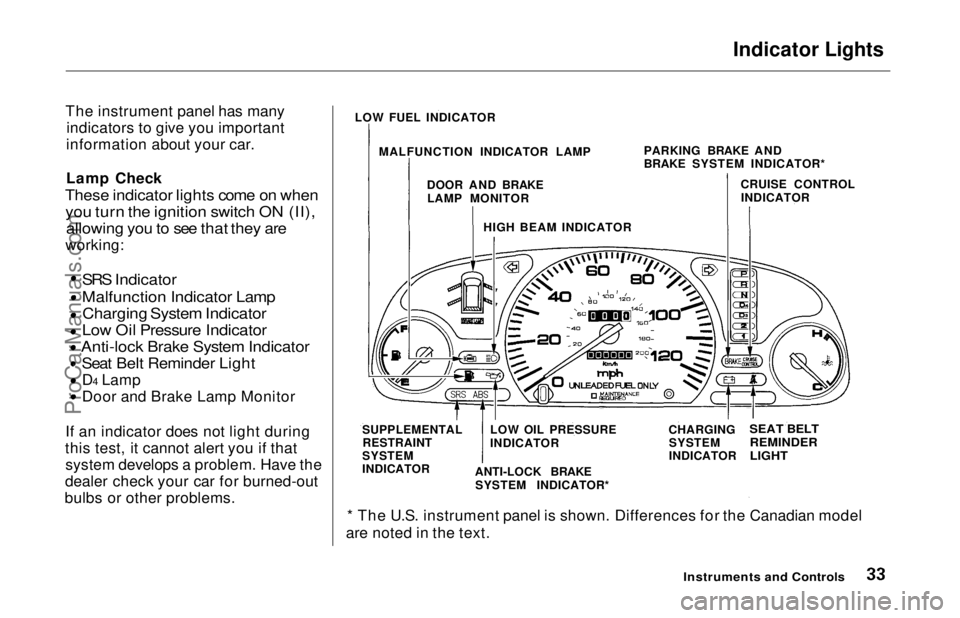
The instrument panel has many indicators to give you important
information about your car.
Lamp Check
These indicator lights come on when
you turn the ignition switch ON (II),
allowing you to see that they are
working:
SRS Indicator
Malfunction Indicator Lamp
Charging System Indicator
Low Oil Pressure Indicator
Anti-lock Brake System Indicator
Seat Belt Reminder Light
D4 Lamp
Door and Brake Lamp Monitor
If an indicator does not light during
this test, it cannot alert you if that system develops a problem. Have the
dealer check your car for burned-out
bulbs or other problems.
* The U.S. instrument panel is shown. Differences for the Canadian model
are noted in the text.
Instruments and Controls
LOW FUEL INDICATOR
MALFUNCTION INDICATOR LAMP DOOR AND BRAKELAMP MONITOR
HIGH BEAM INDICATOR PARKING BRAKE AND
BRAKE SYSTEM INDICATOR*
CRUISE CONTROLINDICATOR
SUPPLEMENTAL RESTRAINT
SYSTEM
INDICATOR LOW OIL PRESSURE
INDICATOR
ANTI-LOCK BRAKE SYSTEM INDICATOR* CHARGING
SYSTEM
INDICATOR
SEAT BELT
REMINDER
LIGHTProCarManuals.comMain Menu Table of Contents s t
Page 110 of 241
Service Station Procedures
Filling the Fuel Tank
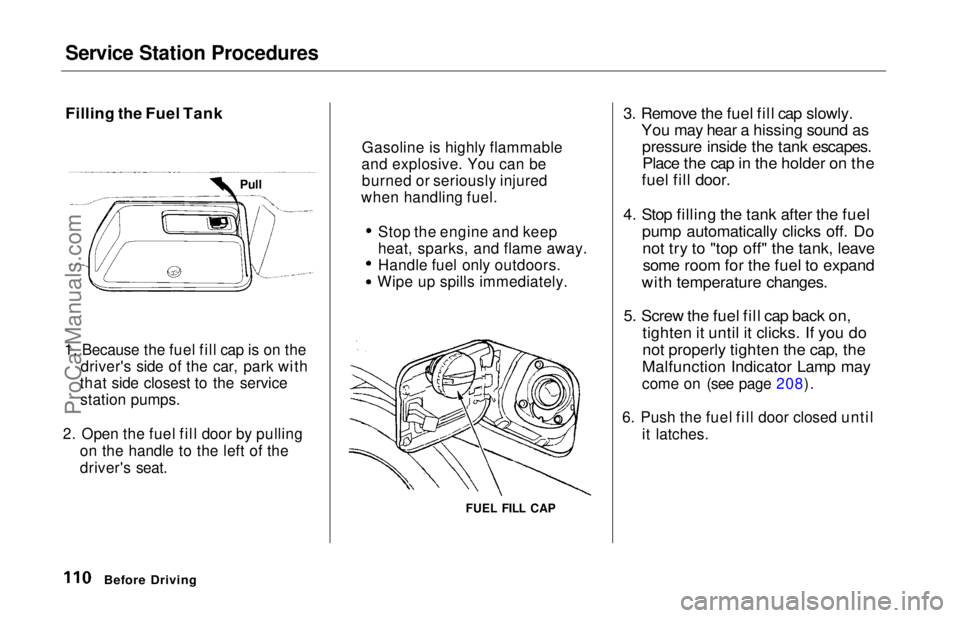
1. Because the fuel fill cap is on the driver's side of the car, park with
that side closest to the service station pumps.
2. Open the fuel fill door by pulling on the handle to the left of the
driver's seat.
3. Remove the fuel fill cap slowly.
You may hear a hissing sound aspressure inside the tank escapes.Place the cap in the holder on the
fuel fill door.
4. Stop filling the tank after the fuel pump automatically clicks off. Donot try to "top off" the tank, leavesome room for the fuel to expand
with temperature changes.
5. Screw the fuel fill cap back on, tighten it until it clicks. If you do
not properly tighten the cap, the
Malfunction Indicator Lamp may
come on (see page 208).
6. Push the fuel fill door closed until it latches.
Before Driving
Pull
FUEL FILL CAP
Gasoline is highly flammable
and explosive. You can be burned or seriously injured
when handling fuel. Stop the engine and keep
heat, sparks, and flame away.
Handle fuel only outdoors.
Wipe up spills immediately.ProCarManuals.comMain Menu Table of Contents s t
Page 114 of 241
Fuel Economy
The condition of your car and your driving habits are the two most
important things that affect the fuel
mileage you get.
Vehicle Condition
Always maintain your car according to the maintenance schedule. This
will keep it in top operating condition.
An important part of that mainte- nance is the Owner Maintenance
Checks (see page 146). For
example, an underinflated tire
causes more "rolling resistance,"
which uses fuel. It also wears out
faster, so check the tire pressure at
least monthly.
In winter, the build-up of snow on
your car's underside adds weight and
rolling resistance. Frequent cleaning
helps your fuel mileage and reduces
the chance of corrosion. Driving Habits
You can improve fuel economy by driving moderately. Rapid acceler-
ation, abrupt cornering, and hard
braking use more fuel.
Always drive in the highest gear that allows the engine to run and acceler-
ate smoothly.
Depending on traffic conditions, try
to maintain a constant speed. Every
time you slow down and speed up,
your car uses extra fuel. Use the cruise control, when appropriate, to
increase fuel economy. A cold engine uses more fuel than a
warm engine. It is not necessary to"warm-up" a cold engine by letting it
idle for a long time. You can drive
away in about a minute, no matter
how cold it is outside. The engine
will warm up faster, and you get better fuel economy. To cut down on
the number of "cold starts," try to combine several short trips into one.
The air conditioning puts an extra load on the engine which makes it use more fuel. Turn off the A/C to
cut down on air conditioning use. Use the flow-through ventilation
when the outside air temperature is moderate.
Before DrivingProCarManuals.comMain Menu Table of Contents s t
Page 145 of 241
Owner Maintenance Checks
You should check the following items at the specified intervals. If
you are unsure of how to perform any check, turn to the page given. Engine oil level — Check every
time you fill the fuel tank. See
page 112.
Engine coolant level — Check the
radiator reserve tank every time
you fill the fuel tank. See page 113.
Windshield washer fluid — Check the level in the reservoir monthly.
If weather conditions cause you to
use the washers frequently, check
the reservoir each time you stop
for fuel. See page 156.
Automatic transmission — Check the fluid level monthly. See page
157.
Brakes — Check the fluid level
monthly. See page 158. Tires — Check the tire pressure
monthly. Examine the tread for
wear and foreign objects. See page
171.
Lights — Check the operation of
the headlights, parking lights,
taillights, high-mount brake light,
turn signals, brake lights, and
license plate lights monthly. See
page 177.
MaintenanceProCarManuals.comMain Menu Table of Contents s t
Page 170 of 241

Tires
To safely operate your car, your tires must be the proper type and size, in
good condition with adequate tread, and correctly inflated. The following
pages give more detailed information on how and when to check air
pressure, how to inspect your tires
for damage and wear, and what to do
when your tires need to be replaced. Inflation
Keeping the tires properly inflated
provides the best combination of
handling, tread life and riding
comfort. Underinflated tires wear
unevenly, adversely affect handling
and fuel economy, and are more
likely to fail from being overheated. Overinflated tires can make your car
ride more harshly, are more prone to damage from road hazards, and wear
unevenly.
We recommend that you visually check your tires every day. If you
think a tire might be low, check it immediately with a tire gauge. Use a gauge to measure the air
pressure at least once a month. Even
tires that are in good condition may
lose one to two psi per month. Remember to check the spare tire at
the same time you check all the other tires.
Check the pressure in the tires when
they are cold. This means the car
has been parked for at least three
hours. If you have to drive the car
before checking the tire pressure,
the tires can still be considered "cold" if you drive less than 1 mile (1.6 km).
CONTINUED
Maintenance
Using tires that are excessively
worn or improperly inflated can
cause a crash in which you can be seriously hurt or killed.
Follow all instructions in this
owner's manual regarding tire
inflation and maintenance.ProCarManuals.comMain Menu Table of Contents s t
Page 235 of 241
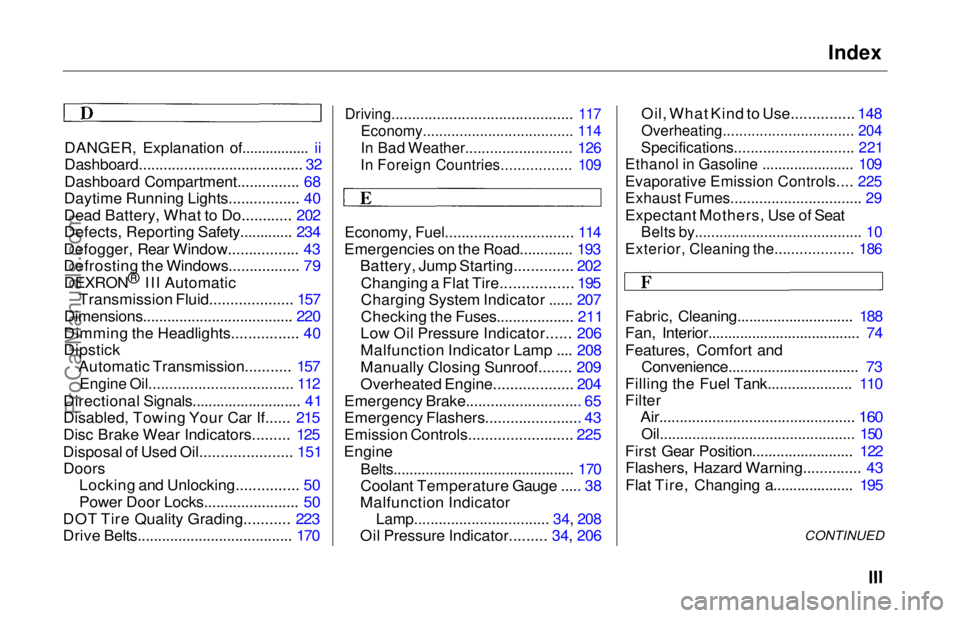
Index
DANGER, Explanation of................. ii
Dashboard........................................ 32
Dashboard Compartment............... 68
Daytime Running Lights................. 40
Dead Battery, What to Do............ 202
Defects, Reporting Safety............. 234
Defogger, Rear Window................. 43
Defrosting the Windows................. 79 DEXRON ®
III Automatic
Transmission Fluid.................... 157
Dimensions..................................... 220
Dimming the Headlights................ 40
Dipstick Automatic Transmission........... 157
Engine Oil................................... 112
Directional Signals........................... 41
Disabled, Towing Your Car If...... 215
Disc Brake Wear Indicators......... 125
Disposal of Used Oil...................... 151 Doors Locking and Unlocking............... 50
Power Door Locks....................... 50
DOT Tire Quality Grading........... 223
Drive Belts...................................... 170
Driving............................................ 117
Economy..................................... 114
In Bad Weather.......................... 126
In Foreign Countries................. 109
Economy, Fuel............................... 114
Emergencies on the Road............. 193
Battery, Jump Starting.............. 202
Changing a Flat Tire................. 195
Charging System Indicator ...... 207
Checking the Fuses................... 211
Low Oil Pressure Indicator...... 206
Malfunction Indicator Lamp .... 208
Manually Closing Sunroof........ 209
Overheated Engine................... 204
Emergency Brake............................ 65
Emergency Flashers....................... 43
Emission Controls......................... 225
Engine
Belts............................................. 170
Coolant Temperature Gauge ..... 38
Malfunction Indicator
Lamp................................. 34, 208
Oil Pressure Indicator......... 34, 206 Oil, What Kind to Use............... 148
Overheating................................ 204
Specifications............................. 221
Ethanol in Gasoline ....................... 109
Evaporative Emission Controls.... 225
Exhaust Fumes................................ 29
Expectant Mothers, Use of Seat
Belts by......................................... 10
Exterior, Cleaning the................... 186
Fabric, Cleaning............................. 188
Fan, Interior...................................... 74
Features, Comfort and Convenience................................. 73
Filling the Fuel Tank..................... 110
Filter
Air................................................ 160
Oil................................................ 150
First Gear Position......................... 122 Flashers, Hazard Warning.............. 43
Flat Tire, Changing a.................... 195
CONTINUEDProCarManuals.comMain Menu s t
Page 237 of 241
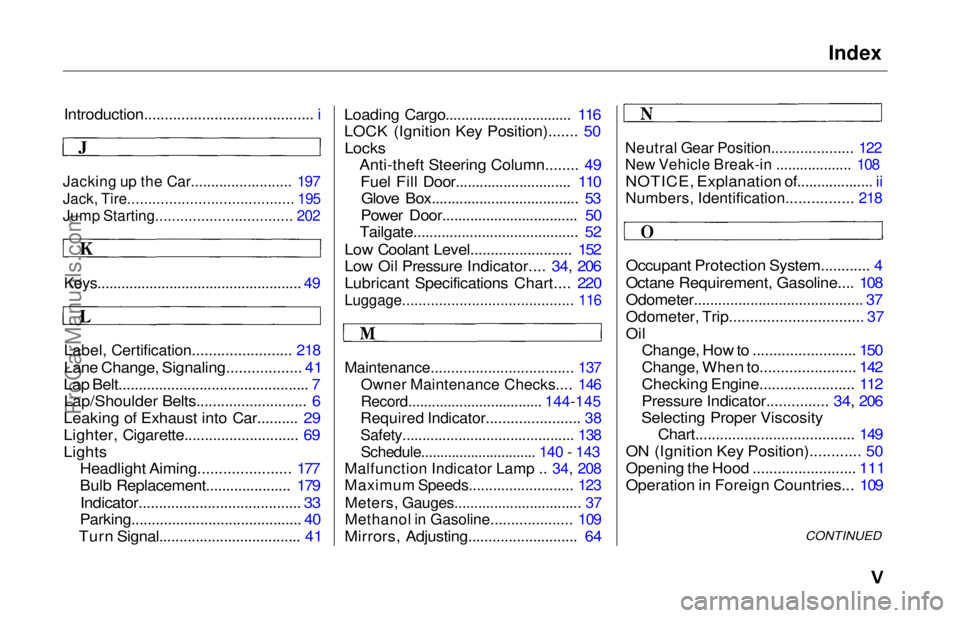
Index
Introduction......................................... i
Jacking up the Car......................... 197
Jack, Tire........................................ 195
Jump Starting................................. 202
Keys................................................... 49
Label, Certification........................ 218
Lane Change, Signaling.................. 41
Lap Belt............................................... 7 Lap/Shoulder Belts........................... 6
Leaking of Exhaust into Car.......... 29
Lighter, Cigarette............................ 69
Lights Headlight Aiming...................... 177
Bulb Replacement..................... 179
Indicator........................................ 33
Parking.......................................... 40
Turn Signal................................... 41 Loading Cargo................................ 116
LOCK (Ignition Key Position)....... 50
Locks
Anti-theft Steering Column........ 49
Fuel Fill Door............................. 110Glove Box..................................... 53
Power Door.................................. 50
Tailgate......................................... 52
Low Coolant Level......................... 152
Low Oil Pressure Indicator.... 34, 206
Lubricant Specifications Chart.... 220
Luggage.......................................... 116
Maintenance................................... 137
Owner Maintenance Checks.... 146
Record.................................. 144-145
Required Indicator....................... 38
Safety........................................... 138
Schedule.............................. 140 - 143
Malfunction Indicator Lamp .. 34, 208
Maximum Speeds.......................... 123
Meters, Gauges................................ 37
Methanol in Gasoline.................... 109
Mirrors, Adjusting........................... 64
Neutral Gear Position.................... 122
New Vehicle Break-in ................... 108
NOTICE, Explanation of................... ii
Numbers, Identification................ 218
Occupant Protection System............ 4
Octane Requirement, Gasoline.... 108
Odometer.......................................... 37
Odometer, Trip................................ 37
Oil Change, How to ......................... 150
Change, When to....................... 142
Checking Engine....................... 112
Pressure Indicator............... 34, 206
Selecting Proper Viscosity Chart....................................... 149
ON (Ignition Key Position)............ 50
Opening the Hood ......................... 111
Operation in Foreign Countries... 109
CONTINUEDProCarManuals.comMain Menu s t
Page 241 of 241

Gas Station Information
Gasoline: UNLEADED gasoline
Pump octane number of 86 or
higher
Fuel Tank Capacity: 17.2 US gal (65 l ,14.3 Imp gal)
Recommended Engine Oil:
API SH grade
"Energy Conserving II" oil
SAE 5W-30 viscosity Tire Pressure (measured cold):
Front/Rear:
32 psi (220 kPa , 2.2 kgf/cm2)
Spare Tire Pressure: 60 psi (420 kPa , 4.2 kgf/cm2) Automatic Transmission Fluid:
Honda Premium Formula Auto-
matic Transmission Fluid (ATF)ProCarManuals.comMain Menu s t