1997 HONDA ODYSSEY catalytic converter
[x] Cancel search: catalytic converterPage 109 of 241

Gasoline
The following are the EPA-approved percentages of oxygenates:
ETHANOL (ethyl or grain alcohol)
You may use gasoline containing up to 10 percent ethanol by volume.Gasoline containing ethanol may be
marketed under the name "Gasohol."
MTBE (Methyl Tertiary Butyl Ether)
You may use gasoline containing up to 15 percent MTBE by volume.
METHANOL (methyl or wood
alcohol)
You may use gasoline containing up to 5 percent methanol by volume as
long as it also contains cosolventsand corrosion inhibitors to protect
the fuel system. Gasoline containing
more than 5 percent methanol by
volume may cause starting and/or performance problems. It may alsodamage metal, rubber and plastic
parts of your fuel system. If you notice any undesirable
operating symptoms, try another
service station or switch to another
brand of gasoline.
Fuel system damage or performance
problems resulting from the use of an oxygenated fuel containing more
than the percentages of oxygenates
given above are not covered under
warranty.
Driving in Foreign Countries
If you are planning to take your Honda outside the U.S. or Canada,
contact the tourist bureaus in the
areas you will be traveling in to find out about the availability of unleaded
gasoline with the proper octane
rating.
If unleaded gasoline is not available,
be aware that using leaded gasoline in your Honda will affect perfor-
mance and fuel mileage, and damage
its emissions controls. It will no
longer comply with U.S. andCanadian emissions regulations, and
will be illegal to operate in North
America. To bring your car back into compliance will require the replace-
ment of several components, such as
the oxygen sensors and the three
way catalytic converter. These re- placements are not covered under
warranty.
Before DrivingProCarManuals.comMain Menu Table of Contents s t
Page 124 of 241
Parking
Always use the parking brake when
you park your vehicle. The indicator on the instrument panel shows that
the parking brake is not fully released; it does not indicate that the
parking brake is firmly set. Make sure the parking brake is set firmly
or your vehicle may roll if it is
parked on an incline.
Set the parking brake before you put
the transmission in Park. This keeps
the vehicle from moving and putting
pressure on the parking mechanism
in the transmission — making it easier to move the shift lever out of
Park when you want to drive away. If the vehicle is facing uphill, turn
the front wheels away from the curb.
If the vehicle is facing downhill, turn
the front wheels toward the curb.
Make sure the parking brake is fully
released before driving away.
Driving with the parking brake
partially set can overheat or damage the rear brakes, and will cause the
ABS indicator to light. Parking Tips
Make sure the sunroof and the
windows are closed.
Turn off the lights. Place any packages, valuables, etc.,
in the cargo area or take them
with you.
Lock the doors with the key or the
remote transmitter.
Never park over dry leaves, tall
grass, or other flammable
materials. The three way catalytic
converter gets very hot, and could
cause these materials to catch on
fire.
DrivingProCarManuals.comMain Menu Table of Contents s t
Page 214 of 241
Technical Information
The diagrams in this section give you the dimensions and capacities of
your Honda, and the locations of the identification numbers. The expla-
nations of several electronic andmechanical systems on your Honda
are for the more technically-oriented
owner. Identification Numbers................. 218
Specifications................................. 220
Tire Information............................ 222
Tire Size Designation................ 222
Wheel Size Designation............ 222Tire Speed Ratings.................... 222
Tire Pressure Adjustment For High Speed Driving........ 223
DOT Tire Quality Grading....... 223 Treadwear.............................. 223
Traction.................................. 224
Temperature.......................... 224 Emission Controls......................... 225
The Clean Air Act...................... 225Crankcase Emission Control System..................................... 225
Evaporative Emission Control System..................................... 225
Exhaust Emission Controls...... 226 PGM-FI System..................... 226
Ignition Timing Control System................................. 226
Exhaust Gas Recirculation (EGR) System.................... 226
Three Way Catalytic Converter............................ 226
Replacement Parts..................... 226
Three Way Catalytic Converter... 227
Technical InformationProCarManuals.comMain Menu s t
Page 223 of 241

Emission Controls
Exhaust Emission Controls
The exhaust emission controls include four systems: PGM-FI,
Ignition Timing Control, ExhaustGas Recirculation and Three Way
Catalytic Converter. These four
systems work together to control the
engine's combustion and minimize
the amount of HC, CO, and NOx that
comes out the tailpipe. The exhaust
emission control systems are
separate from the crankcase and
evaporative emission control
systems.
PGM-FI System
The PGM-FI System uses sequential multiport fuel injection.It has three subsystems: Air Intake,
Engine Control, and Fuel Control.
The Powertrain Control Module (PCM) uses various sensors to
determine how much air is going
into the engine. It then controls how
much fuel to inject under all operat-
ing conditions. Ignition Timing Control System
This system constantly adjusts the ignition timing, reducing the amountof HC, CO and NOx produced.
Exhaust Gas Recirculation (EGR)
System
The Exhaust Gas Recirculation (EGR) system takes some of the
exhaust gas and routes it back into
the intake manifold. Adding exhaust
gas to the air/fuel mixture reduces
the amount of NOx produced when
the fuel is burned.
Three Way Catalytic Converter
The three way catalytic converter is in the exhaust system. Through
chemical reactions, it converts HC,CO, and NOx in the engine's exhaust
to carbon dioxide (CO 2), dinitrogen
(N 2), and water vapor. Replacement Parts
The emission control systems are designed and certified to work to-
gether in reducing emissions to
levels that comply with the Clean Air
Act. To make sure the emissions remain low, you should use only newGenuine Honda replacement parts or
their equivalent for repairs. Using
lower quality parts may increase the emissions from your car.
The emissions control systems are covered by warranties separate from
the rest of your car. Read your
warranty manual for more informa-
tion.
Technical InformationProCarManuals.comMain Menu Table of Contents s t
Page 224 of 241
Three Way Catalytic Converter
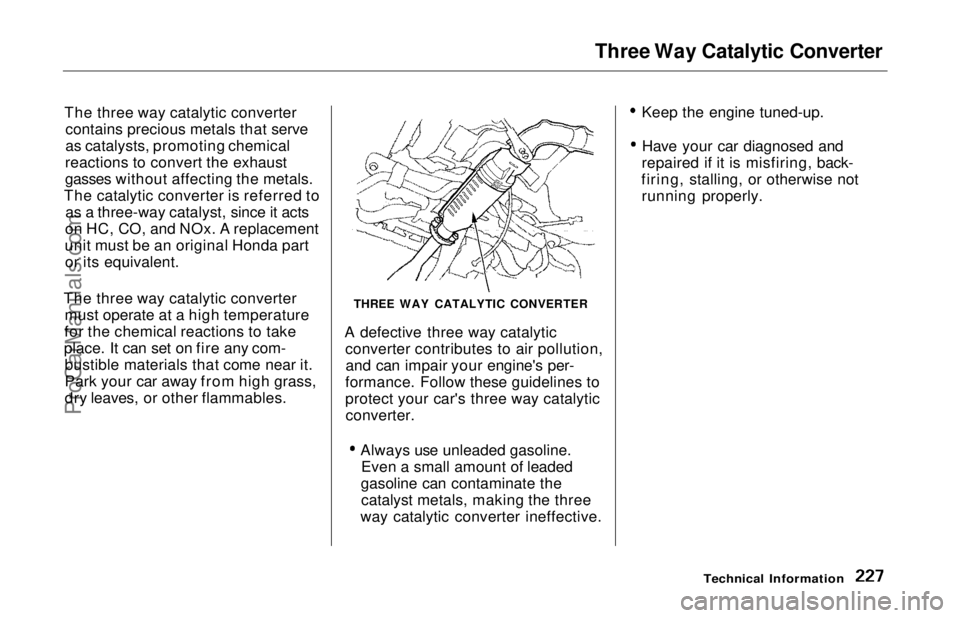
The three way catalytic converter contains precious metals that serve
as catalysts, promoting chemical
reactions to convert the exhaust
gasses without affecting the metals.
The catalytic converter is referred to as a three-way catalyst, since it acts
on HC, CO, and NOx. A replacement
unit must be an original Honda part or its equivalent.
The three way catalytic converter must operate at a high temperature
for the chemical reactions to take
place. It can set on fire any com- bustible materials that come near it.
Park your car away from high grass,
dry leaves, or other flammables. A defective three way catalytic
converter contributes to air pollution,and can impair your engine's per-
formance. Follow these guidelines to
protect your car's three way catalytic converter.
Always use unleaded gasoline.Even a small amount of leaded
gasoline can contaminate the catalyst metals, making the three
way catalytic converter ineffective. Keep the engine tuned-up.
Have your car diagnosed and
repaired if it is misfiring, back-
firing, stalling, or otherwise not running properly.
Technical Information
THREE WAY CATALYTIC CONVERTERProCarManuals.comMain Menu Table of Contents s t
Page 239 of 241
Index
Seats
Folding the Third Seats.............. 60
Head Restraints........................... 56
Passenger Seating....................... 54
Reclining the Second Seat.......... 59
Removing the Second Seats....... 57
Third Seat Access........................ 56
Serial Number................................ 218
Service Intervals*.......................... 142
Service Manual.............................. 235
Service Station Procedures .......... 110
Setting the Clock............................. 66
Shifting the Automatic
Transmission.............................. 120
Shift Lever Position Indicator...... 120
Shift Lever Positions..................... 120
Side Marker Lights, Bulb
Replacement in.......................... 180
Signaling Turns................................ 41
Snow Tires...................................... 176
Solvent-type Cleaners.................... 186
Sound System................................... 83
Spare Tire
Inflating....................................... 194
Specifications............................. 221
Spark Plugs, Replacing................. 162 Specifications Charts..................... 220
Speed Control................................... 46
Speedometer.................................... 37
SRS Indicator.............................. 16, 34
START (Ignition Key Position)..... 50
Starting the Engine........................ 119 In Cold Weather at HighAltitude................................... 119
With a Dead Battery................. 202
Steam Coming from Engine......... 204
Steering Wheel
Adjustment................................... 44
Anti-theft Column Lock.............. 49
Stereo Sound System...................... 83
Storing Your Car............................ 184
Sunroof.............................................. 63
Closing Manually....................... 209
Operation...................................... 63
Supplemental Restraint System Service Precautions..................... 17
Servicing....................................... 16
SRS Indicator.......................... 16, 34
System Components.................... 12
Synthetic Oil................................... 149 Tailgate............................................. 52
Taillights, Changing Bulbs in....... 181
Taking Care of the Unexpected .. 193
Tape Player................................. 87, 99
Technical Descriptions Emission Control Systems........ 225
Three Way Catalytic Converter................................ 227
Tire Information........................ 222
Temperature Gauge........................ 38
Tether Attachment Points.............. 26 Three Way Catalytic Converter... 227
Time, Setting the............................. 66
Timing Belt..................................... 170
Tire Chains..................................... 176
Tire, How to Change a Flat.......... 195
Tires................................................ 171 Air Pressure............................... 171
Checking Wear.......................... 173
Compact Spare........................... 194
DOT Tire Quality Grading....... 223
Inflation....................................... 171
CONTINUEDProCarManuals.comMain Menu s t