Page 128 of 241
The Braking System, Driving in Bad Weather
If anything goes wrong, the ABS
indicator on the instrument panel
comes on (see page 35). This means
the anti-lock function of the braking
system has shut down. The brakes
still work like a conventional system
without anti-lock, providing normal stopping ability. You should have the
dealer inspect your vehicle as soon
as possible if this light stays on after
you start the engine, or comes on while driving. Driving in Bad Weather
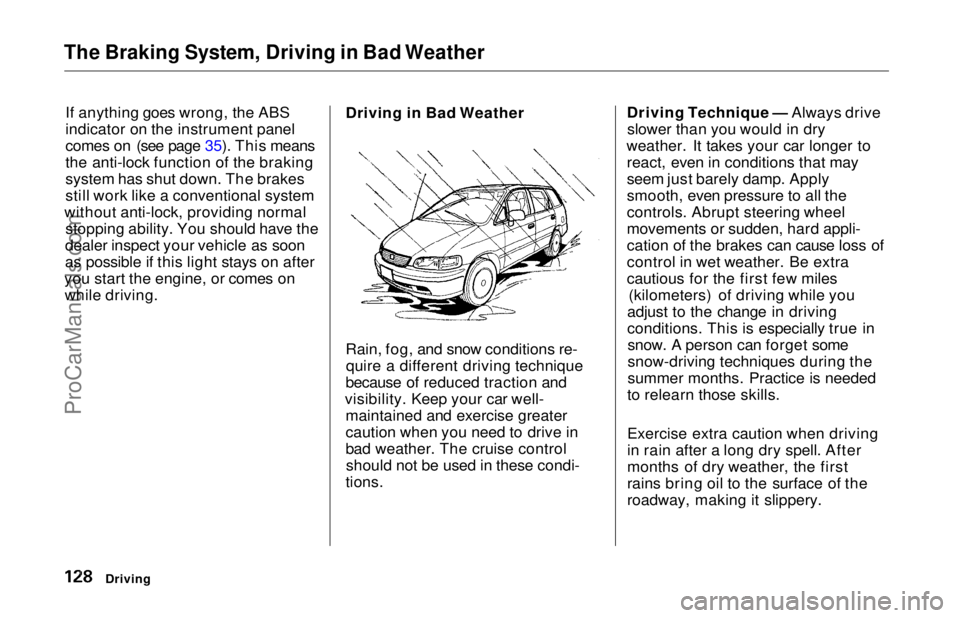
Rain, fog, and snow conditions re-
quire a different driving technique
because of reduced traction and
visibility. Keep your car well- maintained and exercise greater
caution when you need to drive in
bad weather. The cruise controlshould not be used in these condi-
tions. Driving Technique — Always drive
slower than you would in dry
weather. It takes your car longer to react, even in conditions that may
seem just barely damp. Apply
smooth, even pressure to all the
controls. Abrupt steering wheel
movements or sudden, hard appli-
cation of the brakes can cause loss of
control in wet weather. Be extra
cautious for the first few miles (kilometers) of driving while you
adjust to the change in driving
conditions. This is especially true in snow. A person can forget some
snow-driving techniques during the
summer months. Practice is needed
to relearn those skills.
Exercise extra caution when driving
in rain after a long dry spell. After
months of dry weather, the first
rains bring oil to the surface of the
roadway, making it slippery.
DrivingProCarManuals.comMain Menu Table of Contents s t
Page 157 of 241
Brake Fluid
Check the fluid level in the reser-
voirs monthly. There are two reser-
voirs. They are:
Brake fluid reservoir
ABS reservoir
The brake fluid in the brake and anti- lock brake systems should be
replaced according to the time anddistance recommendations in the
maintenance schedule. Always use Genuine Honda DOT 3
brake fluid. If it is not available, youshould use only DOT 3 or DOT 4
fluid, from a sealed container, as a temporary replacement. However,
the use of any non-Honda brake fluid can cause corrosion and decrease
the life of the system. Have the
brake fluid replaced with Honda DOT 3 brake fluid as soon as
possible.
Brake fluid marked DOT 5 is not
compatible with your car's brakingsystem and can cause extensive
damage.
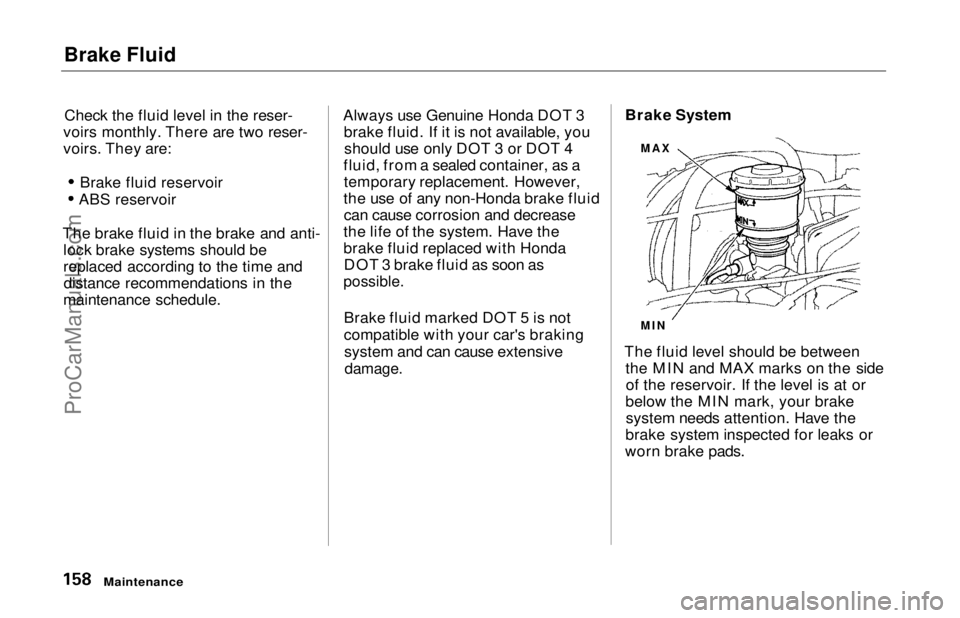
Brake System
The fluid level should be between the MIN and MAX marks on the sideof the reservoir. If the level is at or
below the MIN mark, your brake system needs attention. Have the
brake system inspected for leaks or
worn brake pads.
Maintenance
MAX
MINProCarManuals.comMain Menu Table of Contents s t
Page 158 of 241
Brake Fluid, Power Steering
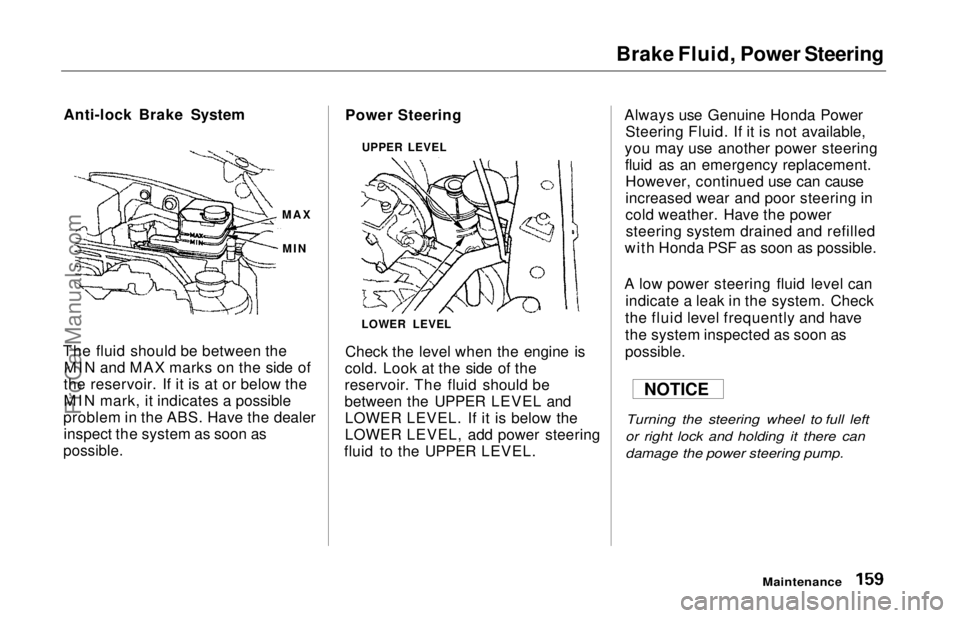
Anti-lock Brake System
The fluid should be between the MIN and MAX marks on the side of
the reservoir. If it is at or below the
MIN mark, it indicates a possible
problem in the ABS. Have the dealer inspect the system as soon as
possible.
Power Steering
Check the level when the engine is
cold. Look at the side of the
reservoir. The fluid should be
between the UPPER LEVEL and LOWER LEVEL. If it is below the
LOWER LEVEL, add power steering
fluid to the UPPER LEVEL. Always use Genuine Honda Power
Steering Fluid. If it is not available,
you may use another power steering fluid as an emergency replacement.However, continued use can cause
increased wear and poor steering in
cold weather. Have the powersteering system drained and refilled
with Honda PSF as soon as possible.
A low power steering fluid level can indicate a leak in the system. Check
the fluid level frequently and have
the system inspected as soon as
possible.
Turning the steering wheel to full left
or right lock and holding it there can
damage the power steering pump.
Maintenance
MAX
MIN
NOTICE
LOWER LEVEL UPPER LEVELProCarManuals.comMain Menu Table of Contents s t
Page 165 of 241
Windshield Wipers
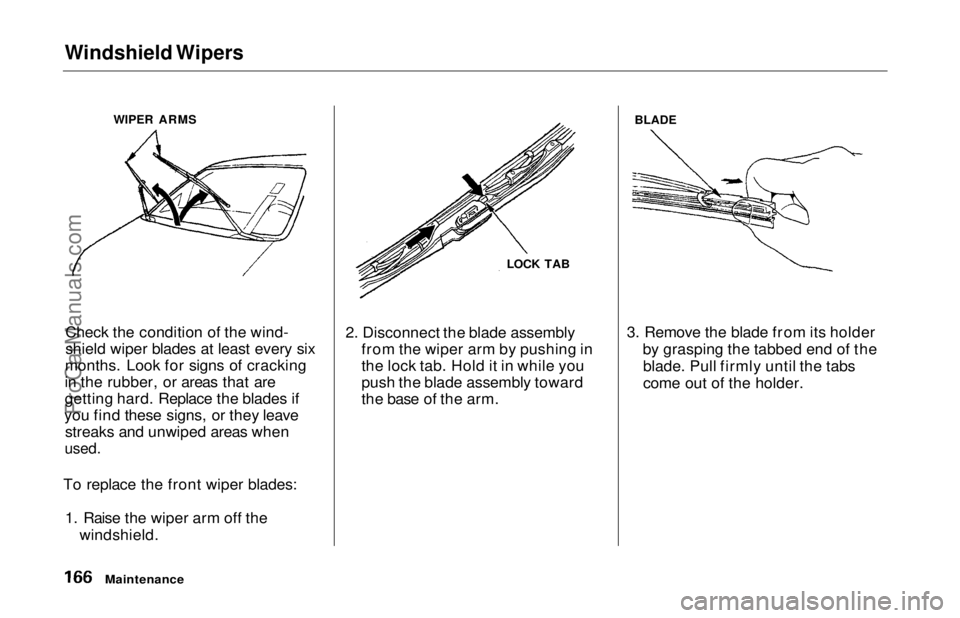
Check the condition of the wind-
shield wiper blades at least every six
months. Look for signs of cracking
in the rubber, or areas that are
getting hard. Replace the blades if
you find these signs, or they leave streaks and unwiped areas when
used.
To replace the front wiper blades: 1. Raise the wiper arm off the windshield. 2. Disconnect the blade assembly
from the wiper arm by pushing in
the lock tab. Hold it in while you
push the blade assembly toward
the base of the arm. 3. Remove the blade from its holder
by grasping the tabbed end of theblade. Pull firmly until the tabs
come out of the holder.
Maintenance
WIPER ARMS
LOCK TABBLADEProCarManuals.comMain Menu Table of Contents s t
Page 166 of 241
Windshield Wipers
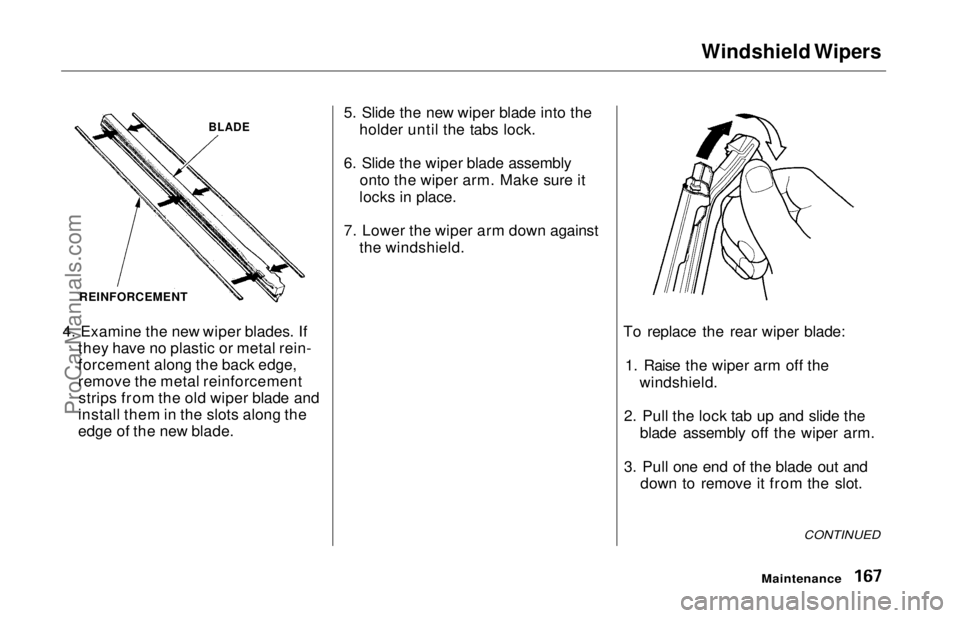
4. Examine the new wiper blades. If they have no plastic or metal rein-
forcement along the back edge,
remove the metal reinforcementstrips from the old wiper blade and
install them in the slots along the
edge of the new blade. 5. Slide the new wiper blade into the
holder until the tabs lock.
6. Slide the wiper blade assembly onto the wiper arm. Make sure it
locks in place.
7. Lower the wiper arm down against the windshield.
To replace the rear wiper blade:1. Raise the wiper arm off the windshield.
2. Pull the lock tab up and slide the blade assembly off the wiper arm.
3. Pull one end of the blade out and down to remove it from the slot.
CONTINUED
Maintenance
BLADE
REINFORCEMENTProCarManuals.comMain Menu Table of Contents s t
Page 174 of 241
Tires
It is best to replace all four tires at
the same time. If that is not possible
or necessary, then replace the two
front tires or the two rear tires as a
pair. Replacing just one tire can seriously affect your car's handling.
The ABS works by comparing the speed of the wheels. When replacing
tires, use the same size originally supplied with the car. Tire size and
construction can affect wheel speed
and may cause the system to work in-
consistently. If you ever need to replace a wheel,
make sure the wheel's specifications
match those of the original wheel
that came on your car. Replacement
wheels are available at your Honda
dealer.
Wheels and Tires Wheel: 15 x 6 JJ
Tire:
P205/65R15 92S
See Tire Information on page 222 for
additional information about tire and
wheel size designations. See page 223 for information about DOT Tire
Quality Grading.
Winter Driving
Tires that are marked "M + S" or "All Season" on the sidewall have an
all-weather tread design. They
should be suitable for most winterdriving conditions. Tires without
these markings are designed for optimum traction in dry conditions.
They may not provide adequate performance in winter driving.
For the best performance in snowyor icy conditions, you should install
snow tires or tire chains. They may
be required by local laws under certain conditions.
CONTINUED
Maintenance
Installing improper tires on your
car can affect handling and
stability. This can cause a crash in which you can be seriously
hurt or killed.
Always use the size and type of
tires recommended in this owner's manual.ProCarManuals.comMain Menu Table of Contents s t
Page 178 of 241
Lights
Replacing a Headlight Bulb
Your car has halogen headlight bulbs, one on each side. When
replacing a bulb, handle it by its steel
base and protect the glass fromcontact with your skin or hard
objects. If you touch the glass, clean
it with denatured alcohol and a clean
cloth.
Halogen headlight bulbs get very hot
when lit. Oil, perspiration, or a scratch
on the glass can cause the bulb to
overheat and shatter.
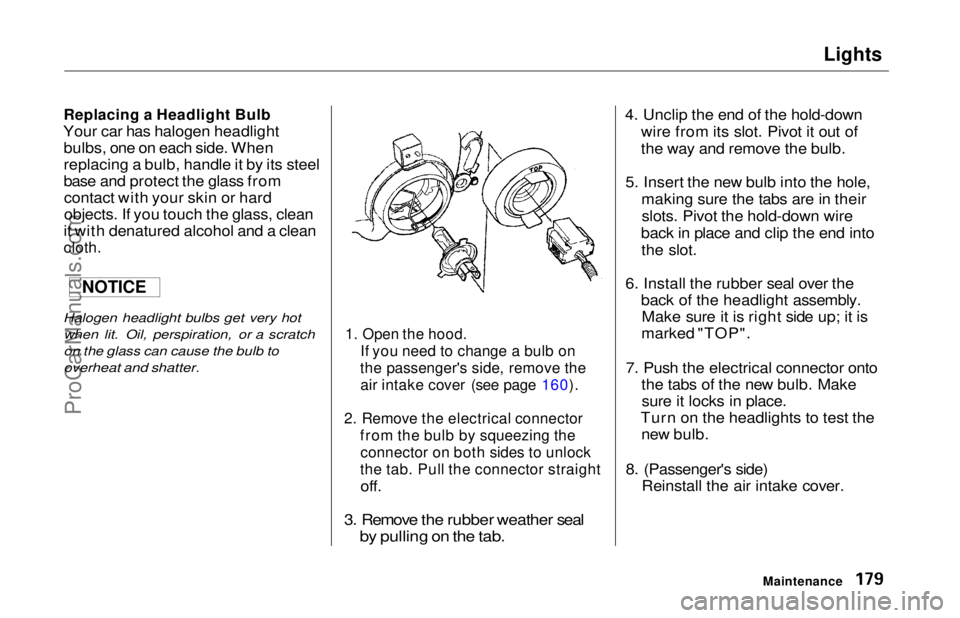
1. Open the hood.
If you need to change a bulb on
the passenger's side, remove the
air intake cover (see page 160).
2. Remove the electrical connector from the bulb by squeezing the
connector on both sides to unlock
the tab. Pull the connector straight
off.
3. Remove the rubber weather seal
by pulling on the tab.
4. Unclip the end of the hold-down
wire from its slot. Pivot it out of
the way and remove the bulb.
5. Insert the new bulb into the hole, making sure the tabs are in theirslots. Pivot the hold-down wire
back in place and clip the end into the slot.
6. Install the rubber seal over the back of the headlight assembly.Make sure it is right side up; it is
marked "TOP".
7. Push the electrical connector onto the tabs of the new bulb. Makesure it locks in place.
Turn on the headlights to test the new bulb.
8. (Passenger's side) Reinstall the air intake cover.
Maintenance
NOTICEProCarManuals.comMain Menu Table of Contents s t
Page 179 of 241
Lights
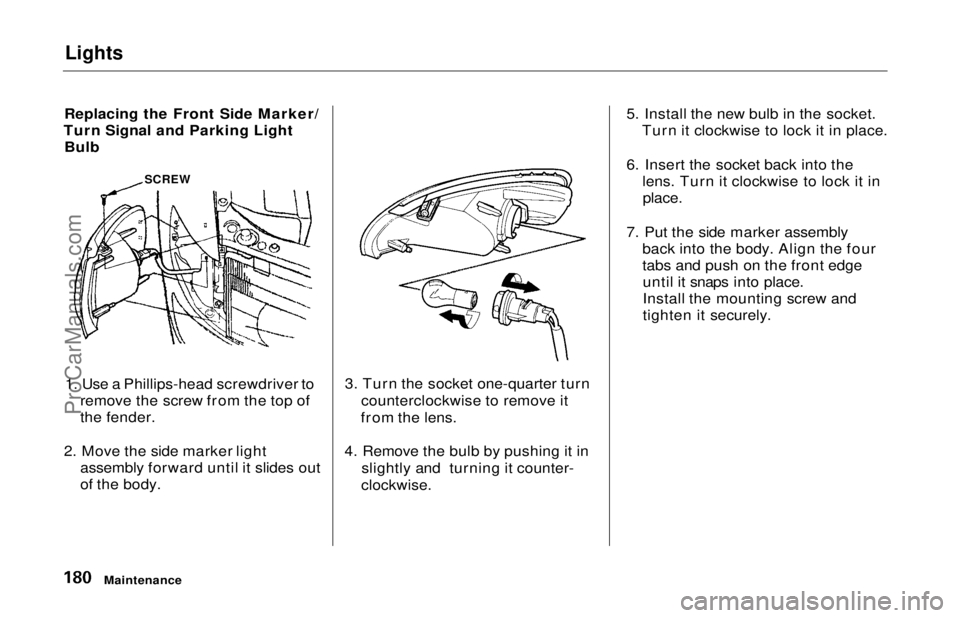
Replacing the Front Side Marker/
Turn Signal and Parking Light Bulb
1. Use a Phillips-head screwdriver to remove the screw from the top of
the fender.
2. Move the side marker light assembly forward until it slides out
of the body. 3. Turn the socket one-quarter turn
counterclockwise to remove it
from the lens.
4. Remove the bulb by pushing it in slightly and turning it counter-
clockwise.
5. Install the new bulb in the socket.
Turn it clockwise to lock it in place.
6. Insert the socket back into the lens. Turn it clockwise to lock it in
place.
7. Put the side marker assembly back into the body. Align the four
tabs and push on the front edgeuntil it snaps into place.
Install the mounting screw and
tighten it securely.
Maintenance
SCREWProCarManuals.comMain Menu Table of Contents s t