1997 GMC SIERRA fuel cap
[x] Cancel search: fuel capPage 283 of 436
/1 CAUTION:
If you get gasoline on yourself and then
something ignites it, you could be badly burned. Gasoline can spray out on you if you open the
fuel filler cap too quickly. This spray can happen
if your tank is nearly full, and
is more likely in
hot weather. Open the fuel filler cap slowly and
wait for
any “hiss” noise to stop. Then unscrew
the cap all the
way.
When you put the cap back on, turn it to the right
(clockwise)
until you hear a clicking sound. Make sure
you fully install the cap.
NOTICE:
If you need a new cap, be sure to get the right
type.
Your dealer can get one for you. If you get
the wrong type, it may not
fit or have proper
venting, and your fuel tank and emissions system
might be damaged.
Be careful not
to spill gasoline. Clean gasoline from
painted surfaces as soon as possible. See “Cleaning the
Outside of Your Vehicle” in the Index.
6-7
ProCarManuals.com
Page 291 of 436
Engine Oil (Gasoline Engine)
If your vehicle has a diesel engine, see “Engine Oil (Diesel Engine)” in the Diesel Engine Supplement.
It’s a good idea to check your engine oil every time you
get fuel. In order to get an accurate reading, the oil must
be warm and the vehicle must be on level ground.
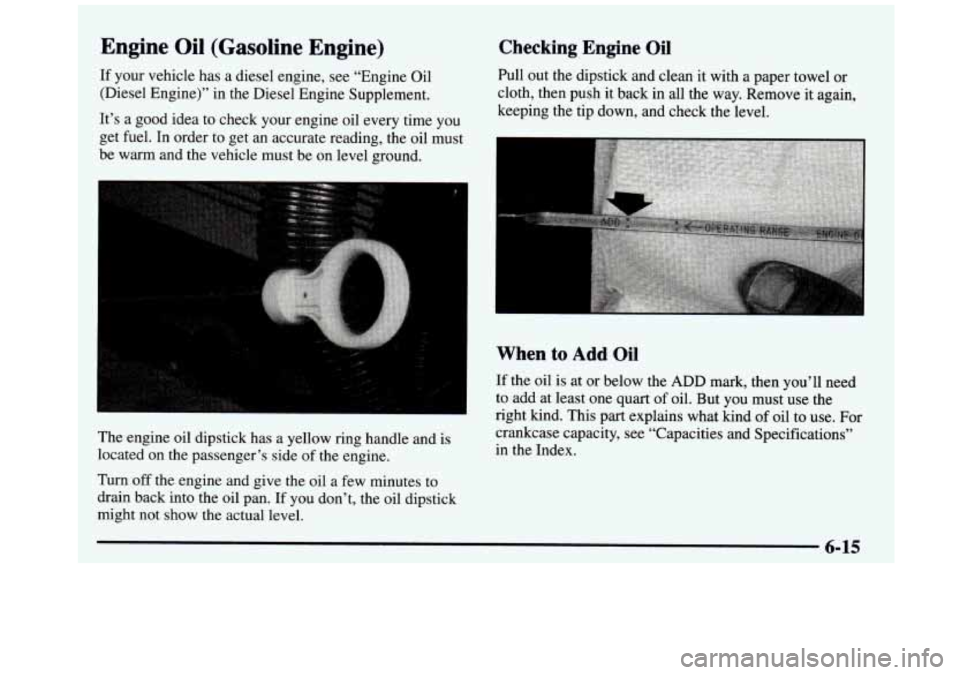
The engine oil dipstick has
a yellow ring handle and is
located on the passenger’s side
of the engine.
Turn
off the engine and give the oil a few minutes to
drain back into the oil pan.
If you don’t, the oil dipstick
might not show the actual level.
Checking Engine Oil
Pull out the dipstick and clean it with a paper towel or
cloth, then push it back in all the way. Remove it again,
keeping the tip down, and check the level.
When to Add Oil
If the oil is at or below the ADD mark, then you’ll need
to add at least one
quart of oil. But you must use the
right kind. This part explains what kind of oil to use.
For
crankcase capacity, see “Capacities and Specifications”
in the Index.
6-15
ProCarManuals.com
Page 354 of 436
Fuel Tank Capacity (Approximate)
Type
Short Bed
Long Bed Standard Crew Cab
Chassis-Cab Side Tank
Chassis-Cab Rear Tank 3500
HD Models Side Tank
3500
HD Models Rear Tank
Cooling System Capacity (Approximate)
After refill, the level must be rechecked. See “Cooling
System” in the Index.
Engine
“VORTEC” 4300
“VORTEC”
5000
“VORTEC” 5700
“VORTEC” 7400
“VORTEC”
7400
w/3500 HD
VIN
W
M
R
J
J
Quantity
13 quarts (12.3 L)
17.5 quarts (16.6 L)
17.5 quarts (16.6 L)
25 quarts (23.5 L)
28.5 quarts (27 L)
Crankcase Capacity (Approximate)
After refill, the level must be rechecked. See “Engine
Oil” in the Index.
Engine
“VORTEC” 4300
“VORTEC”
5000
“VORTEC” 5700”
“VORTEC” 7400*
VIN
W
M
R
J
Quantity with Filter?
5 quarts (4.8 L)
5 quarts (4.8 L)
7 quarts (6.5 L)
4.5 quarts (4.3
L)
?Oil
filter should be changed at every oil change.
*Add one additional quart (.946
L) for C-3500 HD Models.
Quantity
26 gallons (98 L)
34 gallons (128 L)
34 gallons (128 L)
22 gallons (83 L)
18 gallons (68 L)
22 gallons (83 L)
18 gallons (68 L)
Air Conditioning Refrigerants
Not all air conditioning refrigerants are the same.
If the
air conditioning system in your vehicle needs
refrigerant, be sure the proper refrigerant
is used.
If you’re not sure, ask your GM dealer.
See the refrigerant charge label under the hood for
information regarding refrigerant capacity.
6-78
ProCarManuals.com
Page 359 of 436
Maintenance Schedule
-
Short Trip/City Definition -- Gasoline Engines
Follow the Short TripKity Maintenance Schedule if any
one of these conditions is true for your vehicle:
Most trips are less than 5 to 10 miles (8 to 16 km).
This is particularly important when outside
temperatures
are below freezing.
driving in stop-and-go traffic).
off-road frequently.
Most trips include extensive idling (such as frequent
You operate your vehicle in dusty areas or
You frequently tow a trailer.
If the vehicle is used for delivery service, police, taxi
One of the reasons you should follow this schedule if you
operate
your vehicle under any of these conditions is that
these conditions cause engine
oil to break down soonel:
Short Trip/City Intervals -- Gasoline Engines
Every
3,000 Miles (5 000 km): Engine Oil and Filter
or other commercial application.
Change (or
3 months, whichever occurs first). Chassis
Lubrication (or
3 months, whichever occurs first). Drive
Axle Service (or
3 months, whichever occurs fmt).
Short Trip/City Intervals -- Gasoline Engines
Every 6,000 Miles (10
000 km): Tire Rotation.
Every 15,000 Miles (25 000 km): Shields and
Underhood Insulation Inspection (GVWR above
8,500 lbs. only). Front Wheel Bearing Repack (2WD
only) (or at each brake relining, whichever occurs first).
Every 30,000 Miles (50 000 km): Fuel Filter Replacement.
Every 50,000 Miles (83 000 km): Automatic
Transmission Service (vehicles over
8600 GVWR or
driven under severe conditions only).
Every 60,000 Miles (100 000 km): Engine Accessory
Drive Belt Inspection. Fuel Tank, Cap and Lines
Inspection. Exhaust Gas Recirculation System
Inspection. Evaporative Control System Inspection.
Every 100,000 Miles (166 000 km): Spark Plug Wire
Inspection. Spark Plug Replacement. Positive
Crankcase Ventilation (PCV) Valve Inspection.
Every 150,000 Miles (240 000 km): Cooling System
Service (or every
60 months, whichever occurs first).
These intervals only summarize maintenance services.
Be sure to follow the complete maintenance schedule
on the following pages.
ProCarManuals.com
Page 360 of 436
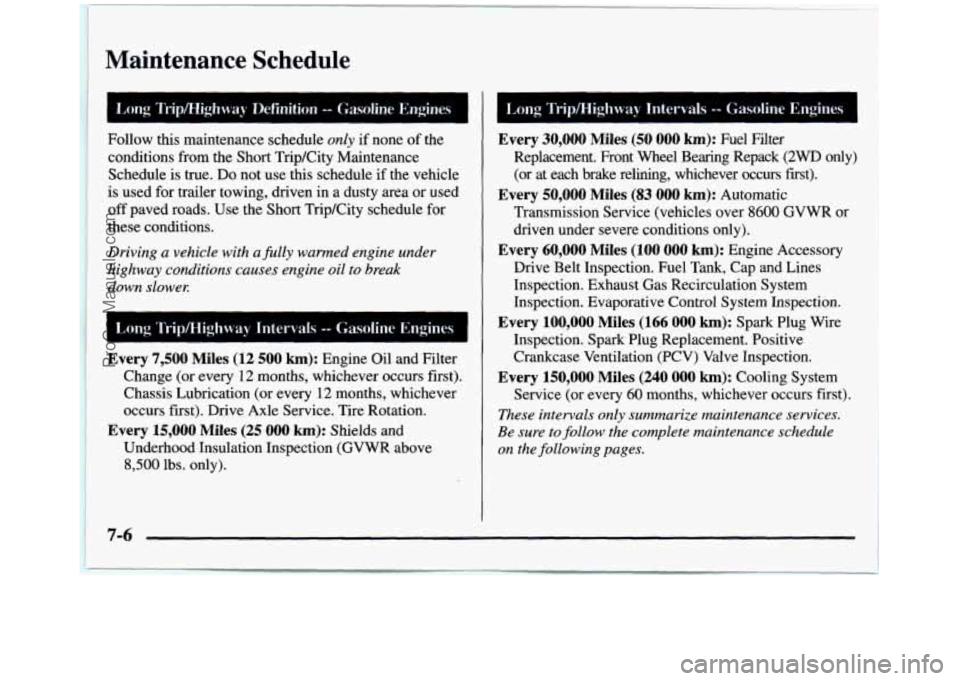
Maintenance Schedule
Follow this maintenance schedule only if none of the
conditions from the Short Trip/City Maintenance
Schedule is true.
Da not use this schedule if the vehicle
is used for trailer towing, driven in a dusty area or used
off paved roads. Use the Short Trip/City schedule for
these conditions.
Driving a vehicle with afully warmed engine under
highway conditions causes engine
oil to break
down slower:
Every 7,500 Miles (12 500 km): Engine Oil and Filter
Change (or every
12 months, whichever occurs first).
Chassis Lubrication (or every 12 months, whichever
occurs first). Drive Axle Service. Tire Rotation.
Underhood Insulation Inspection (GVWR above
8,500 lbs. only).
Every 15,000 Miles (25 OOO km): Shields and
I
1 Long Trip/Highway Intervals -- Gasoline Engines ~~~ ~
~ ~~
Every 30,000 Miles (50 000 km): Fuel Filter
Replacement. Front Wheel Bearing Repack
(2WD only)
(or at each brake relining, whichever occurs fiist).
Transmission Service (vehicles over
8600 GVWR or
driven under severe conditions only).
Every 60,000 Miles (100 000 km): Engine Accessory
Drive Belt Inspection. Fuel
Tank, Cap and Lines
Inspection. Exhaust Gas Recirculation System
Inspection. Evaporative Control System Inspection.
Every 100,000 Miles (166 000 km): Spark Plug Wire
Inspection. Spark Plug Replacement. Positive
Crankcase Ventilation (PCV) Valve Inspection.
Every 150,000 Miles (240 000 km): Cooling System
Service (or every
60 months, whichever occurs first).
Every 50,000 Miles (83 000 km): Automatic
These intervals only summarize maintenance services.
Be sure to
follow the complete maintenance schedule
on the following pages.
7-6
ProCarManuals.com
Page 375 of 436
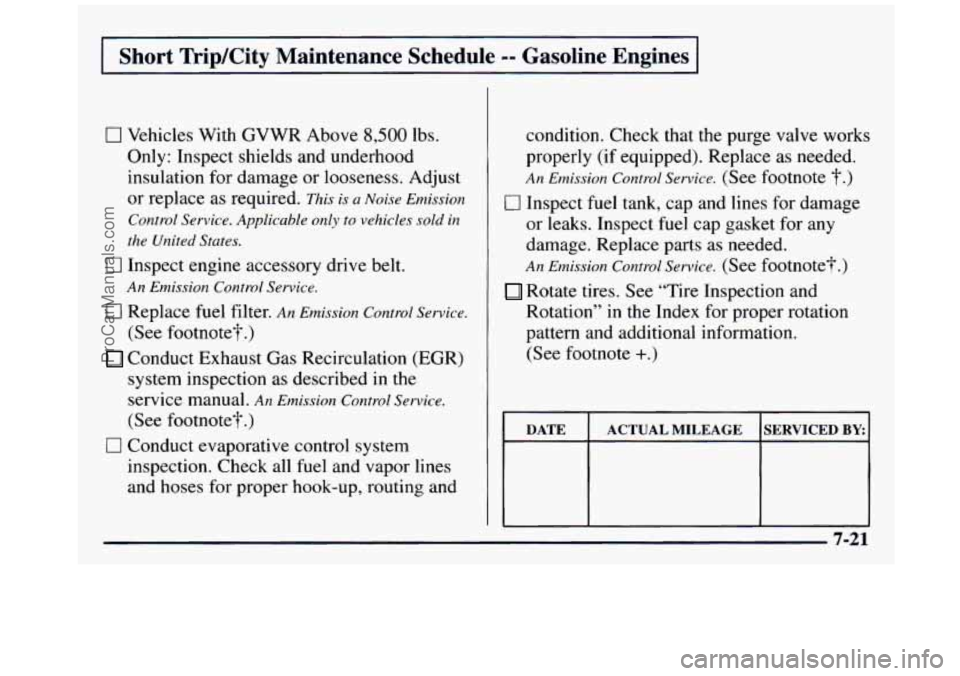
I Short TripKity Maintenance Schedule == Gasoline Engines 1
0 Vehicles With GVWR Above 8,500 lbs.
Only: Inspect shields and underhood
insulation for damage or looseness. Adjust
or replace as required. This is a Noise Emission
Control Service. Applicable only to vehicles
sold in
the United States.
0 Inspect engine accessory drive belt.
0 Replace fuel filter. An Emission Control Service.
(See footnote?.)
Conduct Exhaust Gas Recirculation (EGR)
system inspection as described in the
service manual.
An Emission Control Service.
(See footnote?.)
inspection, Check all fuel and vapor lines
and hoses for proper hook-up, routing and
An Emission Control Service.
0 Conduct evaporative control system condition. Check that
the purge valve works
properly (if equipped). Replace as needed.
An Emission Control Service. (See footnote ?.)
0 Inspect fuel tank, cap and lines for damage
or leaks. Inspect fuel cap gasket for any
damage. Replace parts as needed.
An Emission Control Service. (See footnote?.)
Rotate tires. See “Tire Inspection and
Rotation” in the Index for proper rotation
pattern and additional information.
(See footnote
+.)
DATE SERVICED BY: ACTUAL MILEAGE
I I I I
7-21
ProCarManuals.com
Page 392 of 436
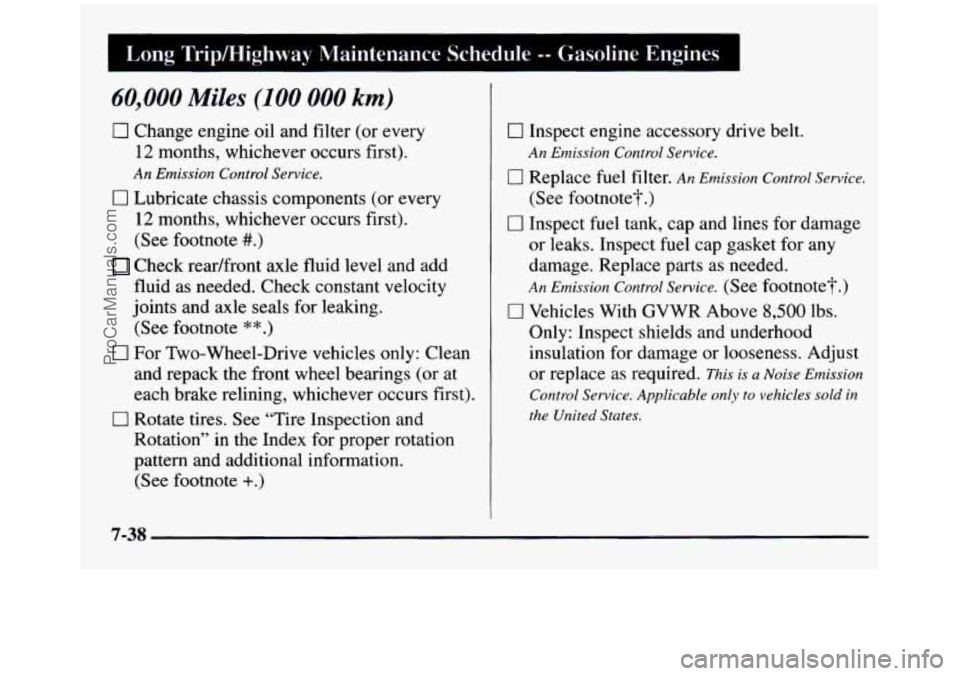
I Long Trip/Highway Maintenance Schedule -- Gasoline Engines I -
60,000 Miles (100 000 km)
0 Change engine oil and filter (or every
12 months, whichever occurs first).
An Emission Control Service.
0 Lubricate chassis components (or every
12 months, whichever occurs first).
(See footnote
#.)
Check readfront axle fluid level and add
fluid as needed. Check constant velocity
joints and axle seals for leaking.
(See footnote
**.)
0 For Two-Wheel-Drive vehicles only: Clean
and repack the front wheel bearings (or at
each brake relining, whichever occurs first).
0 Rotate tires. See “Tire Inspection and
Rotation” in the Index for proper rotation
pattern and additional information.
(See footnote
+.)
0 Inspect engine accessory drive belt.
0 Replace fuel filter. An Emission Control Service.
(See footnote?.)
0 Inspect fuel tank, cap and lines for damage
or leaks. Inspect fuel cap gasket for any
damage. Replace parts
as needed.
An Emission Control Service. (See footnote?.)
0 Vehicles With GVWR Above 8,500 lbs.
Only: Inspect shields and underhood
insulation for damage or looseness. Adjust
or replace as required.
This is a Noise Emission
Control Service. Applicable only
to vehicles sold in
the United States.
An
Emission Control Service.
7-38
ProCarManuals.com
Page 426 of 436
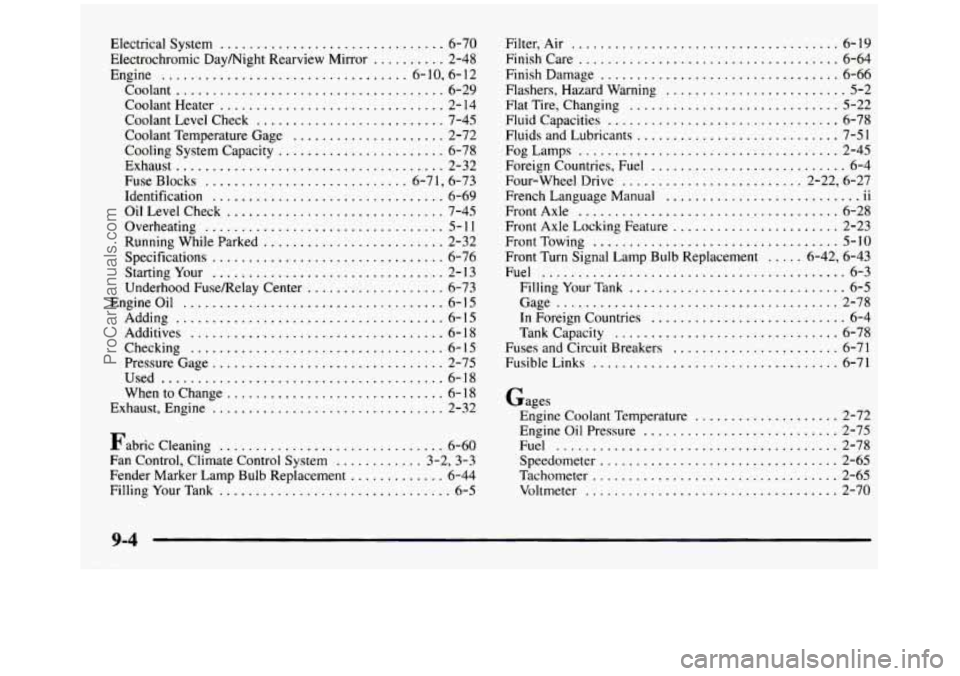
Electrical System ............................... 6-70
Engine
.................................. 6-10. 6-12
Electrochromic
Daymight Rearview Mirror
.......... 2-48
Coolant
..................................... 6-29
Coolant Heater
............................... 2- 14
Coolant Level Check
.......................... 7-45
Coolant Temperature Gage
..................... 2-72
Cooling System Capacity
....................... 6-78
Exhaust
..................................... 2-32
FuseBlocks
............................ 6-71, 6-73
Identification
................................ 6-69
OilLevelCheck
.............................. 7-45
Overheating
................................. 5-11
Running While Parked
......................... 2-32
Specifications
................................ 6-76
StartingYour
................................ 2-13
Underhood Fuse/Relay Center
................... 6-73
Engineoil
.................................... 6-15
Adding
..................................... 6-15
Additives
................................... 6-18
Checking
................................... 6-15
Used
....................................... 6-18
Whentochange
.............................. 6-18
Exhaust. Engine
................................ 2-32
Pressure Gage
................................ 2-75
Fabric Cleaning
............................... 6-60
Fan Control. Climate Control System ............ 3.2. 3.3
Fender Marker Lamp
Bulb Replacement ............. 6-44
FillingYourTank
................................ 6-5
Filter. Air ..................................... 6-19
Finish Care
.................................... 6-64
Finish Damage
................................. 6-66
Flashers. Hazard Warning
......................... 5-2
Flat Tire. Changing
............................. 5-22
Fluid Capacities
................................ 6-78
Fluids and Lubricants
............................ 7-51
Fog Lamps
.................................... 2-45
Foreign Countries. Fuel
........................... 6-4
Four-wheel Drive
......................... 2-22. 6-27
French LanguageManual
11
Front Axle .................................... 6-28
Front Axle Locking Feature
....................... 2-23
FrontTowing
.................................. 5-10
Front Turn Signal Lamp Bulb Replacement ..... 6-42. 6-43
Fuel
.......................................... 6-3
Filling Your Tank
.............................. 6-5
Gage ....................................... 2-78
In Foreign Countries ........................... 6-4
Tank Capacity
............................... 6-78
Fuses and Circuit Breakers
....................... 6-71
FusibleLinks
.................................. 6-71
.. ...........................
bages Engine Coolant Temperature
.................... 2-72
Engine Oil Pressure
........................... 2-75 "
Fuel ....................................... 2-78
Speedometer
................................. 2-65
Tachometer
.................................. 2-65
Voltmeter
................................... 2-70
9-4
ProCarManuals.com