1997 GMC SIERRA lock
[x] Cancel search: lockPage 350 of 436
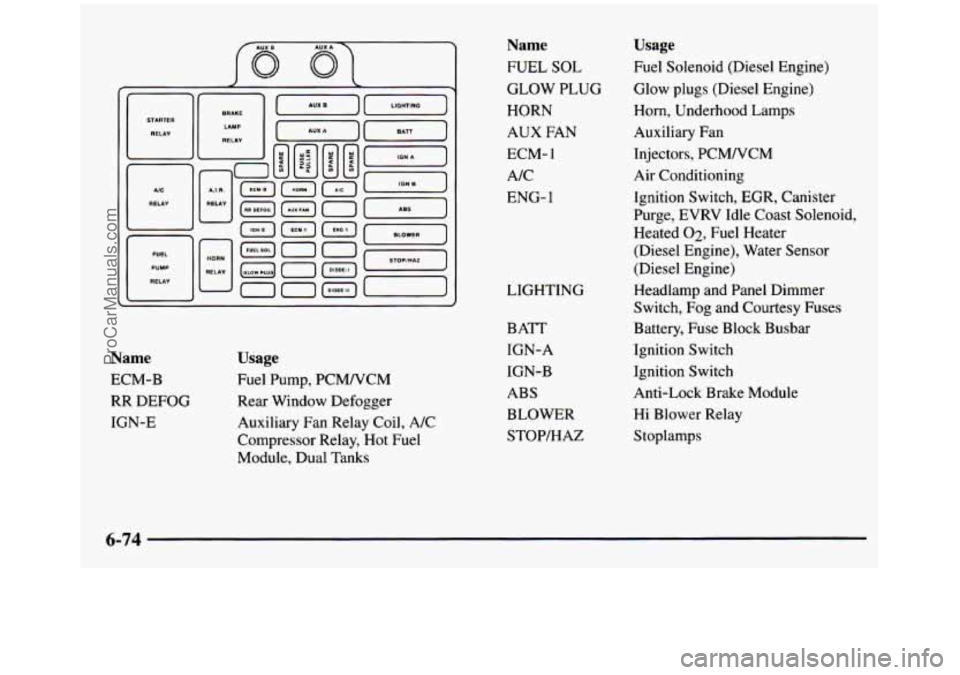
Name
ECM-B
RR DEFOG IGN-E
Usage
Fuel Pump, PCMNCM
Rear Window Defogger
Auxiliary Fan Relay Coil,
A/C
Compressor Relay, Hot Fuel
Module, Dual Tanks
Name
FUEL SOL
GLOW PLUG
HORN
AUX FAN
ECM-
1
NC
ENG-
1
LIGHTING
BATT
IGN-A
IGN-B ABS
BLOWER STOP/HAZ
Usage
Fuel Solenoid (Diesel Engine)
Glow plugs (Diesel Engine)
Horn, Underhood Lamps
Auxiliary Fan
Injectors,
PCMNCM
Air Conditioning
lgnition Switch,
EGR, Canister
Purge,
EVRV Idle Coast Solenoid,
Heated
02, Fuel Heater
(Diesel Engine), Water Sensor
(Diesel Engine)
Headlamp and Panel Dimmer
Switch,
Fog and Courtesy Fuses
Battery, Fuse Block Busbar
Ignition Switch
Ignition Switch
Anti-Lock Brake Module
Hi Blower Relay
Stoplamps
6-74
ProCarManuals.com
Page 362 of 436
Short TripKity Maintenance Schedule -- Gasoline Engines
** Drive axle service (see “Recommended Fluids and
Lubricants”
in the Index for proper lubricant to use):
0
e
0
0
Locking Differential -- Drain fluid and refill at first
engine oil change. At subsequent oil changes, check
fluid level and add fluid as needed. If driving in
dusty areas
or towing a trailer, drain fluid and refill
every 15,000 miles
(25 000 km).
Standard Differential -- Check fluid level and add
fluid
as needed at every oil change. If driving in
dusty areas or towing a trailer, drain fluid and refill
every
15,000 miles (25 000 km).
More frequent lubrication may be required for
heavy-duty
or off-road use.
3500 HD Models with applications requiring extreme
overloadtrailer towing conditions and high-speed (above
45 mph or 70 km/h) conditions for extended
periods of time must have the drive axle fluid changed every
30,000 miles (50 OOO km). See “Recommended
Fluids and Lubricants” in this section.
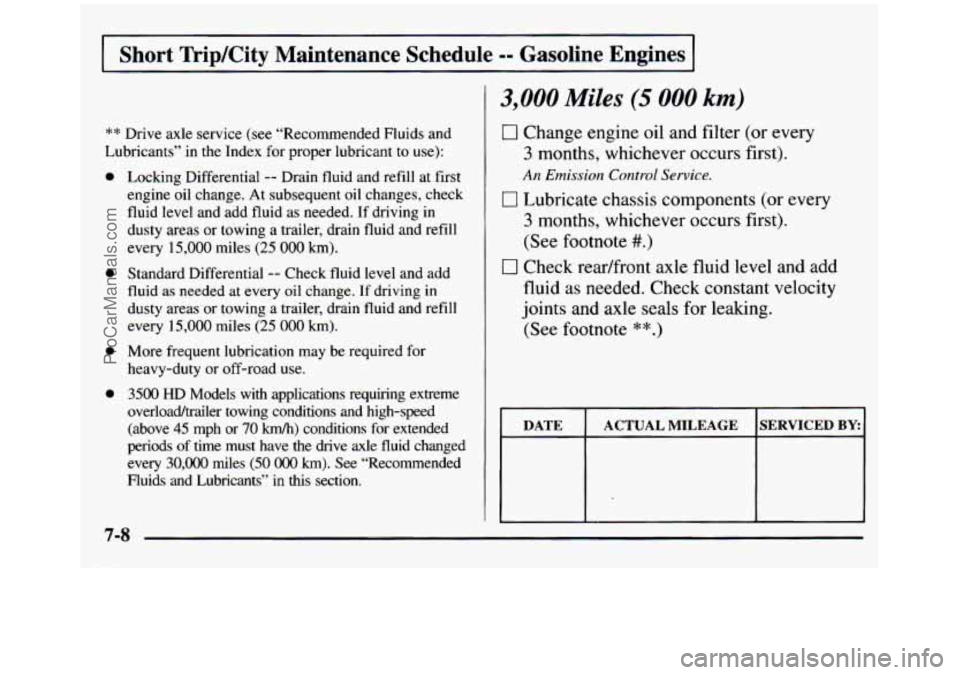
3,000 Miles (5 000 km)
0 Change engine oil and filter (or every
3 months, whichever occurs first).
An Emission Control Service.
0 Lubricate chassis components (or every
3 months, whichever occurs first).
(See footnote
#.)
0 Check readfront axle fluid level and add
fluid as needed. Check constant velocity
joints and axle seals for leaking.
(See footnote **.)
DATE ACTUAL MILEAGE SERVICED BY:
ProCarManuals.com
Page 385 of 436
Long Tripmighway Maintenance Schedule -- Gasdin-
The services shown in this schedule up to 100,000 miles
( 166 000 km) should be performed after 100,000 miles
(166
000 km) at the same intervals. The services shown
at
150,000 miles (240 000 km) should be performed at
the same interval after 150,000 miles (240
000 km).
See “Owner Checks and Services” and “Periodic
Maintenance Inspections’’ following.
Footnotes
The U.S. Environmental Protection Agency or the
California
Air Resources Board has determined that the
failure to perform this maintenance item will not nullify
the emission warranty or limit recall liability prior to the
completion
of the vehicle’s useful life. We, however, urge
that
all recommended maintenance services be performed
at the indicated intervals and the maintenance be recorded.
# Lubricate the front suspension, kingpin bushings,
steering linkage, transmission shift linkage, transfer case
shift linkage, parking brake cable guides, rear driveline
center splines, front axle propshaft splines and brake
pedal springs. Ball joints and kingpin bushings should
not be lubricated unless their temperature is 10 OF
(- 12°C) or higher, or they could be damaged.
+ A good time to check your brakes is during tire
rotation. See “Brake System Inspection” under “Periodic
Maintenance Inspections” in Part
C of this schedule.
** Drive axle service (see “Recommended Fluids and
Lubricants”
in the Index for proper lubricant to use):
0
0
0
Locking Differential -- Drain fluid and refill at first
engine oil change. At subsequent oil changes, check
fluid level and add fluid as needed.
Standard Differential
-- Check fluid level and add
fluid as needed at every engine oil change.
3500 HD Models with applications requiring
high-speed (above
45 mph or 70 kmh) operation for
extended periods of time must have the drive axle
fluid changed every
30,000 miles (50 000 km).
7-31
ProCarManuals.com
Page 400 of 436
At Least Twice a Year
Restraint System Check
Make sure the safety belt reminder light and all your
belts, buckles,
latch plates, retractors and anchorages are
working properly. Look for any other loose or damaged
safety belt system
parts. If you see anything that might
keep a safety belt system from doing its job, have it
repaired. Have any torn or frayed safety belts replaced.
Also look for any opened or broken air bag coverings,
and have them repaired or replaced. (The air bag system
does
not need regular maintenance.)
Wiper Blade Check
Inspect wiper blades for wear or cracking. Replace blade
inserts that appear worn or damaged or that streak or
miss areas of the windshield. Also see “Wiper Blades,
Cleaning” in the Index.
Air Cleaner Filter Restriction Indicator Check
Your vehicle has an indicator on the engine that lets you
know when the air cleaner filter is dirty and needs
to be
changed. Check indicator at least twice a year or when
your oil is changed. See “Air Cleaner” in
the Index for
more information. Inspect your air cleaner filter restriction indicator more often
if the vehicle is used in
dusty areas or under off road conditions.
Manual Transmission Check
Check the transmission fluid level; add if needed. See
“Manual Transmission” in
the Index. Check the system for
leaks. A fluid loss may indicate a problem. Have the
system inspected and repaired if needed.
Automatic Transmission Check
Check the transmission fluid level; add if needed. See
“Automatic Transmission” in the Index.
A fluid loss
may indicate a problem. Check the system and repair
if needed.
Hydraulic Clutch System Check
Check the fluid level in the clutch reservoir. See
“Hydraulic Clutch Fluid” in the Index. A fluid loss in
this system could indicate a problem. Have the system
inspected and repaired
at once.
At Least Once a Year
Key Lock Cylinders Service
Lubricate the key lock cylinders with the lubricant
specified
in Part D.
7-46
ProCarManuals.com
Page 401 of 436
Body Lubrication Service
Lubricate all fuel doors, body hood and body door
hinges, tailgate and tailgate handle pivot points, latches,
locks and folding seat hardware. Part
D tells you what to
use. More frequent lubrication may be required when
exposed
to a corrosive environment.
Starter Switch Check
’ A CAUTION:
When you are doing this check, the vehicle could
move suddenly.
If it does, you or others could be
injured. Follow the steps below.
3. On automatic transmission vehicles, try to start the
engine
in each gear. The starter should work only in
PARK (P) or NEUTRAL (N). If the starter works in
any other position, your vehicle needs service.
On manual transmission vehicles, put
the shift lever
in NEUTRAL (N), push the clutch down halfway
and try
to start the engine. The starter should work
only when the clutch
is pushed down all the way to
the floor. If the starter works when the clutch isn’t
pushed all the way down, your vehicle needs service.
1. Before you start, be sure you have enough room
2. Firmly apply both the parking brake (see “Parking
around the vehicle.
Brake” in
the Index if necessary) and the
regular brake.
NOTE: Do not use the accelerator pedal, and be
ready
to turn off the engine immediately if it starts.
Brake-’Ikansmission Shift Interlock (BTSI) Check
(Automatic Transmission)
I A CAUTION:
When you are doing this check, the vehicle could
move suddenly. If it does,
you or others could be
injured. Follow the steps below.
1. Before you start, be sure you have enough room
around the vehicle. It should be parked on a
level surface.
7-47
ProCarManuals.com
Page 402 of 436
2. Firmly apply the parking brake (see “Parking Brake”
in the Index if necessary). Parking Brake and Automatic Transmission
PARK (P) Mechanism Check
NOTE: Be ready to apply the regular brake
immediately
if the vehicle begins to move.
3. With the engine off, turn the key to the RUN position,
but don’t start the engine. Without applying
the regular
brake, try to move the shift lever
out of PARK (P)
with normal effort. If the shift lever moves out
of
PARK (P), your vehicle’s BTSI needs service.
Ignition Transmission Lock Check
While parked, and with the parking brake set, try to turn
the ignition key to
LOCK in each shift lever position.
With an automatic transmission, the key should turn
to
LOCK only when the shift lever is in PARK (P).
With a manual transmission, the key should turn to
LOCK only when the shift lever is in REVERSE (R).
On vehicles with a key release button, try to turn the key
to
LOCK without pressing the button. The key should
turn to
LOCK only when you press the key button.
On all vehicles, the key should come out only in LOCK.
I
When you are doing this check, your vehicle
could begin
to move. You or others could be
injured and property could be damaged. Make
sure there is room in front
of your vehicle in case
it begins to roll. Be ready to apply the regular
brake at once should the vehicle begin to move.
Park on a fairly steep hill, with the vehicle facing
downhill. Keeping
your foot on the regular brake, set the
parking brake.
To check the parking brake’s holding ability:
With the engine running and transmission in
NEUTRAL
(N), slowly remove foot pressure from
the regular brake pedal.
Do this until the vehicle is
held by the parking brake
only.
0 To check the PARK (P) mechanism’s holding ability:
With the engine running, shift
to PARK (P). Then
release all brakes.
7-48
ProCarManuals.com
Page 406 of 436
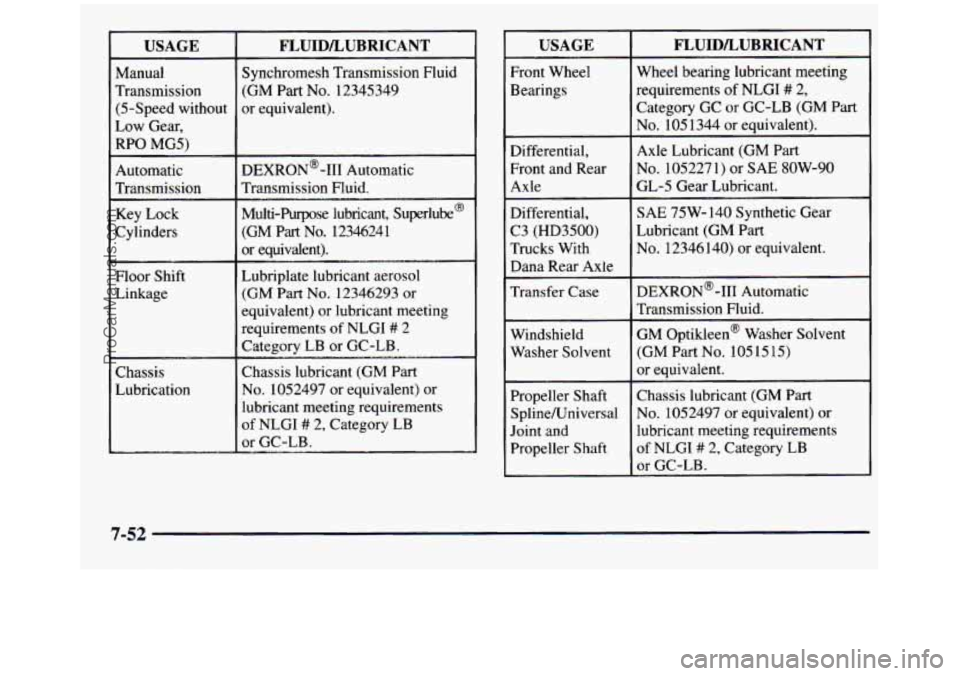
USAGE
Manual
Transmission (5-Speed without
Low Gear,
RPO MG5)
Automatic
Transmission
Key Lock
Cylinders
Floor Shift
Linkage
Chassis
Lubrication
FLUIDLUBRICANT
~~
Synchromesh Transmission Fluid
(GM Part
No. 12345349
or equivalent).
DEXRON@-111 Automatic
Transmission Fluid.
Multi-Purpose lubricant, Superlube@ (GM Part
No. 12346241
or equivalent).
Lubriplate lubricant aerosol (GM
Part No. 12346293 or
equivalent) or lubricant meeting
requirements of NLGI
## 2
Categorv LB or GC-LB, ~~~
Chassis lubricant (GM Part
No. 1052497 or equivalent) or
lubricant meeting requirements
of NLGI # 2, Category LB
or GC-LB.
USAGE
Front Wheel
Bearings
Differential,
Front and Rear
Axle
Differential,
C3 (HD3500)
Trucks With
Dana Rear Axle
Transfer Case
Windshield Washer Solvent
Propeller Shaft SplineLJniversal
Joint and
Propeller Shaft
FLUIDLUBRICANT
Wheel bearing lubricant meeting
requirements
of NLGI # 2,
Category GC
or GC-LB (GM Part
No. 105 1344 or equivalent).
Axle Lubricant (GM Part
No. 105227 1) or SAE SOW-90
GL-5 Gear Lubricant.
SAE 75W- 140 Synthetic Gear
Lubricant
(GM Part
No. 12346 140) or equivalent.
DEXR0N'-111 Automatic
Transmission Fluid.
~~
GM Optikleen' Washer Solvent
(GM
Part No. 105 15 15)
or equivalent.
Chassis lubricant (GM Part
No. 1052497 or equivalent) or
lubricant meeting requirements
of
NLGI ## 2, Category LB
or GC-LB.
7-52
ProCarManuals.com
Page 413 of 436
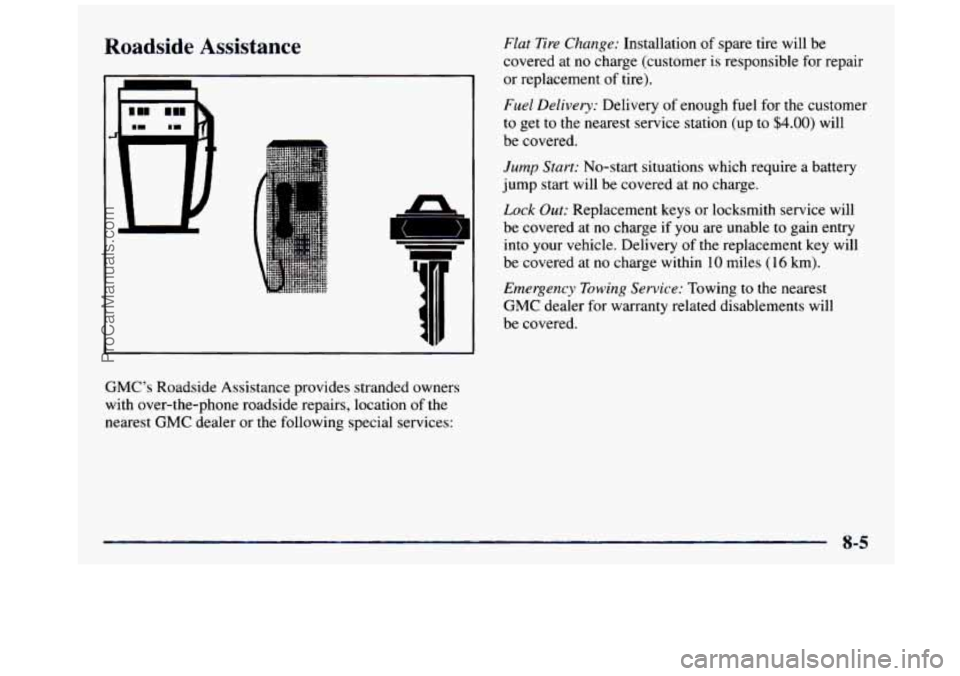
Roadside Assistance
1
GMC’s Roadside Assistance provides stranded owners
with over-the-phone roadside repairs, location of the
nearest
GMC dealer or the following special services:
FZat Tire Change: Installation of spare tire will be
covered at no charge (customer is responsible for repair
or replacement of tire).
Fuel Delivery: Delivery of enough fuel for the customer
to get to the nearest service station (up to
$4.00) will
be covered.
Jump Start: No-start situations which require a battery
jump start will be covered at no charge.
Lock Out: Replacement keys or locksmith service will
be covered at no charge if you are unable to gain entry
into your vehicle. Delivery of
the replacement key will
be covered at no charge within
10 miles (16 km).
Emergency Towing Service: Towing to the nearest
GMC dealer for warranty related disablements will
be covered.
ProCarManuals.com