Page 94 of 167

3.0L 2-Valve Vulcan Engine
Station
Wagon4/270 (600) 0 365 (800)
2/135 (300) 70 (150) 430 (950)
2/135 (300) 0 500 (1100)
The above chart is based on the specified vehicle at
a maximum GCW (Vehicle weight + Trailer weight)
equal to 2245 kg (4950 lbs.).
3.0L 4-Valve Duratec Engine and SHO Sedan
Model Passenger
Load #/kg
(lbs.)Luggage
Load kg
(lbs.)Max Trailer
Wt. kg
(lbs.)
Sedan 5/340 (750) 0 590 (1300)
2/135 (300) 70 (150) 725 (1600)
2/135 (300) 0 795 (1750)
Station
Wagon5/340 (750) 70 (150) 455 (1000)
2/135 (300) 70 (150) 660 (1450)
2/135 (300) 0 725 (1600)
The above chart is based on the specified vehicle at
a maximum GCW (Vehicle weight + Trailer weight)
equal to 2270 kg (5450 lbs.).
Do not exceed the GVWR or the GAWR
specified on the Safety Compliance
Certification Label.
Towing trailers beyond the maximum
recommended gross trailer weight exceeds
the limit of the vehicle and could result in engine
damage, transaxle damage, structural damage, loss
of control, and personal injury.
Driving
95
ProCarManuals.com
Page 95 of 167
Preparing to tow
Use the proper equipment for towing a trailer, and
make sure it is properly attached to your vehicle.
See your dealer or a reliable trailer dealer if you
require assistance.
Hitches
Your vehicle has a load carrying hitch. This type of
hitch places the tongue load of a trailer on the rear
wheels of your vehicle. You must distribute the load
in your trailer so that 10±15% of the total weight of
the trailer is on the tongue.
Safety chains
Always connect the trailer's safety chains to the
vehicle. To connect the trailer's safety chains, cross
the chains under the trailer tongue and allow slack
for turning corners.
If your use a rental trailer, follow the instructions
that the rental agency gives to you.
Trailer brakes
Electric brakes and manual, automatic or surge-type
brakes are safe if installed properly and adjust them
to the manufacturer's specifications. The trailer
brakes must meet local and Federal regulations.
Do not connect a trailer's hydraulic brake
system directly to your vehicle's brake
system. Your vehicle may not have enough braking
power and your chances of having a collision
greatly increase.
Trailer lamps
Trailer lamps are required on most towed vehicles.
Make sure your trailer lamps conform to local and
Federal regulations. See your dealer or trailer rental
agency for proper instructions and equipment for
hooking up trailer lamps.
Driving
96
ProCarManuals.com
Page 96 of 167

Driving while you tow
Do not drive faster than 72 km/h (45 mph) with any
weight on the trailer while towing on a hot day or in
hilly country.
Cruise control may shut off if you are towing on
long, steep grades.
When towing a trailer:
²Use 2 (Second) (if equipped) or 1 (First) when
towing up or down steep hills. This will eliminate
excessive downshifting and upshifting for
optimum fuel economy and transaxle cooling.
²Anticipate stops and brake gradually.
Servicing after towing
If you tow a trailer for long distances, your vehicle
will require more frequent service intervals. Refer to
theService Guidefor more information.
Trailer towing tips
²Practice turning, stopping and backing up in an
area before starting on a trip to get the feel of the
vehicle trailer combination. When turning, drive
slightly beyond the normal turning point so the
trailer wheels will clear curbs and other obstacles.
²Allow more room for stopping with a trailer
attached.
²The trailer tongue weight should be 10±15% of
the loaded trailer weight.
²After you have traveled 80 km (50 miles),
thoroughly check your hitch, electrical
connections and trailer wheel lug nuts.
²When stopped in traffic for long periods of time in
hot weather, place the gearshift in P (Park) and
increase idle speed. This aids engine cooling and
air conditioner efficiency.
²Vehicles with trailers should not be parked on a
grade. If you must park on a grade, place wheel
chocks under the trailer's wheels.
Driving
97
ProCarManuals.com
Page 108 of 167
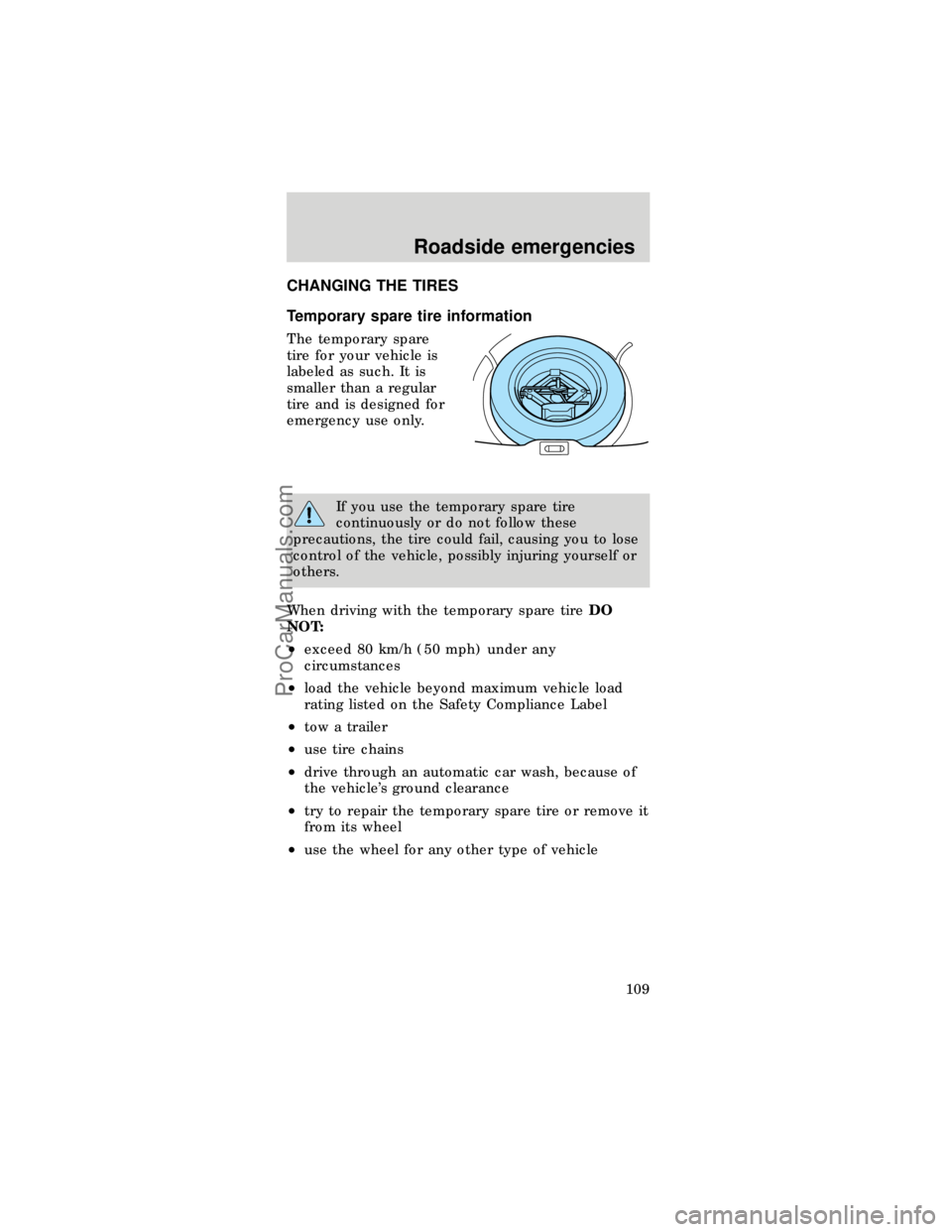
CHANGING THE TIRES
Temporary spare tire information
The temporary spare
tire for your vehicle is
labeled as such. It is
smaller than a regular
tire and is designed for
emergency use only.
If you use the temporary spare tire
continuously or do not follow these
precautions, the tire could fail, causing you to lose
control of the vehicle, possibly injuring yourself or
others.
When driving with the temporary spare tireDO
NOT:
²exceed 80 km/h (50 mph) under any
circumstances
²load the vehicle beyond maximum vehicle load
rating listed on the Safety Compliance Label
²tow a trailer
²use tire chains
²drive through an automatic car wash, because of
the vehicle's ground clearance
²try to repair the temporary spare tire or remove it
from its wheel
²use the wheel for any other type of vehicle
Roadside emergencies
109
ProCarManuals.com
Page 115 of 167

REMOVING THE JUMPER CABLES
1. Remove the jumper
cables in reverse order.
Take the cable off the
metallic surface (1)
first, followed by the
cable on the negative
(-) booster battery
terminal (2).
2. Remove the cable
from the positive (+)
terminal of the booster
battery (3) and then
the discharged battery (4).
3. After the disabled vehicle has been started, allow
it to idle for a while so the engine can ªrelearnº its
idle conditions.
WRECKER TOWING
If you need to have
your vehicle towed,
contact a professional
towing service or, if
you are a member,
your roadside
assistance center. Your
vehicle should be
towed from the front
unless conditions do
not allow it. It is
recommended that
your vehicle be towed
with a wheel lift or flatbed equipment.
When calling for a tow truck, tell the operator what
kind of vehicle you have. A towing manual is
available from Ford Motor Company for all
authorized tow truck operators. Have your tow truck
driver refer to this manual for proper hook-up and
towing procedures for your vehicle.
+–
+–2
3
4
1
Roadside emergencies
116
ProCarManuals.com
Page 116 of 167
TOWING YOUR VEHICLE BEHIND ANOTHER
VEHICLE
At times, you may want to tow your vehicle behind
another vehicle, such as a recreational vehicle, car
or a truck.
Before you have your vehicle towed:
²Release the parking brake.
²Move the gearshift to N (Neutral).
²Turn the key in the ignition to OFF.
²Unlock the steering wheel.
Do not tow your vehicle at a speed faster than 56
km/h (35 mph) or for a distance greater than 80 km
(50 miles), unless the drive wheels are placed on
dollies.
Never use a tow bar that attaches to the
bumper when you tow your vehicle. This
could damage the bumper and cause an accident.
Roadside emergencies
117
ProCarManuals.com
Page 123 of 167
Remove the filler cap and use a funnel to pour oil in
the opening.
3. Recheck the oil level. Make sure the oil level is
not above the MAX or FULL mark on the dipstick.
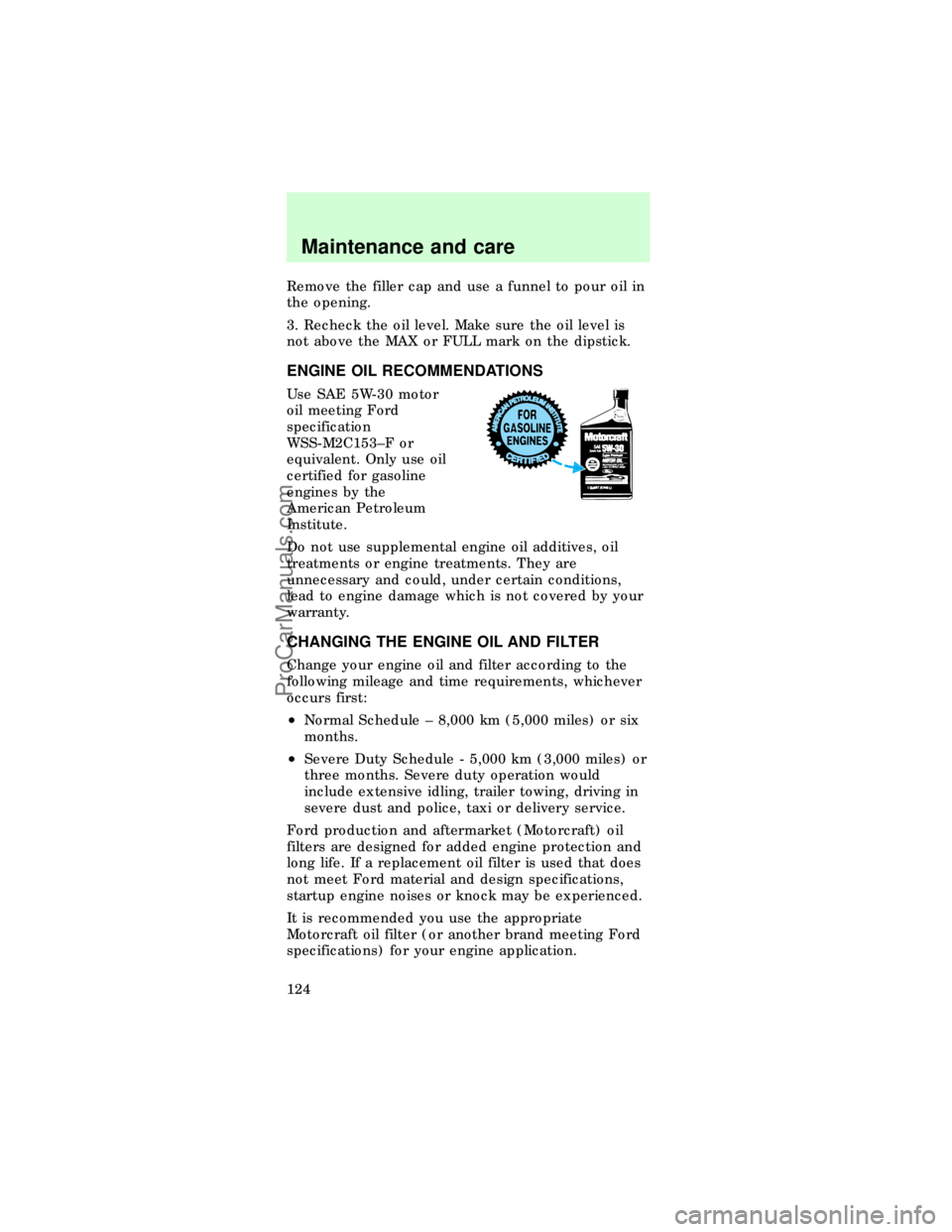
ENGINE OIL RECOMMENDATIONS
Use SAE 5W-30 motor
oil meeting Ford
specification
WSS-M2C153±F or
equivalent. Only use oil
certified for gasoline
engines by the
American Petroleum
Institute.
Do not use supplemental engine oil additives, oil
treatments or engine treatments. They are
unnecessary and could, under certain conditions,
lead to engine damage which is not covered by your
warranty.
CHANGING THE ENGINE OIL AND FILTER
Change your engine oil and filter according to the
following mileage and time requirements, whichever
occurs first:
²Normal Schedule ± 8,000 km (5,000 miles) or six
months.
²Severe Duty Schedule - 5,000 km (3,000 miles) or
three months. Severe duty operation would
include extensive idling, trailer towing, driving in
severe dust and police, taxi or delivery service.
Ford production and aftermarket (Motorcraft) oil
filters are designed for added engine protection and
long life. If a replacement oil filter is used that does
not meet Ford material and design specifications,
startup engine noises or knock may be experienced.
It is recommended you use the appropriate
Motorcraft oil filter (or another brand meeting Ford
specifications) for your engine application.
Maintenance and care
124
ProCarManuals.com
Page 144 of 167
²Headlamps
²High-mount brake lamp
²Tail lamps
²Brake lamps
²Backup lamps
²Hazard flashers
²Turn signals
²License plate lamp
²Interior overhead lamps
Do not remove lamp bulbs unless they will be
replaced immediately. If a bulb is removed for an
extended period of time, contaminants may enter
the lamp housings and affect performance.
High-mount brake lamp - Sedan
To remove the brake lamp:
1. Remove package
tray trim, then push
attachment toward the
rear.
2. Slide brake lamp up
and away from the rear
window to remove it
from the tabs that hold
it down.
3. Disconnect bulbs.
To install brake lamp:
1. Install bulbs, then position the brake lamp over
tab slots and line up the tab with the tab slots.
2. Push down and toward the rear window to engage
the tabs.
3. Push attachment toward the rear window and line
up slot in attachment with the edge of the sheet
metal screw.
Maintenance and care
145
ProCarManuals.com