1997 FORD PROBE brake
[x] Cancel search: brakePage 129 of 288
![FORD PROBE 1997 2.G Owners Manual 126
*
[TO05500(ALL)01/96]
3.If you have an automatic transaxle, make
sure that the gearshift is in P (Park) and the
parking brake is set before you turn the key.
*
[TO05600(ALL)01/96]
If you have a ma](/manual-img/11/5321/w960_5321-128.png "FORD PROBE 1997 2.G Owners Manual 126
*
[TO05500(ALL)01/96]
3.If you have an automatic transaxle, make
sure that the gearshift is in P (Park) and the
parking brake is set before you turn the key.
*
[TO05600(ALL)01/96]
If you have a ma")
126
*
[TO05500(ALL)01/96]
3.If you have an automatic transaxle, make
sure that the gearshift is in P (Park) and the
parking brake is set before you turn the key.
*
[TO05600(ALL)01/96]
If you have a manual transaxle, make sure
that the parking brake is fully set, push the
clutch pedal to the floor, and put the
gearshift into Neutral before you turn the
key.(Remember, the starter will operate
only if the clutch pedal is pushed all the
way to the floor.)
%*
[TO05700(ALL)01/96]
Testing the Warning Lights
*
[TO05800(ALL)02/96]
Before you start your vehicle, you should test
the warning lights on the instrument panel to
make sure that they work. Refer to the
Instrumentationchapter.
%*
[TO06000(ALL)01/96]
Starting Your Engine
*
[TO06100(ALL)01/96]
To start your engine:
*
[TO06300(ALL)01/96]
1. Follow the steps underPreparing to Start
Your Vehicleat the beginning of this section.
*
[TO06320(ALL)01/96]
2. Keep your foot on the brake pedal and turn
the ignition key to the ON position.
*
[TO06330(ALL)01/96]
3. DO NOT depress the accelerator pedal when
starting your engine. DO NOT use the
accelerator while the vehicle is parked.
*
[TO06340(ALL)01/96]
4. Turn the key to the START position
(cranking) until the engine starts. Allow the
key to return to the ON position after the
engine has started.
*
[TO06400(ALL)05/96]
If you have difficulty in turning the key,
rotate the steering wheel slightly because it
may be binding.
File:08prtop.ex
Update:Wed May 15 15:01:01 1996
Page 130 of 288
![FORD PROBE 1997 2.G Owners Manual 127 %
*
[TO06430(ALL)01/96]
For a cold engine:
*
[TO06440(ALL)01/96]
q
At temperatures10ÊF (-12ÊC) andbelow:If
the engine does not start infifteen (15)
secondson the first try, turn the key to OFF,](/manual-img/11/5321/w960_5321-129.png "FORD PROBE 1997 2.G Owners Manual 127 %
*
[TO06430(ALL)01/96]
For a cold engine:
*
[TO06440(ALL)01/96]
q
At temperatures10ÊF (-12ÊC) andbelow:If
the engine does not start infifteen (15)
secondson the first try, turn the key to OFF,")
127 %
*
[TO06430(ALL)01/96]
For a cold engine:
*
[TO06440(ALL)01/96]
q
At temperatures10ÊF (-12ÊC) andbelow:If
the engine does not start infifteen (15)
secondson the first try, turn the key to OFF,
wait approximately ten (10) seconds so you
do not flood the engine, then try again.
*
[TO06450(ALL)01/96]
q
At temperaturesabove10ÊF(-12ÊC):If the
engine does not start infive (5) secondson
the first try, turn the key to OFF, wait
approximately ten (10) seconds so you do not
flood the engine, then try again.
%*
[TO06460(ALL)01/96]
For a warm engine:
*
[TO06470(ALL)01/96]
q
Do not hold the key in the START position
for more thanfive (5) secondsat a time. If
the engine does not start within five (5)
seconds on the first try, turn the key to the
OFF position. Wait a few seconds after the
starter stops, then try again.
*
[TO06480(ALL)01/96]
Whenever you start your vehicle, release the key
as soon as the engine starts. Excessive cranking
could damage the starter.
*
[TO06490(ALL)01/96]
After you start the engine, let it idle for a few
seconds. Keep your foot on the brake pedal and
put the gearshift lever in gear. Release the
parking brake. Slowly release the brake pedal
and drive away in the normal manner.
*
[TO06500(ALL)04/96]
NOTE: Automatic transaxle equipped vehicles
have an interlock that prevents you
from shifting out of P (Park) unless
your foot is on the brake pedal.
File:08prtop.ex
Update:Wed May 15 15:01:01 1996
Page 135 of 288
![FORD PROBE 1997 2.G Owners Manual 132
*
[TO22000(ALL)03/96]
Removing the Key From the
Ignition
*
[TO22100(ALL)01/96]
1. Put the gearshift selector lever in P (Park)
(automatic transaxle) or 1 (First) (manual
transaxle).
*
[TO22200(ALL](/manual-img/11/5321/w960_5321-134.png "FORD PROBE 1997 2.G Owners Manual 132
*
[TO22000(ALL)03/96]
Removing the Key From the
Ignition
*
[TO22100(ALL)01/96]
1. Put the gearshift selector lever in P (Park)
(automatic transaxle) or 1 (First) (manual
transaxle).
*
[TO22200(ALL")
132
*
[TO22000(ALL)03/96]
Removing the Key From the
Ignition
*
[TO22100(ALL)01/96]
1. Put the gearshift selector lever in P (Park)
(automatic transaxle) or 1 (First) (manual
transaxle).
*
[TO22200(ALL)01/96]
2. Set the parking brake fully.
[TO22300(ALL)01/96]
3.For a manual transaxle:Push in on the lock
cylinder and turn the key from ACC to
LOCK.
[TO22400(ALL)01/96]
For an automatic transaxle:Turn the key to
LOCK.
*
[TO22500(ALL)03/96]
4. Remove the key.
*
[TO22600(ALL)01/96]
If the driver or passenger door is open while the
key is still in the ignition, a warning chime
sounds.
*
[TO22700(ALL)01/96]
RWARNING
Always set the parking brake fully and
make sure that the gearshift is securely
latched in P (Park) (automatic transaxle) or
in 1 (First) (manual transaxle).
*
[TO22800(ALL)03/96]
RWARNING
Do not leave children, unreliable adults,
or pets unattended in your vehicle.
File:08prtop.ex
Update:Wed May 15 15:01:01 1996
Page 136 of 288
![FORD PROBE 1997 2.G Owners Manual 133
Driving
%*
[GF00300(ALL)05/96]
Brakes
%*
[GF00400(ALL)01/96]
Applying the Brakes
[GF00500(ALL)04/96]
Your vehicle may have four-wheel power
anti-lock disc brakes which adjust automatically
through](/manual-img/11/5321/w960_5321-135.png "FORD PROBE 1997 2.G Owners Manual 133
Driving
%*
[GF00300(ALL)05/96]
Brakes
%*
[GF00400(ALL)01/96]
Applying the Brakes
[GF00500(ALL)04/96]
Your vehicle may have four-wheel power
anti-lock disc brakes which adjust automatically
through")
133
Driving
%*
[GF00300(ALL)05/96]
Brakes
%*
[GF00400(ALL)01/96]
Applying the Brakes
[GF00500(ALL)04/96]
Your vehicle may have four-wheel power
anti-lock disc brakes which adjust automatically
through everyday use.
[GF00600(ALL)04/96]
Some models have power front disc brakes and
rear drum brakes which automatically adjust as
the brake pads and linings wear down.
*
[GF00700(ALL)01/96]
If your vehicle does not have anti-lock brakes,
apply the brake pedal gradually. Use the
ªsqueezeº technique Ð push on the brake pedal
with a steadily increasing force. This allows the
wheels to continue to roll while you are slowing
down, which lets you steer properly.
*
[GF00800(ALL)01/96]
If your vehicle does not have anti-lock brakes,
extreme braking can make the wheels lock and
slide, causing you to lose control of the steering.
If the wheels lock, release the brake pedal and
repeat the ªsqueezeº technique.
*
[GF00900(ALL)01/96]
Do not drive with your foot resting on the brake
pedal; you will wear out the linings and increase
your vehicle's stopping distance. Brake rotor
damage may also eventually occur.
*
[GF00950(ALL)02/96]
NOTE: If you are driving down a long or
steep hill, shift to a lower gear and do
not apply your brakes continuously. If
you apply your brakes continuously,
they may overheat and become less
effective.
File:09prgfp.ex
Update:Fri Jan 3 09:33:04 1997
Page 137 of 288
![FORD PROBE 1997 2.G Owners Manual 134 %
*
[GF01000(ALL)01/96]
Occasional brake noise is normal and often does
not indicate a performance concern with the
vehicles brake system. In normal operation,
automotive brake systems may emit o](/manual-img/11/5321/w960_5321-136.png "FORD PROBE 1997 2.G Owners Manual 134 %
*
[GF01000(ALL)01/96]
Occasional brake noise is normal and often does
not indicate a performance concern with the
vehicles brake system. In normal operation,
automotive brake systems may emit o")
134 %
*
[GF01000(ALL)01/96]
Occasional brake noise is normal and often does
not indicate a performance concern with the
vehicle's brake system. In normal operation,
automotive brake systems may emit occasional
or intermittent squeal or groan noises when the
brakes are applied. Such noises are usually
heard during the first few brake applications in
the morning; however they may be heard at any
time while braking and can be aggravated by
environmental conditions such as cold, heat,
moisture, road dust, salt or mud. If a
"metal-to-metal" or "continuous grinding" sound
is present while braking, the brake linings may
be worn-out and should be inspected by a
qualified service technician.
*
[GF01100(ALL)01/96]
Anti-lock Brake System (If equipped)
[GF01200(ALL)04/96]
If your vehicle is equipped with the anti-lock
brake system (ABS), the wheels will not lock and
slide when you press down hard on the brake
pedal. The ABS automatically starts releasing
and reapplying the front brakes independently
and the rear brakes together whenever your
vehicle's wheels start to lock. When this
happens, you will feel the brake pedal pulsate.
This is an indication that the ABS is working
correctly and is normal.
*
[GF01300(ALL)01/96]
If the brake pedal is applied while the vehicle is
driven over uneven road surfaces, the ABS may
cycle and the driver may sense a pulsation in
the brake pedal, accompanied by a slight up and
down movement of the pedal height and a
clicking sound. This may also happen when
driving on an inclined surface such as a
driveway while making a sharp turn. This is a
normal condition.
[GF01400(ALL)04/96]
Each time you turn the ignition key to the ON
position, the ABS will function through one test
cycle. When this happens, the ABS light will
illuminate for up to five seconds. If the light
illuminates longer than five seconds, shut off the
File:09prgfp.ex
Update:Fri Jan 3 09:33:04 1997
Page 138 of 288

135
engine and restart. If it remains illuminated, it
means the ABS is disabled and should be
serviced immediately to restore the benefits of
the anti-lock feature. Normal braking is not
affected unless the red BRAKE system warning
light is also illuminated.
[GF01500(ALL)04/96]
ABS has self-check capabilities. As described
above, the system turns on the ABS light each
time you start your engine. After the engine is
started and the ABS light turns off, the system
performs another test the first time the vehicle
reaches 4-9 mph (6-15 km/h). The system turns
on the ABS pump motor for approximately 1/2
second. At this time, a mechanical noise may be
heard. This is a normal part of the self-check
feature. If a malfunction is found during this
check the ABS light will come on.
[GF01510(ALL)12/96]
On vehicles equipped with an antilock braking
system (ABS), a noise from the hydraulic pump
motor and pulsation in the pedal may be
observed during ABS braking events. Pedal
pulsation coupled with noise while braking
under panic conditions or on loose gravel, wet
or snowy roads is normal and indicated proper
functioning of the vehicle's antilock brake
system. If the vehicle has continuous vibration or
shudder while braking, mainly in the steering
wheel, the vehicle most likely needs service.
[GF01600(ALL)03/96]
Ford Motor Company has not found any
detrimental effects of popular mobile radio
transmitting equipment installed on vehicles
equipped with the Anti-lock Brake System if
normal radio installation practices are rigidly
followed. However, if after installing mobile
radio transmitting equipment, the Anti-lock
Brake System light comes on at any time other
than immediately after turning the key to the
File:09prgfp.ex
Update:Fri Jan 3 09:33:04 1997
Page 139 of 288
136ON position, or during a sudden stop, have
your mobile radio dealer inspect the radio
installation. Proper radio installation procedures
to be followed are published by the radio
manufacturer.
%*
[GF01700(ALL)05/96]
Parking Brake
*
[GF01800(ALL)03/96]
The parking brake should be used whenever
you park your vehicle.
*
[GF01900(ALL)03/96]
If the brakes don't operate while the vehicle is
in motion, you can make an emergency stop
with the parking brake, however, the stopping
distance will be much greater than normal.
*
[GF02000(ALL)01/96]
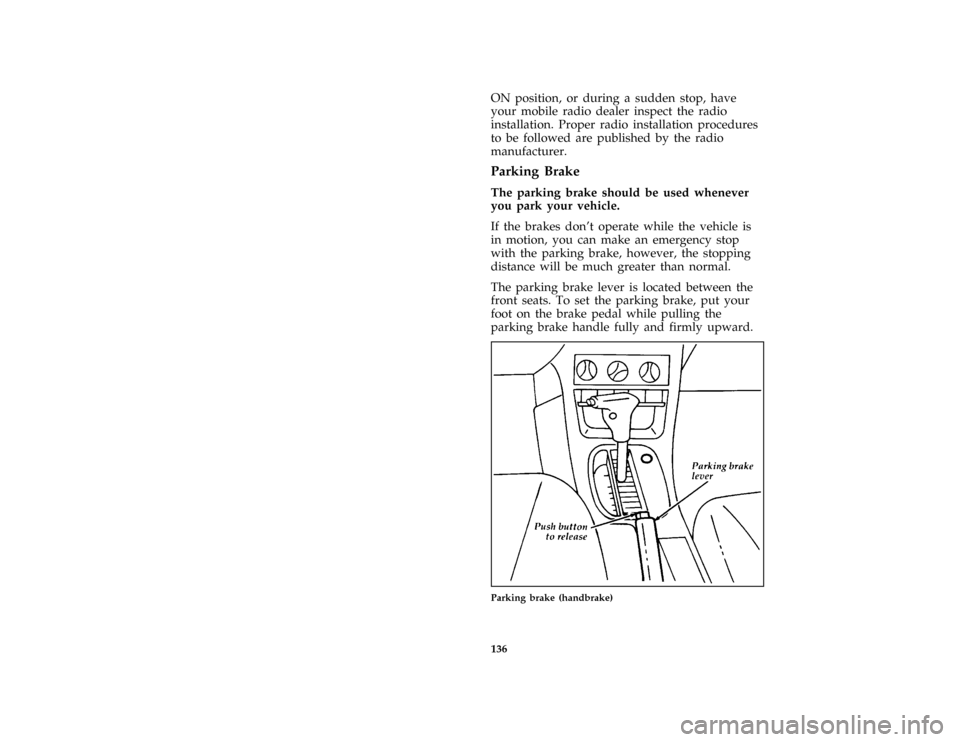
The parking brake lever is located between the
front seats. To set the parking brake, put your
foot on the brake pedal while pulling the
parking brake handle fully and firmly upward.
[GF02100(ALL)01/96]
half page art:0032065-C
Parking brake (handbrake)
File:09prgfp.ex
Update:Fri Jan 3 09:33:04 1997
Page 140 of 288
![FORD PROBE 1997 2.G Owners Manual 137
*
[GF02200(ALL)01/96]
RWARNING
To prevent personal injury, do not release
the parking brake while outside the
vehicle.
*
[GF02300(ALL)01/96]
RWARNING
Always set the parking brake fully and
make su](/manual-img/11/5321/w960_5321-139.png "FORD PROBE 1997 2.G Owners Manual 137
*
[GF02200(ALL)01/96]
RWARNING
To prevent personal injury, do not release
the parking brake while outside the
vehicle.
*
[GF02300(ALL)01/96]
RWARNING
Always set the parking brake fully and
make su")
137
*
[GF02200(ALL)01/96]
RWARNING
To prevent personal injury, do not release
the parking brake while outside the
vehicle.
*
[GF02300(ALL)01/96]
RWARNING
Always set the parking brake fully and
make sure that the gearshift is securely
latched in P (Park) (automatic transaxle) or
in 1 (First) (manual transaxle).
*
[GF02400(ALL)01/96]
Always check the Brake Warning Light each
time you start your engine. Driving with the
parking brake on will cause the brakes to wear
out quickly and will reduce the fuel economy.
*
[GF02500(ALL)02/96]
RWARNING
If the parking brake is fully released, but
the Brake System light remains on, have
the brakes checked immediately. They
may not be working properly.
*
[GF02600(ALL)03/96]
The parking brake is not designed to stop a
moving vehicle, but you can use the parking
brake to stop your vehicle in an emergency if
the normal brakes fail. However, since the
parking brake applies only the rear brakes, the
stopping distance will increase greatly and the
handling of your vehicle will be adversely
affected.
%
*
[GF02800(ALL)01/96]
Steering Your Vehicle
[GF02900(ALL)01/96]
Your vehicle is equipped with power steering.
Power steering uses energy from the engine to
help steer your vehicle.
%*
[GF03000(ALL)03/96]
If the amount of effort needed to steer your
vehicle changes at a constant vehicle speed, have
the power steering system checked. If the power
File:09prgfp.ex
Update:Fri Jan 3 09:33:04 1997