Page 105 of 219
Utility and four-wheel
drive vehicles arenot
designed for cornering at speeds
as high as passenger cars any
more than low-slung sports cars
are designed to perform
satisfactorily under off-road
conditions. Avoid sharp turns or
abrupt maneuvers in these
vehicles.
4WD operation is not
recommended on dry pavement.
Doing so could result in difficult
disengagement of the transfer
case, increased tire wear and
decreased fuel economy.
4WD system indicator lights
The 4WD system indicator lights
illuminate only under the following
conditions. If these lights
illuminate during normal driving,
have your vehicle serviced.
4x4± illuminates when 4H (4WD
High) or 4L (4WD Low) is
selected.
LOW RANGE ± illuminates when
4L (4WD Low) is selected.
f12_fourwd_lights
f12_using_4wd_leverop
Driving
106
Page 106 of 219
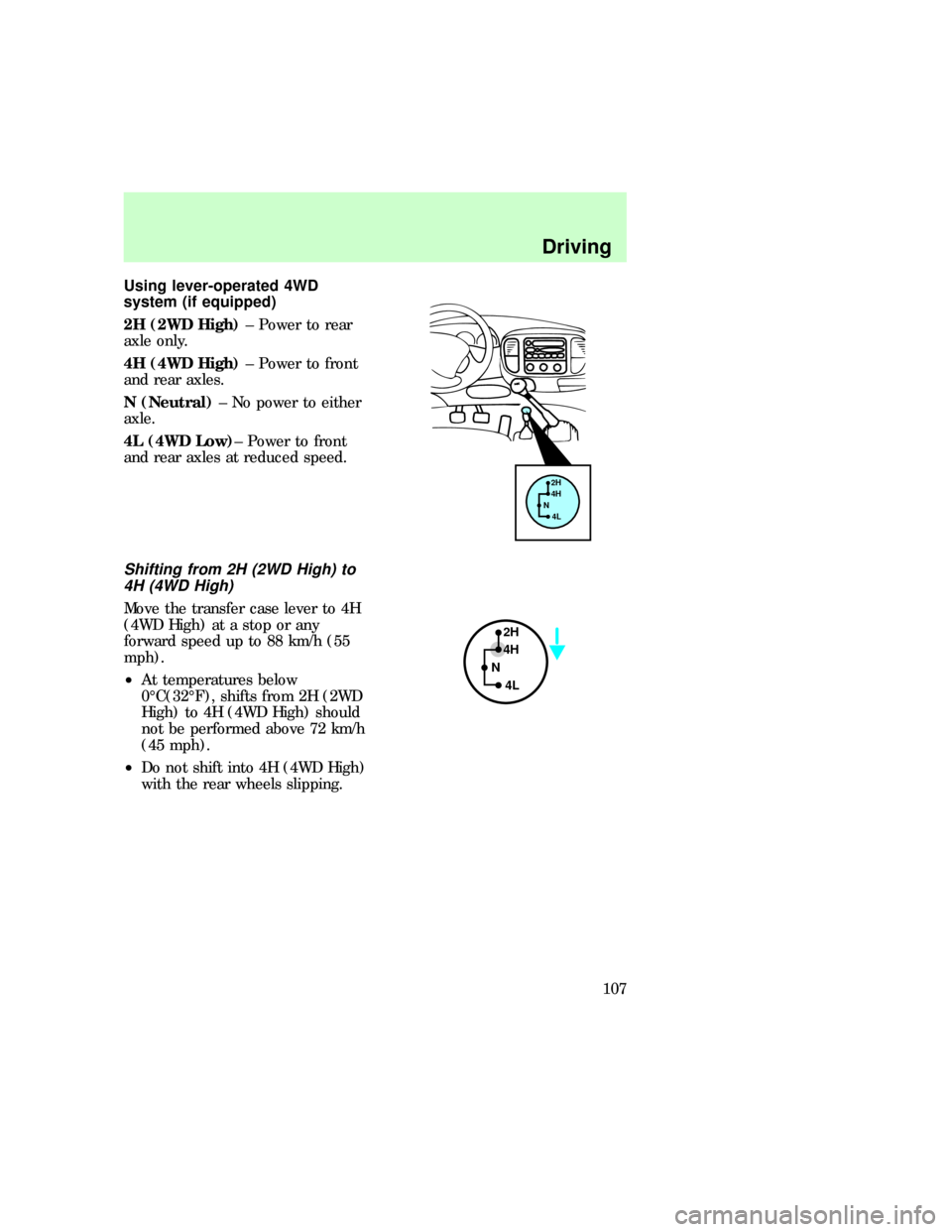
Using lever-operated 4WD
system (if equipped)
2H (2WD High)± Power to rear
axle only.
4H (4WD High)± Power to front
and rear axles.
N (Neutral)± No power to either
axle.
4L (4WD Low)± Power to front
and rear axles at reduced speed.
Shifting from 2H (2WD High) to
4H (4WD High)
Move the transfer case lever to 4H
(4WD High) at a stop or any
forward speed up to 88 km/h (55
mph).
²At temperatures below
0ÉC(32ÉF), shifts from 2H (2WD
High) to 4H (4WD High) should
not be performed above 72 km/h
(45 mph).
²Do not shift into 4H (4WD High)
with the rear wheels slipping.
2H
4H
4L N
2H
4H
4L N
f12_shifting_2h_4h
f12_shifting_4h_2h
Driving
107
Page 109 of 219
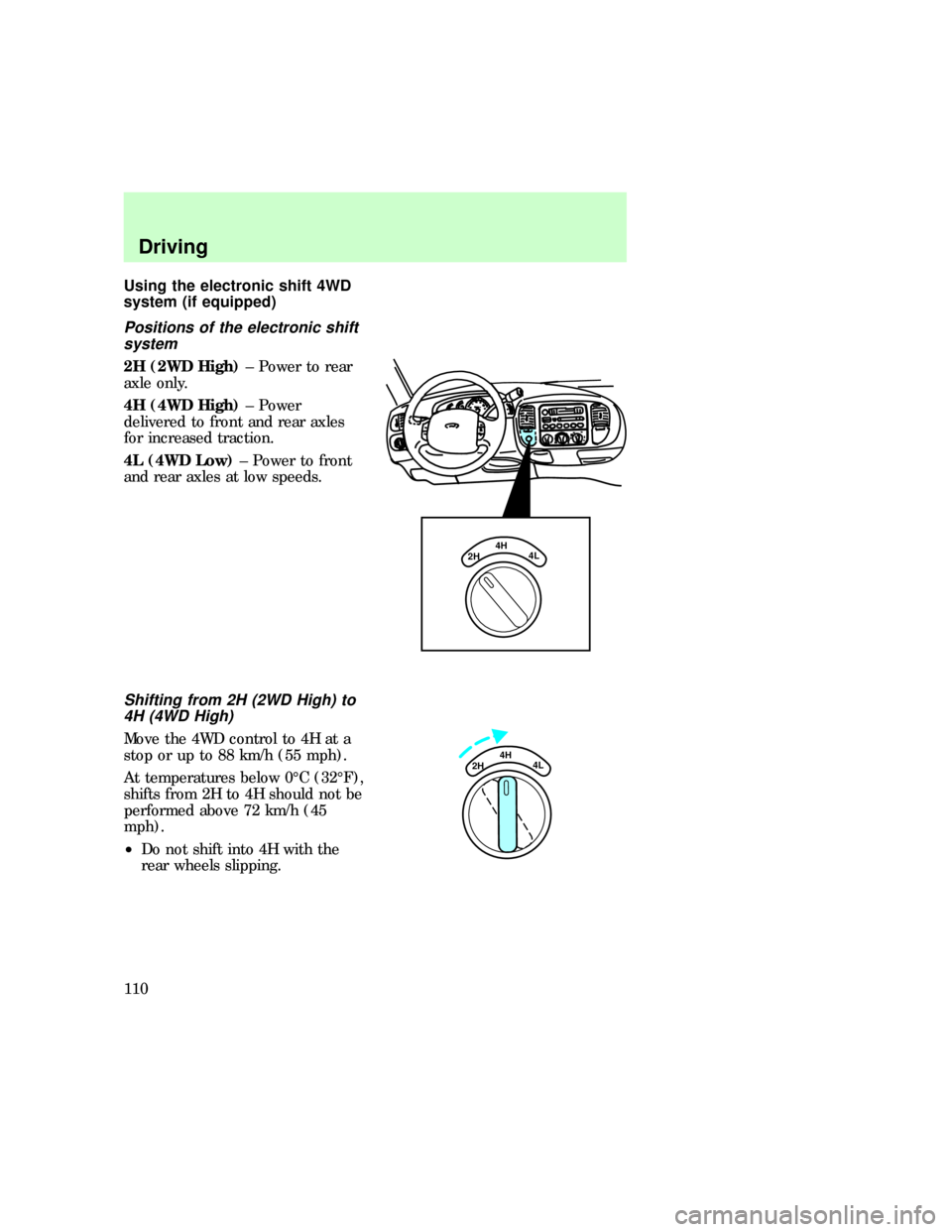
Using the electronic shift 4WD
system (if equipped)
Positions of the electronic shift
system
2H (2WD High)± Power to rear
axle only.
4H (4WD High)± Power
delivered to front and rear axles
for increased traction.
4L (4WD Low)± Power to front
and rear axles at low speeds.
Shifting from 2H (2WD High) to
4H (4WD High)
Move the 4WD control to 4H at a
stop or up to 88 km/h (55 mph).
At temperatures below 0ÉC (32ÉF),
shifts from 2H to 4H should not be
performed above 72 km/h (45
mph).
²Do not shift into 4H with the
rear wheels slipping.
2H4H
4L
2H4H
4L
f12_ct_2h_4h
f12_ct_4h_2hDriving
110
Page 111 of 219

When using 4WD, maintain
steering wheel control at all times,
especially in rough terrain. Since
sudden changes in terrain can
result in abrupt steering wheel
motion, make sure you grip the
steering wheel from the outside.
Do not grip the spokes.
Drive cautiously to avoid vehicle
damage from concealed objects
such as rocks and stumps.
You should either know the terrain
or examine maps of the area
before driving. Map out your route
before driving in the area. For
more information on driving
off-road, read the ªFour Wheelingº
supplement in your owner's
portfolio.
If your vehicle gets stuck
If the vehicle is stuck, shift the
transmission in a steady motion
between forward and reverse
gears. Allow the transmission to
engage, then press lightly on the
accelerator. DO NOT rock the
vehicle for more than a few
minutes. The transmission and
tires may be damaged or the
engine can overheat.
Do not spin the wheels at
over 35 mph (55 km/h).
The tires may fail and injure a
passenger or bystander.
Sand
When driving over sand, try to
keep all four wheels on the most
f12_driving_sand
Driving
112
Page 112 of 219
solid area of the trail. Do not
reduce the tire pressures but shift
to a lower gear and drive steadily
through the terrain. Apply the
accelerator slowly and avoid
spinning the wheels.
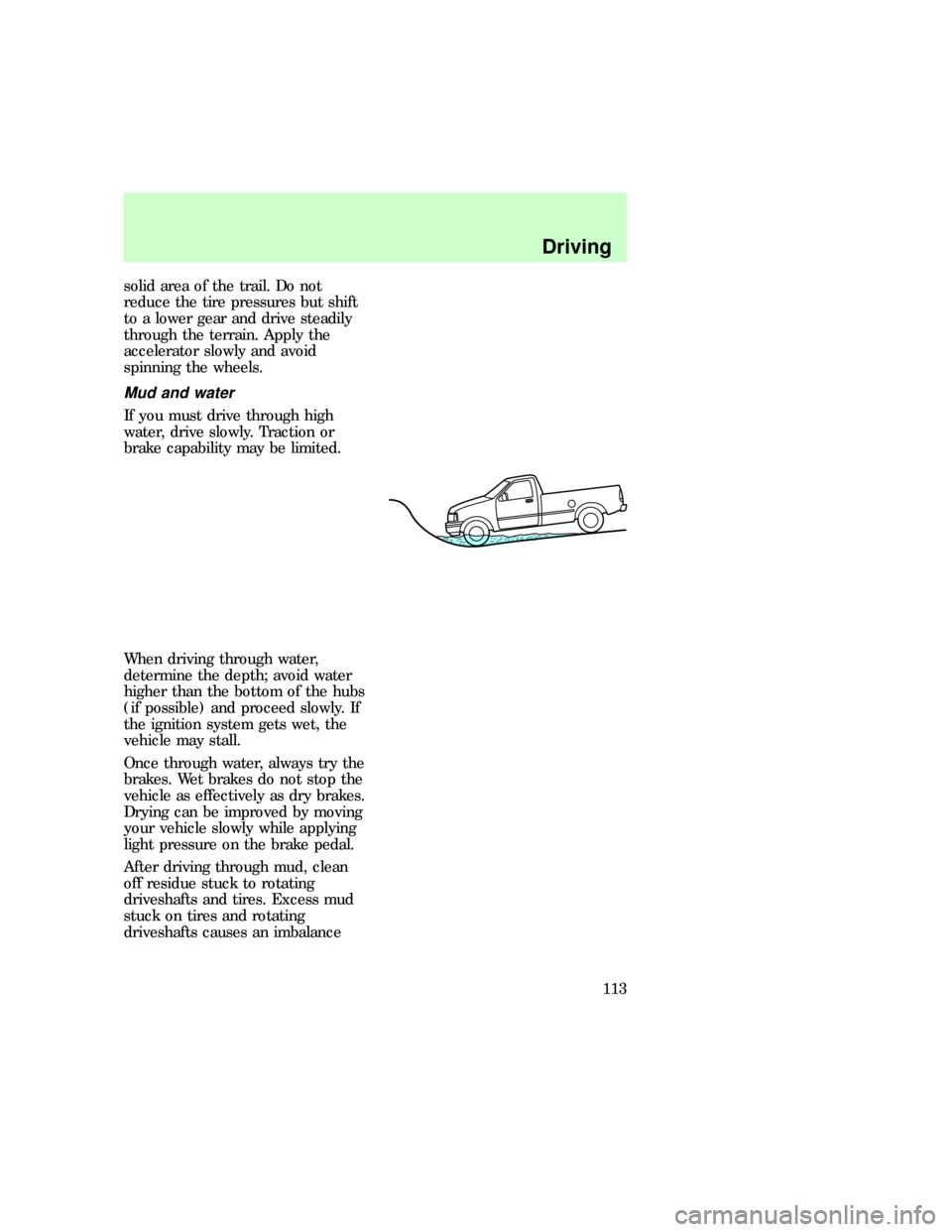
Mud and water
If you must drive through high
water, drive slowly. Traction or
brake capability may be limited.
When driving through water,
determine the depth; avoid water
higher than the bottom of the hubs
(if possible) and proceed slowly. If
the ignition system gets wet, the
vehicle may stall.
Once through water, always try the
brakes. Wet brakes do not stop the
vehicle as effectively as dry brakes.
Drying can be improved by moving
your vehicle slowly while applying
light pressure on the brake pedal.
After driving through mud, clean
off residue stuck to rotating
driveshafts and tires. Excess mud
stuck on tires and rotating
driveshafts causes an imbalance
f12_driving_mud_water
Driving
113
Page 127 of 219

²Allow more room for stopping
with a trailer attached.
²Practice turning, stopping and
backing in an area before
starting on a trip to get the feel
of the vehicle/trailer
combination.
²When turning, drive slightly
beyond the normal turning point
so the trailer wheels will clear
curbs and other obstacles.
²When stopped in traffic for long
periods of time in hot weather,
place the automatic transmission
gearshift in P (Park) to increase
idle speed. This aids engine
cooling and air conditioner
efficiency.
²Vehicles with trailers should not
be parked on a grade. If you
must park on a grade, place
wheel chocks under the trailer's
wheels.
²After you have travelled about
80 km (50 miles), thoroughly
check your hitch, electrical
connections and trailer wheel
lug nuts.
Launching or retrieving a boat
When backing down a ramp during
boat launching or retrieval,
²Do not allow the static water
level to rise above the bottom
edge of the rear bumper and
²Do not allow waves to break
higher than 15 cm (six inches)
above the bottom edge of the
rear bumper.
com_launch-retrieving_boat.01
Driving
128
Page 128 of 219
Exceeding these limits may allow
water to enter critical vehicle
components, adversely affecting
driveability, emissions and
reliability.
Servicing when towing
If you tow a trailer for long
distances, your vehicle will require
more frequent service intervals.
Refer to the ªService Guideº for
more information.
SNOWPLOWING
Ford recommends the following
specifications for low speed,
personal use snow removal:
²F-150 4WD long wheelbase or
F-250 4WD Regular Cab
²4.6L or 5.4L engine
²Super engine cooling
²Heavy duty front suspension
package
²Automatic transmission with
auxiliary automatic transmission
fluid cooling
²All-terrain tires
Do not install a snowplow and
plow with your vehicle until it has
been driven at least 800 km (500
miles).
Installing snowplow
Read the following instructions
before installing a snowplow:
²Front GAWR must not exceed
63% of the GVW. Add ballast
weight to the back of the
f12_service_towing
f12_snowplowing
f12_install_plow
Driving
129
Page 132 of 219
If you are driving more then 24 km
(15 miles) at temperatures above
freezing, angle the plow blade
either full left or full right to
provide maximum airflow to the
radiator.
If you are driving less than 24 km
(15 miles) at speeds up to 64 km/h
(40 mph) in cold weather, you will
not need to worry about blade
position to provide maximum
airflow.
Transmission operation while
plowing
²Shift transfer case to 4L (4WD
Low) when plowing in small
areas at speeds below 8 km/h (5
mph).
²Shift transfer case to 4H (4WD
High) when plowing larger areas
or light snow at higher speeds.
Do not exceed 24 km/h (15
mph).
²Do not shift the transmission
from a forward gear to R
(Reverse) until the engine is at
idle and the wheels are stopped.
²If the vehicle is stuck, shift the
transmission in a steady motion
between forward and reverse
gears. Do not rock the vehicle
for more than a few minutes.
The transmission and tires may
be damaged or the engine can
overheat.
Driving
133