Page 12 of 28
COOLING SYSTEM
MAINTENANCE
Engine coolant
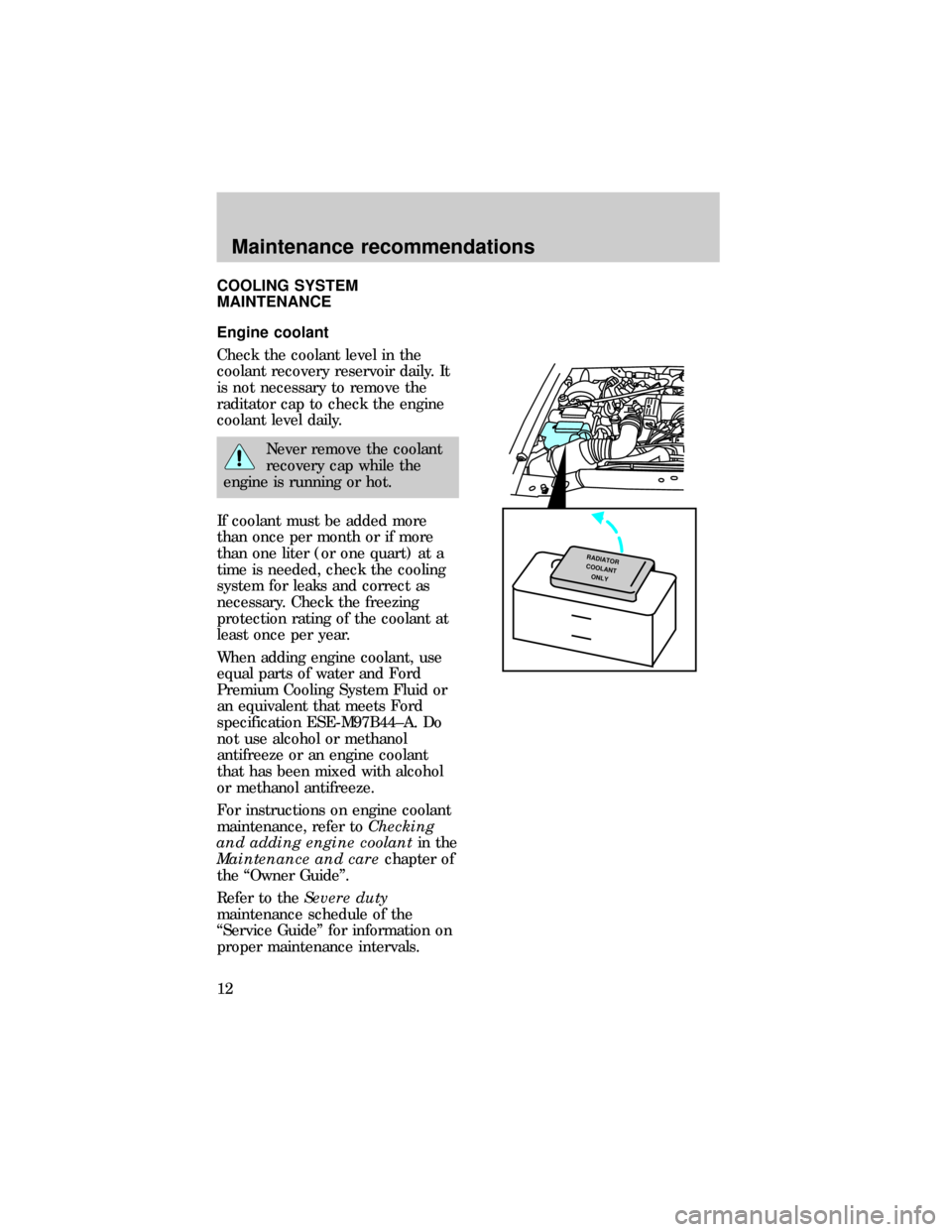
Check the coolant level in the
coolant recovery reservoir daily. It
is not necessary to remove the
raditator cap to check the engine
coolant level daily.
Never remove the coolant
recovery cap while the
engine is running or hot.
If coolant must be added more
than once per month or if more
than one liter (or one quart) at a
time is needed, check the cooling
system for leaks and correct as
necessary. Check the freezing
protection rating of the coolant at
least once per year.
When adding engine coolant, use
equal parts of water and Ford
Premium Cooling System Fluid or
an equivalent that meets Ford
specification ESE-M97B44±A. Do
not use alcohol or methanol
antifreeze or an engine coolant
that has been mixed with alcohol
or methanol antifreeze.
For instructions on engine coolant
maintenance, refer toChecking
and adding engine coolantin the
Maintenance and carechapter of
the ªOwner Guideº.
Refer to theSevere duty
maintenance schedule of the
ªService Guideº for information on
proper maintenance intervals.
RADIATOR
COOLANT
ONLY
Maintenance recommendations
12
Page 13 of 28
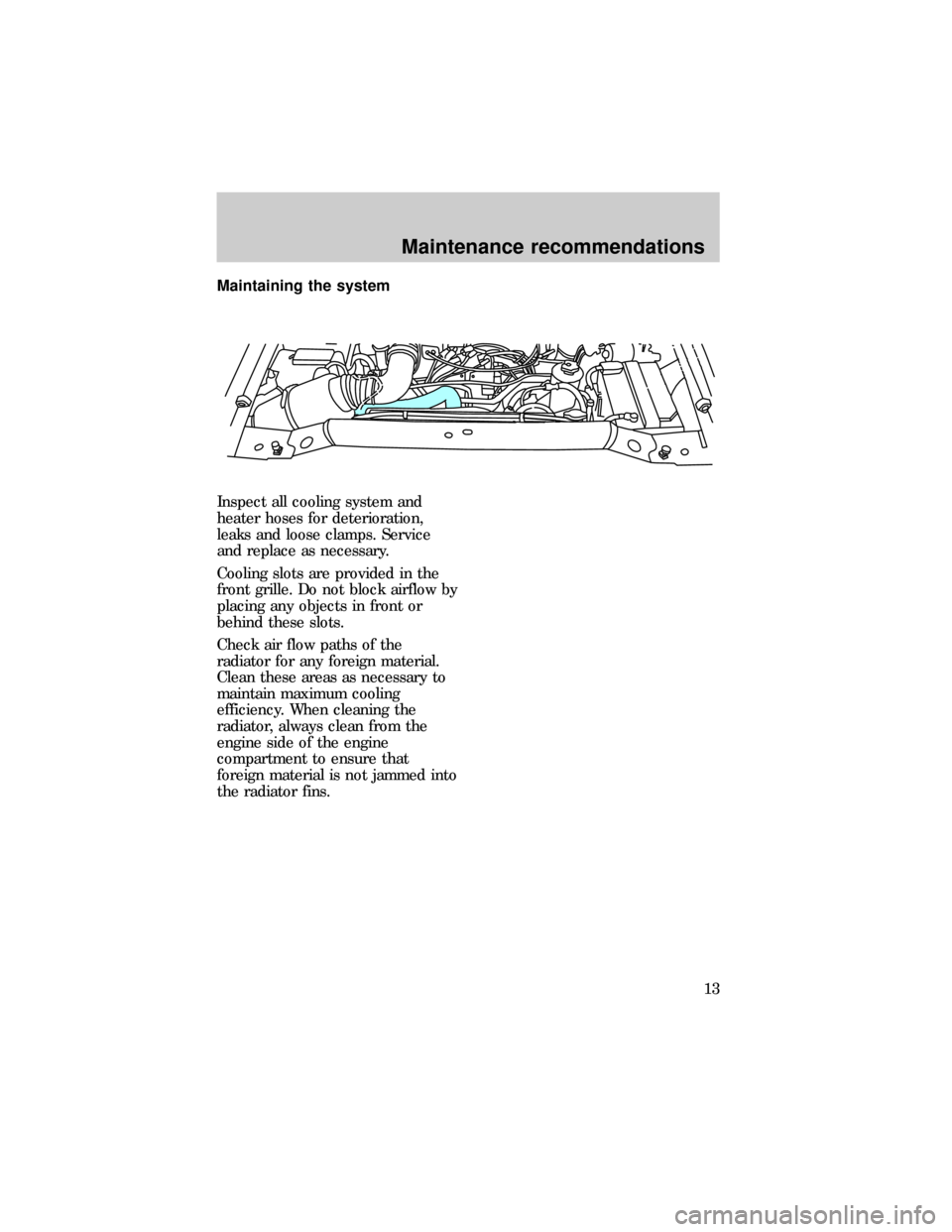
Maintaining the system
Inspect all cooling system and
heater hoses for deterioration,
leaks and loose clamps. Service
and replace as necessary.
Cooling slots are provided in the
front grille. Do not block airflow by
placing any objects in front or
behind these slots.
Check air flow paths of the
radiator for any foreign material.
Clean these areas as necessary to
maintain maximum cooling
efficiency. When cleaning the
radiator, always clean from the
engine side of the engine
compartment to ensure that
foreign material is not jammed into
the radiator fins.
Maintenance recommendations
13
Page 15 of 28

equivalent that meets Ford
specification ESR-M13P4±A to the
terminal surfaces to help prevent
corrosion from forming.
Check the tightness of the cables
to the battery post by hand. It may
be necessary to tighten the clamp
with a suitable wrench.
Ignition system
Visually inspect the plug wires and
ignition coil pack. Any oily dirt
should be removed and the area
cleaned with a damp cloth. Ensure
that all high voltage wires are
firmly attached to the coil pack
and that the other ends are firmly
seated over each spark plug.
Other electrical systems
Wiring, lighting and aftermarket
electrical equipment should be
checked monthly for proper
routing, deterioration or chafing on
other components.
UNDER VEHICLE
MAINTENANCE
Catalytic converters
During normal engine operation,
the catalytic converter surface
temperature can reach up to 816ÉC
(1500ÉF). To avoid injury, ensure
that the converter has cooled
before attempting maintenance.
Ford recommends that an under
vehicle inspection be performed at
Severe Dutyintervals listed in the
ªService Guideº. With the vehicle
Maintenance recommendations
15
Page 18 of 28

SPECIAL SERVICE EQUIPMENT
The Explorer is not designed
nor intended to be used as a
pursuit vehicle or an
ambulance.
The following optional equipment
is designed to meet Ford
Corporate Product Standards;
however, the equipment does not
meet corporate guidelines relative
to police packages. therefore, the
optional equipment is intended for
use in limited law enforcement
services only. Use of DSO special
service options does not imply nor
allow use as a pursuit vehicle.
Components that are part of some
available options are listed below
and on the following pages, along
with a brief outline of their major
features.
ELECTRICAL
Heavy-duty alternator
Handling the high electrical loads
imposed on special service vehicles
by the broad range of necessary
equipment requires a high ampere
output alternator.
The 4.0 L SOHC or 5.0 L Explorer
engine, when equipped with a 130
ampere alternator, has the voltage
regulator integral with the
alternator. No external voltage
regulator is required.
Severe duty equipment
18
Page 19 of 28

Heavy-duty battery special
service
Special service vehicles are
equipped with a maintenance-free
battery which does not require the
addition of water or other regular
service.
Installing aftermarket equipment
When installing aftermarket
equipment, avoid using fasteners
that are too long for the
application or are in an area that
might damage other vehicle
components (i.e., wiring, brake
lines, fuel tank and lines,
powertrain components exhaust
system, suspension, etc.).
Do not make electrical connections
to vehicle electrical systems not
specifically designed for
aftermarket equipment installation.
Do not install and components into
the Powertrain control module
(PCM) harness. Connecting into
this system may affect engine and
transmission operation. As an
example, connection of
aftermarket electrical equipment
into the brake light circuit or any
other circuit which is connected to
the PCM, anti-lock brake
computer, air bag system,
transmission or any other vehicle
system may cause vehicle
malfunction.
Severe duty equipment
19
Page 25 of 28
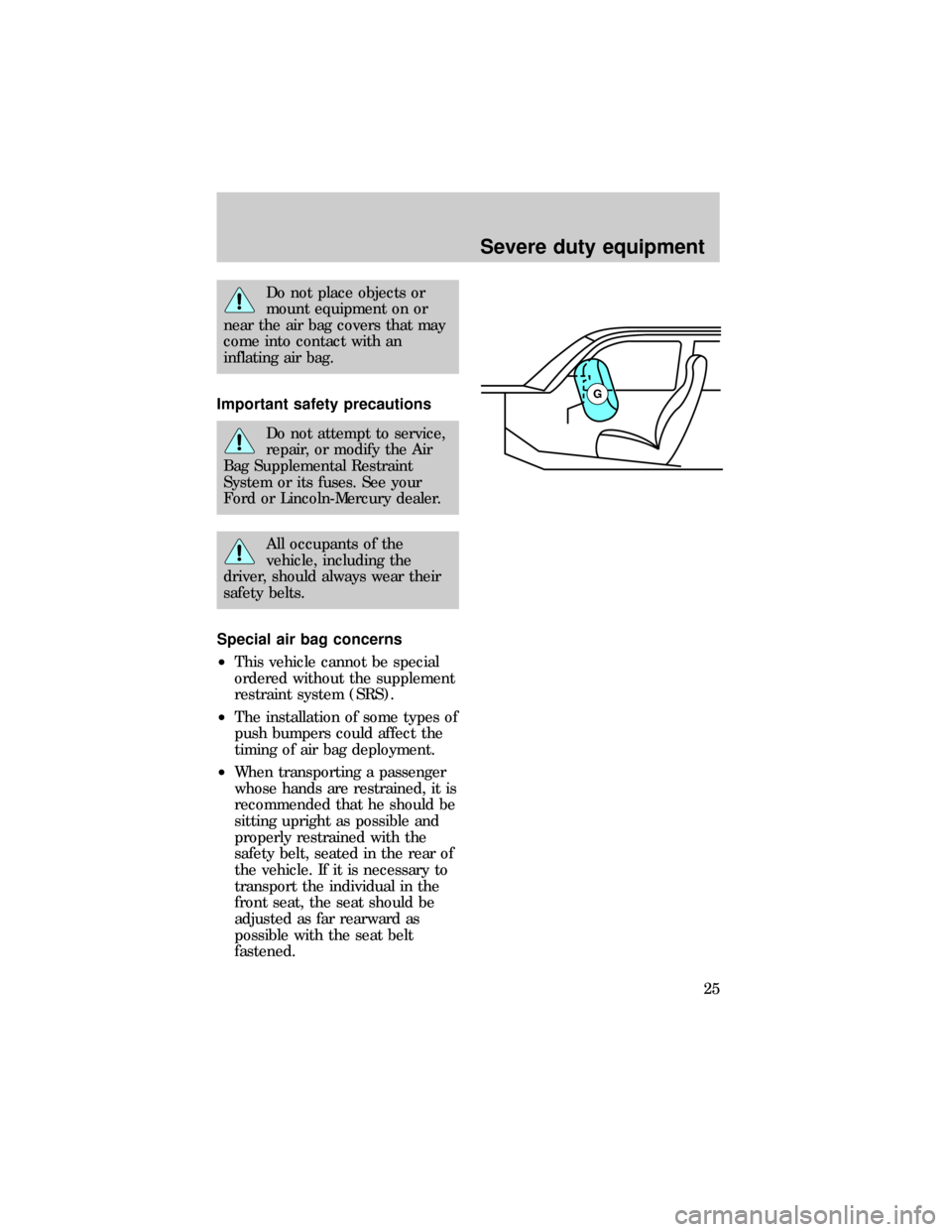
Do not place objects or
mount equipment on or
near the air bag covers that may
come into contact with an
inflating air bag.
Important safety precautions
Do not attempt to service,
repair, or modify the Air
Bag Supplemental Restraint
System or its fuses. See your
Ford or Lincoln-Mercury dealer.
All occupants of the
vehicle, including the
driver, should always wear their
safety belts.
Special air bag concerns
²This vehicle cannot be special
ordered without the supplement
restraint system (SRS).
²The installation of some types of
push bumpers could affect the
timing of air bag deployment.
²When transporting a passenger
whose hands are restrained, it is
recommended that he should be
sitting upright as possible and
properly restrained with the
safety belt, seated in the rear of
the vehicle. If it is necessary to
transport the individual in the
front seat, the seat should be
adjusted as far rearward as
possible with the seat belt
fastened.
G
Severe duty equipment
25
Page 28 of 28
Automatic transmission ................3
Axle ................................................3
Engine
service points ..............................2Service concerns ...........................2
Index
28