Page 106 of 236
Activating the automatic locking
mode (ALR) on the built-in child
safety seat
1. Fully extend the right shoulder
belt.
2. Allow the belts to tighten snugly
against the child's shoulders.
Deactivating the automatic
locking mode (ALR) on the
built-in child safety seat
1. Disconnect the chest clip and
remove the left and right safety
belt tongues from the crotch
buckle.
2. Allow the shoulder belts to fully
retract.
Removing your child from the
built-in child safety seat
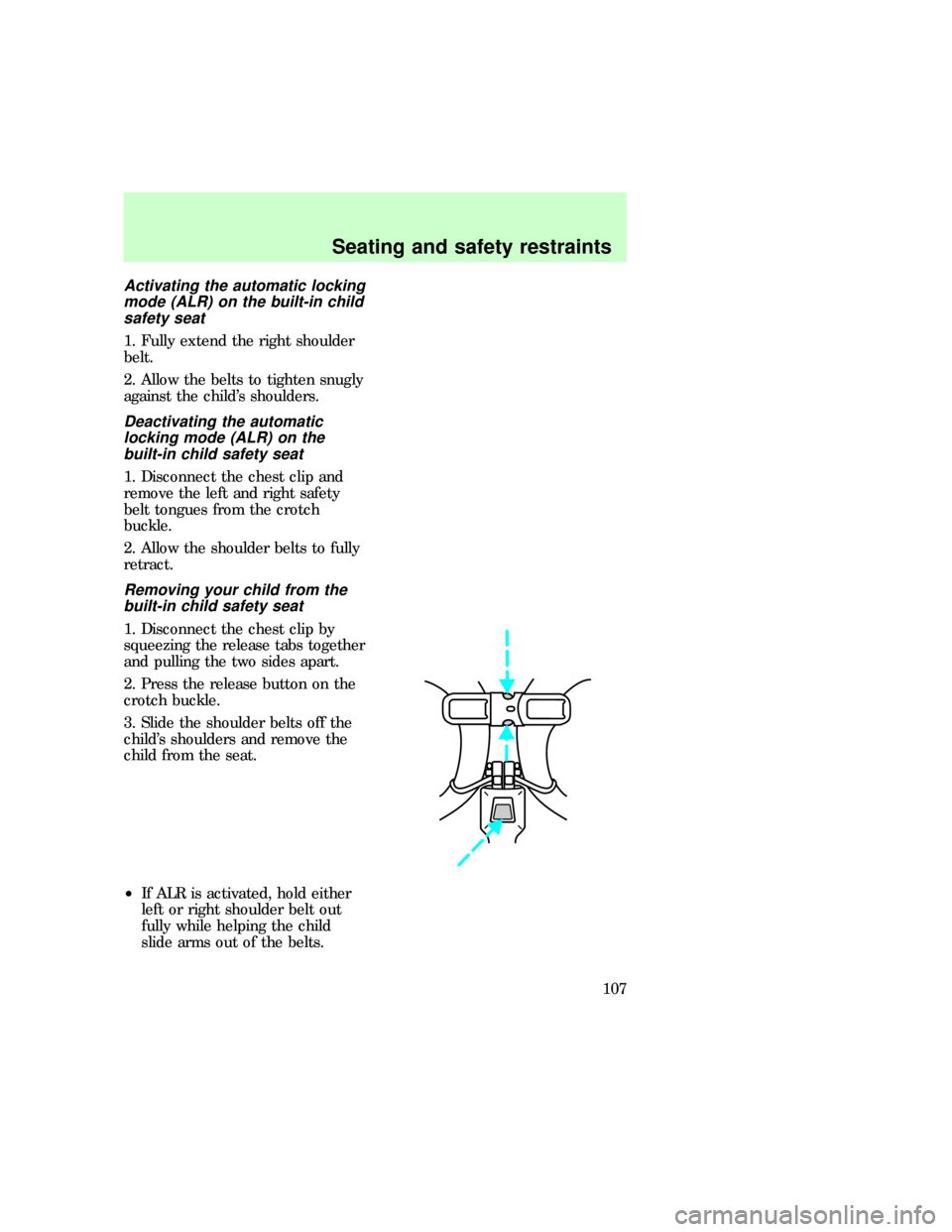
1. Disconnect the chest clip by
squeezing the release tabs together
and pulling the two sides apart.
2. Press the release button on the
crotch buckle.
3. Slide the shoulder belts off the
child's shoulders and remove the
child from the seat.
²If ALR is activated, hold either
left or right shoulder belt out
fully while helping the child
slide arms out of the belts.
uno_canceling_alr_in_seat
uno_removing_child_from_seat
Seating and safety restraints
107
Page 107 of 236
4. Fold the cushion protector flap
onto the child seat cushion. Slide
the belt tongues up and out of the
way of the cushion, then return
the child seat cushion to the
stowed (upright) position.
5. Slide the Velcrotstraps through
the D-rings on the child seat
cushion and attach.
6. Slide the head restraint down
until the top of the head restraint
is flush with the top of the adult
seat back.
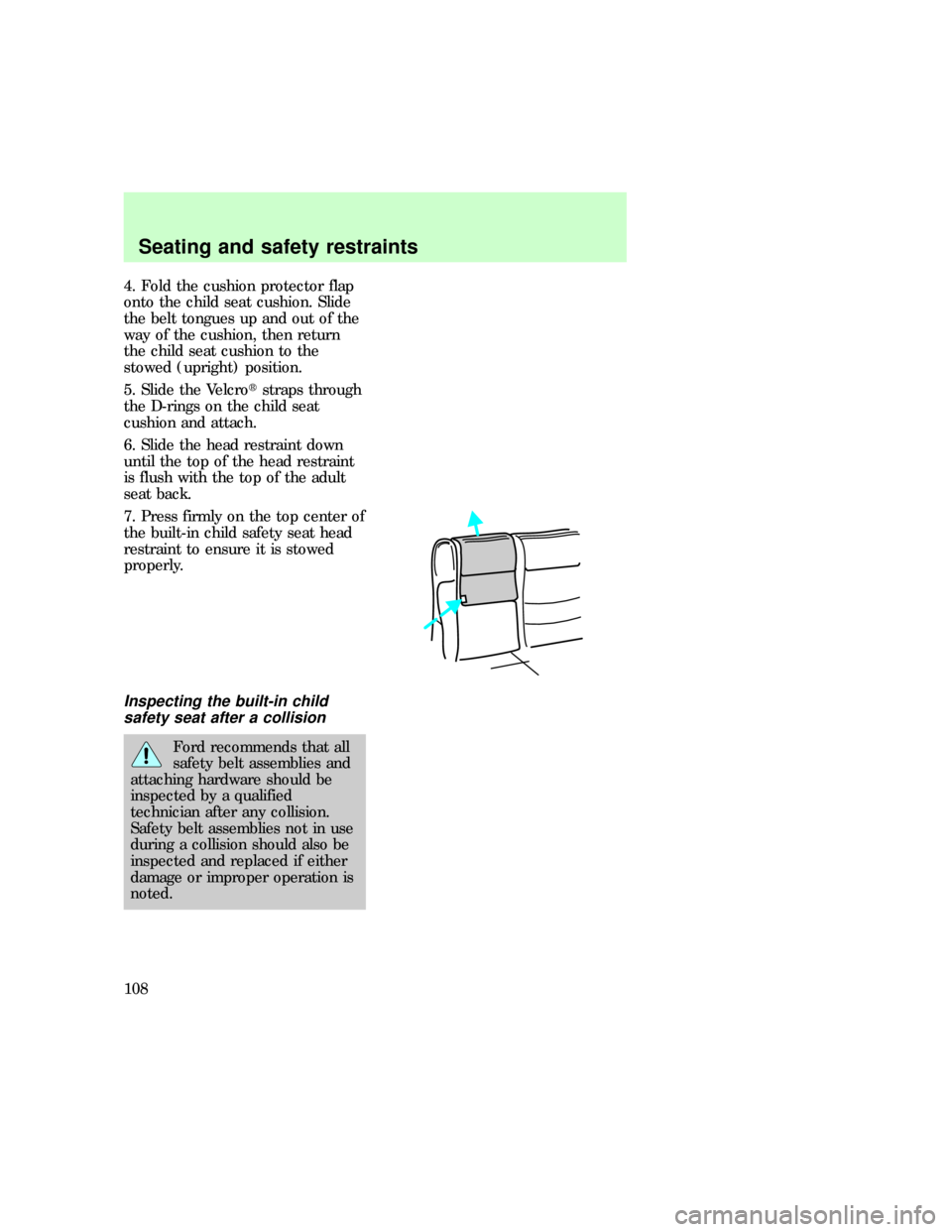
7. Press firmly on the top center of
the built-in child safety seat head
restraint to ensure it is stowed
properly.
Inspecting the built-in child
safety seat after a collision
Ford recommends that all
safety belt assemblies and
attaching hardware should be
inspected by a qualified
technician after any collision.
Safety belt assemblies not in use
during a collision should also be
inspected and replaced if either
damage or improper operation is
noted.
uno_inspecting_seat
Seating and safety restraints
108
Page 112 of 236
standard requirements regulating
the impulse electrical field strength
of radio noise.
When starting a fuel-injected
engine, avoid pressing the
accelerator before or during
starting. Only use the accelerator
when you have difficulty starting
the engine. For more information
on starting the vehicle, refer to
Starting the vehiclein this
chapter.
Before starting the vehicle:
1. Make sure all vehicle occupants
have buckled their safety belts. For
more information on safety belts
and their proper usage, refer to
theSeating and safety restraints
chapter.
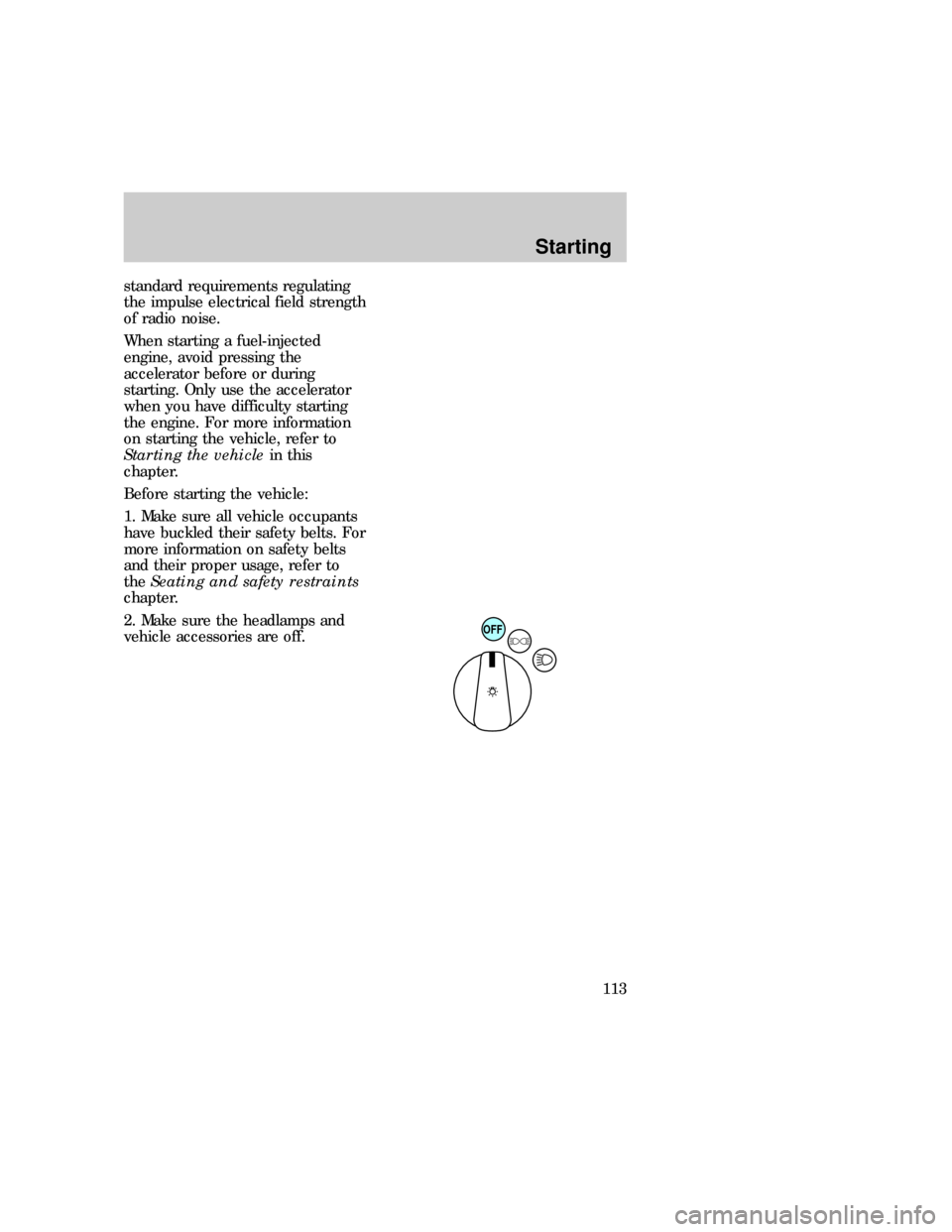
2. Make sure the headlamps and
vehicle accessories are off.
OFF
Starting
113
Page 114 of 236
Make sure the following lights
illuminate briefly. If a light fails to
illuminate, have the vehicle
serviced.
²If the driver's safety belt is
fastened, the
light does not
illuminate.
STARTING
Special conditions when
starting
Starting the engine
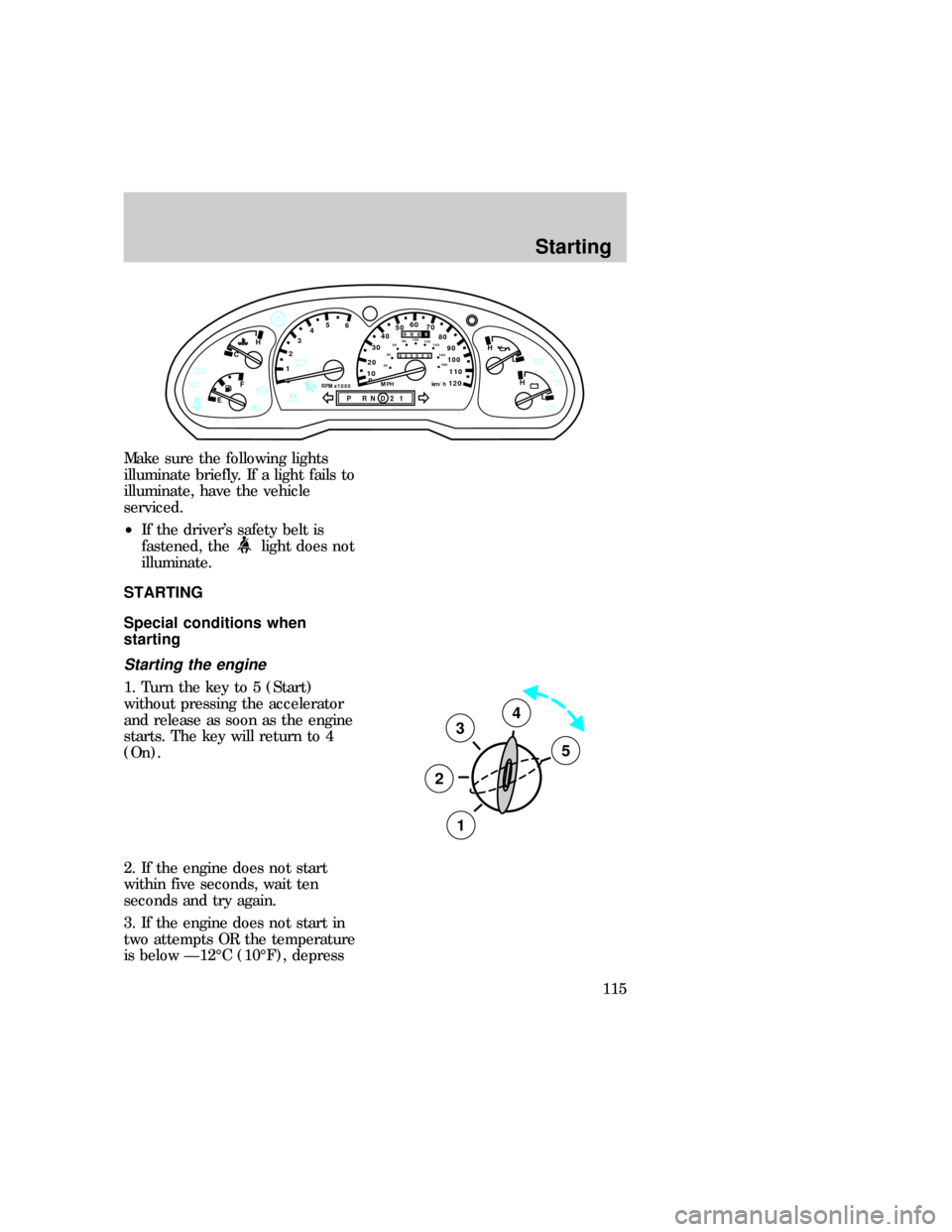
1. Turn the key to 5 (Start)
without pressing the accelerator
and release as soon as the engine
starts. The key will return to 4
(On).
2. If the engine does not start
within five seconds, wait ten
seconds and try again.
3. If the engine does not start in
two attempts OR the temperature
is below Ð12ÉC (10ÉF), depress
0ABS
- +
P RND21RPM x 1000
12345
6- +
H
H
L LH
C
F
E
!BRAKE
CHECK
GAGE
0
20
1030405060
70
80
90
110
120000000
oooo
10020406080100
120
140
160
180
MPH km/hDOOR
AJARCHECK
GAUGE
O/D
OFF4WD
LOW 4WD SPEED
CONT
3
2
1
5
4
uno_special_conditions_title
uno_starting_vehicle
Starting
115
Page 136 of 236
Do not exceed the GVWR
or the GAWR specified on
the Safety Compliance
Certification Label.
It is extremely dangerous
to ride in a cargo area,
inside or outside of a vehicle. In
a collision, people riding in these
areas are more likely to be
seriously injured or killed. Do not
allow people to ride in any area
of your vehicle that is not
equipped with seats and safety
belts. Be sure everyone in your
vehicle is in a seat and using a
safety belt properly.
Driving with a heavy load
The total vehicle weight plus the
total weight of passengers and
cargo should never exceed the
GVWR.
The weight that the vehicle carries
over the front and rear axles
should never exceed the GVWR for
the respective axle.
The weight limits of your vehicle's
tires affect the GVWR or GAWR
limitations. Using tires with higher
weight limits than the original tires
will not increase the GVWR or
GAWR of your vehicle; using tires
with lower weight limits may lower
the GVWR or GAWR of your
vehicle.
uno_driving_heavy_load
uno_trailer_title
Driving
137
Page 162 of 236
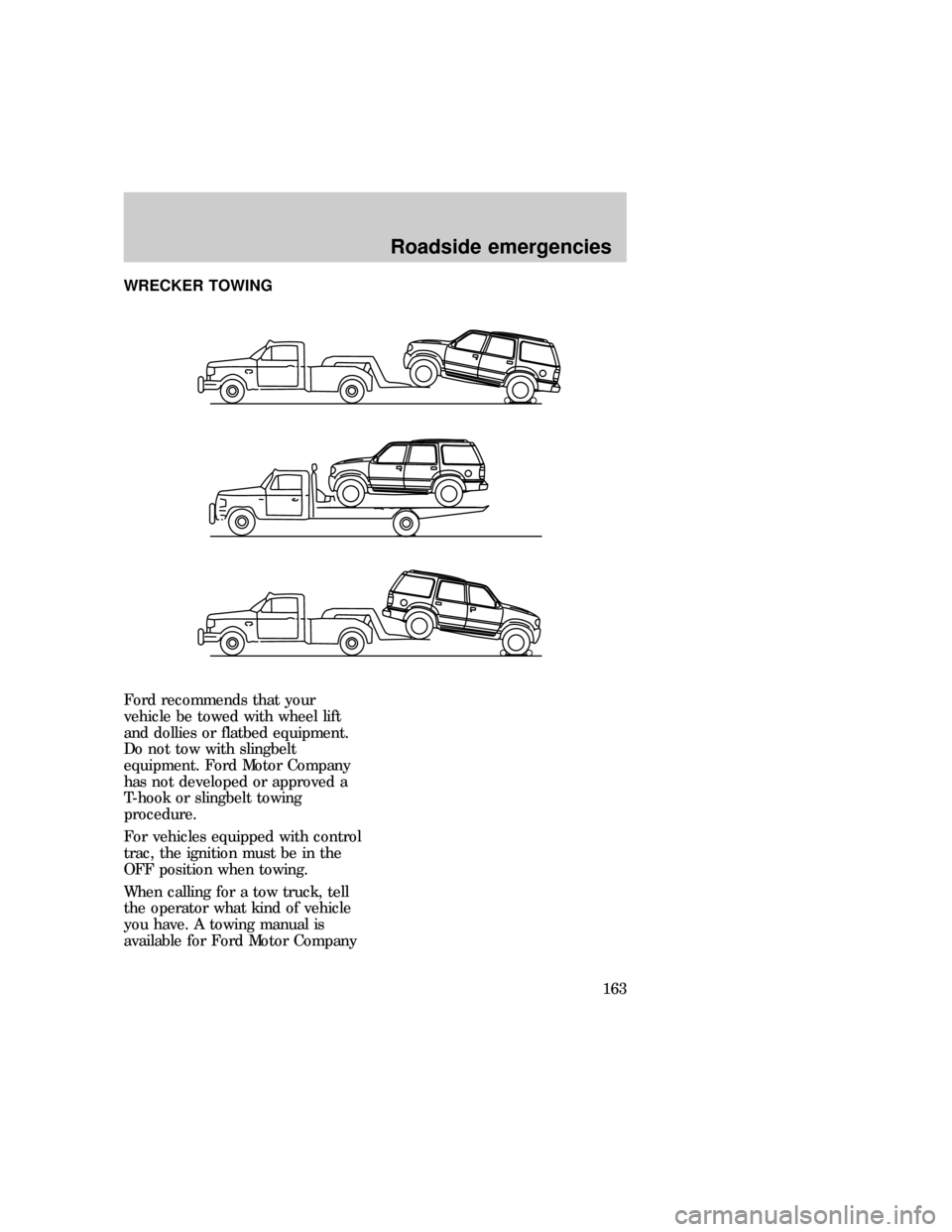
WRECKER TOWING
Ford recommends that your
vehicle be towed with wheel lift
and dollies or flatbed equipment.
Do not tow with slingbelt
equipment. Ford Motor Company
has not developed or approved a
T-hook or slingbelt towing
procedure.
For vehicles equipped with control
trac, the ignition must be in the
OFF position when towing.
When calling for a tow truck, tell
the operator what kind of vehicle
you have. A towing manual is
available for Ford Motor Company
Roadside emergencies
163
Page 198 of 236
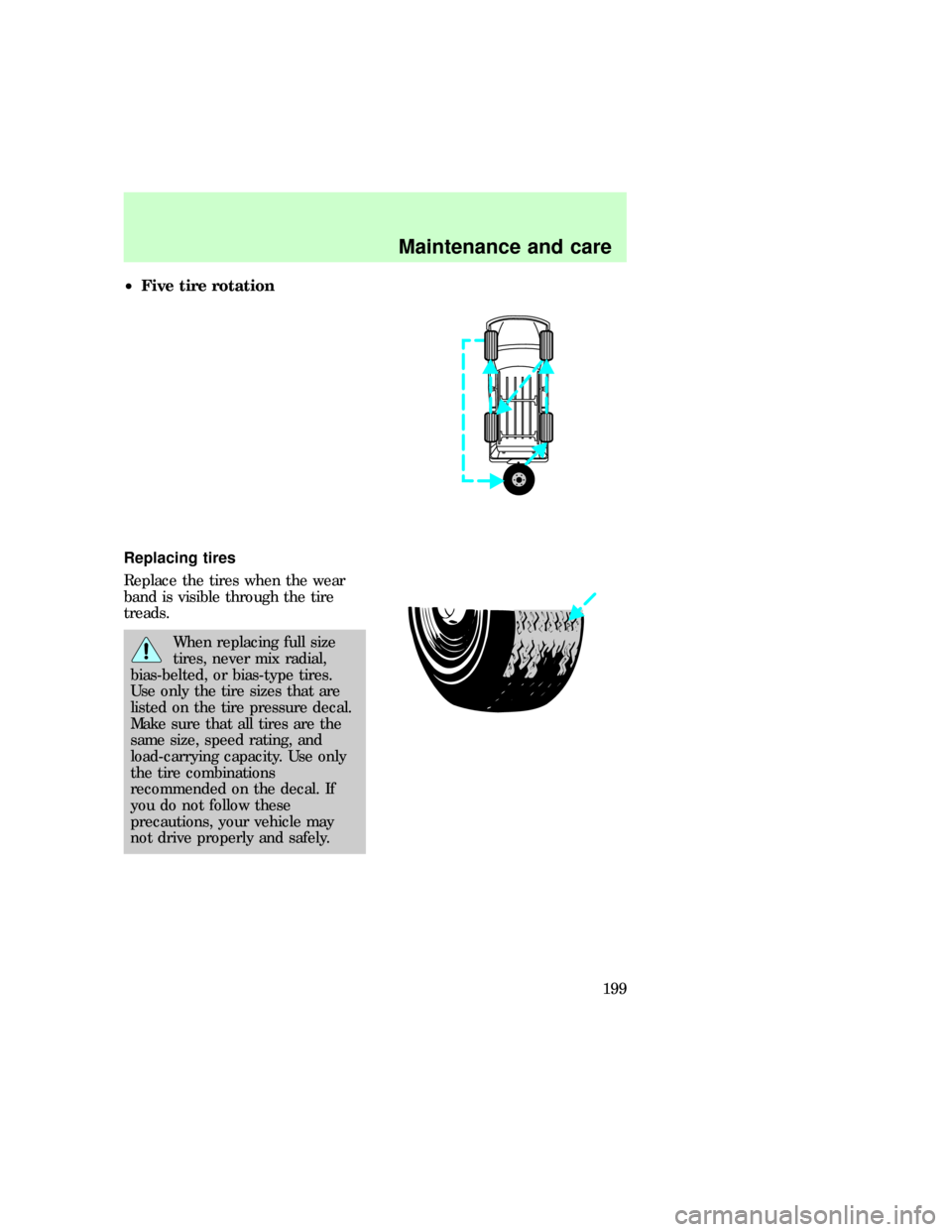
²Five tire rotation
Replacing tires
Replace the tires when the wear
band is visible through the tire
treads.
When replacing full size
tires, never mix radial,
bias-belted, or bias-type tires.
Use only the tire sizes that are
listed on the tire pressure decal.
Make sure that all tires are the
same size, speed rating, and
load-carrying capacity. Use only
the tire combinations
recommended on the decal. If
you do not follow these
precautions, your vehicle may
not drive properly and safely.
uno_types_tires
Maintenance and care
199
Page 219 of 236
vinyl cleaner or a mild soap.
Cleaning and maintaining the
safety belts
Clean the safety belts with a mild
soap solution recommended for
cleaning upholstery or carpets. Do
not bleach or dye the belts,
because these actions may weaken
the belt webbing.
All safety belt assemblies,
including retractors, buckles, front
seat belt buckle support assemblies
(slide bar) (if equipped), shoulder
belt height adjusters (if equipped),
child safety seat tether bracket
assemblies (if equipped) and
attaching hardware should be
inspected after any collision. Ford
recommends that all safety belt
assemblies used in vehicles
involved in a collision be replaced.
However, if the collision was minor
and a qualified technician finds
that the belts do not show damage
and continue to operate properly,
they do not need to be replaced.
Safety belt assemblies not in use
during a collision should also be
inspected and replaced if either
damage or improper operation is
noted.
Cleaning the built-in child seat
(if equipped)
Clean the built-in child seat with
mild soap and water. Do not use
household cleaning products
because they may weaken the
safety belt webbing or damage the
vinyl parts of the seat.
com_safety_belts_cleaning.01
com_child-seat_cleaning.01
Maintenance and care
220