Page 161 of 236
![FORD EXPLORER 1997 2.G Owners Manual Do not connect the end of
the second cable to the
negative ([-]) terminal of the
battery to be jumped. A spark
may cause an explosion of the
gases that surround the battery.
Jump starting
1. Start the](/manual-img/11/4954/w960_4954-160.png "FORD EXPLORER 1997 2.G Owners Manual Do not connect the end of
the second cable to the
negative ([-]) terminal of the
battery to be jumped. A spark
may cause an explosion of the
gases that surround the battery.
Jump starting
1. Start the")
Do not connect the end of
the second cable to the
negative ([-]) terminal of the
battery to be jumped. A spark
may cause an explosion of the
gases that surround the battery.
Jump starting
1. Start the booster vehicle and
run the engine at moderately
increased speed.
2. Start the engine of the vehicle
with the discharged battery.
3. Once the engine has been
started, run both vehicles for a
further three minutes before
disconnecting the cable leads.
Removing the jumper cables
1. Remove the jumper cables in
reverse order. Take the cable off
the metallic surface (1) first,
followed by the cable on the
negative (-) booster battery
terminal (2).
2. Remove the cable from the
positive (+) terminal of the booster
battery (3) and then the
discharged battery (4).
3. After the disabled vehicle has
been started, allow it to idle for a
while so the engine can ªrelearnº
its idle conditions.
+–
+–
2
3
4
1
uno_jump_starting
com_removing_cables.01
uno_wrecker_towing
Roadside emergencies
162
Page 165 of 236
could get caught in moving
parts. Take precautions with
long hair.
²Do not work on a vehicle with
the engine running in an
enclosed space, unless you are
sure you have enough
ventilation.
²Keep all lit cigarettes, open
flames and other lit material
away from the battery and all
fuel related parts.
If you disconnect the battery, the
engine must ªrelearnº its idle
conditions before your vehicle will
drive properly, as explained in
Batteryin this chapter.
Working with the engine off
²Automatic transmission:
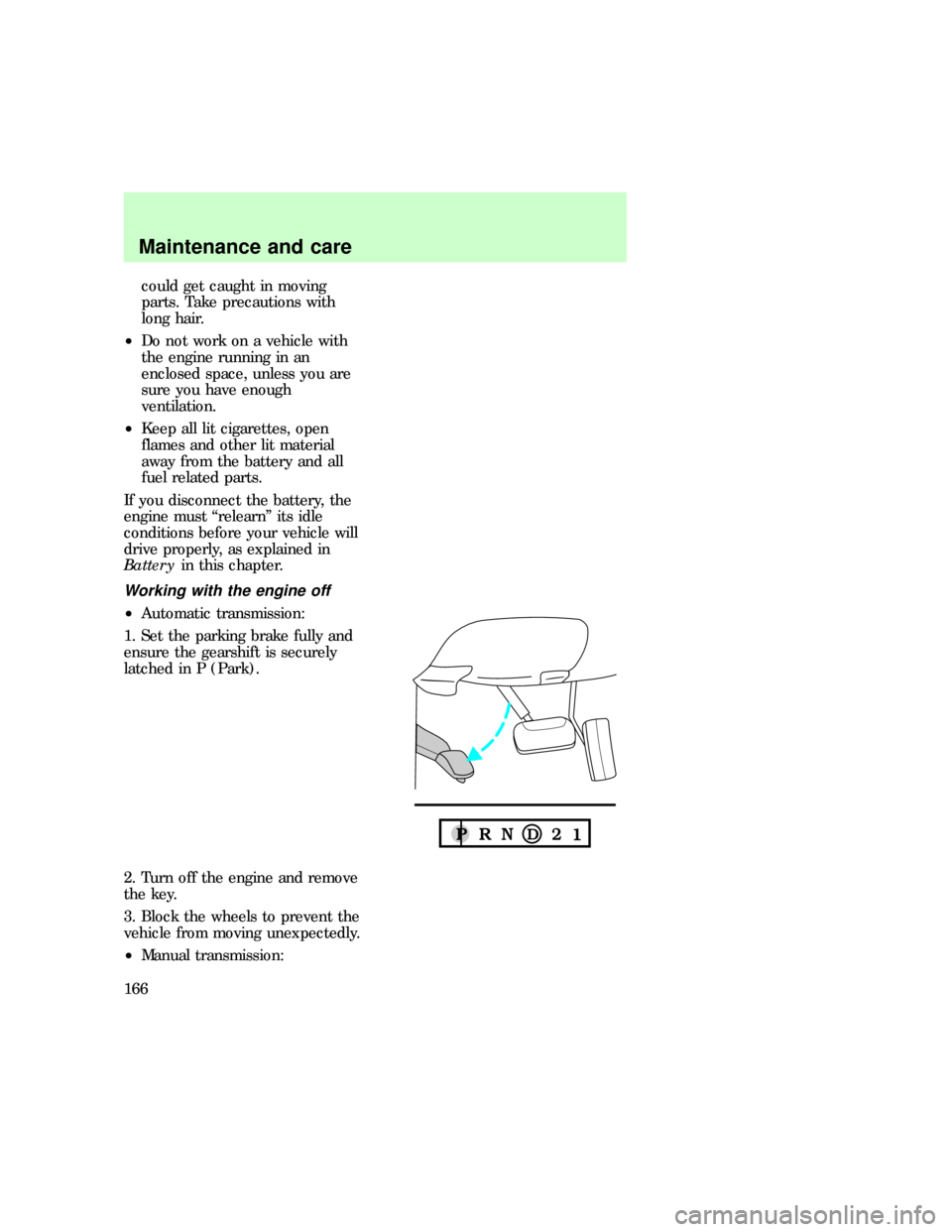
1. Set the parking brake fully and
ensure the gearshift is securely
latched in P (Park).
2. Turn off the engine and remove
the key.
3. Block the wheels to prevent the
vehicle from moving unexpectedly.
²Manual transmission:
uno_working_off
Maintenance and care
166
Page 169 of 236
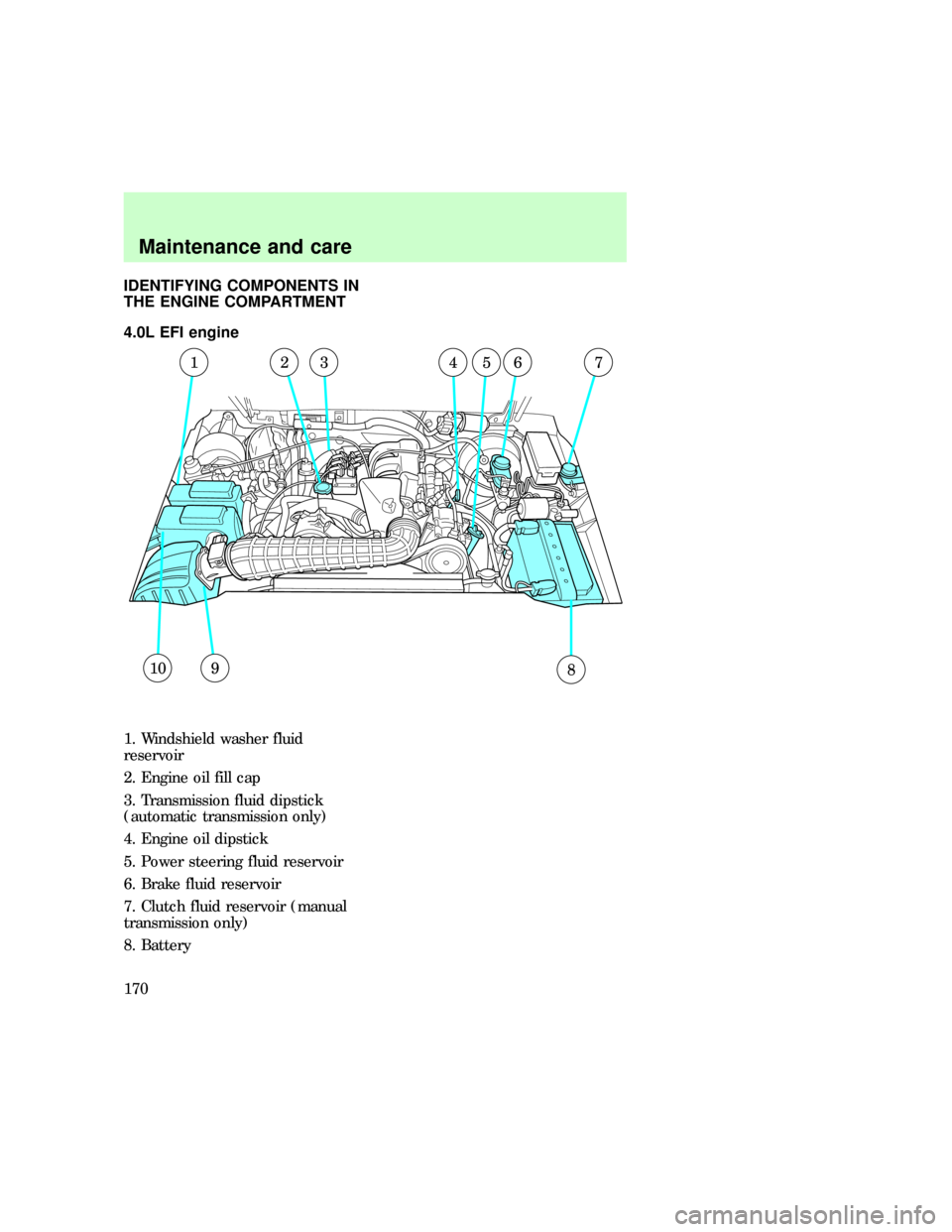
IDENTIFYING COMPONENTS IN
THE ENGINE COMPARTMENT
4.0L EFI engine
1. Windshield washer fluid
reservoir
2. Engine oil fill cap
3. Transmission fluid dipstick
(automatic transmission only)
4. Engine oil dipstick
5. Power steering fluid reservoir
6. Brake fluid reservoir
7. Clutch fluid reservoir (manual
transmission only)
8. Battery
10
1235674
89
com_4.0L-ohv
Maintenance and care
170
Page 170 of 236
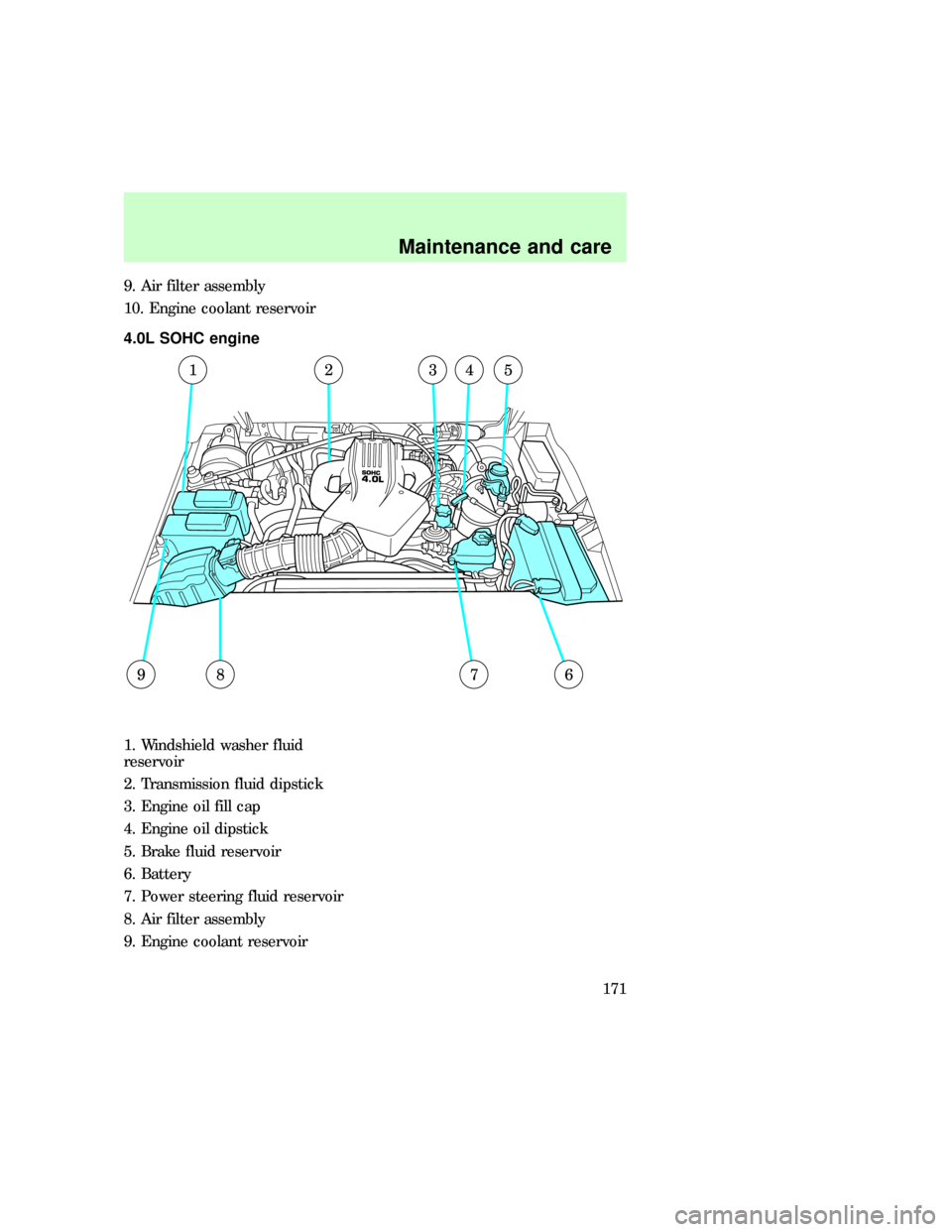
9. Air filter assembly
10. Engine coolant reservoir
4.0L SOHC engine
1. Windshield washer fluid
reservoir
2. Transmission fluid dipstick
3. Engine oil fill cap
4. Engine oil dipstick
5. Brake fluid reservoir
6. Battery
7. Power steering fluid reservoir
8. Air filter assembly
9. Engine coolant reservoir
9
13425
867
com_4.0L-ohc
com_5.0L
Maintenance and care
171
Page 171 of 236
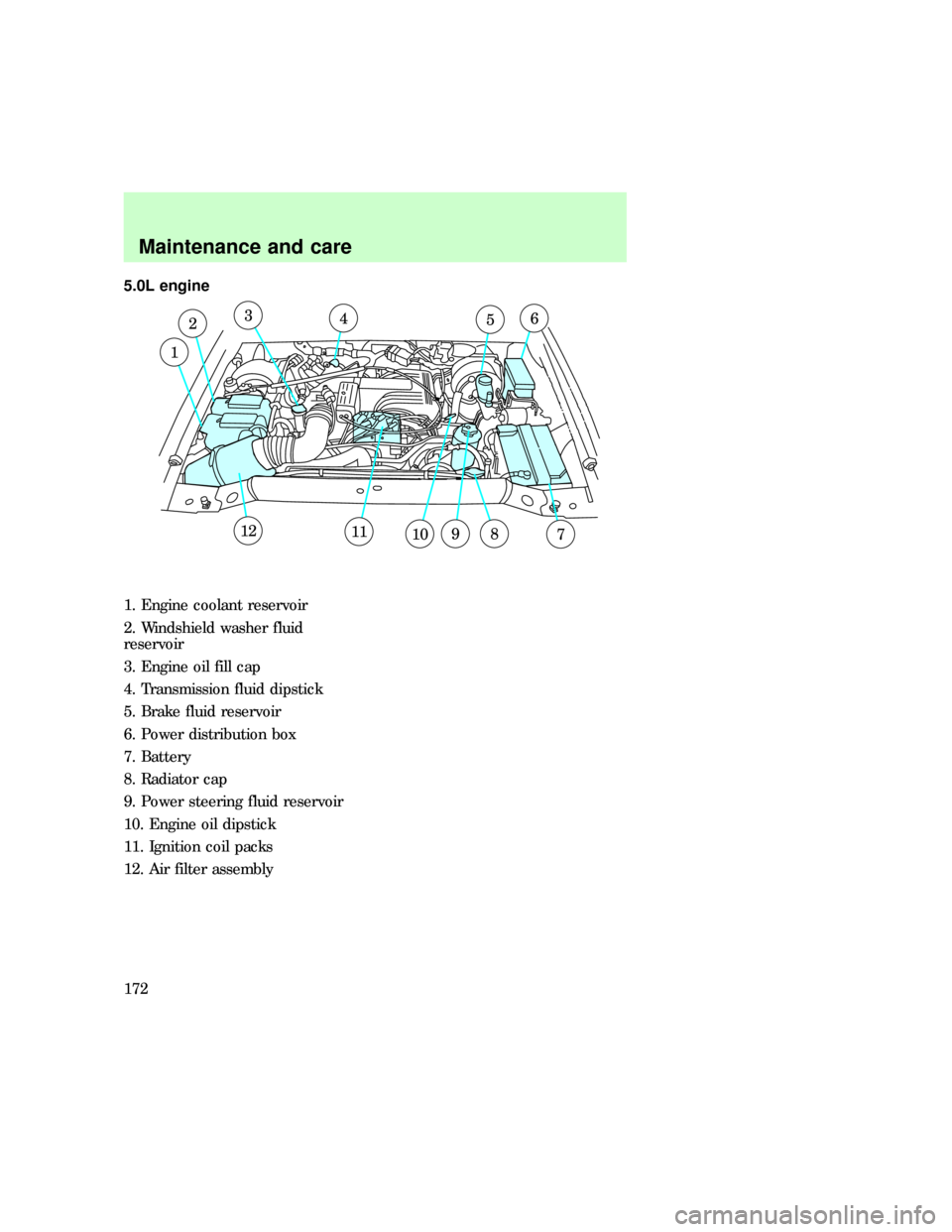
5.0L engine
1. Engine coolant reservoir
2. Windshield washer fluid
reservoir
3. Engine oil fill cap
4. Transmission fluid dipstick
5. Brake fluid reservoir
6. Power distribution box
7. Battery
8. Radiator cap
9. Power steering fluid reservoir
10. Engine oil dipstick
11. Ignition coil packs
12. Air filter assembly
1
236
7
54
81011912
com_check-add_oil.01
Maintenance and care
172
Page 187 of 236
lubricate the driveline joint
according to the maintenance
intervals specified in theService
Guide.
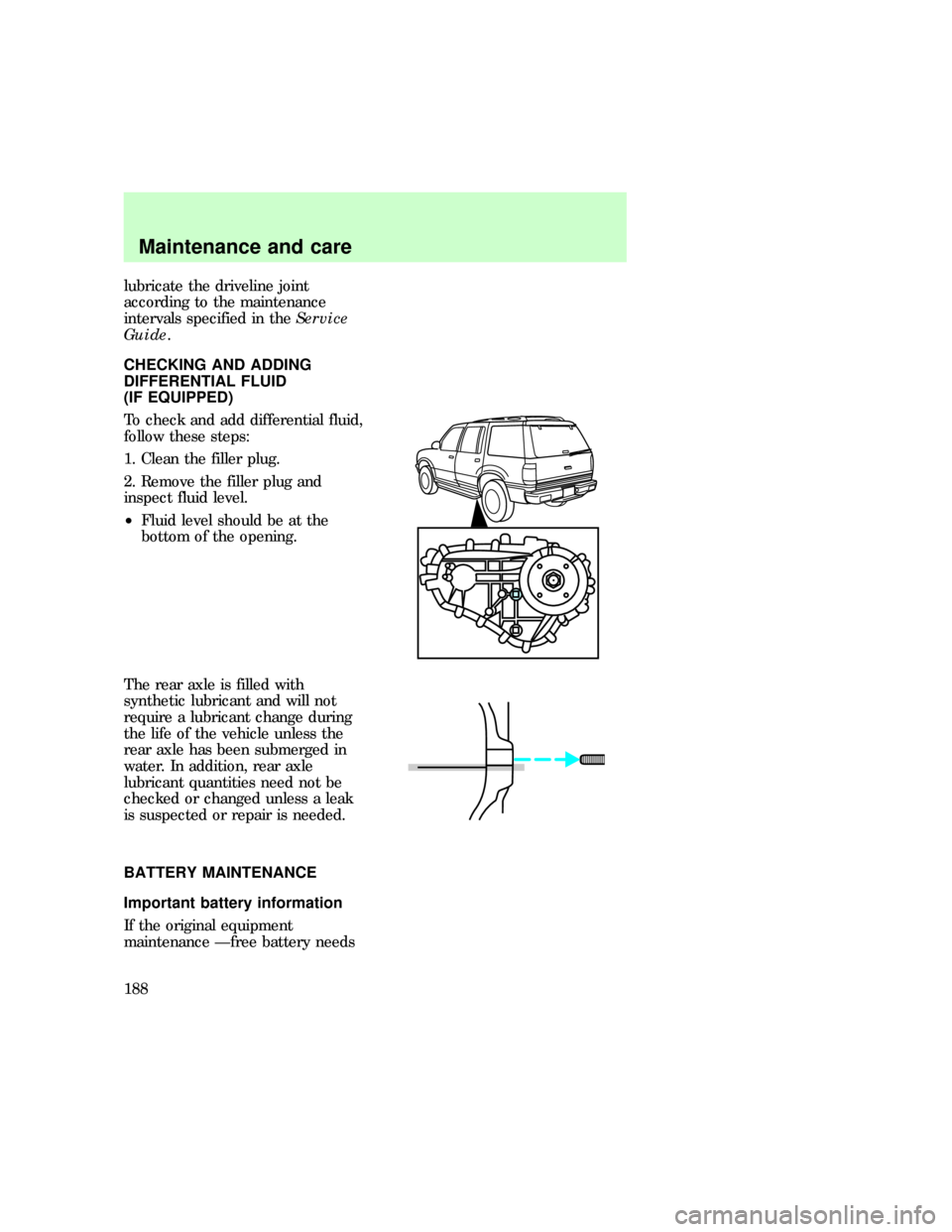
CHECKING AND ADDING
DIFFERENTIAL FLUID
(IF EQUIPPED)
To check and add differential fluid,
follow these steps:
1. Clean the filler plug.
2. Remove the filler plug and
inspect fluid level.
²Fluid level should be at the
bottom of the opening.
The rear axle is filled with
synthetic lubricant and will not
require a lubricant change during
the life of the vehicle unless the
rear axle has been submerged in
water. In addition, rear axle
lubricant quantities need not be
checked or changed unless a leak
is suspected or repair is needed.
BATTERY MAINTENANCE
Important battery information
If the original equipment
maintenance Ðfree battery needs
uno_differentail_fluid
uno_battery_title
uno_info_battery
Maintenance and care
188
Page 188 of 236
replacement, it may be replaced
with a low-maintenance battery.
For information on appropriate
replacement batteries, refer to
Motorcraft partsin theCapacities
and specificationschapter.
Applying too much
pressure on the ends when
lifting a battery could cause acid
to spill. Lift the battery with a
carrier or with your hands on the
opposite corners.
Batteries normally produce
explosive gases which can
cause personal injury. Do not
allow flames, sparks or lit
tobacco to come near the
battery. Always cover your face
and protect your eyes and also
provide ventilation.
Follow these steps to
minimize risk of personal
injury.
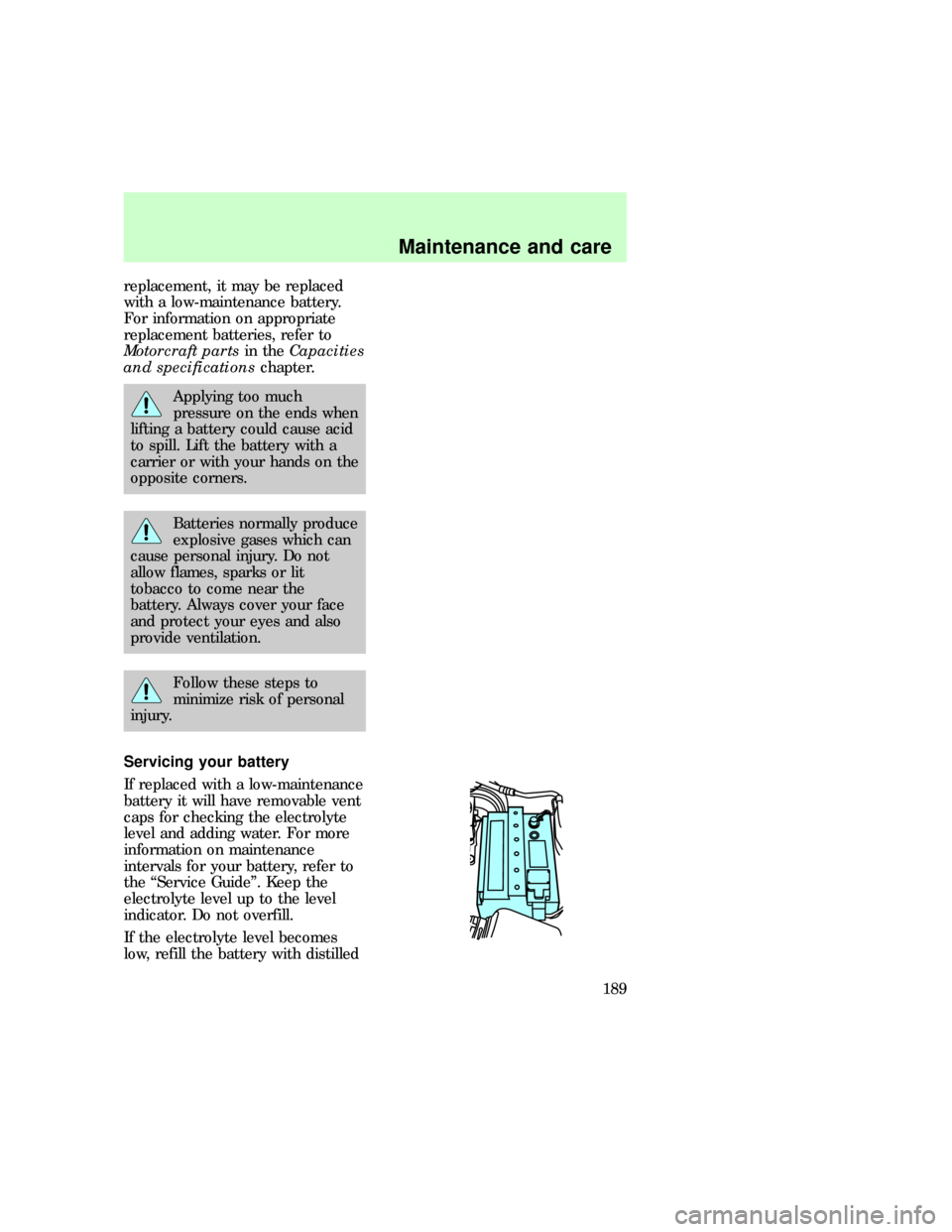
Servicing your battery
If replaced with a low-maintenance
battery it will have removable vent
caps for checking the electrolyte
level and adding water. For more
information on maintenance
intervals for your battery, refer to
the ªService Guideº. Keep the
electrolyte level up to the level
indicator. Do not overfill.
If the electrolyte level becomes
low, refill the battery with distilled
uno_servicing_battery
Maintenance and care
189
Page 189 of 236
water. If necessary, distilled water
may be substituted with tap water
that is not hard and does not have
high mineral or alkali content. If
the battery needs water often,
have the charging system checked
for a possible malfunction.
Relearning the idle function
Because your vehicle's engine is
electronically controlled, some
control conditions are maintained
by power from the battery. When
the battery is disconnected or a
new battery is installed, the
computer must ªrelearnº its idle
conditions before your vehicle can
drive properly. To begin this
process:
Maintenance and care
190