Page 116 of 224
2(Second)Ð Use 2(Second) to
start-up on slippery roads or to
provide additional engine braking
on downgrades. Transmission
operates in first and second gears.
1(Low)Ð Use 1(Low) to provide
maximum engine braking on steep
downgrades. Upshifts can be made
by shifting to 2(Second) or to
D(Overdrive). Selecting 1(Low)
at higher speeds causes a shift to
2(Second), and will shift to 1(Low)
after vehicle decelerates to the
proper speed.
Brake-shift interlock
The brake-shift interlock feature
prevents you from shifting from
P(Park) unless the brake pedal is
depressed (with the ignition in the
On position). If you cannot move
the gearshift out of P(Park) with
the brake pedal depressed:
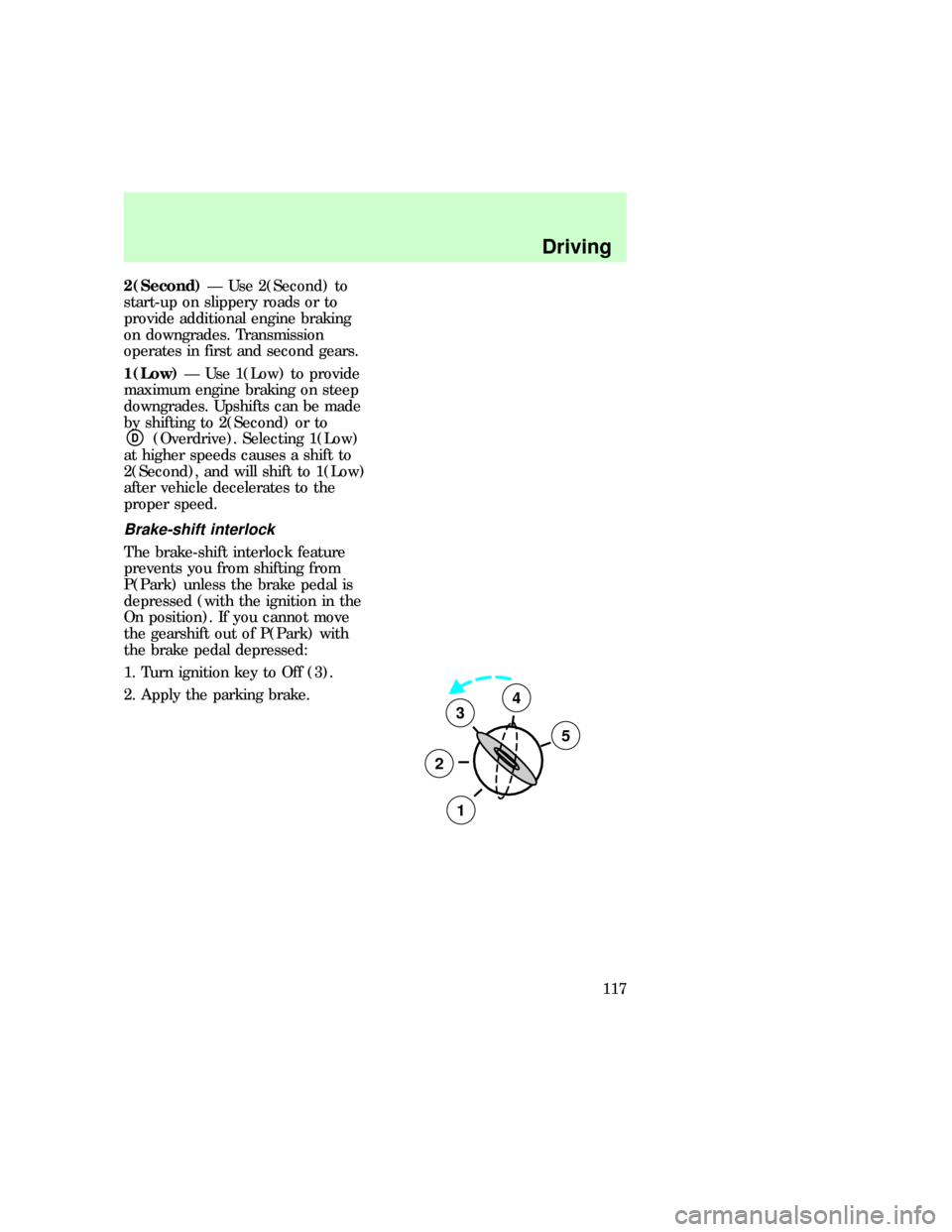
1. Turn ignition key to Off (3).
2. Apply the parking brake.
3
2
1
5
4
exd_brake_shift_interlock
Driving
117
Page 117 of 224
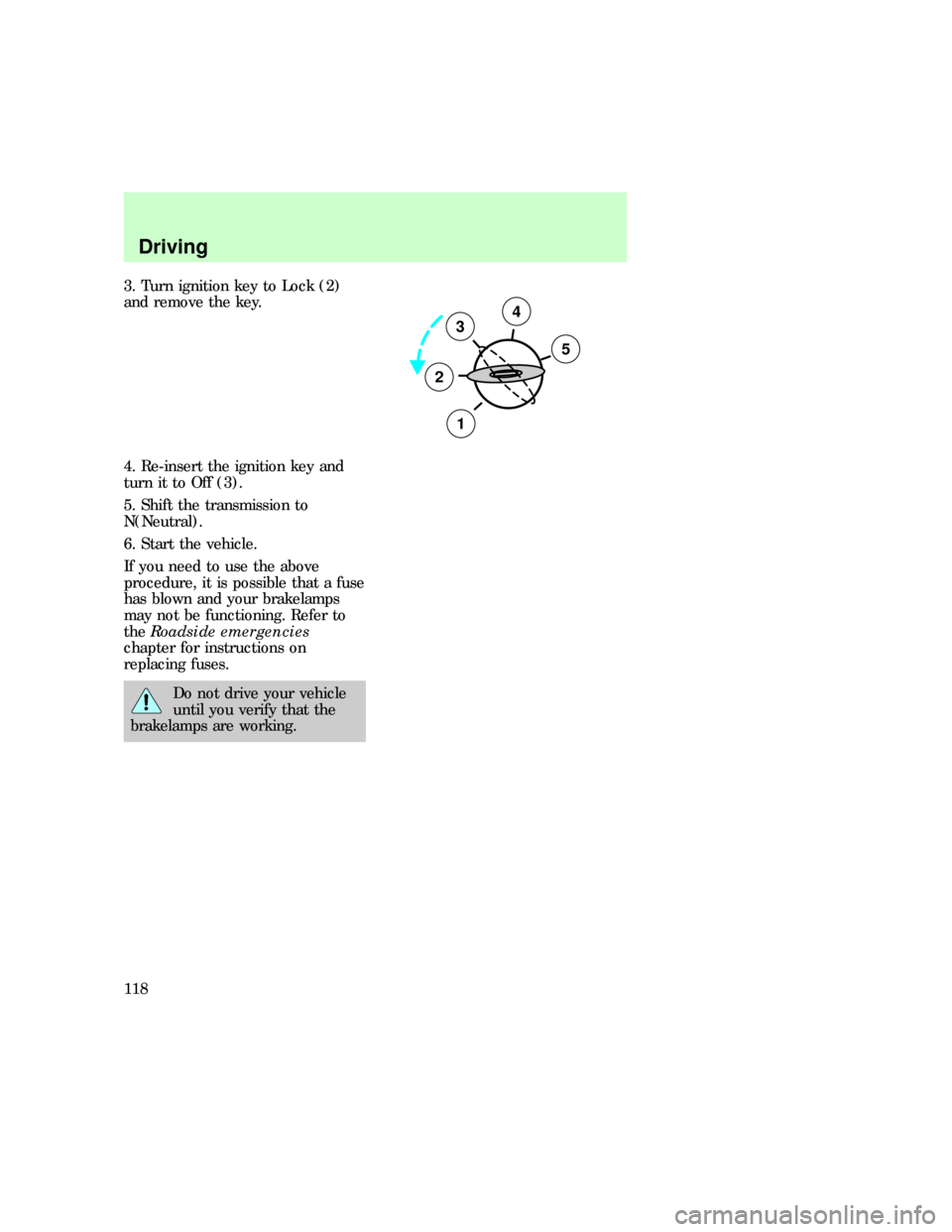
3. Turn ignition key to Lock (2)
and remove the key.
4. Re-insert the ignition key and
turn it to Off (3).
5. Shift the transmission to
N(Neutral).
6. Start the vehicle.
If you need to use the above
procedure, it is possible that a fuse
has blown and your brakelamps
may not be functioning. Refer to
theRoadside emergencies
chapter for instructions on
replacing fuses.
Do not drive your vehicle
until you verify that the
brakelamps are working.
3
2
1
5
4
exd_4wd_operation
Driving
118
Page 126 of 224
TRAILER TOWING
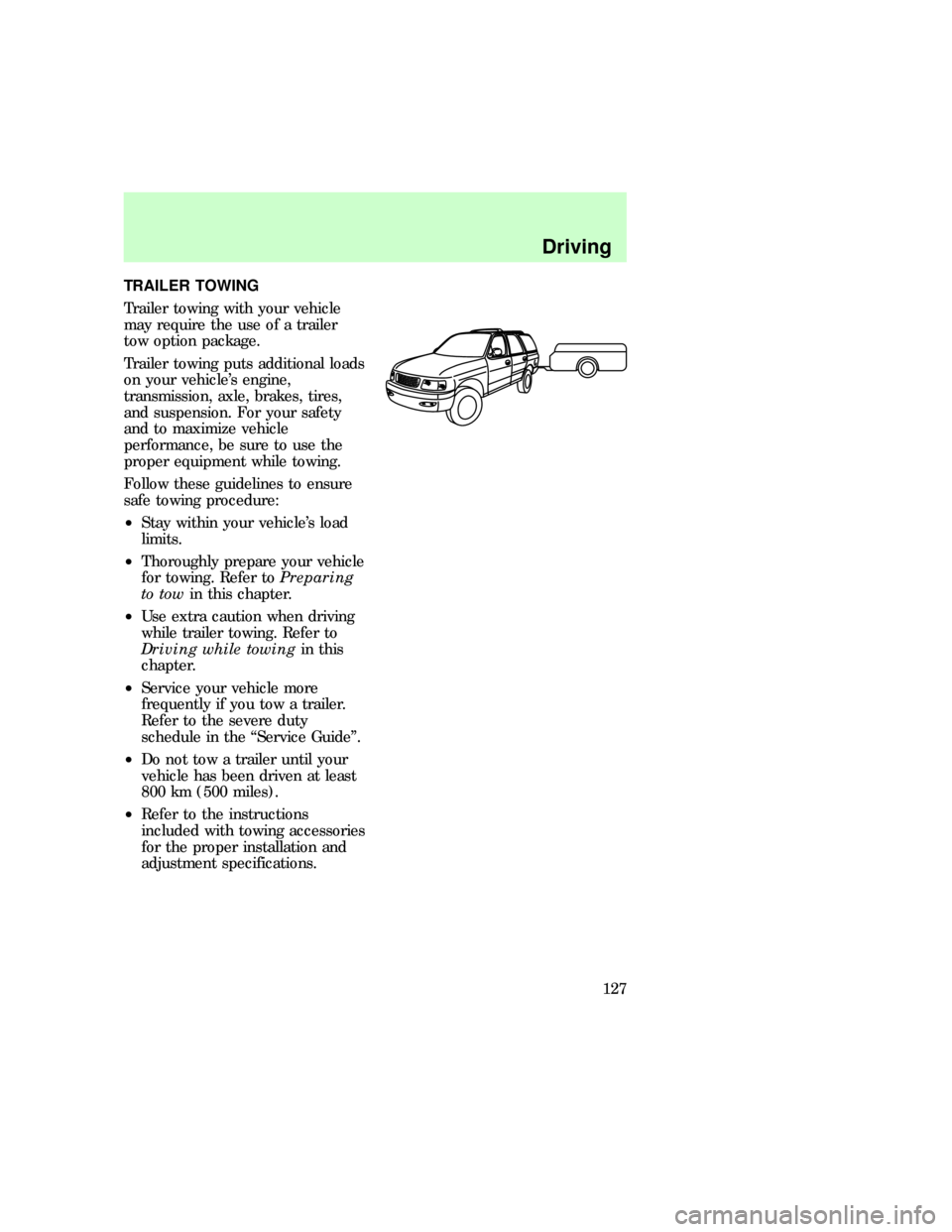
Trailer towing with your vehicle
may require the use of a trailer
tow option package.
Trailer towing puts additional loads
on your vehicle's engine,
transmission, axle, brakes, tires,
and suspension. For your safety
and to maximize vehicle
performance, be sure to use the
proper equipment while towing.
Follow these guidelines to ensure
safe towing procedure:
²Stay within your vehicle's load
limits.
²Thoroughly prepare your vehicle
for towing. Refer toPreparing
to towin this chapter.
²Use extra caution when driving
while trailer towing. Refer to
Driving while towingin this
chapter.
²Service your vehicle more
frequently if you tow a trailer.
Refer to the severe duty
schedule in the ªService Guideº.
²Do not tow a trailer until your
vehicle has been driven at least
800 km (500 miles).
²Refer to the instructions
included with towing accessories
for the proper installation and
adjustment specifications.
Driving
127
Page 128 of 224
with all of the vehicle wheels on
the ground.
Towing trailers beyond the
maximum recommended
gross trailer weight exceeds the
limit of the vehicle and could
result in engine damage,
transmission damage, structural
damage, loss of control and
personal injury.
Preparing to tow
Use the proper equipment for
towing a trailer and make sure that
it is properly attached to your
vehicle. See your dealer or a
reliable trailer retailer if you
require assistance.
If your vehicle is not equipped
with the factory heavy duty trailer
tow option, auxiliary coolers are
recommended for the automatic
transmission system if you are
planning on:
²traveling farther than 80 km (50
miles)
²towing in hilly terrain
²towing frequently
Calculating trailer loads
To determine the amount of weight
that your vehicle can carry:
²Obtain ratings from the Safety
Compliance Certification label
and the trailer towing
specifications in this chapter.
exd_preparing_tow
exd_calculating_load
Driving
129
Page 131 of 224
should the vehicle weight ratings
per axle or combination truck and
trailer exceed the weight ratings
listed on the Safety Compliance
Certification label located on the
driver's side door.
When connecting a trailer hitch:
1. Turn off the air suspension
switch.
2. Connect the trailer.
3. Turn the air suspension back on.
Adjusting an equalizing
hitch so the rear bumper
of the vehicle is lower or higher
than it was unloaded will defeat
the function of the load
equalizing hitch and may cause
unpredictable handling.
Driving while towing a trailer
Speed control (if equipped) may
not work properly while towing on
long, steep grades.
Driving with an automatic
transmission:
²use D, 1 or 2 rather than
Dwhile towing up or down
steep hills
²anticipate stops and brake
gradually.
Towing behind another vehicle
Your vehicle can not be flat towed
with all wheels on the ground.
No neutral tow kit is available for
your vehicle.
exd_driving_trailer
exd_towing_another_vehicle
exd_servicing_while_towing
Driving
132
Page 142 of 224
Slot number Amperage Description
22 10 amp Airbag diagnostic monitor
23 10 amp Electronic flasher, 4WD
vacuum solenoids, trailer
tow battery charge relay,
console climate door
actuator, auxiliary blend
and mode door actuators,
auxiliary pot switching
module
24 10 amp I/P blower relay, junction
fuse box #7
25 5 amp 4WABS module, 4WABS
red lamps relay
26 10 amp Right low beam head
lamp, DRL module
27 5 amp Foglamp relay, main lamp
switch
28 10 amp Left low beam headlamp
29 5 amp Auto lamp module,
instrument cluster,
transmission control
indicator light and switch
30 30 amp Ignition coils, PCM relay,
PATS module, radio
capacitors
31 - Not used
Slot number Amperage Description
1 - Interior lamp relay
2 - Battery saver relay
3 - HBL relay
4 - One touch down relay
5 - Accessory delay relay
Roadside emergencies
143
Page 146 of 224
Removing flat tire and installing
spare
6. Use the tip of the lug wrench to
remove any wheel trim. Insert the
tapered end of the lug wrench
behind the wheel covers or
hubcaps and twist off.
7. Loosen the wheel nuts with the
lug wrench. Do not remove the lug
nuts until the tire has been raised
off the ground.
8. Insert the jack handle into the
jack and use the handle to slide
the jack under the vehicle.
9. Position the jack according to
the following guides and turn the
jack handle clockwise until the
wheel is completely off the ground.
²When one of the back wheels is
off the ground, the transmission
alone will not prevent the
vehicle from moving or slipping
off the jack, even if the vehicle
is in P (Park). To prevent the
vehicle from moving when you
change the tire, be sure that the
parking brake is set and the
diagonally opposite wheel is
blocked. If the vehicle slips off
the jack, someone could be
seriously injured.
Roadside emergencies
147
Page 157 of 224
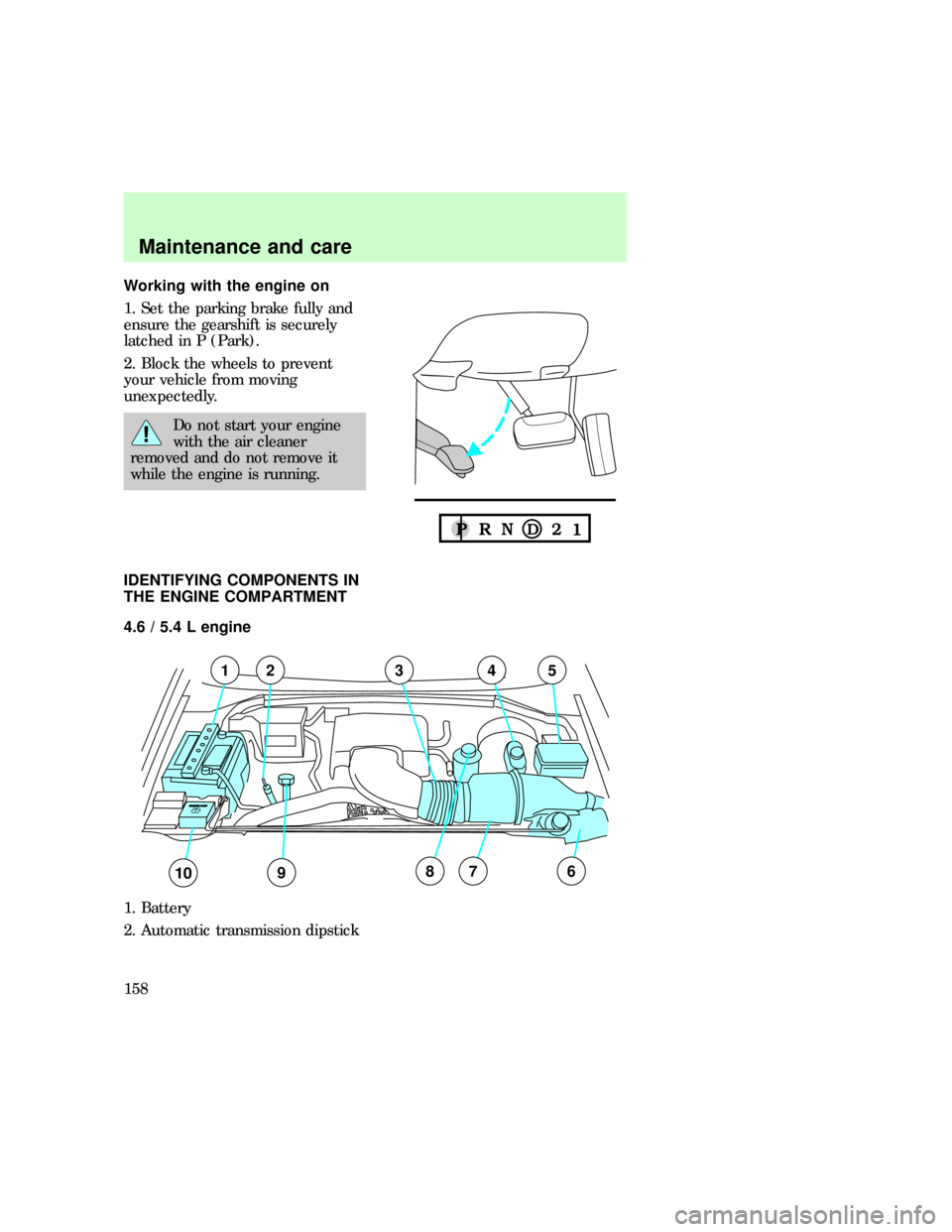
Working with the engine on
1. Set the parking brake fully and
ensure the gearshift is securely
latched in P (Park).
2. Block the wheels to prevent
your vehicle from moving
unexpectedly.
Do not start your engine
with the air cleaner
removed and do not remove it
while the engine is running.
IDENTIFYING COMPONENTS IN
THE ENGINE COMPARTMENT
4.6 / 5.4 L engine
1. Battery
2. Automatic transmission dipstick
12
107869
345
exd_title_engine_compartments
exd_2_engine_compartment
Maintenance and care
158