Page 89 of 191

Special conditions when
starting
Starting a cold engine
At temperatures -12ÉC (10ÉF) and
below, do not hold the key in the
START position longer than 15
seconds. If the engine does not
start on the first attempt:
1. Turn the ignition key to LOCK
and wait approximately ten
seconds.
2. Try starting the engine again.
At temperatures above -12ÉC
(10ÉF), do not hold the key in the
START position longer than five
seconds. If the engine does not
start on the first attempt:
1. Turn the ignition key to LOCK
and wait approximately five
seconds.
2. Try starting the engine again.
Starting a warm engine
Do not hold the key in the START
position longer than five seconds.
If the engine does not start on the
first attempt:
1. Turn the ignition key to LOCK
and wait a few seconds until the
starter stops.
2. Try starting the engine again.
Starting the engine after two
failed attempts
If the engine does not start after
two attempts:
1. Turn the key to LOCK and wait
about two minutes.
Starting
89
Page 94 of 191
The ABS brake system conducts a
self-test each time the vehicle is
driven. A mechanical noise may be
heard while the system conducts
its self-test.
ABS warning light
TheABSlight in the instrument
cluster illuminates and remains
illuminated if an ABS fault is
detected. Have your vehicle
serviced by a qualified service
technician as soon as possible.
Normal braking operation is still
effective unless the
P!BRAKElight is
also illuminated.
Parking brake
The parking brake should be used
whenever the vehicle is parked.
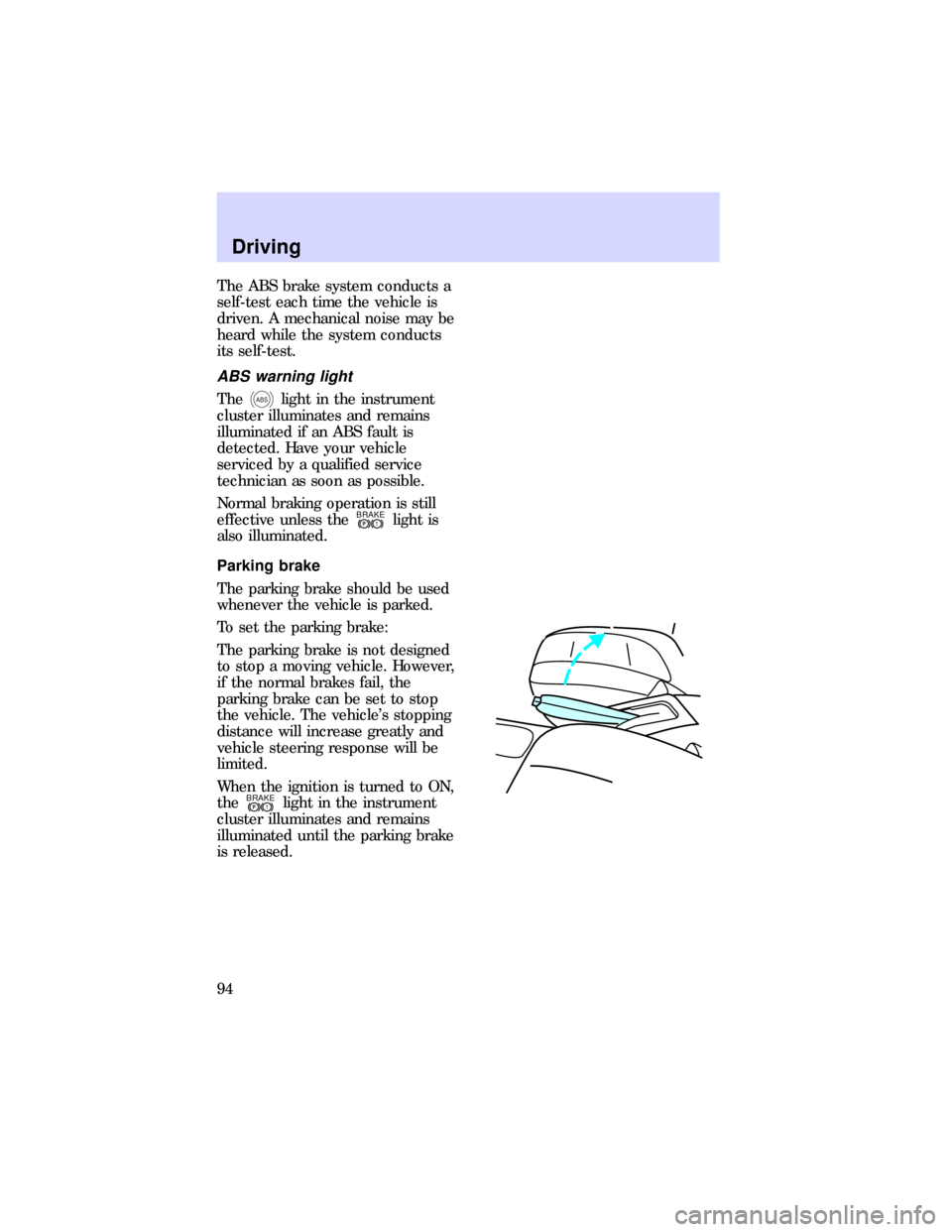
To set the parking brake:
The parking brake is not designed
to stop a moving vehicle. However,
if the normal brakes fail, the
parking brake can be set to stop
the vehicle. The vehicle's stopping
distance will increase greatly and
vehicle steering response will be
limited.
When the ignition is turned to ON,
the
P!BRAKElight in the instrument
cluster illuminates and remains
illuminated until the parking brake
is released.
Driving
94
Page 112 of 191
Number Fuse amperage
ratingCircuits protected
9 Meter 10 amp Backup lamps, shift
lock, gauges, speed
control, turn signals,
key-in-ignition
reminder chime
10 Wiper 20 amp Windshield wipers
and washer
11 (Rear wiper) 10 amp Rear wiper and
washer
12 Hazard 15 amp Hazard flashers, turn
signals
13 Room 10 amp Clock, interior lamp,
luggage compartment
lamp, safety belt
warning chime, radio
power
14 Engine 15 amp Engine control system
15 Mirrors 5 amp Power mirrors
16 Ð Ð Not used
17 Ð Ð Not used
18 (Fog) 10 amp Daytime running
lamps / fog lamps
19 Ð Ð Not used
20 Cigar 20 amp Cigar lighter
21 (Radio) 15 amp Radio (Premium
sound)
Roadside emergencies
112
Page 125 of 191
²Never get under a vehicle that is
supported only by a jack. If you
must work under a vehicle, use
safety stands.
²Keep all lit cigarettes and other
smoking materials away from
the battery and all fuel-related
parts.
Working with the engine off
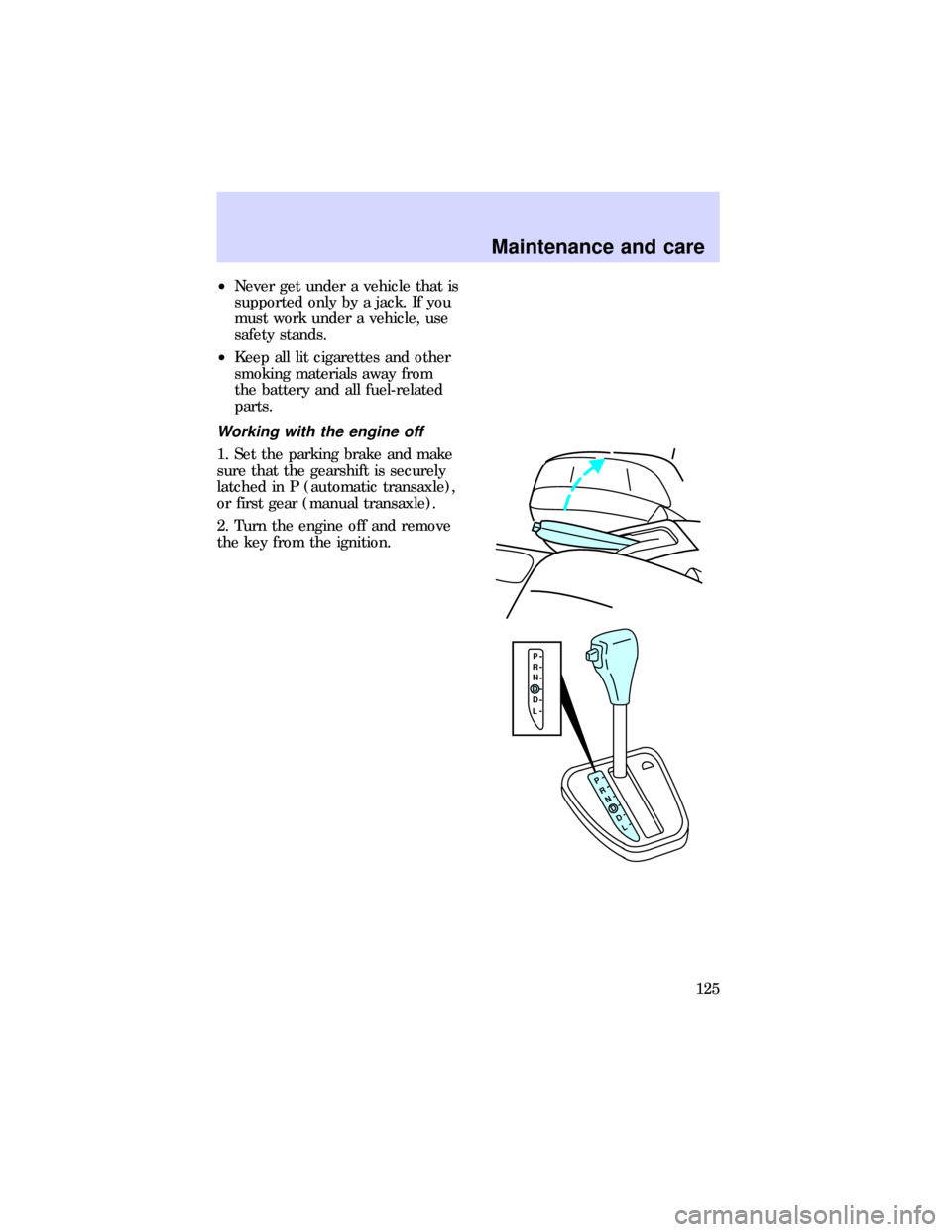
1. Set the parking brake and make
sure that the gearshift is securely
latched in P (automatic transaxle),
or first gear (manual transaxle).
2. Turn the engine off and remove
the key from the ignition.
P
R
N
D
D
L
R
N
D
D
LP
Maintenance and care
125
Page 147 of 191
To make reaching the wiper blades
easy, simply turn the ignition to
the ON position and turn the
wipers on. Wait for them to reach
a vertical position and turn the
ignition to LOCK. Do not move the
wipers manually across the
windshield, this may cause damage
to the wipers.
Inspect the wiper arm pivots on a
regular basis to ensure that the
wiper arms move freely. Lubricate
the pivot points as necessary.
Replacing wiper blades
If the wiper blades do not work
properly after cleaning,
replacement of the blade assembly
or the blade element may be
necessary.
There are three different lengths
of wiper blades on your vehicle.
The driver side wiper blade is 51
cm (20 in) long, and the passenger
side wiper blade is 44.5 cm (17.5
in) long, and the rear window
wiper is 35 cm (13.75 in) long.
Ensure that you install the correct
length wiper blade in the correct
location.
To replace the wiper blades:
Maintenance and care
147
Page 157 of 191
maximum of 10% ethanol or 15%
MTBE. There should be no more
than 5% methanol with cosolvents
and additives to protect the fuel
system.
WHAT YOU SHOULD KNOW
ABOUT THE EMISSION
CONTROL SYSTEM
For more information on your
vehicle's emission control system,
see the Vehicle Emission Control
Information Decal located on the
inside left side of the engine
compartment.
The catalytic converter enables the
vehicle's emission control system
to operate properly.
Follow these guidelines to ensure
proper emission system operation:
²Use only unleaded fuel.
²Avoid running out of fuel.
²Do not turn off the ignition
while your vehicle is in motion.
²Have maintenance performed
according to the intervals in the
Service Guide.
If you notice one or more of the
following, the emission system may
not be working properly; have the
vehicle serviced as soon as
possible:
²fluid leaks
²
,,, lights
illuminate in the instrument
cluster and remain lit
²strange odors
Maintenance and care
157
Page 182 of 191
ENGINE DATA
Engine 2.0 liter; 121 CID; 4 cylinder (in-line);
compression ratio 9.2:1; single overhead cam;
split port induction (SPI)
Horsepower 110 at 5,000 rpm
Torque 169 Nm (125 lb ft at 3,750 rpm)
Required fuel grade 87 (R+M)/2
Firing order /
Injection timing1-3-4-2
Spark plug gap 1.3 to 1.4 mm / 0.052 to 0.056
Ignition system DIS
Valve clearances cold
inlet exhaust0: Maintenance free 0: Maintenance free
VEHICLE DIMENSIONS
Dimensions Ð cm
(inches)Sedan Wagon
V1Overall length 443.25 cm (174.5 in) 439.1 cm (172.9 in)
V2Overall width
(excluding exterior
mirrors)168.00 cm (66.2 in) 170 cm (67 in)
V3Maximum height 135.00 cm (53.2 in) 136.9 cm (53.9 in)
V4Wheelbase 250.00 cm (98.4 in) 250 cm (98.4 in)
V5Track Front
Rear143.5 cm (56.5 in),
143.5 cm (56.5 in)143.5 cm (56.5 in),
143.5 cm (56.5 in)
Capacities and specifications
182
Page 188 of 191

Engine oil ..................................130
check oil warning light ...............9
checking and adding ..............130
Exhaust fumes ............................91
Fan ...............................................18
Flashing the lights ......................27
Floor mats ...................................39
Foglamps ..............................27,163
Fuel
capacity ...................................179
improving fuel economy ........106
low fuel warning light ................7
safety information relating to
automotive fuels .....................153
Fuel pump shut-off switch ..43,107
starting after a collision ...........43
Fuse panels
engine compartment ..............113
instrument panel ....................111
Fuses ..........................................109
charts ................................111,113
checking and replacing ..........109
circuit breakers .......................110
Gauges, Electronic ......................12
Gauges, Mechanical ....................12
engine coolant temperature
gauge .........................................13
fuel gauge ..................................13
odometer ...................................14
speedometer .............................13
trip odometer ............................14
Gearshift .................................36,97
GVWR (Gross Vehicle Weight
Rating) .......................................101
definition .................................101
Hazard flashers ....................29,107
Head restraints ...........................54
Headlamps
daytime running lights .............26
replacing bulbs .......................162
turning on and off ....................26High beams
indicator light .............................9
operation ...................................27
High-mount brakelamp
replacing the bulb ..................164
Hood ..........................................128
prop rod ..................................128
release lever ............................128
working under the hood ........124
Idle
relearning ................................144
Ignition
positions of the ignition ...........25
Inspection/maintenance (I/M)
testing ........................................158
Instrument cluster
sport .........................................6,7
standard ......................................6
Instrument panel ........................15
lighting up panel and interior 6,15
location of components ...........4,5
Interval wipers ............................30
Jump-starting your vehicle ......120
attaching cables ......................121
disconnecting cables ..............122
Lamps ........................................160
bulb replacement
specifications chart ................172
daytime running light system ..26
dome lamps .............................170
fog lamps ............................27,163
headlamps ..........................26,162
high beams ................................27
high-mount brakelamp ...........164
illuminated entry system .........33
interior lamps ....................31,170
map lamps ..........................31,171
replacing bulbs .......................160
tail lamps ..........................167,168
License plate lamps ..................165
Liftgate .................................40,164
warning light .............................10
Index
188