Page 10 of 192
flash or remains on, have the
system serviced immediately.
Turn signal
Illuminates when the left or right
turn signal or the hazard lights are
turned on.
High beams
Illuminates when the headlamp
high beams are on.
Door ajar (if equipped)
Illuminates when the ignition
switch is in the ON or START
position and any door is open.
Oil pressure/Engine coolant
This light will come on when the
key is in the ON position and the:
²engine coolant temperature is
very high
²engine oil pressure is low
The light serves as a notice that a
system needs your attention and to
check the engine coolant
temperature gauge and the engine
oil pressure gauge.
Refer to engine coolant
temperature gauge and engine oil
pressure gauge in this section for
more information.
DOOR
AJAR
com_turn_signal.01
com_high_beams.01
eco_door_ajar
eco_oil-press_eng-temp_light
eco_warning_chimes
Instrumentation
10
Page 13 of 192
engine is overheating. Switch off
the ignition and let it cool. Refer to
Checking and adding engine
coolantin theMaintenance and
carechapter.
Engine oil pressure gauge
This shows the engine oil pressure
in the system. Sufficient pressure
exists as long as the needle
remains in the normal range.
If the gauge indicates constantly
low pressure at normal engine
speed, refer toChecking and
adding engine oilin the
Maintenance and carechapter. If
the gauge indicates a low pressure
and the engine oil level is correct,
switch off the engine immediately
and have your vehicle checked at
your dealership or by a qualified
technician.
Charging system gauge
If the pointer moves and stays
outside of the normal range, have
the vehicle's electrical system
checked as soon as safely possible.
Odometer
Registers the total kilometers
(mileage) of the vehicle.
H
L
18
8
20 km/h
406080
10 0
12 0
14 0
16 0
com_oil_pressure.03
com_voltage.01
com_odometer.01 com_trip_odometer.01
Instrumentation
13
Page 129 of 192
ENGINE COMPARTMENT
COMPONENTS
1. Windshield washer fluid
reservoir
2. Engine oil filler
3. Automatic transmission fluid
dipstick
4. Air cleaner
5. Engine oil dipstick
6. Power steering fluid reservoir
7. Brake master cylinder
8. Engine coolant recovery
reservoir
9. Battery
91234
5
6
7
8
com_check-add_oil.01
Maintenance and care
129
Page 130 of 192
CHECKING AND ADDING
ENGINE OIL
Use WSS-M2C153±F motor oil
CERTIFIED FOR GASOLINE
ENGINES by the American
Petroleum Institute.
Engine oils with an SAE 5W-30
viscosity and displaying the
American Petroleum Institute
certification mark are preferred for
your vehicle. They provide the best
engine performance, fuel economy
and engine protection for all
climates down to ±25ÉC (-15ÉF).
Do not use:
²ªnon-detergentº oils
²oils labeled API SA, SB, SC, SD,
SE, SF or SG
²additional engine oil additives,
oil treatments or engine
treatments
Additional engine oil additives, oil
treatments or engine treatments
are never needed and could, under
certain conditions, lead to engine
damage which is not covered by
your Ford warranty.
Synthetic engine oils which are
CERTIFIED and of the preferred
viscosity may be used in your
engine. The engine oil and oil filter
must still be changed according to
the ªService Guideº.
eco_checking_engine_oil
Maintenance and care
130
Page 131 of 192
Checking the engine oil
Check the engine oil each time you
fuel your vehicle.
To check the oil:
1. Make sure the vehicle is on level
ground. If the engine is warm, turn
the engine off and wait a few
minutes for the oil to drain into
the oil pan.
2. Set the parking brake and
ensure the gearshift is securely
latched in P (Park).
3. Open the hood. Protect yourself
from engine heat.
4. Locate and carefully remove the
engine oil dipstick.
4.2L/4.6L engines
ADDFULL
Maintenance and care
131
Page 133 of 192
Adding engine oil
1. Check the engine oil. For
instructions, refer toChecking the
engine oilin this chapter.
2. If the fluid level is not within
the normal range, add only
certified engine oil of the preferred
viscosity. Add engine oil through
the oil filler cap. Remove the filler
cap and use a funnel to pour oil in
the opening.
3. Recheck the oil level. Make sure
the oil level is not above the full
mark on the dipstick.
Continuous contact with
usedmotor oil has caused
cancer in laboratory mice.
Changing the engine oil and
filter
Change your engine oil and filter
according to the following
kilometers (mileage) and time
requirements, whichever occurs
first:
²Normal Schedule ± 8,000 km
(5,000 miles) or six months.
²Severe Duty Schedule ± 5,000
km (3,000 miles) or three
months. Severe duty operation
would include extensive idling,
trailer towing, driving in severe
dust and police, taxi or delivery
service.
com_oil_and_filter_change.01
Maintenance and care
133
Page 134 of 192
Ford production and aftermarket
(Motorcraft) oil filters are designed
for added engine protection and
long life. If a replacement oil filter
is used that does not meet Ford
material and design specifications,
startup engine noises or knock
may be experienced.
It is recommended you use the
appropriate Motorcraft oil filter (or
another brand meeting Ford
specifications) for your engine
application.
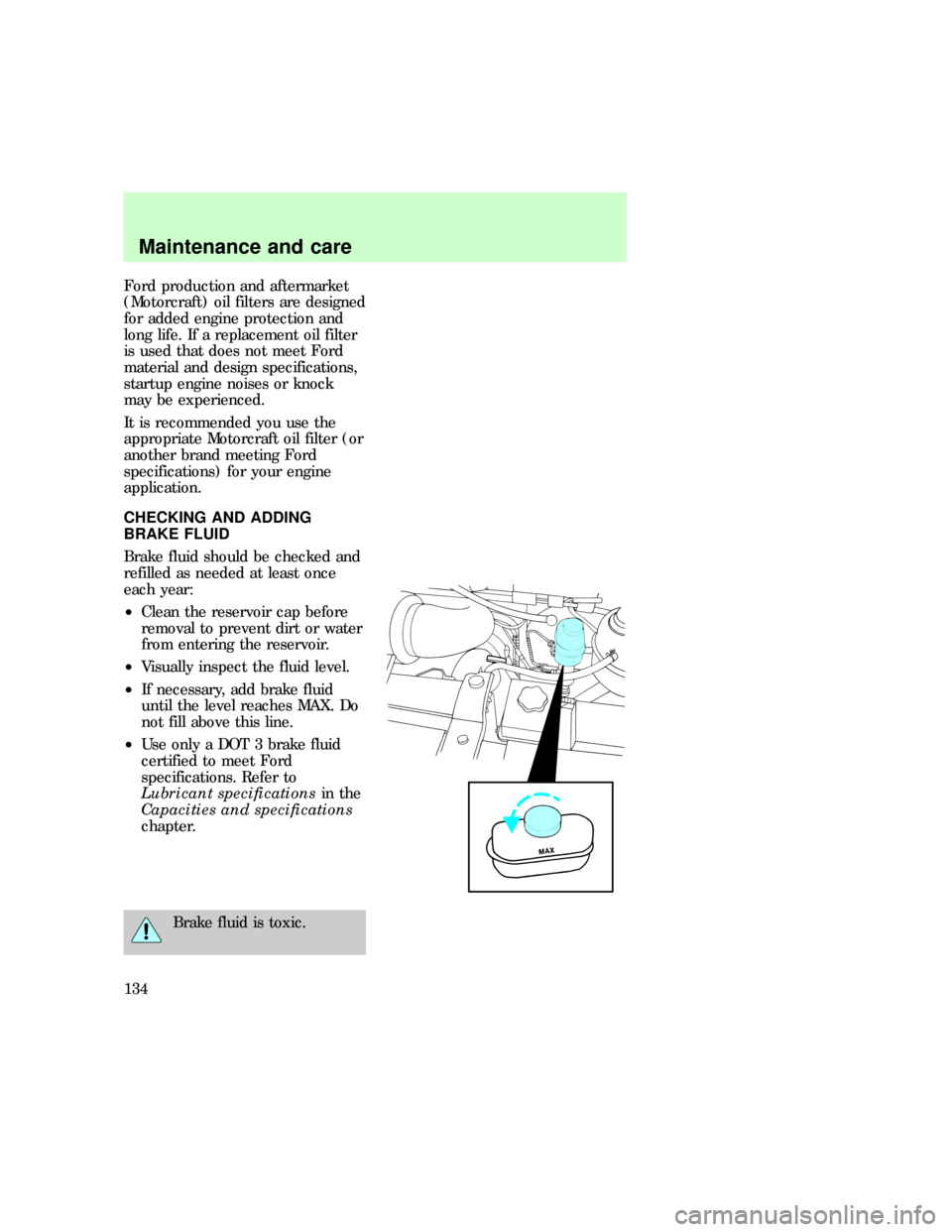
CHECKING AND ADDING
BRAKE FLUID
Brake fluid should be checked and
refilled as needed at least once
each year:
²Clean the reservoir cap before
removal to prevent dirt or water
from entering the reservoir.
²Visually inspect the fluid level.
²If necessary, add brake fluid
until the level reaches MAX. Do
not fill above this line.
²Use only a DOT 3 brake fluid
certified to meet Ford
specifications. Refer to
Lubricant specificationsin the
Capacities and specifications
chapter.
Brake fluid is toxic.
com_checking-adding_fluid.01
Maintenance and care
134
Page 165 of 192
REPLACING BULBS
Replacing exterior bulbs
It is a good idea to check the
operation of the following lights
frequently:
²Headlamps
²Tail lamps
²Brakelamps
²High-mount brakelamp
²Backup lamps
²Hazard flashers
²Turn signals
²License plate lamp
Do not remove lamp bulbs unless
they will be replaced immediately.
If a bulb is removed for an
extended period of time,
contaminants may enter the lamp
and affect performance.
Headlamp bulb (aerodynamic)
Handle a halogen
headlamp bulb carefully
and keep out of children's reach.
Grasp the bulb only by its plastic
base and do not touch the glass.
The oil from your hand could
cause the bulb to break the next
time the headlamps are
operated.
eco_replacing_bulbs
eco_replacing_headlamp_aero
Maintenance and care
165