Page 8 of 192
INSTRUMENT CLUSTER
LIGHTS
Brake system warning
This light illuminates when you
turn the ignition key to START to
verify that the indicator bulb is
working. If the light stays on or
comes on after you have released
the parking brake fully, have the
hydraulic brake system serviced.
This light also will illuminate if
vacuum pressure is low on diesel
engine vehicles.
Anti-lock brake system (ABS)
Momentarily illuminates when the
ignition is turned on and the
engine is off. If the light stays on
or continues to flash, the ABS
needs to be serviced.
Service engine soon
This light illuminates when the
engine's Emission Control System
requires service. It will also
illuminate when the ignition key is
000000
0000
BRAKE
NORMALNORMAL
NORMAL
BRAKE
ABS
SERVICE
ENGINE SOON
eco_warn-lights
eco_brake_system
com_anti-lock_brake.01
eco_service_engine
Instrumentation
8
Page 16 of 192
2. Pull the headlamp control
toward you to the outer position.
Headlamps are now on in addition
to above.
3. Rotate the control when it is in
the on position to brighten or dim
the instrument panel lamps. Rotate
fully counterclockwise to operate
courtesy and cargo lamps.
Daytime running light (DRL)
system (if equipped)
The DRL system turns on the high
beam headlamps, with a reduced
light output, when:
²the vehicle is running (ignition
switch is in the ON position)
²the vehicle has a fully released
parking brake
eco_headlight_daytime_running
Controls and features
16
Page 76 of 192
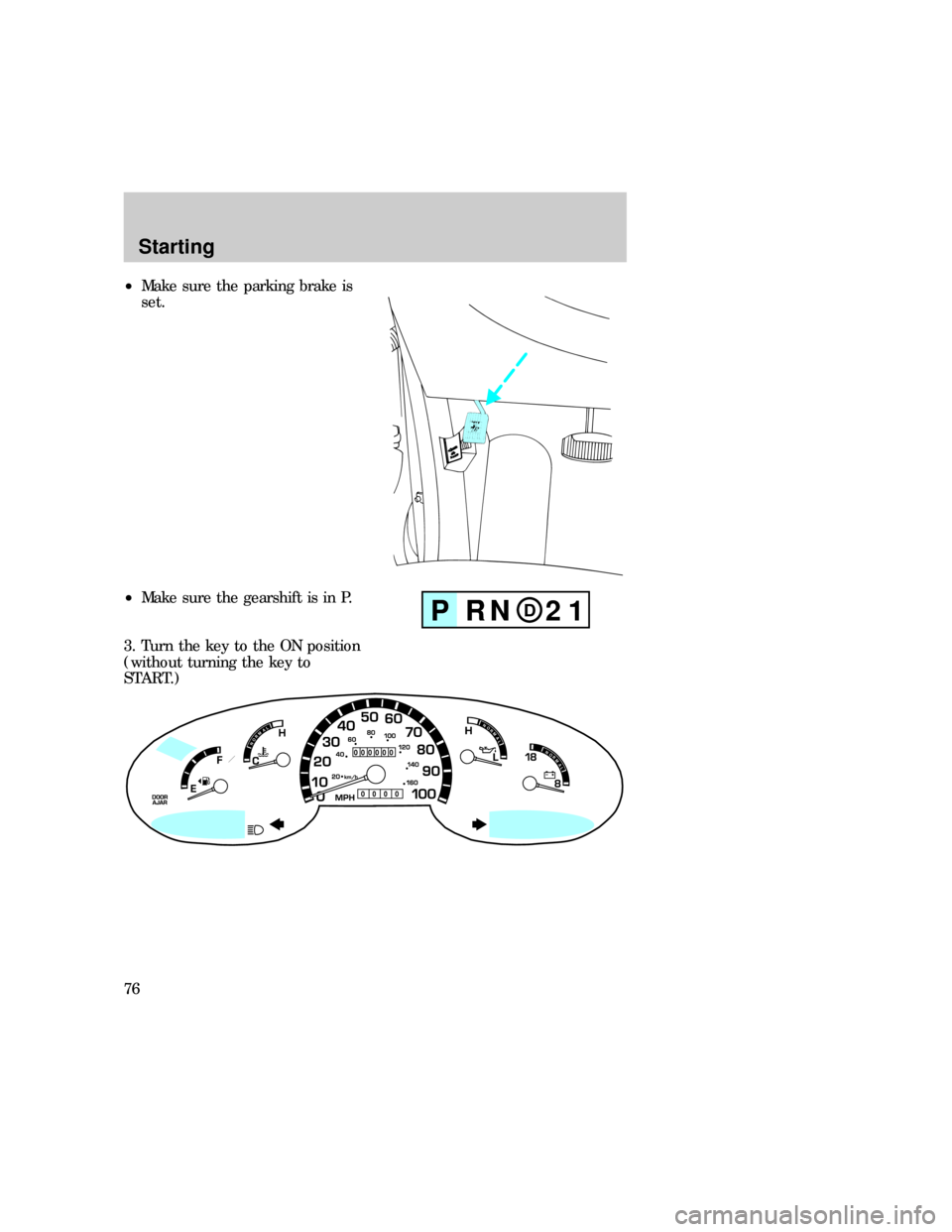
²Make sure the parking brake is
set.
²Make sure the gearshift is in P.
3. Turn the key to the ON position
(without turning the key to
START.)
DPRN 21
000000
0000
BRAKE
NORMALNORMAL
NORMAL
Starting
76
Page 77 of 192
Make sure the corresponding lights
illuminate briefly. If a light fails to
illuminate, have the vehicle
serviced.
²If the driver's safety belt is
fastened, the
light does not
illuminate.
STARTING PROCEDURE
Starting the engine
1. Turn the key to 5 (Start)
without pressing the accelerator.
The key will return to 4 (On).
2. If the engine does not start
within five seconds, wait ten
seconds and try again.
3. If the engine does not start in
two attempts OR the temperature
is below Ð12ÉC (10ÉF), depress
accelerator and start the engine
while holding the accelerator
down. Release accelerator when
engine starts.
4. After idling for a few seconds,
apply the brake and release the
parking brake.
Using the engine block heater
(if equipped)
An engine block heater warms the
engine coolant, which improves
starting, warms up the engine
3
2
1
5
4
eco_start_title
com_starting_vehicle.01
com_engine_heater.01
Starting
77
Page 80 of 192

BRAKES
Your brakes are self-adjusting.
Refer to the ªService Guideº for
maintenance scheduling.
Anti-lock brake system (ABS) (if
equipped)
The ABS operates by detecting the
onset of wheel lock up during
brake applications and
compensating for this tendency.
The front wheels are prevented
from locking even when the brakes
are firmly applied. The
accompanying illustration depicts
the advantage of an ABS equipped
vehicle (on bottom) to a non-ABS
equipped vehicle (on top) during
hard braking.
Using ABS
²In an emergency, apply full force
on the brake. The ABS will be
activated immediately, thus
allowing you to retain full
steering control of your vehicle
and, providing there is sufficient
space, will enable you to avoid
obstacles and bring the vehicle
to a quiet stop.
²We recommend that you
familiarize yourself with this
braking technique. However,
avoid taking any unnecessary
risks.
Parking brake
The parking brake should be used
whenever you park your vehicle. It
is not designed to stop a moving
com_brakes.01
com_abs.01
com_using_abs.01
eco_parking_brake
Driving
80
Page 81 of 192
vehicle. However, if the normal
brakes fail, the parking brake can
be used to stop your vehicle in an
emergency. Since the parking
brake applies only the rear brakes,
the vehicle's stopping distance will
increase greatly and the handling
of your vehicle will be adversely
affected.
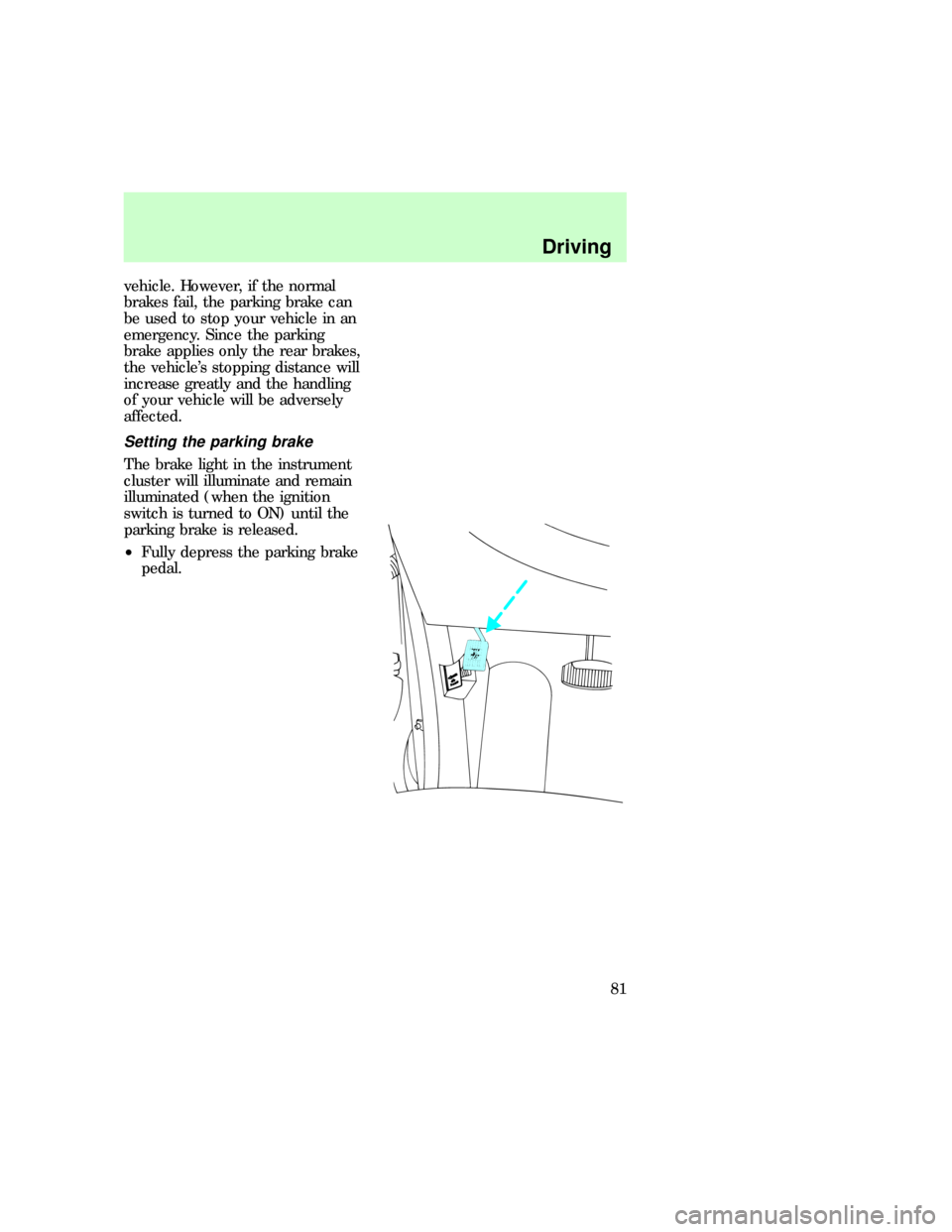
Setting the parking brake
The brake light in the instrument
cluster will illuminate and remain
illuminated (when the ignition
switch is turned to ON) until the
parking brake is released.
²Fully depress the parking brake
pedal.
eco_setting_pbrake eco_releasing_pbrake
Driving
81
Page 82 of 192
Releasing parking brake
²Push parking brake pedal down
firmly, then release.
If the parking brake is fully
released, but the Brake
System light remains on, have
the brakes checked immediately.
They may not be working
properly.
STEERING YOUR VEHICLE
If the amount of effort needed to
steer your vehicle changes at a
constant speed, have the vehicle
power steering system checked.
Never hold the steering wheel to
the extreme left or right for more
than five seconds if the engine is
running. This can damage the
power steering pump.
After any severe impact or
collision involving the front end,
observe the steering wheel
alignment. If the spoke of the
eco_steeing_vehicle
Driving
82
Page 83 of 192
steering wheel seem to be in a
different position while going
straight down the road, have the
suspension and steering checked
for possible damage.
AUTOMATIC TRANSMISSION
OPERATION
Hold the brake pedal down
while you move the
gearshift lever from position to
position. If you do not hold the
brake pedal down, your vehicle
may move unexpectedly and
injure someone.
Pull the gearshift lever towards
you and downward to move the
automatic gearshift.
P (Park)Ð Always come to a
complete stop before shifting into
or out of P (Park).
When you leave your
vehicle, place the gearshift
lever in P (Park). Set the
parking brake fully, and shut off
the engine. Never park your
vehicle in N (Neutral). If you do
not take these precautions, your
vehicle may move suddenly and
injure someone.
R (Reverse)Ð Always come to a
complete stop before shifting into
or out of R (Reverse).
P RN 21D
P RN 21D
eco_automatic_trans
Driving
83