Page 164 of 192
Preparing your vehicle for
inspection/maintenance (I/M)
testing
In some localities it may be a legal
requirement to pass an I/M test of
the on-board diagnostic (OBD) II
system. If your vehicle's powertrain
system or battery has just been
serviced, the OBD II system is
reset to a condition unready for
I/M testing. To ready the OBD II
system for I/M testing, the law
specifies that additional city and
highway driving is necessary to
complete the check of the OBD II
system.
The driving modes required to
reach the ready condition consist
of a minimum of 30 minutes of city
and highway driving:
²At least 20 minutes driving in
stop and go city-type traffic with
at least four idle periods.
²At least ten minutes of driving
on an expressway or highway.
Before completing the above
driving modes, the engine must be
warmed up and at operating
temperature. Once started, the
vehicle must not be turned off
during these modes.
eco_bulbs_replace
Maintenance and care
164
Page 165 of 192
REPLACING BULBS
Replacing exterior bulbs
It is a good idea to check the
operation of the following lights
frequently:
²Headlamps
²Tail lamps
²Brakelamps
²High-mount brakelamp
²Backup lamps
²Hazard flashers
²Turn signals
²License plate lamp
Do not remove lamp bulbs unless
they will be replaced immediately.
If a bulb is removed for an
extended period of time,
contaminants may enter the lamp
and affect performance.
Headlamp bulb (aerodynamic)
Handle a halogen
headlamp bulb carefully
and keep out of children's reach.
Grasp the bulb only by its plastic
base and do not touch the glass.
The oil from your hand could
cause the bulb to break the next
time the headlamps are
operated.
eco_replacing_bulbs
eco_replacing_headlamp_aero
Maintenance and care
165
Page 166 of 192
1. Open the hood.
2. Push each clip tab toward the
engine compartment and lift
upward to the stop position.
3. Remove the headlamp assembly.
4. Remove bulb retention ring by
turning it counterclockwise about
1/4 turn.
5. Pull bulb assembly out of
headlamp assembly.
6. Pull out bulb.
7. Replace bulb.
8. Reverse steps 1±3 to replace
headlamp assembly.
Bulb specifications
DescriptionNumber of
BulbsTrade Number
Front Lamps - Exterior
Headlamps (low series) 2 H6054
Headlamps (high series) 2 9007
Park lamp and turn signal 2 3157NAK
Rear Lamps - Exterior
Back-up lamps 2 3156K
License plate lamp 2 186
Stop/Tail/Side marker lamp 2 3357K
Turn lamp 2 3156K
High-mount brakelamp 2 912
eco_bulb_specifications
Maintenance and care
166
Page 167 of 192
DescriptionNumber of
BulbsTrade Number
Interior Courtesy Lamps
Cargo lamp 1 211-2
Dome lamp (standard) 1 912
Instrument panel
illumination2 194
Map/reading lamp 2 211-2
Radio Illumination
1
Instrument Panel
Automatic transmission
gear selector1 194
Instrument Panel Controls
A/C control 1 161
Heater control 1 161
Instrument Cluster
Seat belt light 1 194
High beam indicator 1 194
Brake Warning 1 194
Turn signal indicator 1 194
Anti-lock brake system 1 194
Service engine soon 1 194
Air bag readniness 1 194
Door ajar 1 194
Oil pressure/engine
coolant1 194
1Replaceable at Ford authorized
radio service centers.
NA Ð Natural amber
K Ð Krypton filled bulb
com_cleaning_caring.01
Maintenance and care
167
Page 168 of 192

CLEANING AND CARING FOR
YOUR VEHICLE
Refer to the ªCustomer Assistance
Guideº for a list of Ford-approved
cleaners, polishes and waxes.
Washing your vehicle
Wash your vehicle regularly with
cold or lukewarm water. Never use
strong detergents or soap. If your
vehicle is particularly dirty, use a
quality car wash detergent. Always
use a clean sponge, washing glove
or similar device and plenty of
water for best results. To avoid
spots, avoid washing when the
hood is still warm, immediately
after or during exposure to strong
sunlight.
During winter months, it is
especially important to wash the
vehicle on a regular basis. Large
quantities of dirt and road salt are
difficult to remove, and they also
cause damage to the vehicle.
Remove any exterior accessories,
such as antennas, before entering
a car wash.
²After washing, apply the brakes
several times to dry them.
Waxing your vehicle
The best way to determine when
the paintwork needs waxing is by
noting when water stops beading
on the surface. This could be every
three or four months, depending
on operating conditions.
Use only carnauba or
synthetic-based waxes. Remove
com_washing_vehicle.01
com_waxing_vehicle.01
Maintenance and care
168
Page 169 of 192
any bugs and tar before waxing
vehicle. Use cleaning fluid or
alcohol with a clean cloth to
remove. Use tar remover to
remove any tar spots.
Repairing paint chips
Minor scratches or paint damage
from road debris may be repaired
with touch-up paint, paint repair
foil or aerosol paint spray from the
Ford accessory line. Observe the
application instructions on the
products.
Remove particles such as bird
droppings, tree sap, insect
remains, tar spots, road salt and
industrial fallout immediately.
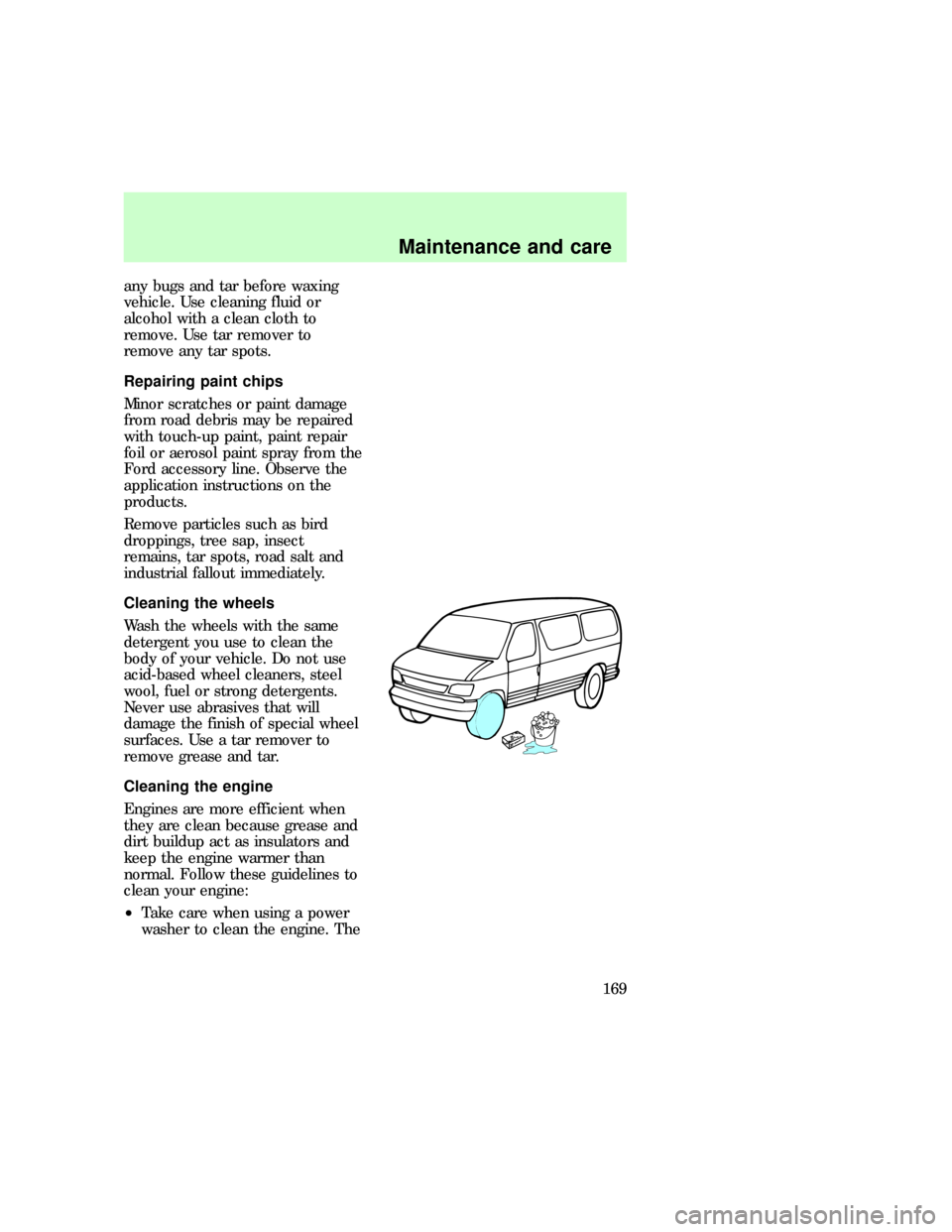
Cleaning the wheels
Wash the wheels with the same
detergent you use to clean the
body of your vehicle. Do not use
acid-based wheel cleaners, steel
wool, fuel or strong detergents.
Never use abrasives that will
damage the finish of special wheel
surfaces. Use a tar remover to
remove grease and tar.
Cleaning the engine
Engines are more efficient when
they are clean because grease and
dirt buildup act as insulators and
keep the engine warmer than
normal. Follow these guidelines to
clean your engine:
²Take care when using a power
washer to clean the engine. The
com_repairing_chips
com_wheels_cleaning.01
com_engine_cleaning.01
Maintenance and care
169
Page 170 of 192
high pressure fluid could
penetrate the sealed parts and
cause damage.
²Do not spray with cold water to
avoid cracking the engine block.
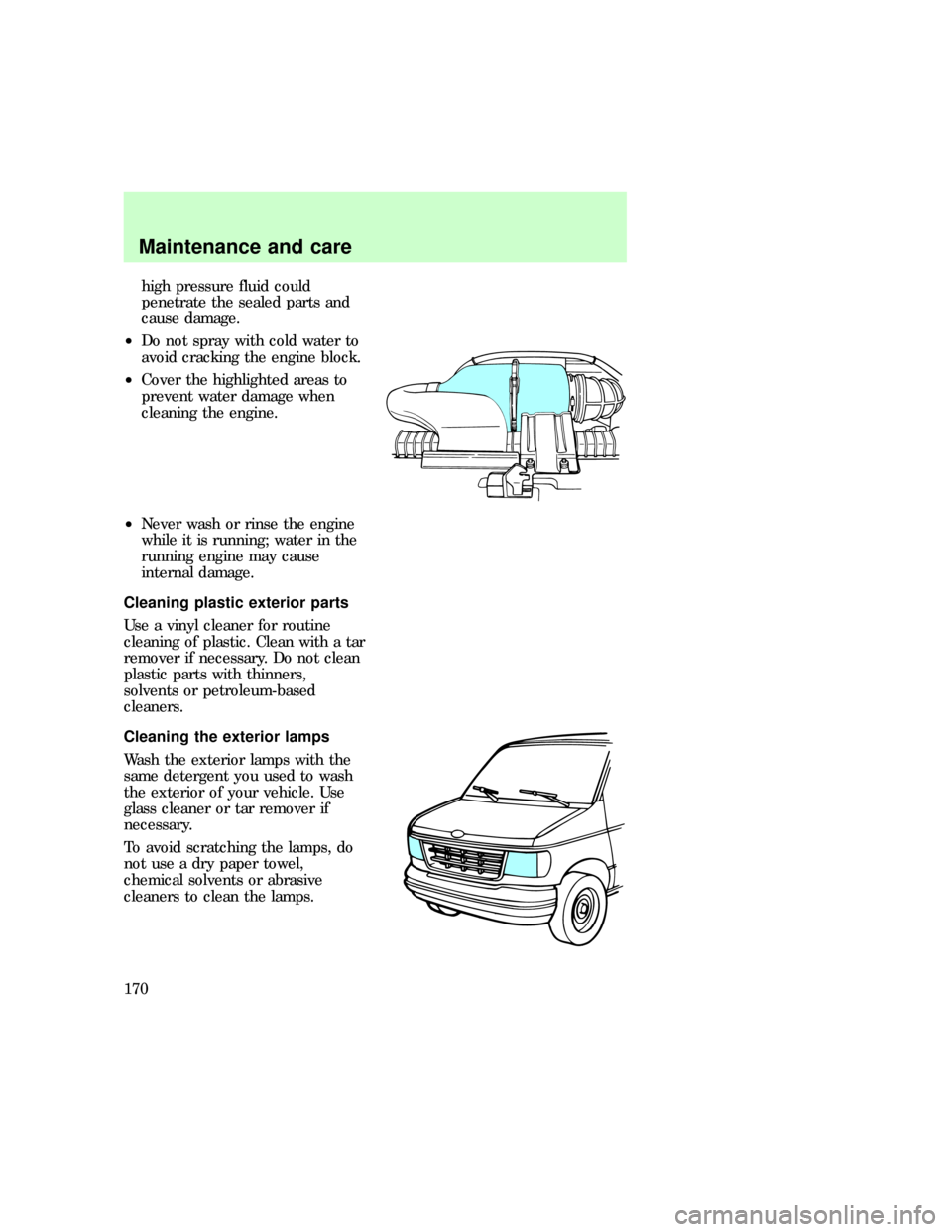
²Cover the highlighted areas to
prevent water damage when
cleaning the engine.
²Never wash or rinse the engine
while it is running; water in the
running engine may cause
internal damage.
Cleaning plastic exterior parts
Use a vinyl cleaner for routine
cleaning of plastic. Clean with a tar
remover if necessary. Do not clean
plastic parts with thinners,
solvents or petroleum-based
cleaners.
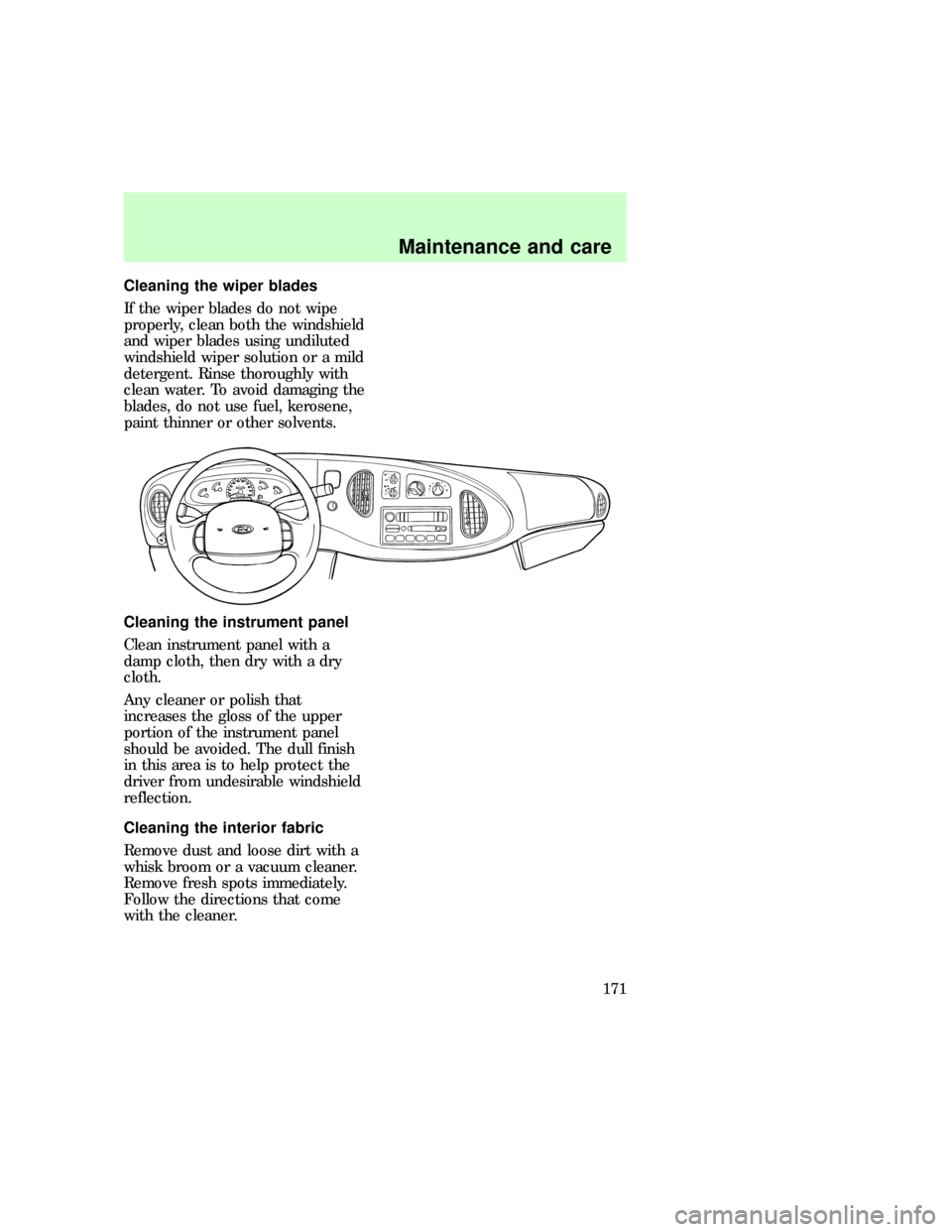
Cleaning the exterior lamps
Wash the exterior lamps with the
same detergent you used to wash
the exterior of your vehicle. Use
glass cleaner or tar remover if
necessary.
To avoid scratching the lamps, do
not use a dry paper towel,
chemical solvents or abrasive
cleaners to clean the lamps.
com_plastic_exterior.01
com_exterior_lamps.01
eco_wiper_cleaning
Maintenance and care
170
Page 171 of 192
Cleaning the wiper blades
If the wiper blades do not wipe
properly, clean both the windshield
and wiper blades using undiluted
windshield wiper solution or a mild
detergent. Rinse thoroughly with
clean water. To avoid damaging the
blades, do not use fuel, kerosene,
paint thinner or other solvents.
Cleaning the instrument panel
Clean instrument panel with a
damp cloth, then dry with a dry
cloth.
Any cleaner or polish that
increases the gloss of the upper
portion of the instrument panel
should be avoided. The dull finish
in this area is to help protect the
driver from undesirable windshield
reflection.
Cleaning the interior fabric
Remove dust and loose dirt with a
whisk broom or a vacuum cleaner.
Remove fresh spots immediately.
Follow the directions that come
with the cleaner.
com_instru-panel_cleaning.01
com_int_fabric_cleaning.01
com_safety_belts_cleaning.01
Maintenance and care
171