Page 196 of 433
Downloaded from www.Manualslib.com manuals search engine Controlling your vehicle is the key to successful
off-road driving. One
of the best ways to control your
vehicle is to control your speed. Here are some things to
keep in mind. At higher speeds:
you approach things faster and you have less time to
scan the terrain for obstacles.
you have less time to react.
0 you have more vehicle bounce when you drive
over obstacles.
0 you’ll need more distance for braking, especially
since you’re on an unpaved surface.
When you’re driving off-road, bouncing and
quick changes in direction can easily throw you
out of position. This could cause you to lose
control and crash.
So, whether you’re driving on
or
off the road, you and your passengers should
wear safety belts.
Scanning the Terrain
Off-road driving can take you over many different kinds
of terrain.
You need to be familiar with the terrain and
its many different features. Here are some things
to consider.
Sugace Conditions. Off-roading can take you over
hard-packed dirt, gravel, rocks, grass, sand, mud, snow
or ice. Each
of these surfaces affects the steering,
acceleration and braking of your vehicle in different
ways. Depending upon the kind of surface you are on,
you may experience slipping, sliding, wheel spinning,
delayed acceleration, poor traction and longer
braking distances.
Sugace Obstacles. Unseen or hidden obstacles can be
hazardous. A rock, log, hole, rut or bump can startle you if
you’re not prepared for them. Often these obstacles are
hidden by grass, bushes, snow or even the
rise and fall of
the terrain itself. Here are some things to consider:
Is the path ahead clear?
Will the surface texture change abruptly up ahead?
Does the travel take you uphill or downhill? (There’s
more discussion of these subjects later.)
Will you have to stop suddenly or change
direction quickly?
4-17
Page 239 of 433
Downloaded from www.Manualslib.com manuals search engine Hazard Warning Flashers
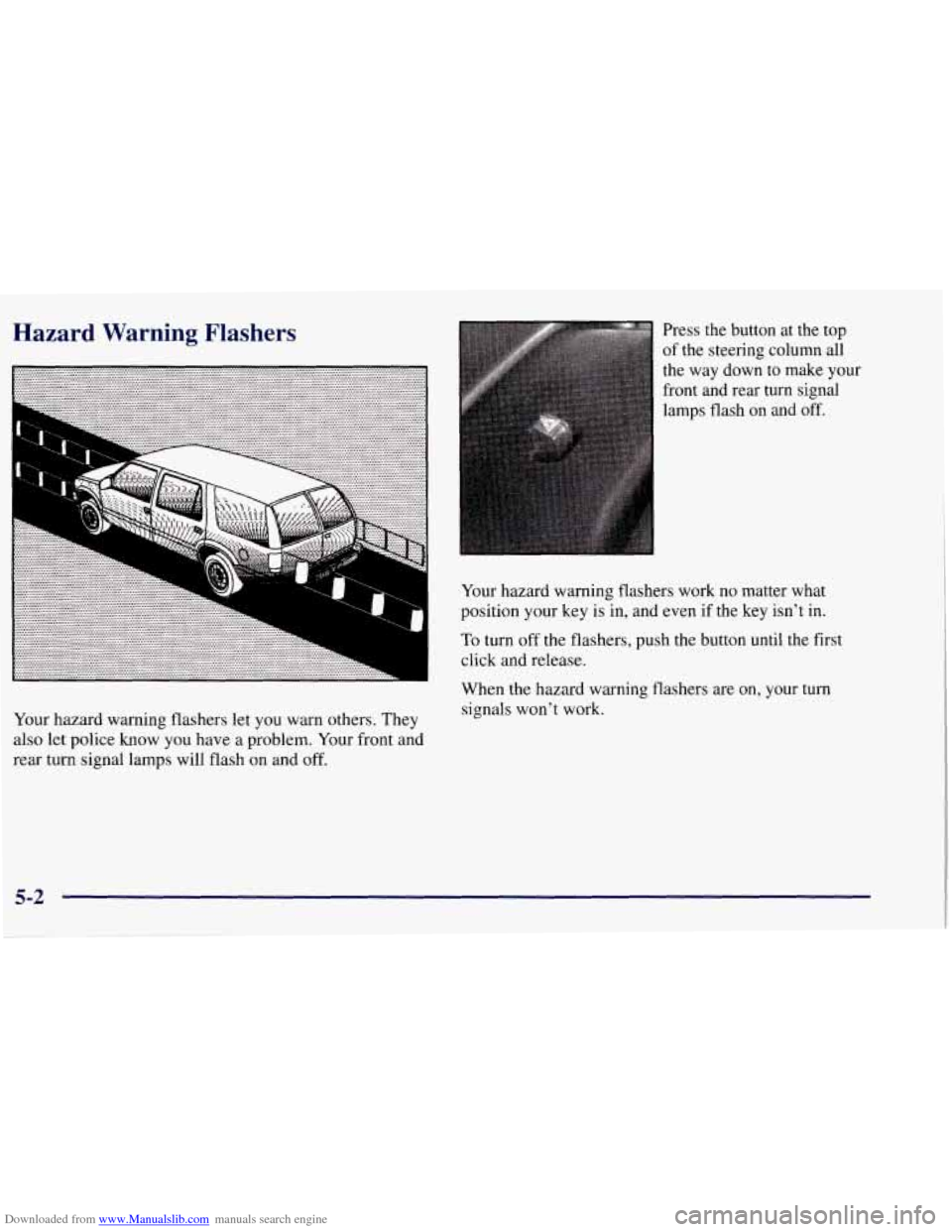
Your hazard warning flashers let you warn others. They
also let police know you have a problem. Your front and
rear turn signal lamps will flash on and off. Press the
button at the top
of the steering column all
the way down to make your
front and rear turn signal
lamps flash on and off.
Your hazard warning flashers work no matter what
position your key is in, and even if the key isn't in.
To turn off the flashers, push the button until the first
click and release.
When the hazard warning flashers are on, your turn
signals won't work.
5-2
Page 246 of 433
Downloaded from www.Manualslib.com manuals search engine Towing From the Front
A vehicle can fall from a car carrier if it isn’t
adequately secured. This can cause a collision,
serious personal injury and vehicle damage. The
vehicle should be tightly secured with chains or
steel cables before it is transported.
Don’t use substitutes (ropes, leather straps,
canvas webbing, etc.) that can be cut by sharp
edges underneath the towed vehicle.
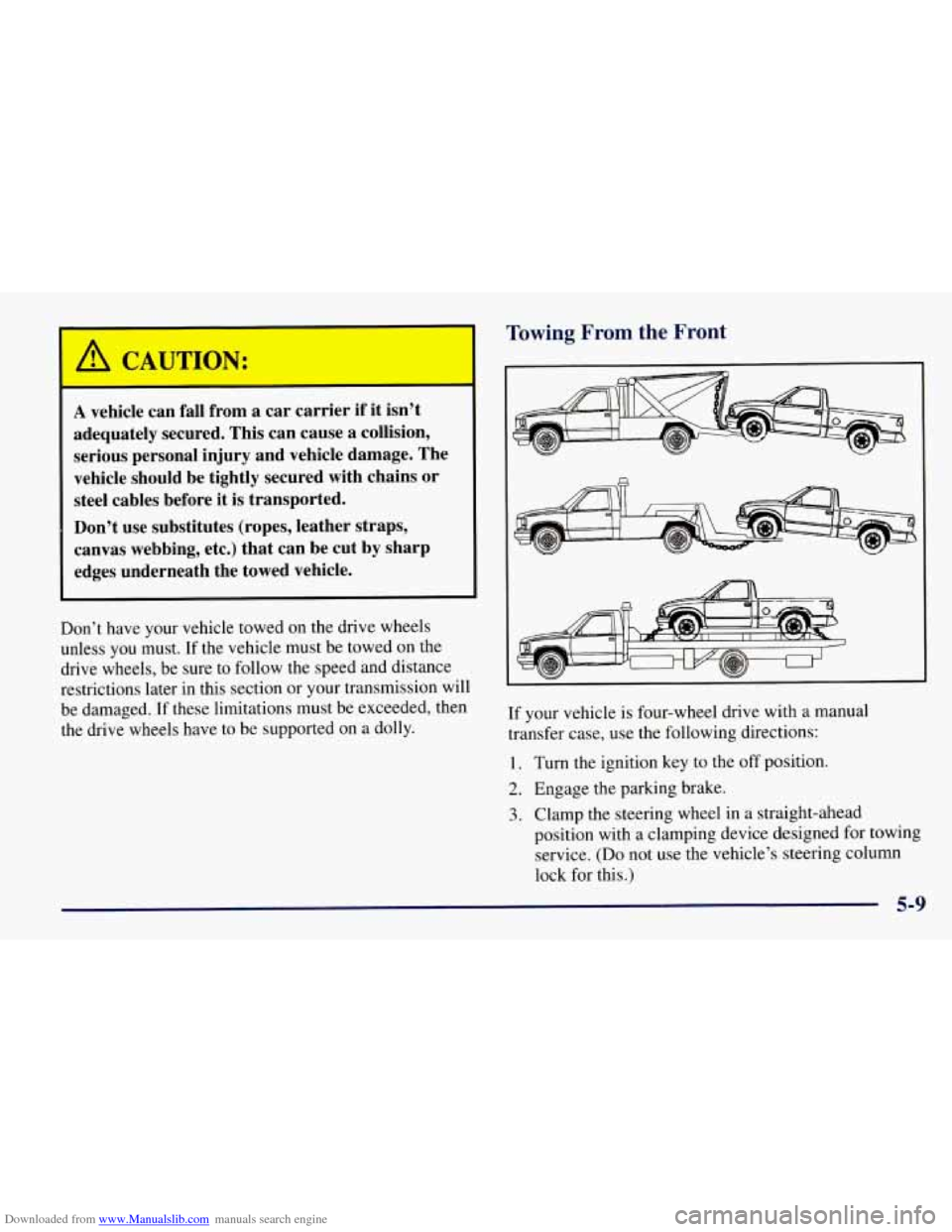
Don’t have your vehicle towed on the drive wheels
unless you must. If the vehicle must be towed
on the
drive wheels, be sure to follow the speed and distance
restrictions later in this section or your transmission will
be damaged.
If these limitations must be exceeded, then
the drive wheels have to be supported on a dolly. If
your vehicle is four-wheel drive with a manual
transfer case, use the following directions:
1. Turn the ignition key to the off position.
2. Engage the parking brake.
3. Clamp the steering wheel in a straight-ahead
position with a clamping device designed for towing
service. (Do not use the vehicle’s steering column
lock for this.)
5-9
Page 247 of 433
Downloaded from www.Manualslib.com manuals search engine 4. Put the transmission in PARK (P).
5. Put the transfer case in NEUTRAL (N).
6. When the vehicle is hooked up, release the
7. Maximum speed 55 mph (88 km/h),
If your vehicle is a two-wheel drive or a four-wheel
drive with an electric shift transfer case, use the
following directions:
1. Turn the ignition key to the OFF position.
2. Engage the parking brake.
3. Clamp the steering wheel in a straight-ahead
parking
brake.
distance unlimited.
position with a clamping device designed for towing
service.
(Do not use the vehicle’s steering column
lock for this.)
4. Put the transmission in NEUTRAL (N).
5. Put the transfer case in 2HIGH (2HI).
6. When the vehicle is hooked up, release the
7. Maximum speed 35 mph (55 km/h), maximum
parking
brake.
distance
50 miles (80 km).
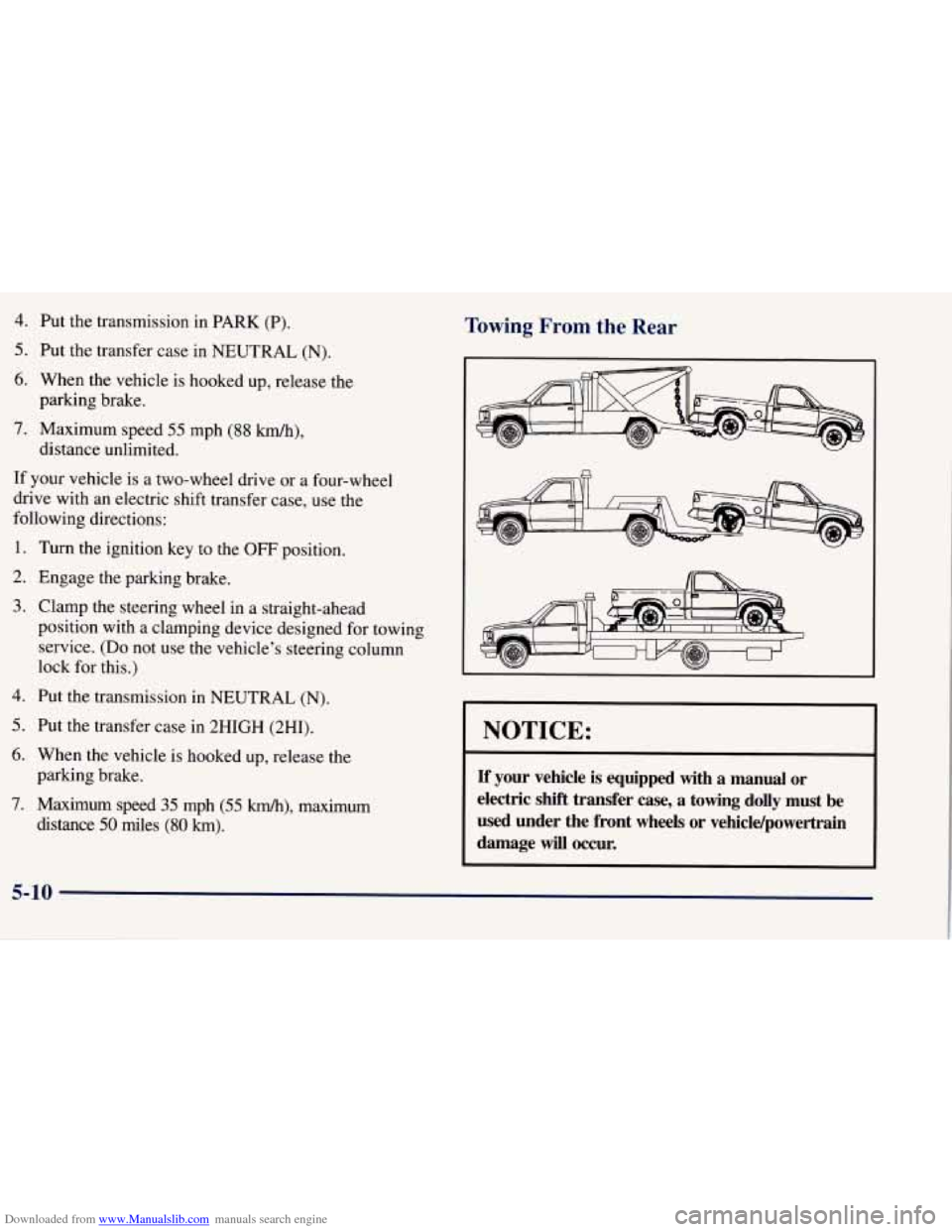
Towing From the Rear
I 3
NOTICE:
If your vehicle is equipped with a manual or
electric shift transfer case, a towing dolly must be
used under the front wheels or vehicldpowertrain
damage will occur.
SI1 n
Page 343 of 433
Downloaded from www.Manualslib.com manuals search engine Fuse/Circuit Breaker Usage
4
Fuse/Circuit Breaker Usage
1 Stop/TCC Switch, Buzzer, CHMSL,
2 Transfer Case
Hazard Lamps, Stoplamps
3 Courtesy Lamps, Cargo Lamp, Glove
Box Lamp, DomeReading Lamps,
Vanity Mirrors, Power Mirrors 10
11
12
13 Instrument Cluster, DRL
Relay, Lamp
Switch, Keyless Entry, Low Coolant
Module, Illuminated Entry Module,
DRAC (Diesel Engine)
Rear Comfort Controls
Cruise Control
Auxiliary Power Outlet
Air Bag System
License Lamp, Parking Lamps,
Taillamps, Roof Marker Lamps,
Tailgate Lamps, Front Sidemarkers,
Fog Lamp Relay, Door Switch
Illumination, Fender Lamps,
Headlamp Switch Illumination
Air Bag System
Wiper Motor, Washer Pump
NC, A/C Blower, High Blower Relay
Power Amp, Rear Liftglass, Cigarette
Lighter, Door Lock Relay, Power
Lumbar Seat
,
Page 344 of 433
Downloaded from www.Manualslib.com manuals search engine 15
16
Fuse/Circuit Breaker Usage
14 4WD Indicator, Cluster, Front and
Rear Comfort Controls, Instrument
Switches, Radio Illumination,
Chime Module
DRL Relay, Fog Lamp Relay
17
18
19
20
21
22
23
24
A
B Front and Rear Turn Signals,
Back-up
Lamps, BTSI Solenoid
Radio (Ignition)
4WALNCM, ABS, Cruise Control
Radio (Battery)
PRNDL, Automatic Transmission, Speedometer, Check Gages,
Warning Lights
Variable Effort Steering
Not Used
Rear Wiper, Rear Washer Pump
Front Axle, 4WD Indicator Lamp,
TP2 Relay (Gasoline Engine)
Power Door Lock, Six-Way Power
Seat, Keyless Entry Module
Power Windows
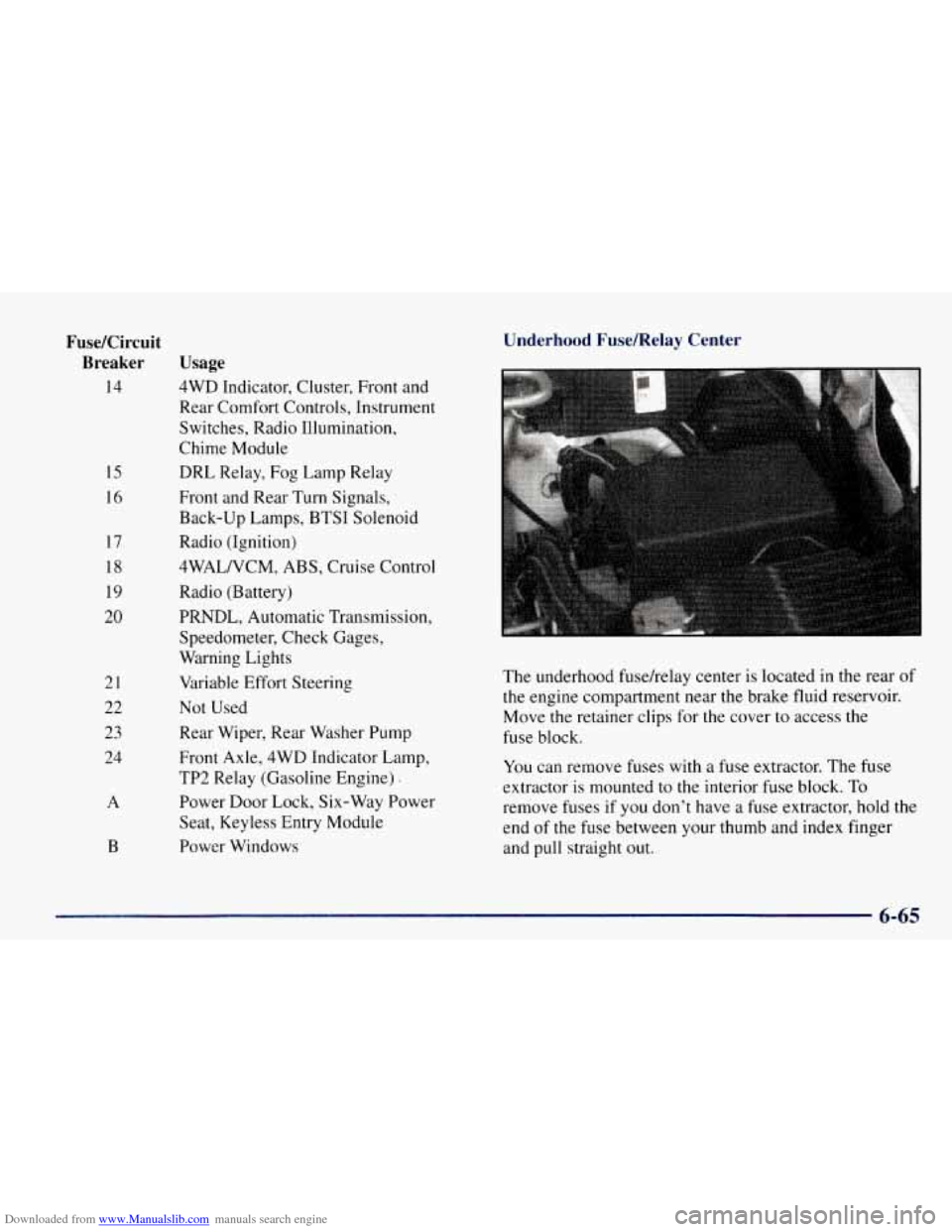
Underhood Fuse/Relay Center
The underhood fusehelay center is located in the rear of
the engine compartment near the brake fluid reservoir.
Move the retainer clips for the cover to access the
fuse block.
You can remove fuses with a fuse extractor. The fuse
extractor is mounted to the interior fuse block. To
remove fuses if you don't have a fuse extractor, hold the
end of the fuse between your thumb and index finger
and pull straight out.
6-65
Page 397 of 433
Downloaded from www.Manualslib.com manuals search engine At Least %ice a Year
Restraint System Check
Make sure the safety belt reminder light and all your
belts, buckles, latch plates, retractors and anchorages are
working properly. Look for any other loose or damaged
safety belt system parts. If you see anything that might
keep a safety belt system from doing its job, have it
repaired. Have any torn or frayed safety belts replaced.
Also look for any opened or broken air bag coverings,
and have them repaired or replaced. (The air bag system
does not need regular maintenance.)
Wiper Blade Check
Inspect wiper blades for wear or cracking. Replace blade
inserts that appear worn or damaged or that streak or
miss areas of the windshield. Also
see “Wiper Blades,
Cleaning” in the Index.
Air Cleaner Filter Restriction Indicator Check
Your vehicle has an indicator on the engine that lets you
know when the air cleaner filter is dirty and needs to be
changed. Check indicator at least twice a year or when your
oil is changed. See
“Air Cleaner’’ in the Index
for more information. Inspect your air cleaner filter
restriction indicator more often if the vehicle is used in
dusty areas or under
off road conditions.
Automatic Transmission Check
Check the transmission fluid level; add if needed. See
“Automatic Transmission” in the Index. A fluid loss
may indicate a problem. Check the system and repair
if needed.
At Least Once a Year
Key Lock Cylinders Service
Lubricate the key lock cylinders with the lubricant
specified in Part
D.
Body Lubrication Service
Lubricate all fuel door, body hood and body door
hinges, rear compartment hinges, tailgate handle pivot
points, latches, locks and folding seat hardware.
Part D
tells you what to use. More frequent lubrication may be
required when exposed to a corrosive environment.
Page 398 of 433
Downloaded from www.Manualslib.com manuals search engine Starter Switch Check
I I
Brake-Transmission Shift Interlock (BTSI) Check
N:
When you are doing this check, the vehicle could
move suddenly. If
it does, you or others could be
injured. Follow the steps below.
1. Before you start, be sure you have enough room
around the vehicle.
2. Firmly apply both the parking brake (see “Parking
Brake” in the Index if necessary) and the
regular brake.
NOTE:
Do not use the accelerator pedal, and be
ready to turn off the engine immediately
if it starts.
3. Try to start the engine in each gear. The starter
should work only
in PARK (P) or NEUTRAL (N).
If the starter works in any other position, your
vehicle needs service.
move suddenly. If it does, you or others could be
injured. Follow the steps below.
I I
1. Before you start, be sure you have enough room
around the vehicle. It should be parked on a
level surface.
2. Firmly apply the parking brake (see “Parking Brake”
in the Index if necessary).
NOTE: Be ready to apply the regular brake
immediately if the vehicle begins to move.
3. With the engine off, turn the key to the RUN
position, but don’t start the engine. Without applying
the regular brake, try to move
the shift lever out
of PARK (P) with normal effort. If the shift lever
moves out of PARK (P), your vehicle’s BTSI
needs service.
7-45