Page 2 of 402
Downloaded from www.Manualslib.com manuals search engine The 1997 Chevrslet S-Series Owner’s Manual
1,- 1 Seats and Restraint Systems
This section tells you how to use your ‘seats-and s;afety belts properly. It also explains the:“SIB” system.
2-1
3-1
4-1
Features and Controls
This section.expl&s how to start and operate your vehicle.
C.omfOrt Contrals and Audio Systems
This sectiun tells you -how to adjust the venti-lation and cordfort c trols an&how 6 @Crate your audio system.
Your Driving and the Road
.He?& you’ll findhelpful information and tip.s about .the road ami how to drive underdifferent c:onditions.
511.
6-1
8-1
9- 1
Problems on the Road
This scctign tells what.to do. if you have a problem while driving, such as a flat tire or o-verheatd engine, etc.
Service and Appearance Care
Here the manual tells yon how to keep your vehic-le runriing prgperly and 1o.oking;go.od.
Maintenance- Schedule
This section tells you when toperform vehicle maintenance and what fluids and lubficants to use.
Customer Assistance Information
This sectim tells y0.u how to contact Chemolet for assistaxe and how to get s-ervice arid. owner publications.,
It alS0 @VeS YOU information on “Reporting Safety Defects” on page 8- 10.
Index
Here’s an alphabetical listing of.almost every subject in this manual: You can use it to quickly Wna,
something you want to read.
i
Page 174 of 402
Downloaded from www.Manualslib.com manuals search engine Highway Hypnosis
:,Is there actually such a condtion as “highway hypnosis”?
“Or is it just plain falling asleep at the wheel? .Call it
highway hypnosis, lack of awareness; or whatevm.
There is something. about an easy stretch of road with the
same scenery, along with the hum of the tires on th.e road,
the drone
of the engine, and the rush of the wind :against
.the vehcle that cai~ ~ake you sleepy. Don’t let it happen
.?to
you! If it does, your vehicle can leave the soad h.Eess
tlzan a second, and you could crash and be injured.
What can you
do about h.ighway hypnosis? First, be
aware that it can .happen.
Then
here a-e some tips:
0 Make sure. your vehicle: is well ventilated; with a
comfortably cool interior.
0 Keep your eyes moving. Scan -the road ahead
and to
the sides. Cheek y-our mirrors and your
imtruine’nts frequently.
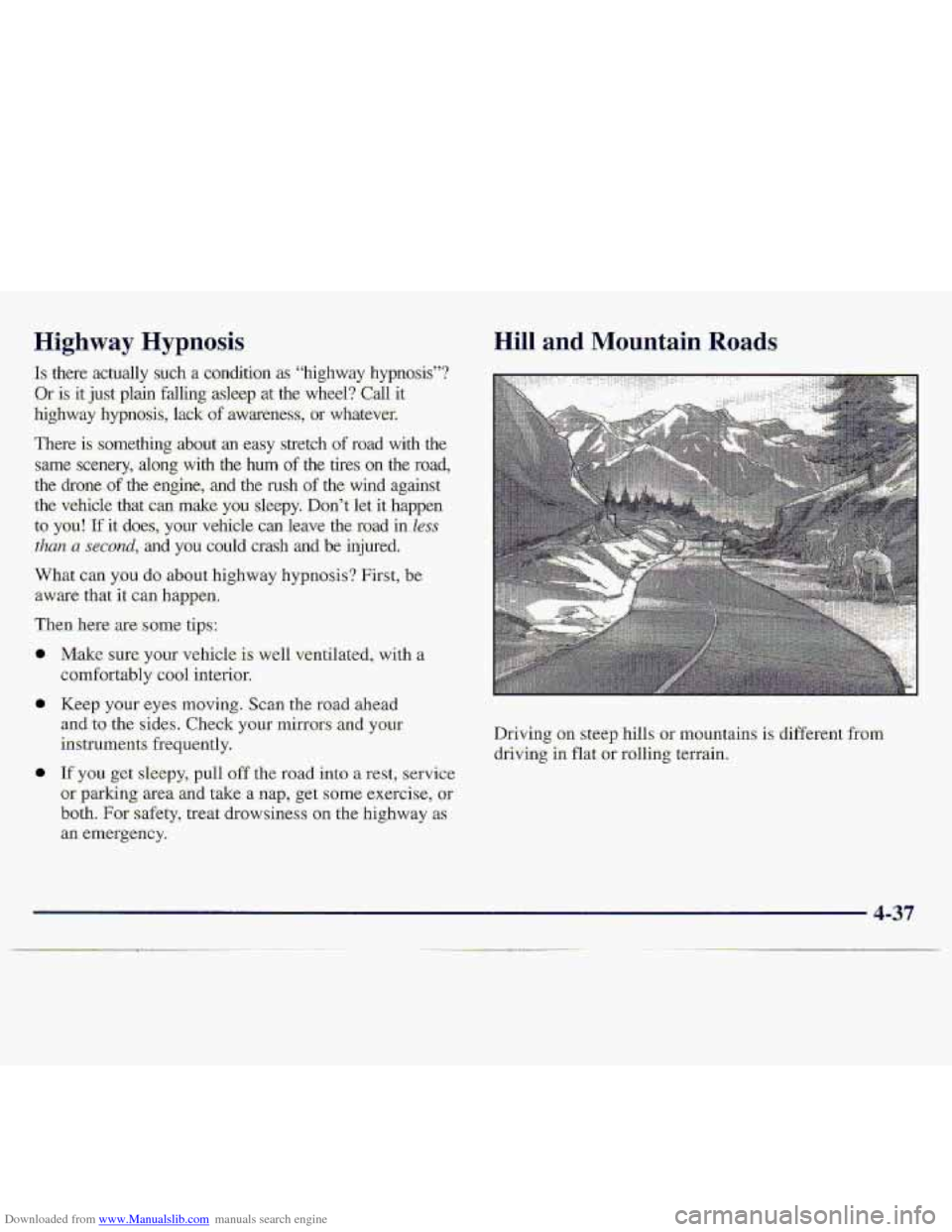
Hill and Mountain Roads-
Driving on steep hills or mountains is different from
drivjng .in
flat or.ro1ling terrain.
0. If-you get sleepy, p.ull off-the road into a rest, service
or-par.king- area and take
a asp, get some exercise, or
both. For safety, treat drowsiness on the highway as
an emergency.
4-37
Page 181 of 402
Downloaded from www.Manualslib.com manuals search engine Load& Your Vehicle
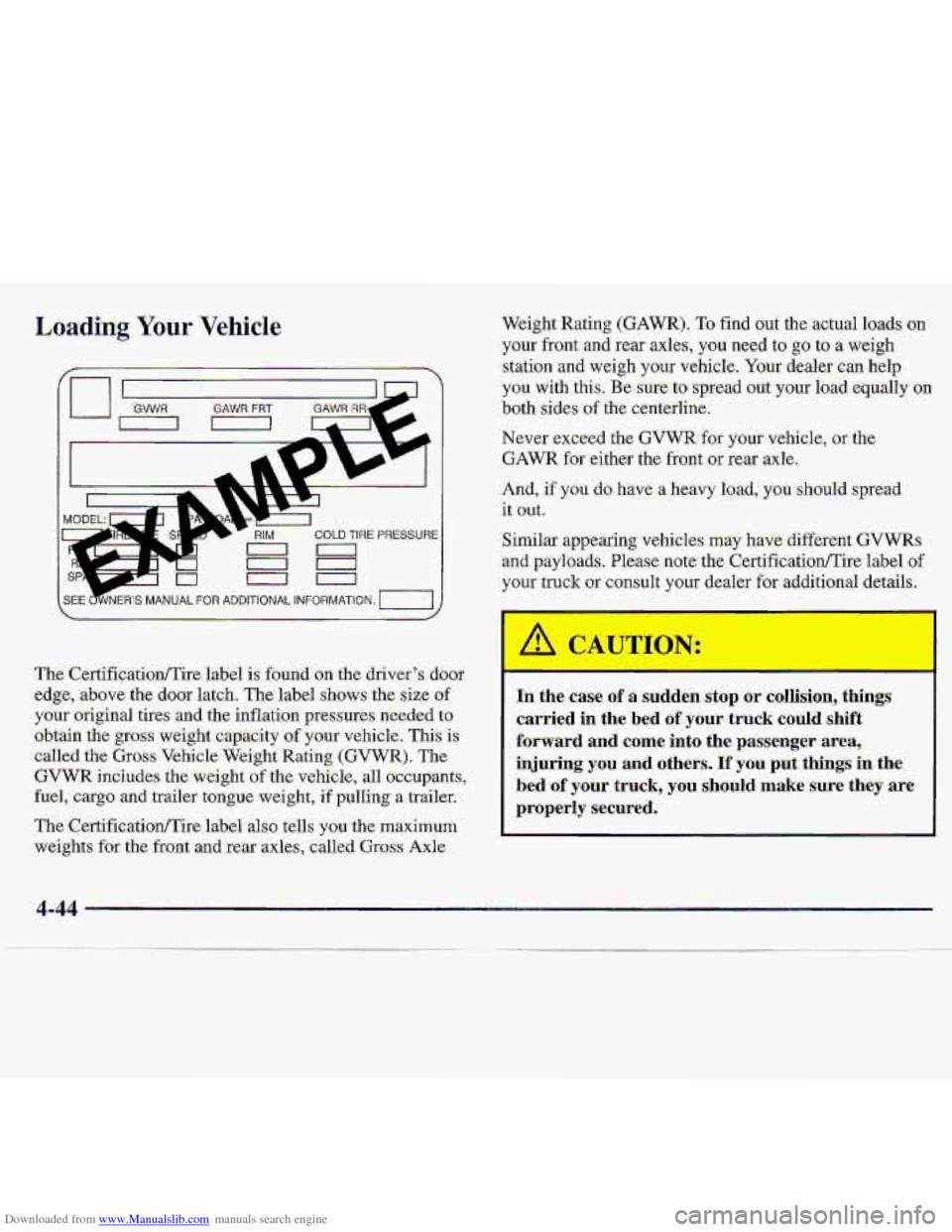
The Certification/Tire.iabel is found on the driver's door
edge, -above the door latch. The label shows the size of
your original. tires and the inflation pressures needed to
obtain the grass weight capacity of your vehicle. This is
called
the Gro-ss- Vehicle Weight Rating (GVWR). The
GVWR
includes the weight of the vehicle, all occupants,
fuel,
cargo aild trailer tongue weight, if pulling a-trailer.
The C&tification/Tire. label
also tells you the maximum
weights for the front and-re,ar axl.es, called Grass Axle Weight
.Rating (GAWR).
To find Qut the actual loads on
your front and rear axles, you need to go to a we.igh
station and weigh your-vehicle. Your dealer
can help
you with this. Be sure to spread out your load equally on
bath sides of the centerline..
Never exceed the GVWR for your vehicle, or the
GAWR
hi either the front or rear axle.
And, if you do have a heavy load, you- sho,uld spfead.
it
out.
Similar appearing vehicles. may have. differeQt GVWRs
and payloads. Please note the Certificatioflire. label sf
your truck or consult your dealer for additional details.
In the.case of a gudden stop or collision, things
carried in the bed of your truck could shift^
forward and come into the passenger area,
injuring you and others. 'If you put things in the
bed of your truck, you should rnake.su.re they are
properly
secured.
I
Page 198 of 402
Downloaded from www.Manualslib.com manuals search engine Section 5 Problems on the Road
Here you'll:find.what ta do about some problems .that ciin "Ciel%af bfi the road.
5- 2 Hazard. Warning Flaihers.
5-2 .Other Warning Devices
5-3 Jump Starting
5-7 Towing Your Vehicle
5-1 2 Engine Overhearing
5-22
5-22
5-23
5-35
5-36
Engine Fan Noise
Ita Tife Goes Flat
Changirig
x Flat 'Tire
Compact Spare Tire (Tf Equipped)
If You're Stuck: In Sand, Mud,
Ice or Snow
Page 220 of 402
Downloaded from www.Manualslib.com manuals search engine If a tire goes flat, avoid further tire and wheel damage
by driving slowly to a level place. Turn on your hazard
warning flashers.
Changing a tire can cause an injury. The vehicle
can slip off the jack and roll over
you or other
people.
You and they could be badly injured.
Find
a level place to change your tire. To help
prevent the vehicle from moving:
I. Set the parking brake firmly.
2. Put an automatic transmission shift
lever in
PARK (PI or shift a manual
transmission to FIRST (1) or
REVERSE (R).
CAUTION: (Continued)
3. If you have a four-wheel-drive vehicle
with
a manual transfer case shift lever,
be sure the transfer case is in
a drive
gear
-- not in NEUTRAL (N).
4. Turn off the engine.
5. Put the wheel blocks at the front and
rear
of the tire farthest away from the
one being changed. That would be the
tire on the other side
of the vehicle, at
the opposite end.
Page 223 of 402
Downloaded from www.Manualslib.com manuals search engine Turn the wheel wrench c0unterclo'ckwiA-e t$ lower the
.spare tire. Keep turning the wheel wrench irntil the spare
tire can be pulled out from under .the vehicle.
When the tire has been completely lowered, tilt the
retainer at the end of the cable.,and pill it through the-
wheel Gpening:. Puli the tire out from underthe vehicle. I
To help avoid v.ehicle .damage, do not drive th-e
vehicle before $he- cable is restored.
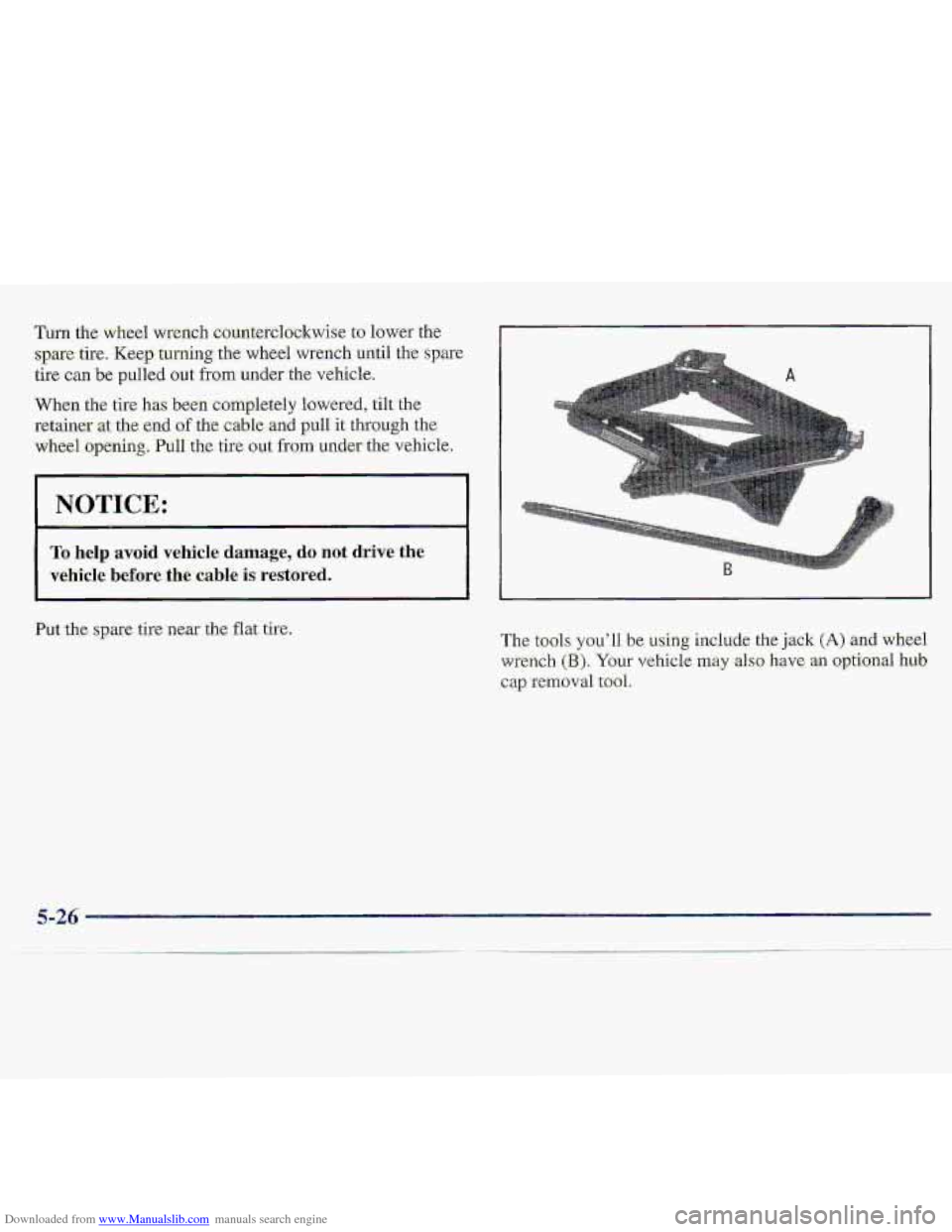
Pwf.the spare .tire nearae- flat tire. The tools you'll be, wing include. the jack (A) and wheel
wrench (€3). Your vehicle may also liava an optional hub,
cap I:emov.d to-ol.
5-26
Page 225 of 402
Downloaded from www.Manualslib.com manuals search engine 1. Using the wheel wrench, lomen all the wheel nuts.
Don't remove them yet.
2. Turn the jack handle clockwise slightly to raise the
jack lift head.
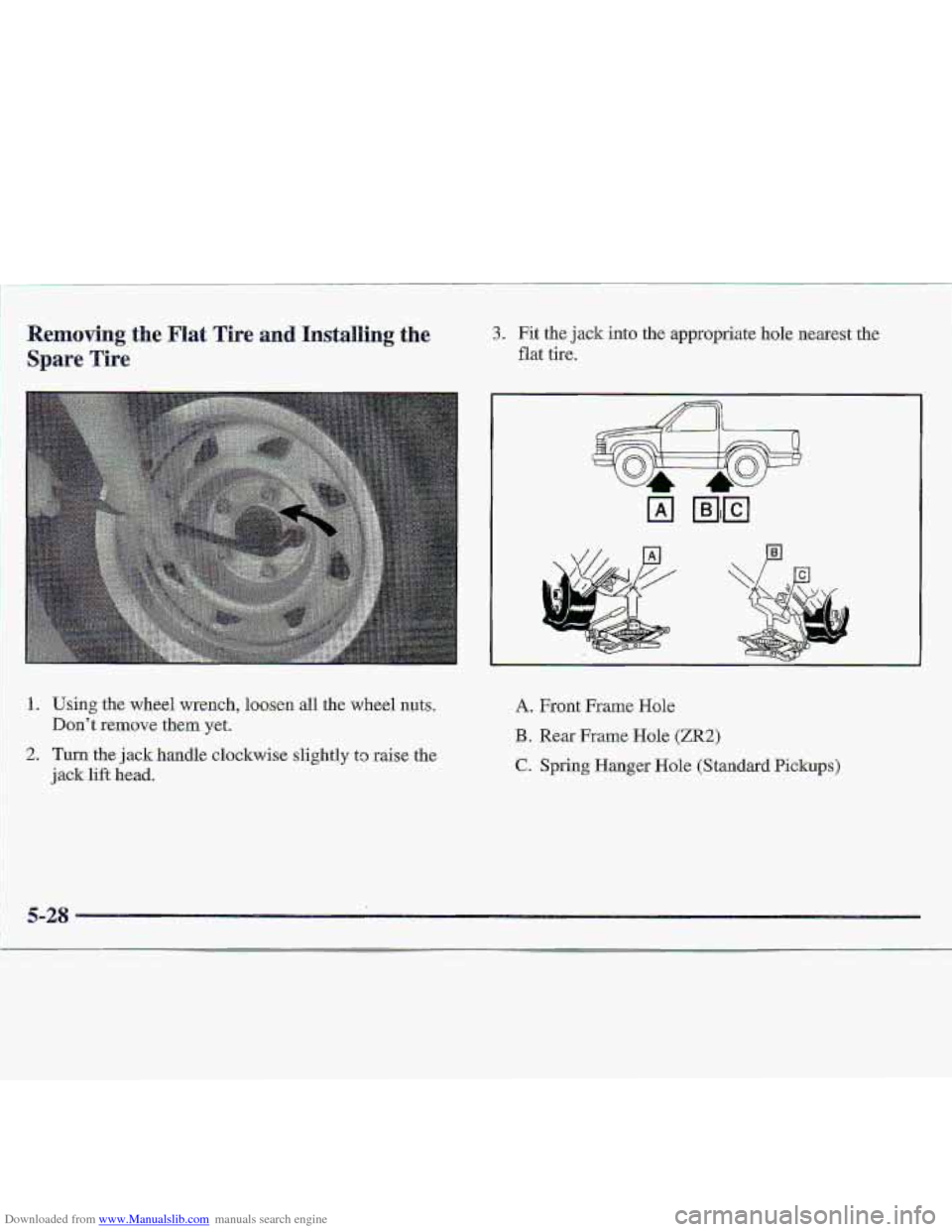
3. Fit the jack into the appropriate ho1.e nearest the
flat
tire.
A. Front Frame Hole.
B. Rear Frame Hole (ZR2)
C. Spring Hanger Hole (Standard Pickups)
5-28
Page 226 of 402
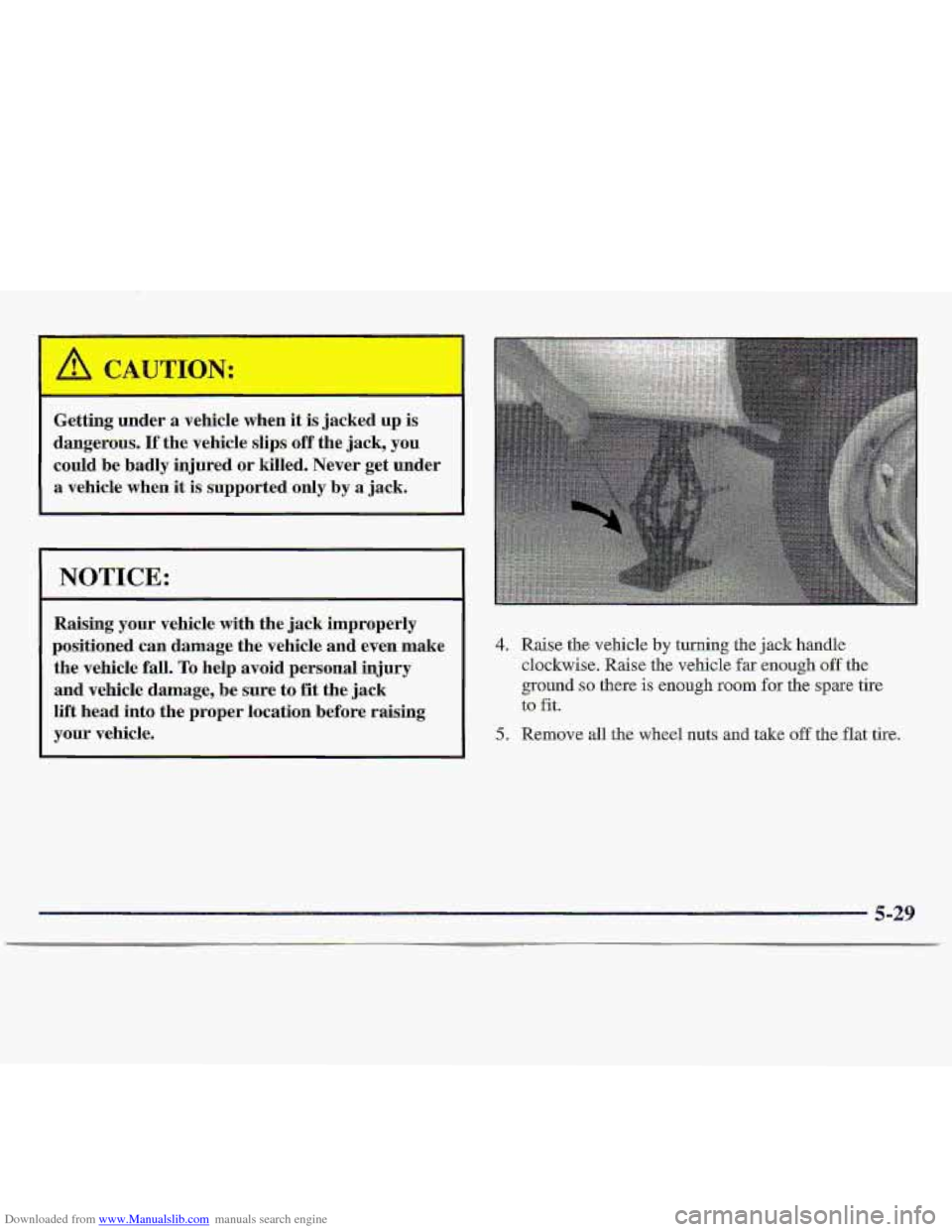
Downloaded from www.Manualslib.com manuals search engine Getting under a vehicle when it is jacked up is
dangerous. If the vehicle slips off the jack, you
could be badly injured or killed. Never get under
a vehicle when
it is supported only by a jack.
I
1 NOTICE:
Raising your vehicle with the jack improperly
positioned
can damage the vehicle and even make
the vehicle
fall. To help avoid personal injury
and vehicle
damage, be sure to fit the jack
18t head into the proper location before raising
your vehicle.
4. Raise the vehicle by turning the jack handle
clockwise. Raise the vehicle far enough off the
ground so there is enough room for the spare tire
to fit.
5. Remove all the wheel nuts and take off the flat-tire;