Page 270 of 402
Downloaded from www.Manualslib.com manuals search engine Using the wrong fluid can badly damage
brake system parts, For example,
just a few
drops
of mineral-based oil, such as. engine
oil, in your brake system can dam-age brake
system
patts-so badly that thef”l1 have to be
rep1aced:Don’t let someone put in the
wrong kind of fluid.
If you spill brake fluid on your vehicle’s
painted surfaces,
the paint- finish can be
damaged:. $e careful not to
spill brake fluid
on your vehicle. If you do, wash it off
imnxdiately. See “Appearance Care” in
the-Index.
Your vehicle has front disc brakes and rear drum brakes..
Disc brake ‘pads have built-in wear indicators that make. a.
high-pitched warning sound when the brake pads are worn
and new pads are needed. The sound may come and go or
be heard all the time your vehicle-is moving (except when
you are pushing on the brake pedal firmly).
The brake wear warnirg sound. means that.s.oon
yaur brakes won’t work, well. That could lead to
an accident. When
you hear the brake wear
warning sound, have
your vehicle serviced.
I NOTICE:
I
Continuing to drive with worn-out brake pads
c’ould result in costly brake repair.
6-33
Page 291 of 402
Downloaded from www.Manualslib.com manuals search engine Using Focl-Type Cleaner on Fabric
1. Vacuum and brush the area to remove any loose dirt.
2. Always clean a whole- trim panel or section. Mask
3. Mi-x Muid-Purpose Powdered Cleaner- following, the
4. Use suds only and apply with a clean sponge. Don’t
5. As- soon as you’ve cleaned the section, use-a sponge
surromdiirrg.trim
along stitch
or welt lines..
directions
on the container label.
saturate
the mater‘ial and do.n’t .rub it roughly.
to remove the suds.
6. Rinse the section with .a- cletin, wet sponge.
7. Wipe off what’s left with a slightly damp paper mwel
8. Dry it immediately with - ,tow dryer.
or
cl.oth.
9. Wipe with a dean
cloth.
Using Solvent-Qpe Cleaner on Fa’
First, see if you have to use solve,nt-type cle at all.
Some spots and stains will clean off better wm Just
water and mild. soap.
‘If you need to use a.solvent:
1. Gently scrape excess soil from -the trim-material with
- -
..
a clean, dull knife or scraper.
2. Use ve1.y little cledner, li-ght pressure arid clean cloths
(preferably cheeseclo.th). Cleanirig- should start at the
outside of the stain, “feathering” toward .the center.
3. Keep changing to a clean section of the cloch.
,4. When you clean a stain from fabric, imme.diately dry the
area with a blow dryer to help prevent a cleaning Ang.
Fabric Protection
Your vehicle has upholstery and carpet that has been
‘treated with Scotchgard
TM Fabric Protector’ a 3M
product. It protects fabrics- by repelling oil and water,
which :are .the c,arriefs of nio$t staihs. Even with this
protection, you still ,nee:d to. clean your upholstery and
carpet. often
to keep it I-0-aking new.
.Further information an cleaning is available by calling
1-800-433-3296 (in Minnesota, ‘I -800-442-6167).
Page 292 of 402
Downloaded from www.Manualslib.com manuals search engine Non-Gre,asy $%aim
11.. %&efully scrape off .excess stain, Thefi .sponge the
soiled area with cool water.
2. Ifa. stai-n remains., 'follow the fwm-type in.strwtions
described. earlier.
1. 'Cgrefully Scrape off excess stain.
2. Clean with coQ1.water and diow to dry.
3. If a ~ -$n.remai:ins, clean it with s.slvent-type c1:leaner.
Page 295 of 402
Downloaded from www.Manualslib.com manuals search engine Finish Ca.re
Occasional waxing. 01 miid~~palishmg~ of yaw-vehicle by
hand may be neces.$ary TC, reinove-regidue. frm the paillf
finisk You Can g~t GM-apprci;v.ed cleaning prod,ucts
fhm your dealer. (See “Appearance C,me :and Materials”
in the Index.)
..
NOTICE:
Machine compounding or aggressive polishing on
a bas.ecoai/clesircaat paint fmish may dull. the.
finish or leave swirl marks..
Foreign-materials su.,ch as ealci-u:m chloride and other-
salts, i.ce ‘melting agent.s, road oil and tar, tree sap, bird
droppings, chemicals: from industrial chimneys, etc., can ~
damage your vehicle’s fhish if theyremain OD painted
sur€&es.
Wash the. vehicle as: Soon a.s p~s’sibk. If
nkcessary, use n:an-ibrasive cl~aners -that ge marked
safe
for painted surfaces to remove fmeign matter..
Exterior painted surfaces are subject to aging, weather
and.chemic’a1 fallout tha3
can take their tall over a period
of years. Y0.u c.m help0 keep the paint finish iooking
new by keeping your .v&icle gaaged .or covered
. whenever possible.
Pratecting Exterior Bright Metal -Parts
Right metal :parts should be cleaned regularly -f,g keep
their lu-ster.
Washing with water is all that-3s umdly
u&ded. ‘Howeve‘s, you. may use chr.ome polish on
chrome or stainless steel trim, if necessary.
Use.specia1
care with duminum tr-im. To avaid
damaging protective trim, never use auto or chrome
polish, steam or caustic soap to clean aluminum. A
coatifig of wax, -.ru.blaed to high -polish, is recomm-ended
for.all bright metal
papts.
Page 311 of 402
Downloaded from www.Manualslib.com manuals search engine I IMPORTANT: I
KEEP ENGINE OIL
AT THE PROPER
LEVEL AND CHANGE AS
RECOMMENDED
Protection
Plan
Introduction
Your Vehicle and the Environment
Proper vehicle maintenance not only helps to keep your
vehidle
in- gpad worbg condition, but also. helps the
environment.
All recommended maintenance procedures
are important. Improper vehicle maintenance
oan even
affect the
quality of the air we breathe. Improper fluid
levels or the wrong tire inflation can increase the level
af emissions from your vehicle. To help protect our
environment, and to keep your vehicle'in good
condition,
please maintain your vehicle properly.
7-2
Page 315 of 402
Downloaded from www.Manualslib.com manuals search engine Maintenance Schedule
Follow this maintenance schedule only if none of the
conditions from the Short Trip/City Maintenance
Schedule is true.
Do not use this schedule if the vehicle
is used for trailer towing, driven in a dusty area or used
off paved roads. Use the Short Trip/City schedule for
these conditions.
Driving a vehicle with af.lly warmed engine under
highway conditions causes engine oil
to break
down slower,
~ - Long'T.l.ip/Hi-ghway Intervals
Every 7,500 Miles (12 500 km): Engine Oil and Filter
Change
(or every 12 months, whichever occurs first).
Chassis Lubrication (or every
12 months, whichever
occurs first). Drive Axle Service. Tire Rotation.
Replacement. Air Cleaner Filter Replacement. Front
Wheel Bearing Repack
(2WD only) (or at each brake
relining, whichever occurs first).
Transmission Service (severe conditions only).
Drive Belt Inspection. Fuel Tank, Cap and
Lines Inspection.
Inspection. Spark Plug Replacement. Positive Crankcase Ventilation (PCV) Valve Inspection.
Every 150,000 Miles (240 000 km): Cooling System
Service (or every
-60 months, whichever occurs first).
These intervals only summarize. maintenance services.
Be sure
to follow the complete maintenance schedule
on the following pages.
Every 30,000 Miles (50 000 km): Fuel Filter
Every 50,000 Miles (83 000 km): Automatic
Every 60,000 Miles (100 000 km): Engine Accessory
Every 100,000 Miles (166 000 km): Spark Plug Wire
7-6
Page 316 of 402
Downloaded from www.Manualslib.com manuals search engine Short Trip/City Maintenance Schedule
+ A good .time. to check your’ brakes is during tire
rotation.
See: “Brake System Inspection” under “Periodic
Maintenance Inspection” in Part C of this schedule,
** Drive axle setvice (see “Recommended Fluids ,and
Lubricants” in the Index for proper lubricant
to use):
0
0
‘Locking Differenti,al -- .Drain fluid. and refill at first
engine oi€ change.
At- subsequent oil Changes, check
fluid level and add fluid as neede.d.. If driving in
dusty areas or towing a trailer, drain fluid and refill
every
15,000 miles (25 000 km).
Standard .Differential -- Check fluid level. and. add
fluid as needed at every oil change If driving in
,dusty areas or towing a trailer, drain fluid and refill
every
15,000. miles (25 ‘000 km).
.More frequent lubrication may
be required for
heavy-duty or off-road use.
Page 317 of 402
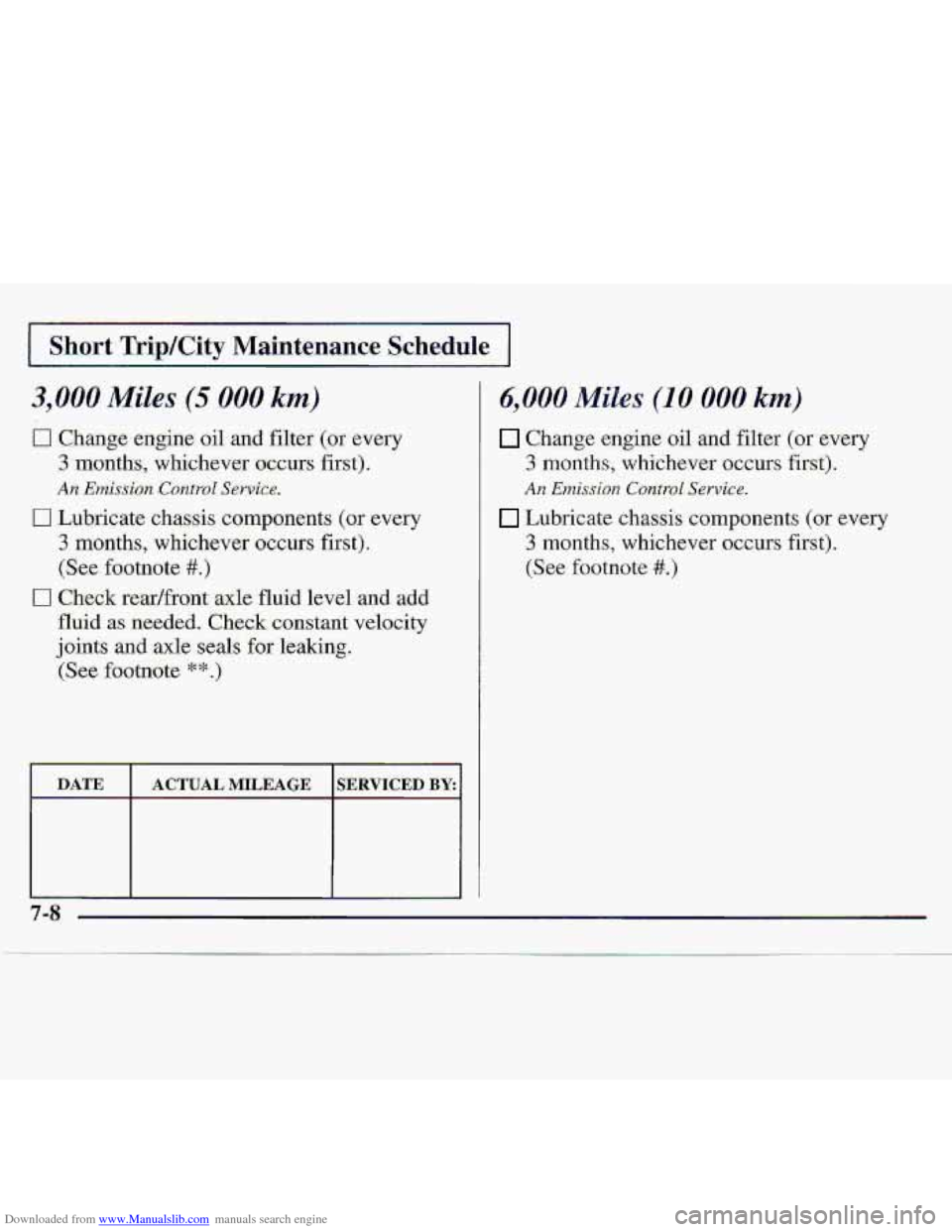
Downloaded from www.Manualslib.com manuals search engine ?art TrWCity Maintenance Schedule
Ll Change engine oil and filter (or every
3 months, whichever oc.curs first).
An Emisxi6~ .Control Sem:ice.
17 Lubricate chassis components (or every
3 months, whichever occurs first).
(See €ootnote #.I
0 Check rearhont axle fluid.level and add
fluid as needed. Check. constant velocity
joints
and -axle seals for leaking.
(See footnote * * .)
6,000 Miles (1.0 000 -km)
Change engine oil and filter (or every
3 months, whichever occurs first).
An E~-taissiari Curttd Service..
Lubricate chassis components (or every
-3 months, whichever occurs first).
(S-ee fmtnate. #.)