Page 106 of 402
Downloaded from www.Manualslib.com manuals search engine Anti-Lock Brake System Warning., Light,
1
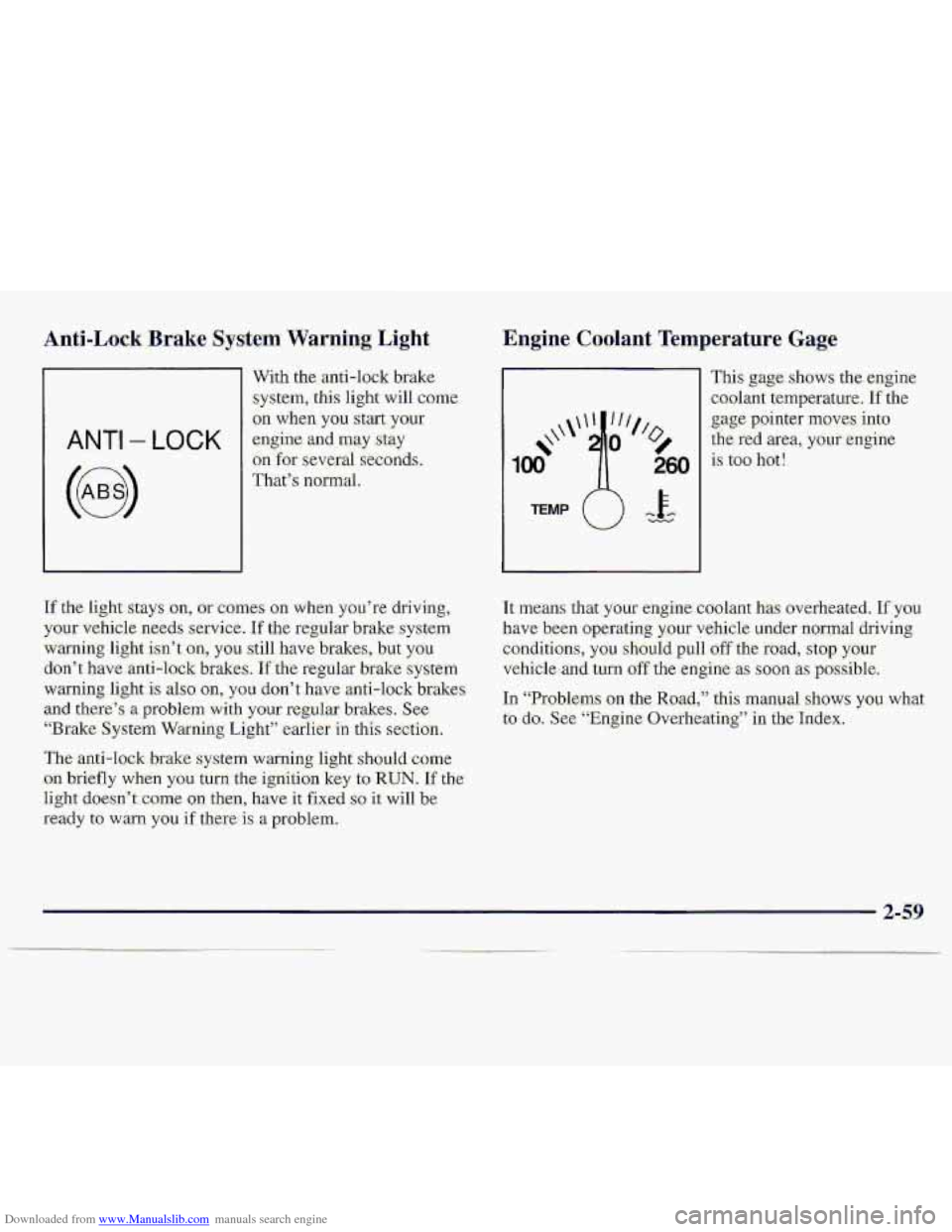
With the anti-lock brake
system, this Light will come
on when. yau start .youx
ANTI - LOCK engine and may stay
Engine Coolant Temperature -Gage
This gage shows the..engin-e
coolant temperature,
If the
moves -into
It means that your engine:co‘olant has overheated. Ifyou
have been operating your vehicle grrtder .normal driving
C.ondifions,
y~u should pull.off ‘the foad, stop your
vehicle. and tm off the engine as soon as possible.
In “Proble.ms on the Road,r’ this mangal shows you what
to do. See “Engine Ovefheittit~g” in the Index.
2-59
Page 110 of 402
Downloaded from www.Manualslib.com manuals search engine Shift Light Check Gages Light.
SHIFT
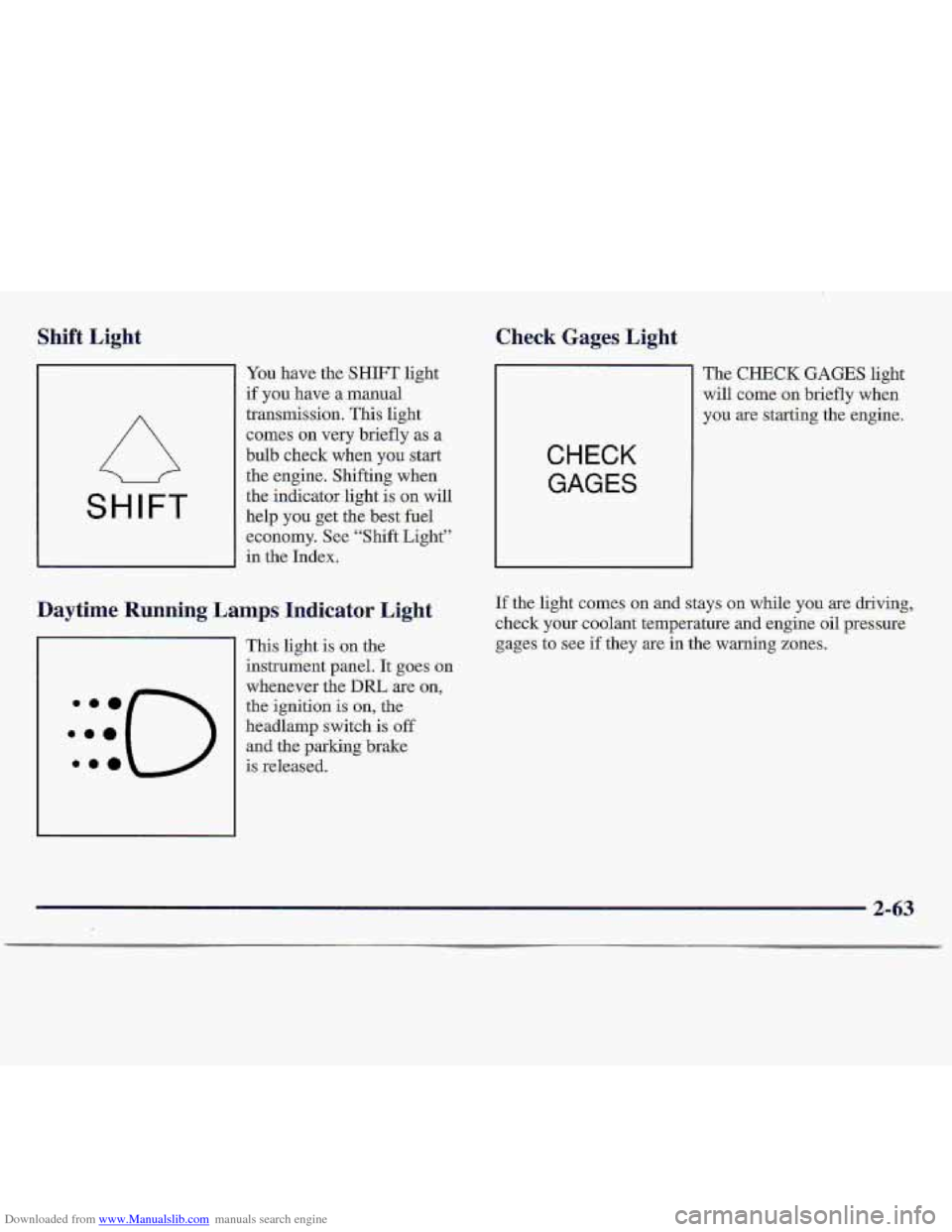
You have the SHIFT light
if you have a manual
transmission. This light
comes- on very briefly as a
bulb check wh-en
you start
the engine. Shifting when
the indicator light is on will
help
you get the best fuel
economy. See “Shift Light”
in the Index.
Daytime Running Lamps Indicator Light
This light is ,on the
instrument panel. It goes on
whenever the
DIU are on,
the ignition is on, the
headlamp switch
is off
and the parking brake-
:::(-)
.ma is released.
CHECK
GAGES
The CHECK GAGES light
will come
on briefly when
y9u
are starting the engine.
If the light comes on and stays on while you are driving,
check
your coolant temperature and engine oil pressure
gages
to see if they are in the warning zones.
2-63
Page 144 of 402
Downloaded from www.Manualslib.com manuals search engine Anti-Lock Brakes (ABS)
Your vehicle has anti-lock bmk& (ABS). ABS is an
advanced .electronic braking systeni that will help
prevent a braking skid.
When you start your engine and begin to drive away,
your-anti-lok
brake system will check. itself. Yau may
hear
a rnsrnentary motor or clicking-noise, w-file this ‘test
is going on. This is normal.
If your-engine ever stqs while you’se driving, brake
normally
but do;n’:t pul~ip your brakes. Ifyou do, th-e
,p%ed-al may get hard-er-to puGh .down. If -your.engi-ne
‘stops, you will-s~tal have some power assist. B:ut
you will a-se it when you brake; Once the power.asskt is
used up, it may take long-er to stop afid thelljrake pedal
will
.be .harder to zrush.
ANTI - LOCK
If there’s a problem with the.
anti-lock brake system, -this
war‘i&g.Iight will stay an.
See. “Anti-Lo& Brake
System
Warning Light” in
th.e Index.
4-7
Page 171 of 402
Downloaded from www.Manualslib.com manuals search engine C.ity Driving.
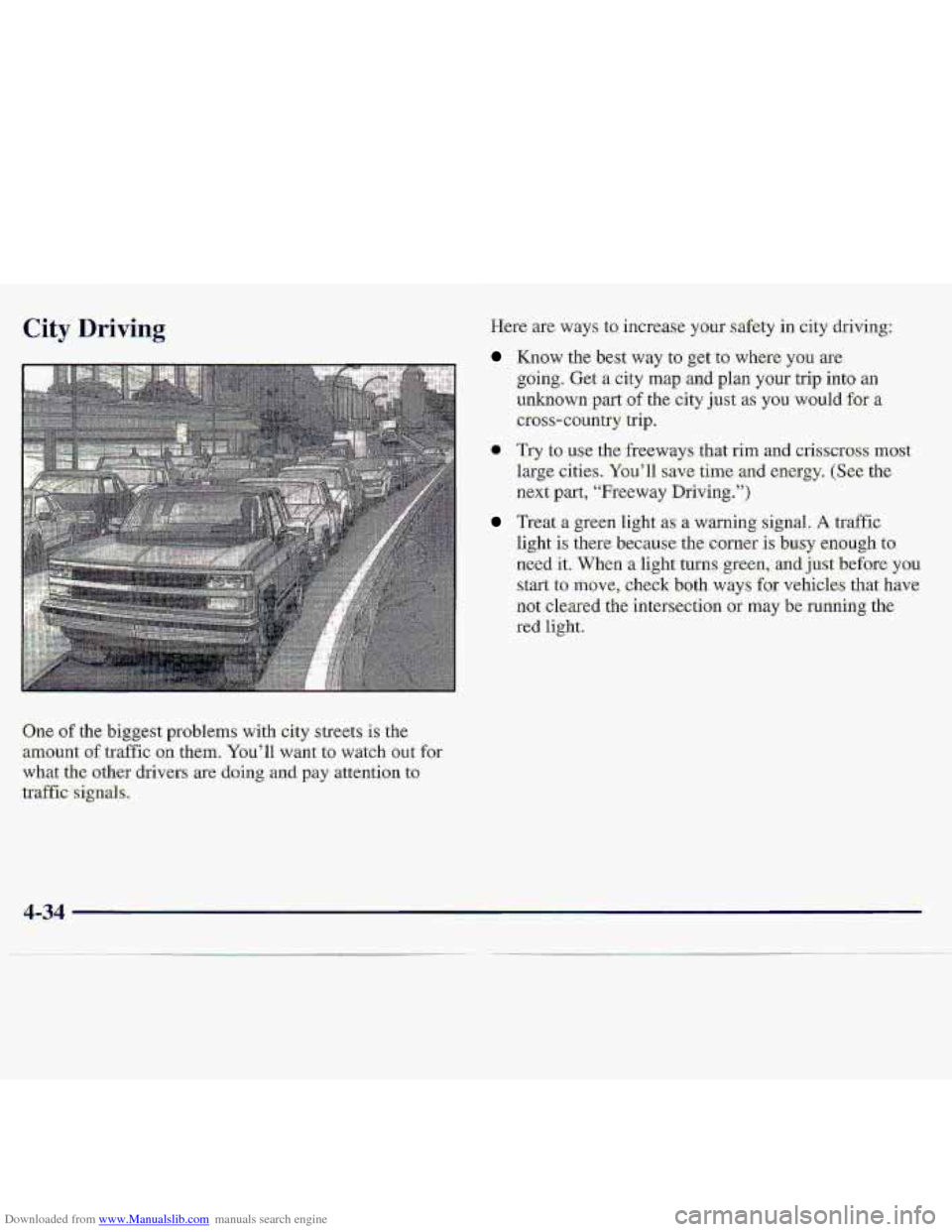
Orkof the bigg.est problems with city streets is the
:amount of traffic on them. You’ll want to watch o.ut for
what the other drivers are doing and pay attention to
traffic -.signals.
Here -are ways to increase y.ou safety in city driving.:
.Know the best way to get to where you are.
going, Get a city map and plan your trip into an
unknown part .of the city just as you wo.uld for a
cross-country trip.
m Try to use the freeways that-rim and.erisscr.oss mmst
large &tie-s. You’ll save time -and energy (See. the
next part, “Freeway Driving.”)
Treat a green light as a warning signal. A traffic
ligh.t-is there because the corner is busy emugh to,
need it. When a light turns gre,en, and just before you
start to Iimve, check both ways for vehicle-s that have
not cleared the intersection Or may be running the’
red li-ght.
4-34
Page 176 of 402
Downloaded from www.Manualslib.com manuals search engine Winter Driving
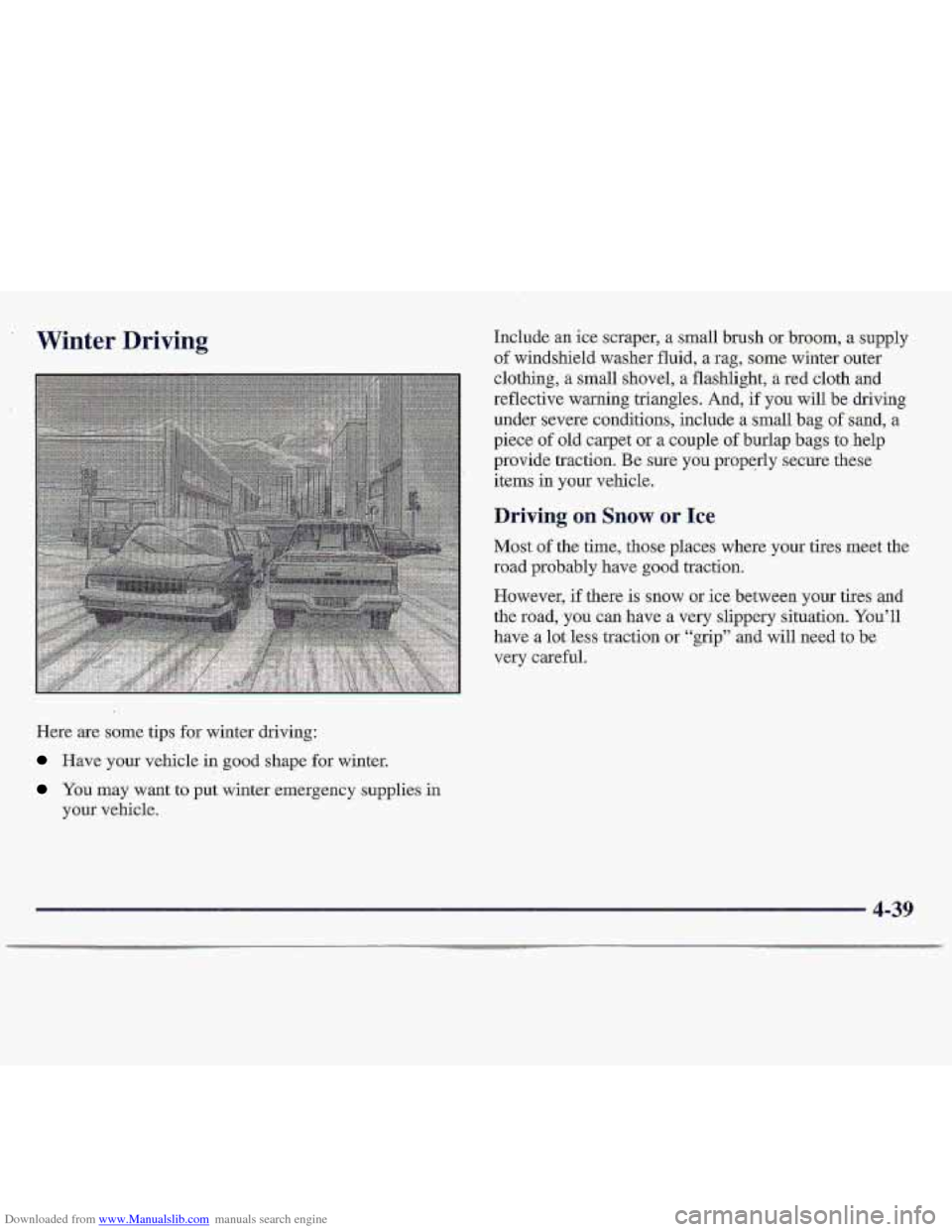
Here are some tips for winter driving:
Have your vehicle in good shape for winter.
You may want to put winter emergency supplies in
your vehicle. Include
an ice scraper, a small brush. or
broom, n supply
of windshield washer fluid, a rag, some winter outer
clothing,
a small shovel, a flashlight, a red cloth and
reflective warning triangles. And,
if you will be driving.
under severe conditions, include-a small bag
of sand, a
piece
of old carpet or a couple of burlap bags to help
provide traction. Be sure you properly secure these
items in your vehicle.
Driving on Snow or Ice
Most of the time, those places where your tires meet the
road probably have good traction.
However,
if there is snow or ice between your tires and
the road, you can have
a very slippery situation. You’ll
have a
lot less traction or “grip” and will need to be
very careful.
4-39
Page 198 of 402
Downloaded from www.Manualslib.com manuals search engine Section 5 Problems on the Road
Here you'll:find.what ta do about some problems .that ciin "Ciel%af bfi the road.
5- 2 Hazard. Warning Flaihers.
5-2 .Other Warning Devices
5-3 Jump Starting
5-7 Towing Your Vehicle
5-1 2 Engine Overhearing
5-22
5-22
5-23
5-35
5-36
Engine Fan Noise
Ita Tife Goes Flat
Changirig
x Flat 'Tire
Compact Spare Tire (Tf Equipped)
If You're Stuck: In Sand, Mud,
Ice or Snow
Page 199 of 402
Downloaded from www.Manualslib.com manuals search engine Hazard Warning Flashe-rs
,, n.....,.,. . _. . . . , . . . . . . ... ..
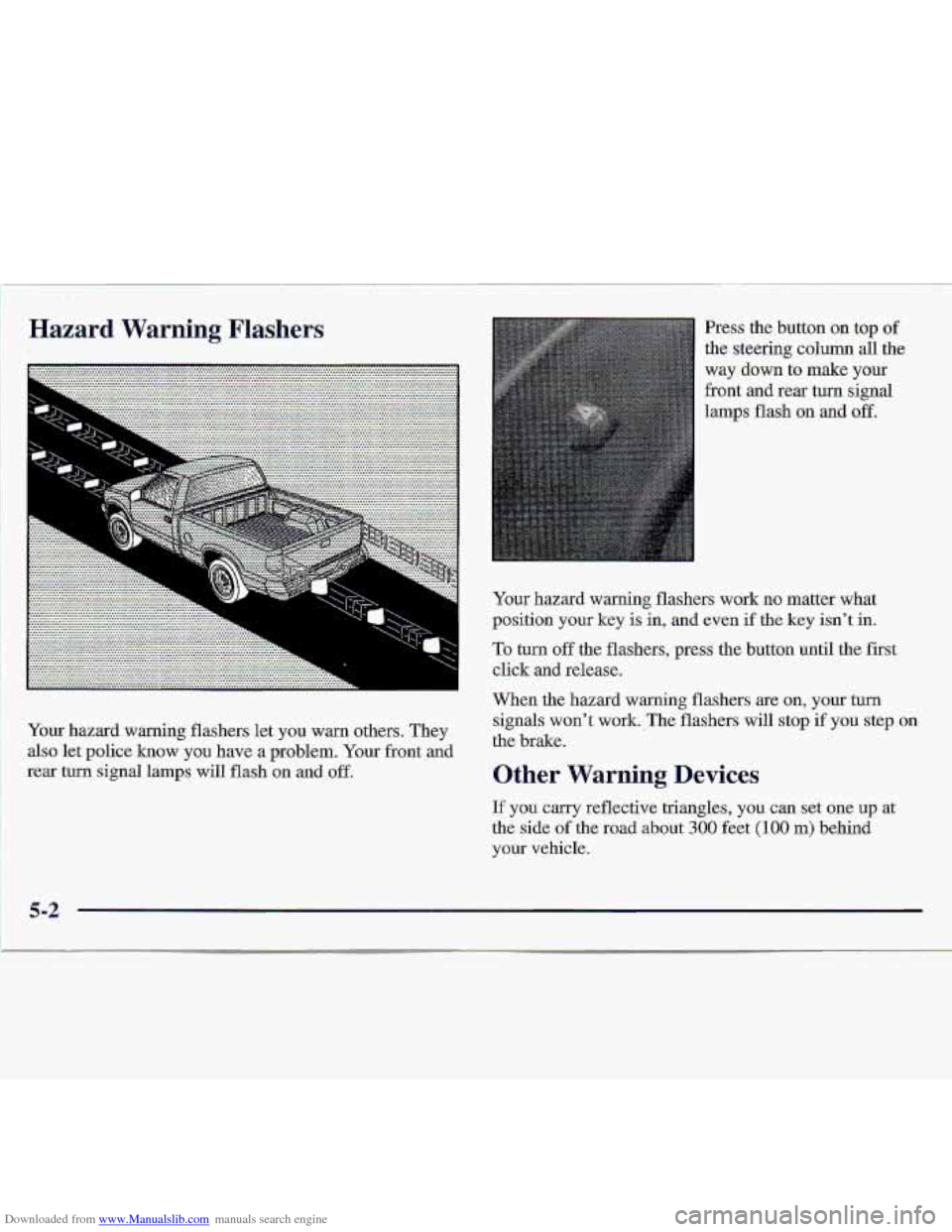
Yom hazard warning flashers let you wan others. They
also kt police how you have. a-pmblem. Your front and
rear turn signal lamp$ will flash on and off.
Press the button on -top -or
the steering column all the
wgy down to make your
front and rear turn signal
lamps. flash :on ad off.
Your hazard warnirrg flashers work no matter-what
position your key is in, and even if the key isn't in.
To turn off the flashers, pres the-button until the first
click. and release..
When
the hazard warning flashers are on, your turn
signals won't work. ,The flashers -will stop if you step on
the brake.
Other Warning Devices
If yb~ &ry Pkflective triangles, .you can set one up at
the side of the road about 300 feet (100 m) behind
your vehicle.
Page 210 of 402
Downloaded from www.Manualslib.com manuals search engine IfNo Steam Is Coming -. From Your Engine
If y0.u get the overheat warning but s.ce or hear RO
steam, the problem may not be too serious. Sometimes
the engine
can get a 1i.ttle too hot when yau:
.O Climb a long hill OLI: a hot day.
0 S.top after high-speed driving.
0 Idle for long periods in traffic.
e- Tow a trailer. See “Dfiving on Grades” in .the Index.
If you get .the overheat warning with no sign of s-team;
try this for a minute or so:-
1. If you have an air conditioner, turn it off.
2. Turn on your heater to full hot at the highest.$gm
speed
and open the window as necessary.
3. 1% you’re in a. traffic jam, shift to NEUTRAL (N);
otherwise, shift to the highest gear while
driving -- AUTOMATlC OVERDRIVE (@) or
DRIVE (D) far automatic transmissions.
If you n.0 longer have the overheat warniiqg,. you
can drive. Just to besafe, driv.e slower for .about
10 minu.tes. If the
warning does;n’.t come back. ofl,
you can drive normdly..
If the warning c.aritinues-, pull OV&, stop, and p-~k y.Our-
vehicle right hway.
If there’s still no sign of steam, push the accelerator Uhtil
the
engine speed is about twice as fast-as normal idie
speed. Bring the. engine speed back to- normal idle sped
after two QP three minutes. Now:s.ye if the warning, stops.
But
&en-, if you still have the .warnhg-, twn qfl--fhc
engine and get Gveryona .out af rhe whicle until it
coois Eo wn.