Page 227 of 386
Downloaded from www.Manualslib.com manuals search engine I
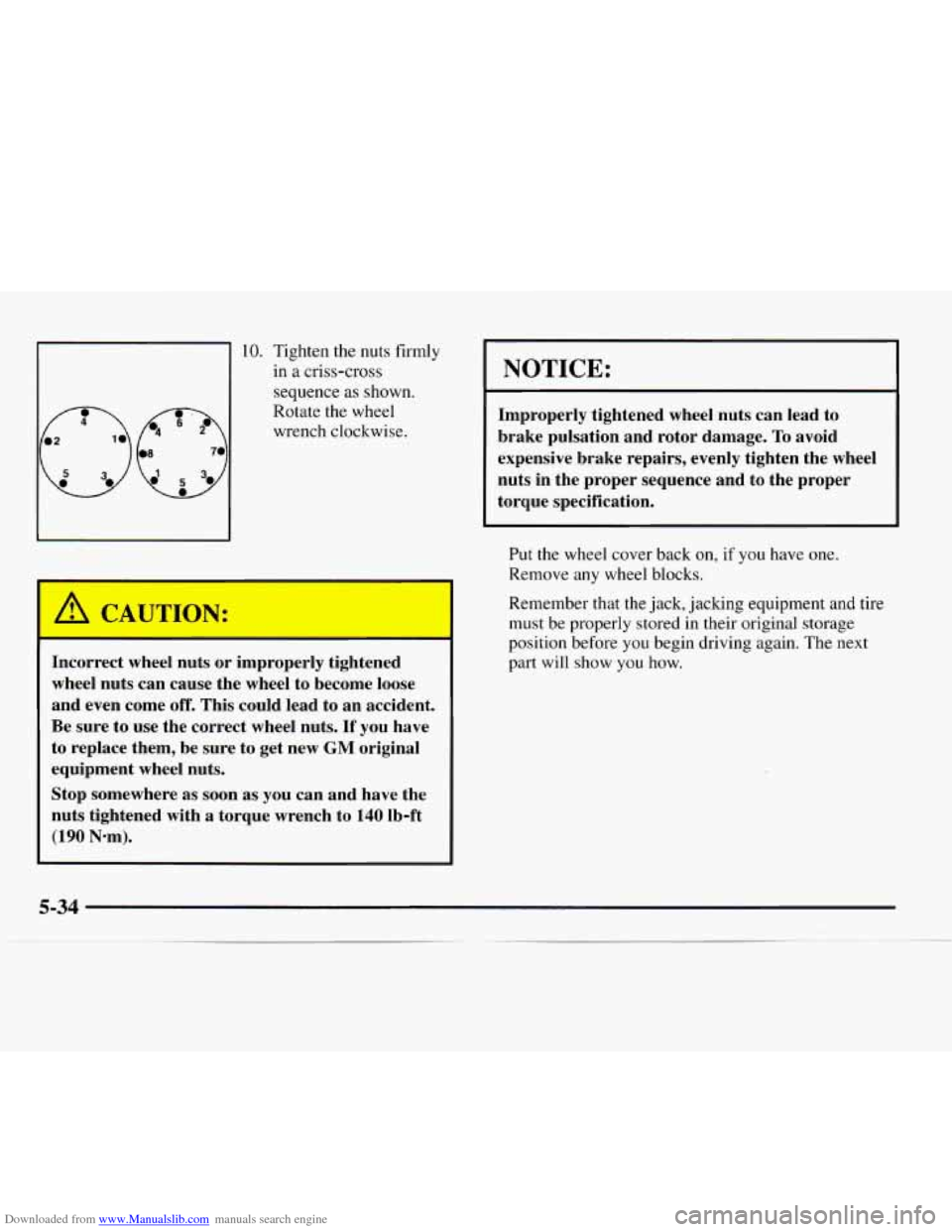
10. Tighten the nuts firmly in
a criss-cross
sequence
as shown.
(f3, e
Rotate the wheel
wrench clockwise.
A CA "TION:
I
Incorrect wheel nuts or improperly tightened
wheel nuts can cause the wheel to become loose
and even come
off. This could lead to an accident.
Be sure to use the correct wheel nuts.
If you have
to replace them, be sure to get new
GM original
equipment wheel nuts.
Stop somewhere as soon as you can and have the
nuts tightened with
a torque wrench to 140 Ib-ft
(190 N*m).
NOTICE:
Improperly tightened wheel nuts can lead to
brake pulsation and rotor damage.
To avoid
expensive brake repairs, evenly tighten the wheel
nuts in the proper sequence and to the proper
torque specification.
Put the wheel cover back on, if you have one.
Remove
any wheel blocks.
Remember that the jack, jacking equipment and tire
must be properly stored in their original storage
position before you begin driving again. The next
part will show you how.
5-34
Page 234 of 386

Downloaded from www.Manualslib.com manuals search engine Section 6 Service and Appearance Care
Here you will find information about the care of your vehicle. This section begins with service and fuel information,
and then it shows how to check important fluid and lubricant levels. There
is also technical information about your
vehicle, and
a part devoted to its appearance care.
6-2
6-3
6-5
6-5
6-7
6-1 1
6-12 6-17
6-18
6-22
6-22
6-25
6-26 6-26
6-27
6-28 6-32 Service
Fuel (Gasoline Engine)
Fuels in Foreign Countries
Filling Your Tank
Checking Things Under the Hood
Noise Control System
Engine Oil (Gasoline Engine)
Air Cleaner (Gasoline Engines)
Automatic Transmission Fluid
Rear Axle
Engine Coolant Radiator Pressure Cap
Thermostat Power Steering Fluid
Windshield Washer Fluid
Brakes
Battery 6-32
6-32
6-40
6-4
1
6-49
6-50
6-54
6-55
6-55
6-55
6-56
6-57
6-5 8
6-59
6-63
6-66
6-67 Bulb Replacement
Halogen Bulbs
Windshield Wiper Blade Replacement
Tires Appearance Care
Cleaning the Inside
of Your Vehicle
Cleaning the Outside of Your Vehicle
Cleaning Aluminum Wheels
(If Equipped)
Cleaning Tires Sheet Metal Damage
Finish Damage
Appearance Care Materials Chart
Vehicle Identification Number (VIN)
Electrical System
Capacities and Specifications
Air Conditioning Refrigerants
Lamp and Bulb Data
Page 242 of 386
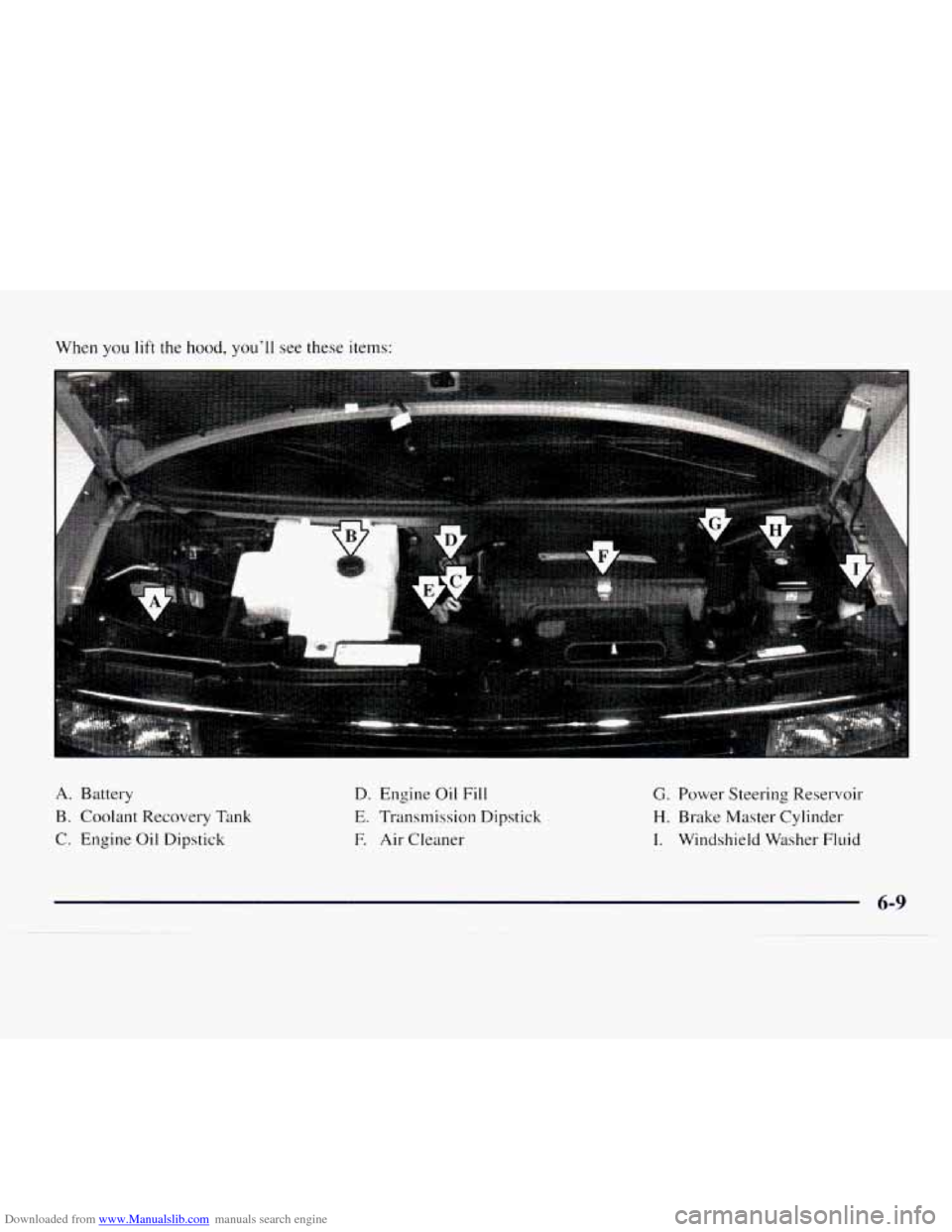
Downloaded from www.Manualslib.com manuals search engine When you lift the hood, you’ll see these items:
A. Battery
B. Coolant Recovery Tank
C. Engine Oil Dipstick D.
Engine Oil Fill E. Transmission Dipstick
E Air Cleaner
G. Power Steering Reservoir
H. Brake Master Cylinder
I. Windshield Washer Fluid
6-9
Page 243 of 386
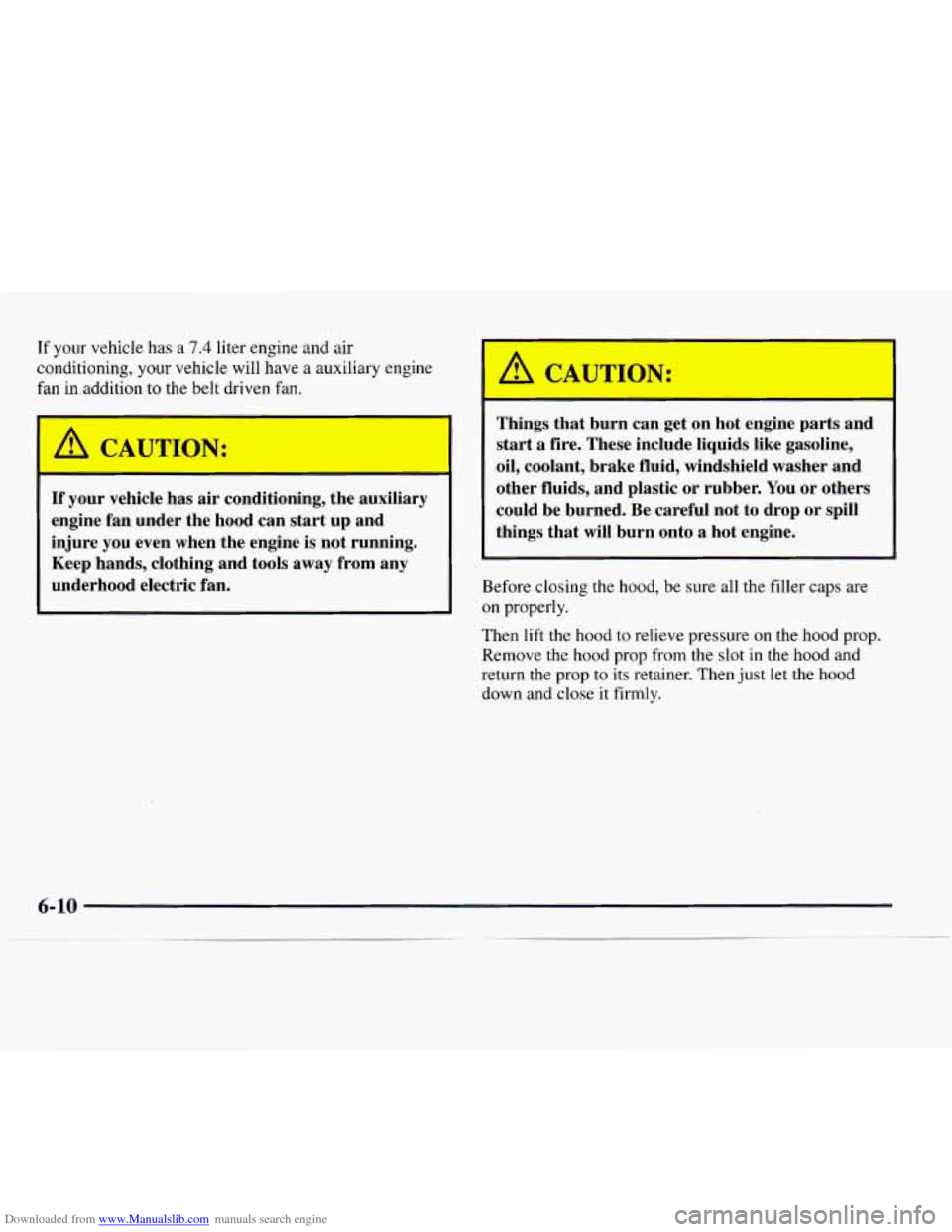
Downloaded from www.Manualslib.com manuals search engine If your vehicle has a 7.4 liter engine and air
conditioning, your vehicle will have
a auxiliary engine
fan in addition to the belt driven fan.
1
,A CAUTION: I
If your vehicle has air conditioning, the auxiliary
engine fan under the hood can start up and
injure you even when the engine is not running.
Keep hands, clothing and tools away from any
underhood electric fan.
I A CAUTION:
i
Things that burn can get on hot engine parts and
start
a fire. These include liquids like gasoline,
oil, coolant, brake fluid, windshield washer and
other fluids, and plastic or rubber. You
or others
could be burned. Be careful not to drop or spill
things that will burn onto
a hot engine.
Before closing the hood, be sure all the filler caps are
on properly.
Then
lift the hood to relieve pressure on the hood prop.
Remove the hood prop from the slot in the hood and
return the prop
to its retainer. Then just let the hood
down and close
it firmly.
6-10
. .~
Page 253 of 386
Downloaded from www.Manualslib.com manuals search engine Checking the Fluid Hot or Cold
0
0
0
0
Park your vehicle on a level place. Keep the
engine running.
With the parking brake applied, place
the shift lever
in PARK
(P).
With your foot on the brake pedal, move the shift
lever through each gear range, pausing for about
three seconds
in each range. Then, position the shift
lever in PARK
(P).
Let the engine run at idle for three minutes or more.
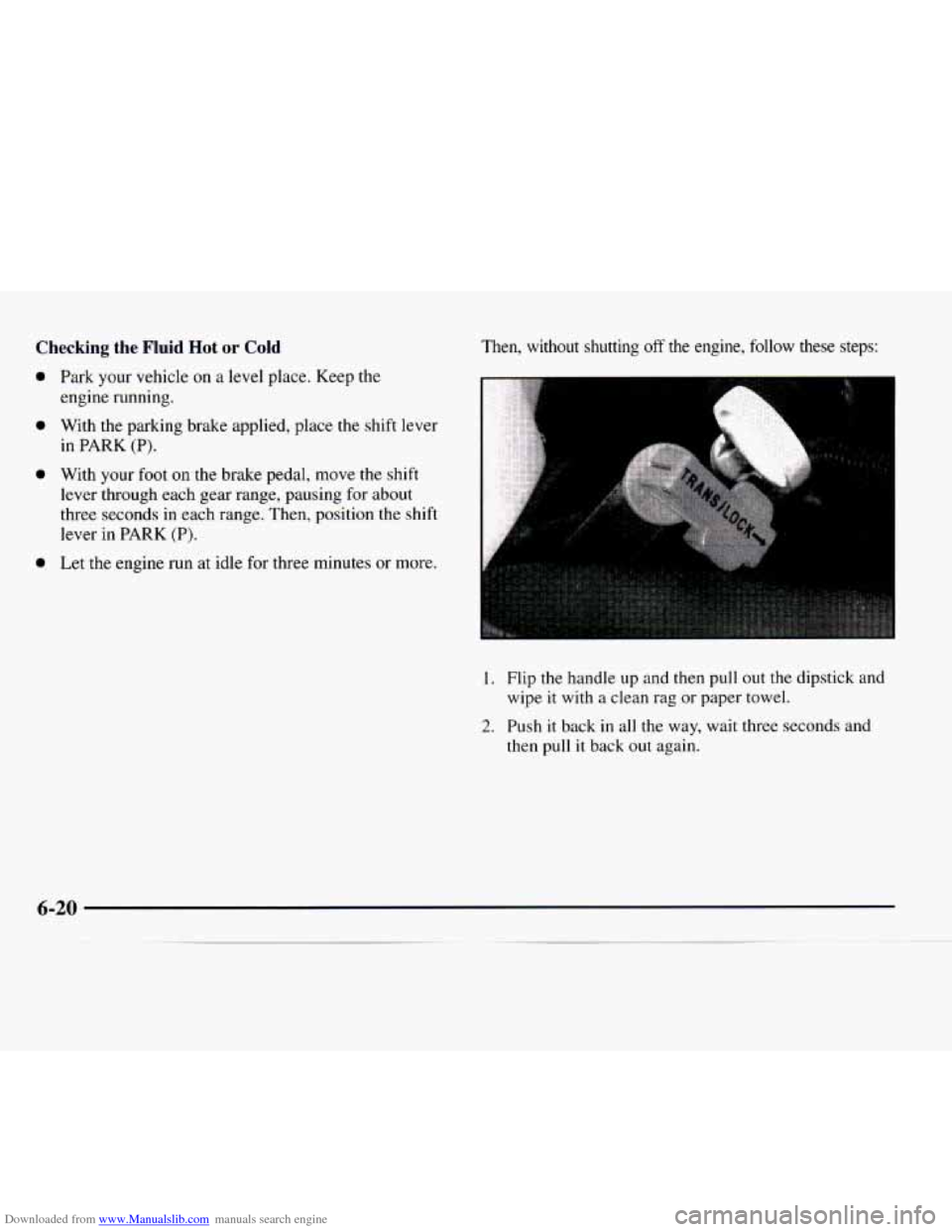
Then, without shutting off the engine, follow these steps:
A i
1. Flip the handle up and then pull out the dipstick and
wipe it with
a clean rag or paper towel.
2. Push it back in all the way, wait three seconds and
then pull
it back out again.
Page 259 of 386

Downloaded from www.Manualslib.com manuals search engine Thermostat
Engine coolant temperature is controlled by a thermostat
in the engine cooling system. The thermostat stops the
flow of coolant through the radiator until the coolant
reaches a preset temperature.
When you replace your thermostat, an
AC@ thermostat
is recommended.
Power Steering Fluid
When to Check Power Steering Fluid
It is not necessary to regularly check power steering
fluid unless you suspect there is a leak in the system or
you hear an unusual noise.
A fluid loss in this system
could indicate a problem. Have the system inspected
and repaired.
How To Check Power Steering Fluid
When the engine compartment is cool, wipe the cap and
top
of the reservoir clean, then unscrew the cap and
wipe the dipstick with
a clean rag. Replace the cap and
completely tighten it. Then remove the cap again and
look at the fluid level on the dipstick.
The level should be at the
FULL COLD mark. If
necessary, add only enough fluid to bring the level up
to the mark.
To prevent brake fluid contamination never check or fill
the power steering reservoir with the master cylinder
cover
off.
What to Use
To determine what kind of fluid to use, see
“Recommended Fluids and Lubricants”
in the Index.
Always use the proper fluid. Failure
to use the proper
fluid can cause leaks and damage hoses and seals.
6-26
Page 261 of 386

Downloaded from www.Manualslib.com manuals search engine Brakes
Brake Fluid
Your brake master cylinder reservoir is here. It is filled
with
DOT-3 brake fluid.
There are only two reasons why the brake fluid level in
the reservoir might go down. The first is that the brake
fluid goes down to an acceptable level during normal
brake lining wear. When new linings are put in, the fluid
level goes back up. The other reason is that fluid is
leaking out
of the brake system. If it is, you should have your brake system
fixed, since a leak means that sooner
or later your brakes won’t work well, or won’t work
at all.
So, it isn’t a good idea to “top off’ your brake fluid.
Adding brake fluid won’t correct
a leak. If you add fluid
when your linings are worn, then you’ll have too much
fluid when you get new brake linings.
You should add
(or remove) brake fluid,
as necessary, only when work is
done on
the brake hydraulic system.
If you have too much brake fluid, it can spill
on the engine. The fluid will burn
if the engine
is hot enough. You or others could be burned,
and your vehicle could be damaged. Add brake
fluid only when work is done on the brake
hydraulic system.
Refer to the Maintenance Schedule to determine when to
check your brake fluid. See “Periodic Maintenance
Inspections”
in the Index.
6-28
Page 262 of 386
Downloaded from www.Manualslib.com manuals search engine Checking Brake Fluid What
to Add
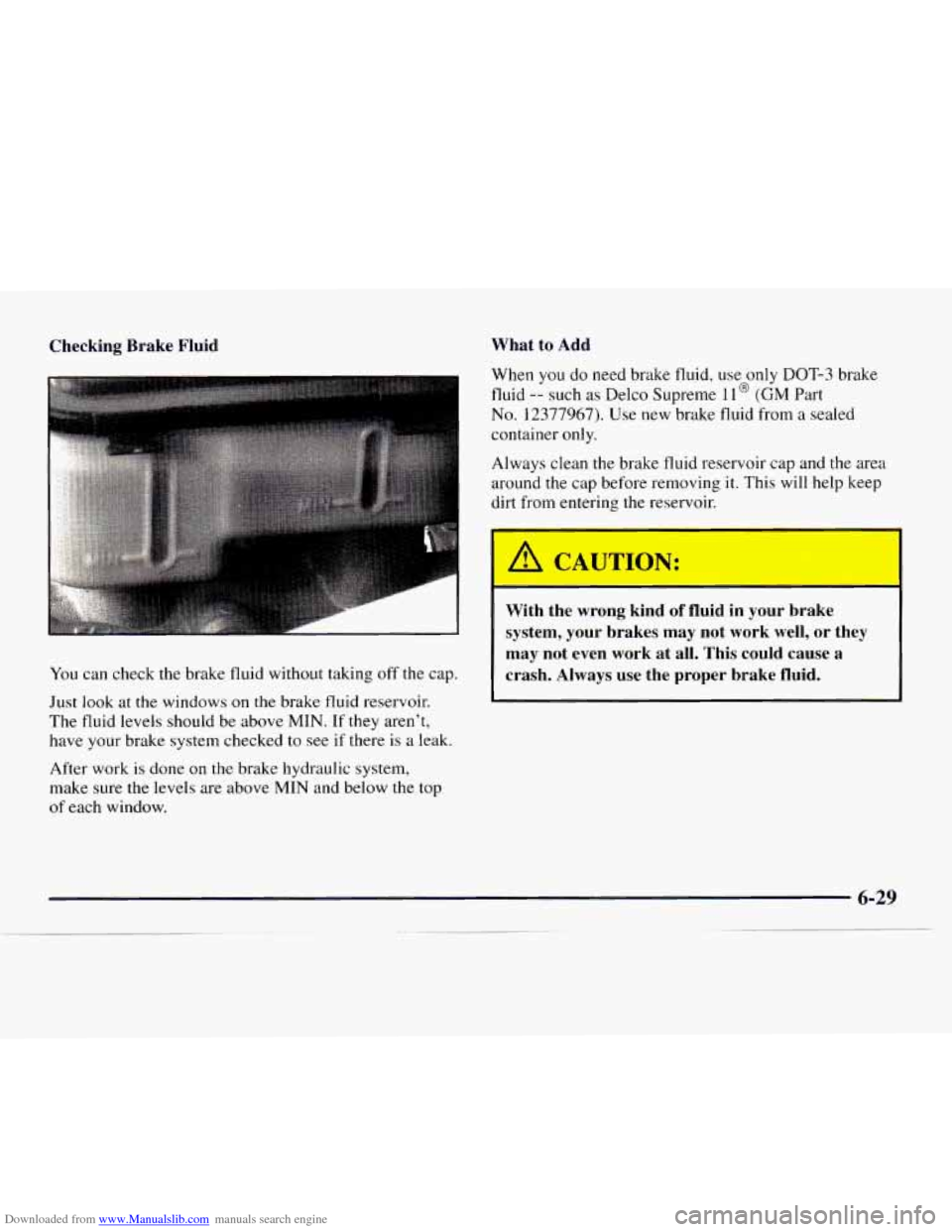
You can check the brake fluid without taking off the cap.
Just
look at the windows on the brake fluid reservoir.
The fluid levels should be above
MIN. If they aren't,
have your brake system checked to see if there
is a leak.
After work is done
on the brake hydraulic system,
make sure the levels are above
MIN and below the top
of each window. When
you do
need brake fluid, use only DOT-3 brake
fluid
-- such as Delco Supreme 11 @ (GM Part
No. 12377967). Use new brake fluid from a sealed
container only.
Always clean the brake fluid reservoir cap and the area
around the cap before removing
it. This will help keep
dirt from entering the reservoir.
, A CAUTION:
H
With the wrong kind of fluid in your brake
system, your brakes may
not work well, or they
may not even work at all. This could cause a
crash. Always use the proper brake fluid.