1997 CHEVROLET EXPRESS light
[x] Cancel search: lightPage 119 of 386

Downloaded from www.Manualslib.com manuals search engine Check Gages Light
The CHECK GAGES light
will come on briefly when
you are starting the engine.
CHECK
GAGES
Fuel Gage
UNLEADED
FUEL ONLY
The fuel gage, when the
ignition
is on, tells you
about how much fuel you
have
left in your tank.
If the light comes on and stays on while you are driving,
check your coolant temperature and engine oil pressure
gages to see if they are in
the warning zones. The gage
will first.indicate EMPTY
(E) before you
are out of fuel, and you should get more fuel as soon
as possible.
Page 132 of 386

Downloaded from www.Manualslib.com manuals search engine Air Conditioning Heating
Before using your
vehicle’s air conditioning, open the
windows to clear the vehicle of hot air. This reduces the
time it takes for your vehicle
to cool down. Then keep
your windows closed for the air conditioner to work at
its best.
You can use MAX
A/C with the temperature knob in the
blue area, when it’s really hot outside and you need to
cool the inside air quickly. MAX A/C lets in only a little
air from the outside.
If you first use MAX
A/C, you can then use A/C with
the temperature knob in the blue area, as
soon as the
vehicle has cooled down,
so outside air will be going
through your vehicle.
If your vehicle has rear air conditioning, setting it on
LO may enhance front A/C performance by allowing
trapped refrigerant in rear lines to circulate.
When the air conditioning, DEFROST or BLEND is on,
you may notice a slight increase or decrease in engine
speed, due to compressor operation. This is normal
because the system is designed to cycle the compressor
on and off to keep the desired temperature. On
cold days, use HEATER with the temperature knob
in the red area. Outside air will be brought in through
the floor outlets. The heater works best if you keep your
windows closed while using it.
If you use the optional engine coolant heater before
starting your engine, your heating system will produce
warmer air faster to heat the passenger compartment in
cold weather. See “Engine Coolant Heater” in the Index.
Ventilation Tips
Keep the hood and front air inlet free of ice, snow,
or any other obstruction (such as leaves). The heater
and defroster will work far better, reducing the
chance of fogging the inside of your windows.
When you enter a vehicle in cold weather, turn the
blower fan to HI for a few moments before driving
off. This helps clear the intake ducts of snow and
moisture, and reduces the chance of fogging the
inside of yow windows.
3-7
Page 134 of 386
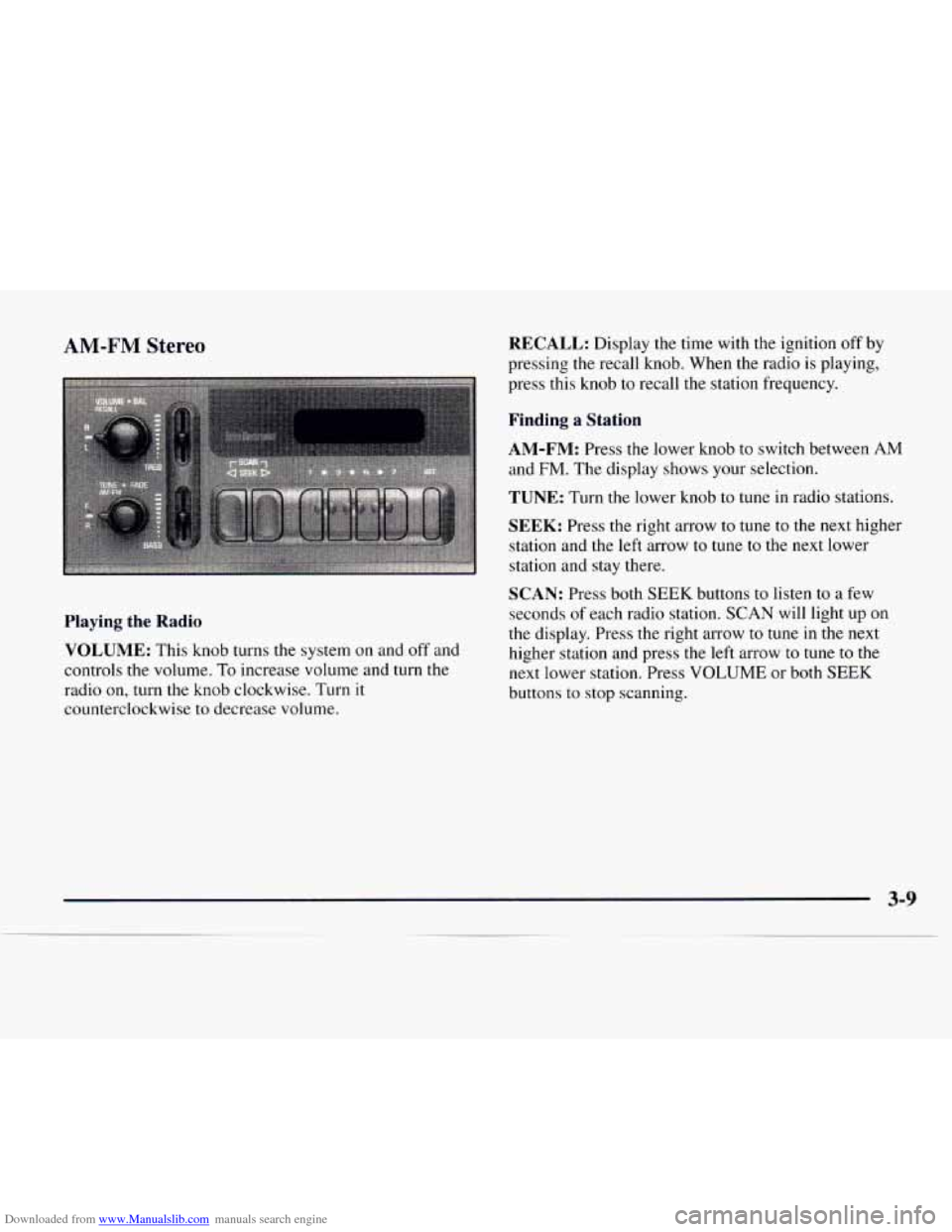
Downloaded from www.Manualslib.com manuals search engine AM-FM Stereo RECALL: Display the time with the ignition off by
pressing the recall knob. When the radio is playing,
press this knob to recall the station frequency.
Finding a Station
AM-FM:
Press the lower knob to switch between AM
and FM. The display shows your selection.
TUNE: Turn the lower knob to tune in radio stations.
SEEK: Press the right arrow to tune to the next higher
station and the left arrow
to tune to the next lower
station and stay there.
Playing the Radio
VOLUME:
This knob turns the system on and off and
controls the volume. To increase volume and turn the
radio on, turn the knob clockwise. Turn it
counterclockwise to decrease volume.
SCAN: Press both SEEK buttons to listen to a few
seconds
of each radio station. SCAN will light up on
the display. Press the right arrow to tune in the next
higher station and press
the left arrow to tune to the
next lower station. Press
VOLUME or both SEEK
buttons to stop scanning.
Page 139 of 386
Downloaded from www.Manualslib.com manuals search engine RECALL: Display the time with the ignition off by
pressing this button. When the radio is playing, press
this button to recall the station frequency.
SCV Your system has a feature called
Speed-Compensated-Volume (SCV). With SCV, your
audio system adjusts automatically
to make up for road
and wind noise
as you drive. Set the volume at the
desired level. Move the control ring behind
the upper
knob clockwise to adjust the SCV. Then, as you drive,
SCV automatically increases the volume, as necessary,
to overcome noise at any particular speed. The volume
level should always sound the same
to you as you drive.
If you don’t want to use SCV, turn the control all the
way down. Each detent on the control ring allows for
more volume compensation at a faster rate
of speed.
Finding a Station
AM-FM: Press this button to switch between AM, FM 1
and FM2. The display will show your selection.
TUNE: Press this knob lightly so it extends. Turn it
to choose radio stations. Push the knob back into its
stored position when you’re not using
it.
SEEK: Press the right arrow to tune to the next
higher station and the left arrow
to tune to the next
lower station and stay there. The sound will mute
while seeking.
SCAN: Press and hold SEEK for two seconds until
SCAN appears
on the display. SCAN allows you to
listen to stations for a few seconds. The receiver will
continue to scan and momentarily stop at each station
until you press the button again. The sound will mute
while scanning.
PUSHBUTTONS: The six numbered pushbuttons let
you return to your favorite stations. You can set up to
18 stations (six AM, six FM 1 and six FM2). Just:
1. Turn the radio on.
2. Press AM-FM to select the band.
3. Tune in the desired station.
4. Press AUTO TONE to select the setting you prefer.
5. Press and hold one of the six pushbuttons. The
sound will mute. When it returns, release the button.
Whenever you press that numbered button, the
station you
set will return and the tone you selected
will be automatically selected for that button.
6. Repeat the steps for each pushbutton.
3-14
Page 140 of 386
Downloaded from www.Manualslib.com manuals search engine P.SCAN: The preset scan button lets you scan through
your favorite stations stored on your pushbuttons.
Select either the AM, FMl or FM2 mode and then
press P.SCAN. It will scan through each station stored
on your pushbuttons and stop for a few seconds before
continuing
to scan through all of the pushbuttons.
Press P.SCAN again or one
of the pushbuttons to stop
scanning
to listen to a specific preset station. P.SCAN
will light up on the display while in this mode. If one of
the stations stored
on a pushbutton is too weak for the
location you are in, the radio display will show the
channel number
(P 1 -P6) for several seconds before
advancing to the next preset station.
Setting the Tone
BASS: Press lightly on this knob to release it from its
stored position. Turn the knob clockwise to increase
bass and counterclockwise to decrease bass. When the
BASS control is rotated, the AUTO TONE display
will go blank.
TREB: Press lightly on this knob to release it from its
stored position. Turn the knob clockwise to increase
treble and counterclockwise to decrease treble. When
the TREB control is rotated, the AUTO TONE display
will go blank. If a station is weak or noisy,
you may
want to decrease the treble.
Push these knobs back into their stored positions when
you’re not using them.
AUTO TONE: Press this button to select among the
six preset equalization settings and tailor the sound to
the music or voice being heard. Each time you press the
button, the selection will switch to one of the preset
settings
of CLASSIC, NEWS, ROCK, POP, C/W
(Countrymestern) or
JAZZ. To return to the manual
mode, press and release this button until the AUTO
TONE display goes blank. This will return the
tone
adjustment to the BASS and TREB controls. If a BASS
or TREB control
is rotated, the AUTO TONE display
will
go blank.
Page 141 of 386
Downloaded from www.Manualslib.com manuals search engine Adjusting the Speakers
BAL: Press lightly on this knob to release it from its
stored position. Turn the control clockwise to adjust
sound
to the right speakers and counterclockwise to
adjust sound to the left speakers. The middle position
balances the sound between the speakers.
FADE: Press lightly on this knob to release it from its
stored position.
Turn the control clockwise to adjust the
sound to the front speakers and counterclockwise for the
rear speakers. The middle position balances the sound
between the speakers.
Push these knobs back into their stored positions when
you’re not using them.
Playing a Cassette Tape
Your tape player is built to work best with tapes that are
30 to 45 minutes long on each side. Tapes longer than
that are
so thin they may not work well in this player.
To load a cassette tape with the ignition off, press
EJECT or RECALL. Then, insert the cassette tape. If
the ignition is
on but the radio is off, the tape will
begin playing, Once the tape
is playing, use the
VOL, AUTO TONE,
BAL, FADE, BASS and TREB controls just as you do
for the radio.
The tape symbol and a direction arrow
will be on the display whenever a tape is being played.
Anytime a tape is inserted, the top side
is selected for
play first.
The player automatically senses
if the cassette tape is
metal or Cr02 and adjusts for best playback sound.
For metal tapes, the double-D symbol will appear
on
the display.
PREV (1): Press the PREV button or the SEEK left
arrow
to search for the previous selection. A minimum
three-second blank gap is required for
the player to stop
at the beginning of the selection. The tape direction
arrow will blink during the SEEK operation.
PROG (2): Press this button to switch from one side of
the tape to the other.
NEXT (3): Press the NEXT button or the SEEK right
arrow
to search for the next selection. A minimum
three-second blank gap is required for
the player to stop
at the beginning of
the selection. The tape direction
arrow will blink during the SEEK operation. The sound
will mute while searching for the next selection.
Page 142 of 386

Downloaded from www.Manualslib.com manuals search engine REV (4): Press this button to rapidly reverse the tape to
the beginning of the cassette or until you press
REV
again. The radio will play the last selected station while
reversing the tape. The tape direction arrow will blink
during the reverse operation.
00 (5): Press this button to reduce cassette tape noise.
The double-D symbol will appear on the display while
the player is in this mode.
Dolby Noise Reduction is manufactured under a license
from Dolby Laboratories Licensing Corporation. Dolby
and the double-D symbol are trademarks
of Dolby
Laboratories Licensing Corporation.
FWD (6): Press this button to rapidly forward the tape
to
the end of the cassette or until you press FWD again.
The radio will play the last selected station while
forwarding the tape. The tape direction arrow will
blink during the forward operation.
AM-FM: Press this button to switch from a tape to
the radio.
TAPE AUX: Press this button to return to the tape
player when playing
the radio. The lighted arrow will
appear and show the direction of play when a tape is in
the active mode.
EJECT Press this button to remove the tape. The
radio will now play. EJECT can be used with either the ignition
or radio off.
To load a cassette tape with the
ignition or radio
off, press EJECT before loading the
cassette. If you leave a cassette tape in the player while
listening to the radio, it may become warm.
CLN: If this message appears on the display, the
cassette tape player needs to be cleaned. It will still play
tapes, but you should clean it as soon as possible to
prevent damage to the tapes and player. See “Care of
Your Cassette Tape Player” in
the Index. After you clean
the player, press and hold EJECT for five seconds to
reset the CLN indicator. The radio will display
--- to
show the indicator was reset.
CD Adapter Kits
It is possible to use a CD adapter kit with your cassette
tape player after activating the bypass feature on your
tape player.
To activate
the bypass feature, the ignition must be on.
Turn your radio off. Press TAPE
AUX and hold for
three seconds. After three seconds, the tape symbol
in
the display will flash for two seconds indicating the
feature is active. Insert the adapter cassette again. It
will power up the radio and begin playing.
This override routine will remain active
until EJECT
is pressed.
3-17
Page 143 of 386
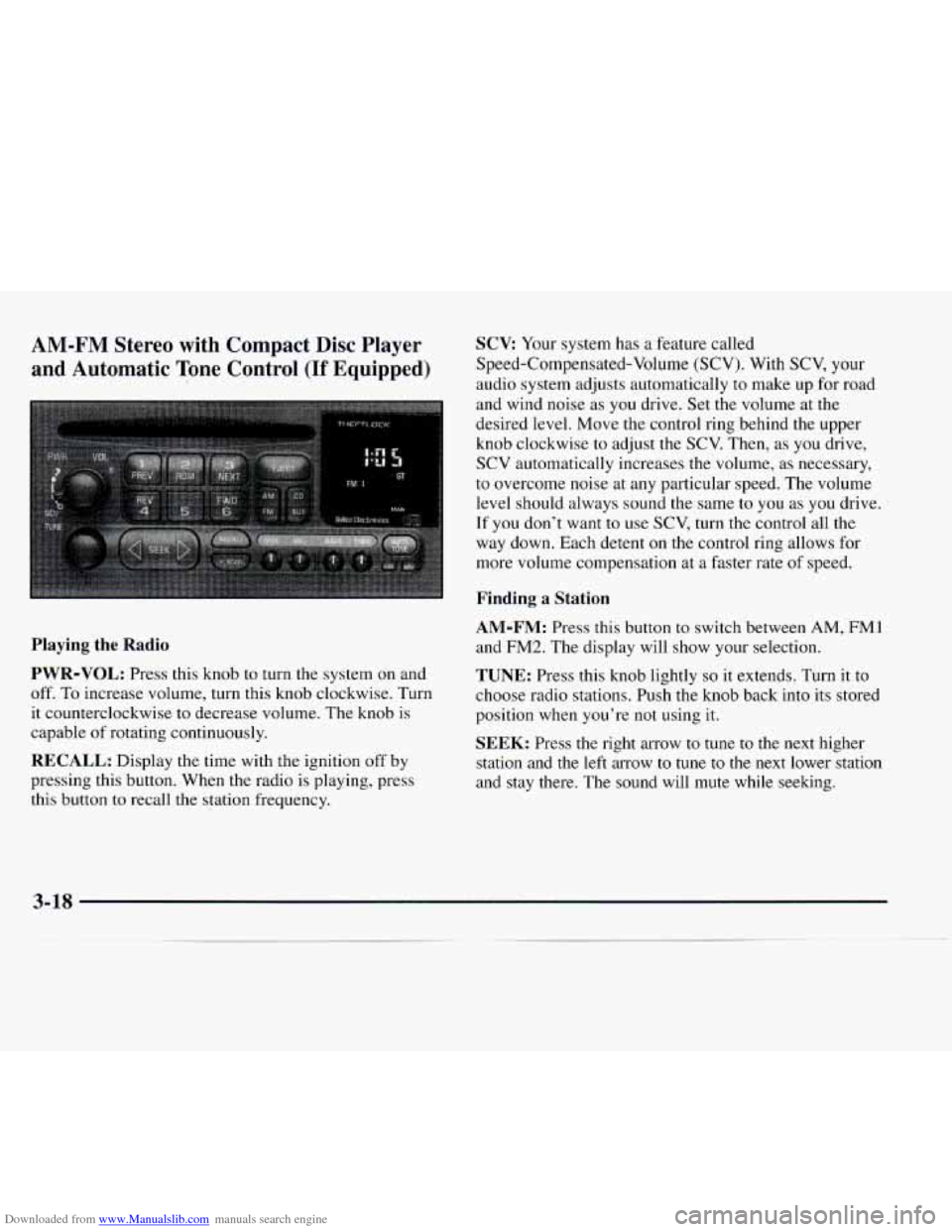
Downloaded from www.Manualslib.com manuals search engine AM-FM Stereo with Compact Disc Player and Automatic
Tone Control (If Equipped)
Playing the Radio
PWR-VOL: Press this knob to turn the system on and
off. To increase volume, turn this knob clockwise. Turn
it counterclockwise to decrease volume. The knob
is
capable of rotating continuously.
RECALL: Display the time with the ignition off by
pressing this button. When the radio is playing, press
this button to recall the station frequency.
SCV: Your system has a feature called
Speed-Compensated-Volume (SCV). With
SCV, your
audio system adjusts automatically to make up for road
and wind noise
as you drive. Set the volume at the
desired level. Move the control ring behind the upper
knob clockwise to adjust the SCV. Then,
as you drive,
SCV automatically increases the volume,
as necessary,
to overcome noise at any particular speed. The volume
level should always sound the same to you
as you drive.
If you don't want to use SCV, turn the control all the
way down. Each detent on the control ring allows for
more volume compensation at a faster rate of speed.
Finding a Station
AM-FM:
Press this button to switch between AM, FM1
and FM2. The display will show your selection.
TUNE: Press this knob lightly so it extends. Turn it to
choose radio stations. Push the knob back into its stored
position when you're not using it.
SEEK: Press the right arrow to tune to the next higher
station and the left arrow
to tune to the next lower station
and stay there. The sound will mute while seeking.
3-18