1997 CHEVROLET EXPRESS engine overheat
[x] Cancel search: engine overheatPage 257 of 386
Downloaded from www.Manualslib.com manuals search engine NOTICE:
If you use an improper coolant mix, your engine
could overheat and be badly damaged. The
repair cost wouldn’t be covered by your
warranty.
Too much water in the mix can freeze
and crack the engine, radiator, heater core and
other parts.
If you have to add coolant more than four times a year,
have your dealer check your cooling
system.
1 NOTICE:
If you use the proper coolant, you don’t have to
add extra inhibitors or additives which claim to
improve the system. These can be harmful.
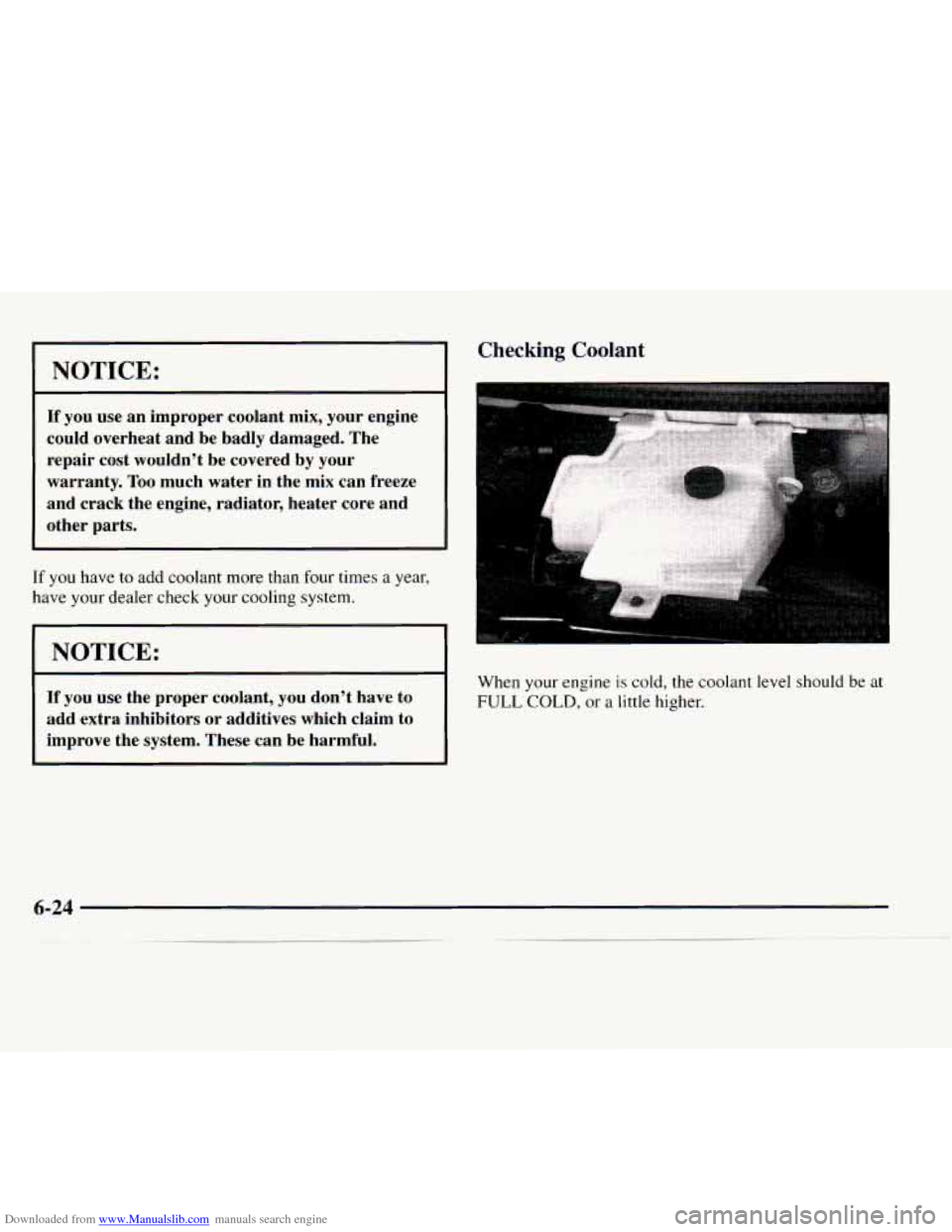
Checking Coolant
When your engine is cold, the coolant level should be at
FULL COLD, or a little higher.
Page 258 of 386
Downloaded from www.Manualslib.com manuals search engine Adding Coolant
If you need more coolant, add the proper DEX-COOL@
coolant mixture at the coolant recovery tank.
I A CAUTION:
I
Thrning the radiator pressure cap when the
engine and radiator are hot can allow steam and
scalding liquids to blow out and burn
you badly.
With the coolant recovery tank, you
will almost
never have to add coolant at the radiator.
Never turn the radiator pressure cap
-- even a
little
-- when the engine and radiator are hot.
Add coolant mixture at the recovery tank, but be careful
not to spill it.
' A CAUTION:
I --
You can be burned if you spill coolant on hot
engine parts. Coolant contains ethylene glycol,
and it will burn if the engine parts are hot
enough. Don't spill coolant on a hot engine.
Radiator Pressure Cap
The radiator pressure cap must be tightly installed with
the arrows
on the cap lined up with the overflow tube on
the radiator filler neck.
I NOTICE:
Your radiator cap is a pressure-type cap and
must be tightly installed to prevent coolant loss
and possible engine damage from overheating.
Be sure the arrows
on the cap line up with the
overflow tube on the radiator filler neck.
Page 274 of 386

Downloaded from www.Manualslib.com manuals search engine 2.
3.
4.
5.
6.
7.
Press down on the blade assembly pivot locking tab.
Pull down on the blade assembly to release it from
the wiper arm hook.
Remove the insert from the blade assembly. The
insert has two notches at one end that are locked by
bottom claws of the blade assembly. At the notched
end, pull the insert from the blade assembly.
To install the new wiper insert, slide the notched end
last, into the end with two blade claws. Slide the
insert all the way through the blade claws at the
opposite end.
Be sure that the notches are locked by the bottom
claws. Make sure that all other claws are properly
locked on both sides of the insert slot.
Put the blade assembly pivot
in the wiper arm hook. Pull
up until the pivot locking tab locks
in the hook slot.
Carefully lower the wiper
arm and blade assembly
into the windshield.
Tires
Your new vehicle comes with high-quality tires made by
a leading tire manufacturer.
If you ever have questions
about your tire warranty and where to obtain service, see
your
GM Warranty booklet for details.
a
0
a
a
Poorly maintained and improperly used tires
are dangerous.
Overloading your tires can cause
overheating
as a result of too much friction.
You could have an air-out and a serious
accident. See “Loading Your Vehicle” in
the Index.
Underinflated tires pose the same danger as
overloaded tires. The resulting accident
could cause serious injury. Check all tires
frequently to maintain the recommended
pressure. Tire pressure should be checked
when your tires are cold.
Overinflated tires are more likely to be
cut, punctured or broken by
a sudden
impact
-- such as when you hit a pothole.
Keep tires at the recommended pressure.
Worn, old tires can cause accidents.
If your
tread is badly worn, or if your tires have
been damaged, replace them.
6-41
Page 278 of 386

Downloaded from www.Manualslib.com manuals search engine Dual Tire Operation
When the vehicle is new, or whenever a wheel, wheel
bolt or wheel nut is replaced, check the wheel
nut torque
after
100, 1,000 and 6,000 miles ( 160, 1 600 and
10 000 km) of driving. For proper torque, see “Wheel
Nut Torque’’ in
the Index.
The outer tire on a dual wheel setup generally wears
faster than the inner tire. Your tires will wear more
evenly and last longer if you rotate the tires periodically.
If you’re going to be doing a lot
of driving on
high-crown roads, you can reduce tire wear by adding
5 psi (35 kPa) to the tire pressure in the outer tires. Be
sure
to return to the recommended pressures when no
longer driving under those conditions. See “Changing a
Flat Tire” in the Index for more information.
A CAUTION:
Buying New Tires
To find out what kind and size of tires you need, look at
the Certificationrnire label.
The tires installed
on your vehicle when it was new had
a Tire Performance Criteria Specification (TPC Spec)
number
on each tire’s sidewall. When you get new tires,
get ones with that same TPC Spec number. That way
your vehicle will continue
to have tires that are designed
to give proper endurance, handling, speed rating,
traction, ride and other things during normal service on
your vehicle. If your tires have an all-season tread
design, the TPC number will be followed by
an “MS”
(for mud and snow).
If you ever replace your tires with those not having a
TPC Spec number, make sure they are the same size,
load range, speed rating and construction type (bias,
bias-belted or radial) as your original tires.
If you operate your vehicle with a tire that is
badly underinflated, the tire can overheat. An
overheated tire can lose air suddenly or catch
fire.
You or others could be injured. Be sure all
tires (including the spare) are properly inflated.
Page 292 of 386

Downloaded from www.Manualslib.com manuals search engine Electrical System
Add-on Electrical Equipment
I NOTICE:
Don’t add anything electrical to your vehicle
unless you check with your dealer first. Some
electrical equipment can damage your vehicle
and the damage wouldn’t be covered
by your
warranty. Some add-on electrical equipment
can keep other components from working as
they should.
Your vehicle has an air bag system. Before attempting to
add anything electrical to your vehicle, see “Servicing
Your Air Bag-Equipped Vehicle”
in the Index.
Headlamp Wiring
The headlamp wiring is protected by a circuit breaker in
the lamp switch. An electrical overload will cause the
lamps to flicker on and
off, or in some cases to remain
off. If this happens, have your headlamp wiring checked
right away.
Windshield Wiper Fuses
The windshield wiper motor is protected by a circuit
breaker and a fuse.
If the motor overheats due to heavy
snow, etc., the wiper will stop until the motor cools.
Although the circuit is protected from electrical
overload, overload due
to heavy snow, etc., may cause
wiper linkage damage. Always clear ice and heavy snow
from the the windshield before using the windshield
wipers.
If the overload is caused by some electrical
problem and
not snow, etc., be sure to get it fixed.
Page 377 of 386
Downloaded from www.Manualslib.com manuals search engine Electrical Equipment. Adding
Electrical System
............
Electronic Road Speed Governor
Engine
....................
Coolant ..................
Coolant Level Check .......
Coolant Temperature Gage . .
Exhaust ..................
Fuse Block ...............
Identification .............
Oil Level Check ...........
Overheating ..............
Running While Parked ......
Starting Your .............
Engine Oil .................
Adding ..................
Additives ................
Checking ................
Pressure Gage .............
Used ....................
Cooling System ...........
................... 6-59
................... 6-59
(Gasoline Engines)
... 2-60
.................... 6-9
................... 6-22
................... 7-45
................... 2-59
................... 6-65
................... 2-28
................... 6-63
.............. 6.58. 6..65
................... 7-45
................... 5-12
................... 2-28
................... 2-17
................... 6-12
................... 6-12
................... 6-16
................... 6-13
................... 2-57
................... 6-16
Whentochange
.............................. 6-16
Exhaust. Engine
................................ 2-28
Fabric Cleaning
............................... 6-50
Fan Control. Climate Control System
................ 3-2
Filling Your Tank
................................ 6-5
Filter. Air
..................................... 6-17
Finish Care
.................................... 6-54 Finish Damage
................................. 6-56
First Gear. Automatic Transmission
................ 2-22
Flashers. Hazard Warning
......................... 5-2
Flat Tire. Changing
............................. 5-23
Fluids and Lubricants
............................ 7-51
Foreign Countries. Fuel
........................... 6-5
French Language Manual
11
Front ParkingKurn Signal Lamp Bulb Replacement .... 6-35
Front Storage Area .............................. 2-44
FrontTowing
.................................. 5-10
Fuel .......................................... 6-3
Canada
...................................... 6-5
FillingYourTank
.............................. 6-5
Gage
....................................... 2-58
In Foreign Countries
........................... 6-5
Tankcapacity
............................... 6-66
Fuses
and Circuit Breakers ....................... 6-60
.. ...........................
Gages
Engine Coolant Temperature
.................... 2-59
Engine Oil Pressure
........................... 2-57
Fuel
....................................... 2-58
Speedometer
................................. 2-49
Voltmeter
................................... 2-60
Gear Positions. Automatic Transmission
............. 2-20
Gross Axle Weight Rating ........................ 4-28
Gross Vehicle Weight Rating
...................... 4-27
Guide en Frangais
11
GVWR ....................................... 4-27
GAWR
....................................... 4-28
.. .................................
9-4
.
Page 379 of 386

Downloaded from www.Manualslib.com manuals search engine Lights Air Bag Readiness
....................... 1.27. 2.5 1
Anti-Lock Brake System Warning ............ 2.53. 4.7
Brake System Warning
......................... 2-52
Daytime Running Lamps Indicator
............... 2-54
Interior
..................................... 2-40
Safety Belt Reminder
..................... 1 . I 1. 2.50
Service Engine Soon
.......................... 2-54
Loading Your Vehicle
........................... 4-27
Locks
......................................... 2-4
Door
........................................ 2-4
Ignition Transmission Lock Check
............... 7-47
PowerDoor
.................................. 2-5
Rear Door Security
............................. 2-5
Sliding Door Child Security
...................... 2-5
LossofControl
................................ 4-13
Lubricants and Fluids ............................ 7-5 1
Lubrication Service. Body ........................ 7-46
Maintenance. Normal Replacement
Parts ........... 6-67
Maintenance Record
............................ 7-53
Maintenance Schedule
............................ 7- 1
Long Tripmighway Definition ................... 7-6
Long Tripmighway Intervals
..................... 7-7
Owner Checks and Services
..................... 7-45
Periodic Maintenance Inspections
................ 7-49
Recommended Fluids and Lubricants
............. 7-5 1
Scheduled Maintenance Services .................. 7-4 Short
Trip/City Definition
....................... 7-5
Short Trip/City Intervals
........................ 7-5
Maintenance. Underbody
......................... 6-56
Maintenance When Trailer Towing
................. 4-37
Malfunction Indicator Lamp
...................... 2-54
ManualFrontSeat
............................... 1-2
Mirrors
....................................... 2-43
Convex Outside
.............................. 2-44
Inside Daymight Rearview
..................... 2-43
Power Remote Control
......................... 2-43
Visor Vanity
................................. 2-46
MMT
......................................... 6-4
Model Reference
................................. vi
Mountain Roads
................................ 4-22
Multifunction Lever
............................. 2-33
Neutral. Automatic Transmission ................. 2-21
New Vehicle Break-In ........................... 2-16
NightVision
................................... 4-15
Noise Control System
........................... 6-11
Odometer
.................................... 2-49
Odometer. Trip
................................. 2-49
Overheating Engine
............................. 5-12
Off-Road Recovery
............................. 4-11
Oil. Engine
.................................... 6-12
Owner Checks and Services
....................... 7-45
Owner Publications. Ordering
..................... 8-11