Page 217 of 386
Downloaded from www.Manualslib.com manuals search engine Removing the Spare Tire and Tools
I
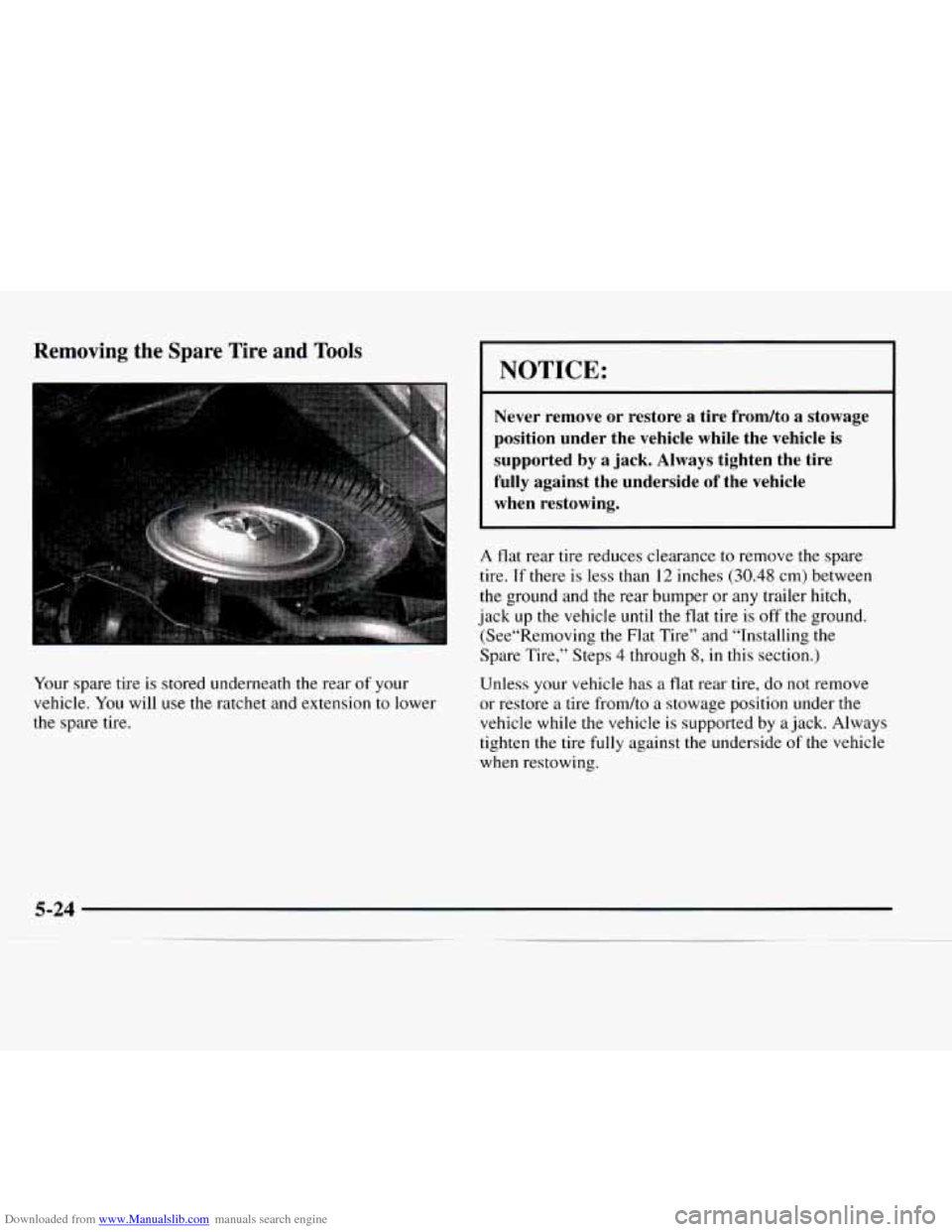
Your spare tire is stored underneath the rear of your
vehicle.
You will use the ratchet and extension to lower
the spare tire.
I
NOTICE:
Never remove or restore a tire frondto a stowage
position under the vehicle while the vehicle is
supported by a jack. Always tighten the tire
fully against the underside
of the vehicle
when restowing.
A flat rear tire reduces clearance to remove the spare
tire.
If there is less than 12 inches (30.48 cm) between
the ground and the rear bumper or any trailer hitch,
jack up the vehicle until the flat tire is
off the ground.
(See“Removing the Flat Tire” and “Installing the
Spare Tire,” Steps
4 through 8, in this section.)
Unless your vehicle has a flat rear tire, do not remove
or restore a tire fromho a stowage position under the
vehicle while the vehicle is supported by a jack. Always
tighten the tire
fully against the underside of the vehicle
when restowing.
Page 218 of 386
Downloaded from www.Manualslib.com manuals search engine If you have a vehicle which was completed from a cab
and chassis, refer to the information from
the body
supplierhstaller.
The spare
tire is a full size tire, like the other tires on
your vehicle.
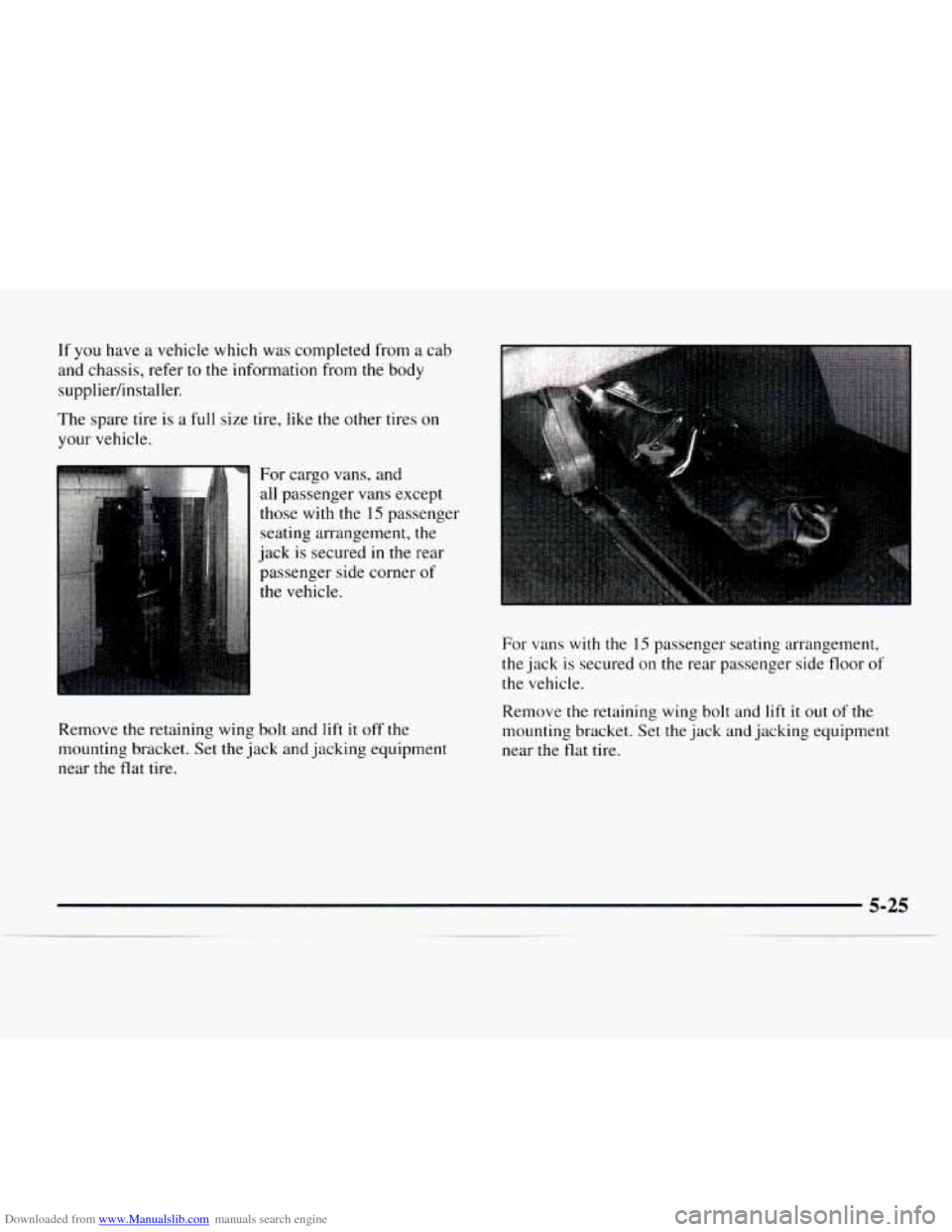
For cargo vans, and
all passenger vans except
those with the
15 passenger
seating arrangement, the
jack is secured in the rear
passenger side corner
of
the vehicle.
Remove the retaining wing bolt and
lift it off the
mounting bracket. Set the jack and jacking equipment
near the flat tire. For vans
with the 15 passenger
seating arrangement,
the jack is secured
on the rear passenger side floor of
the vehicle.
Remove
the retaining wing bolt and lift it out of the
mounting bracket. Set the jack and jacking equipment
near the flat tire.
Page 219 of 386
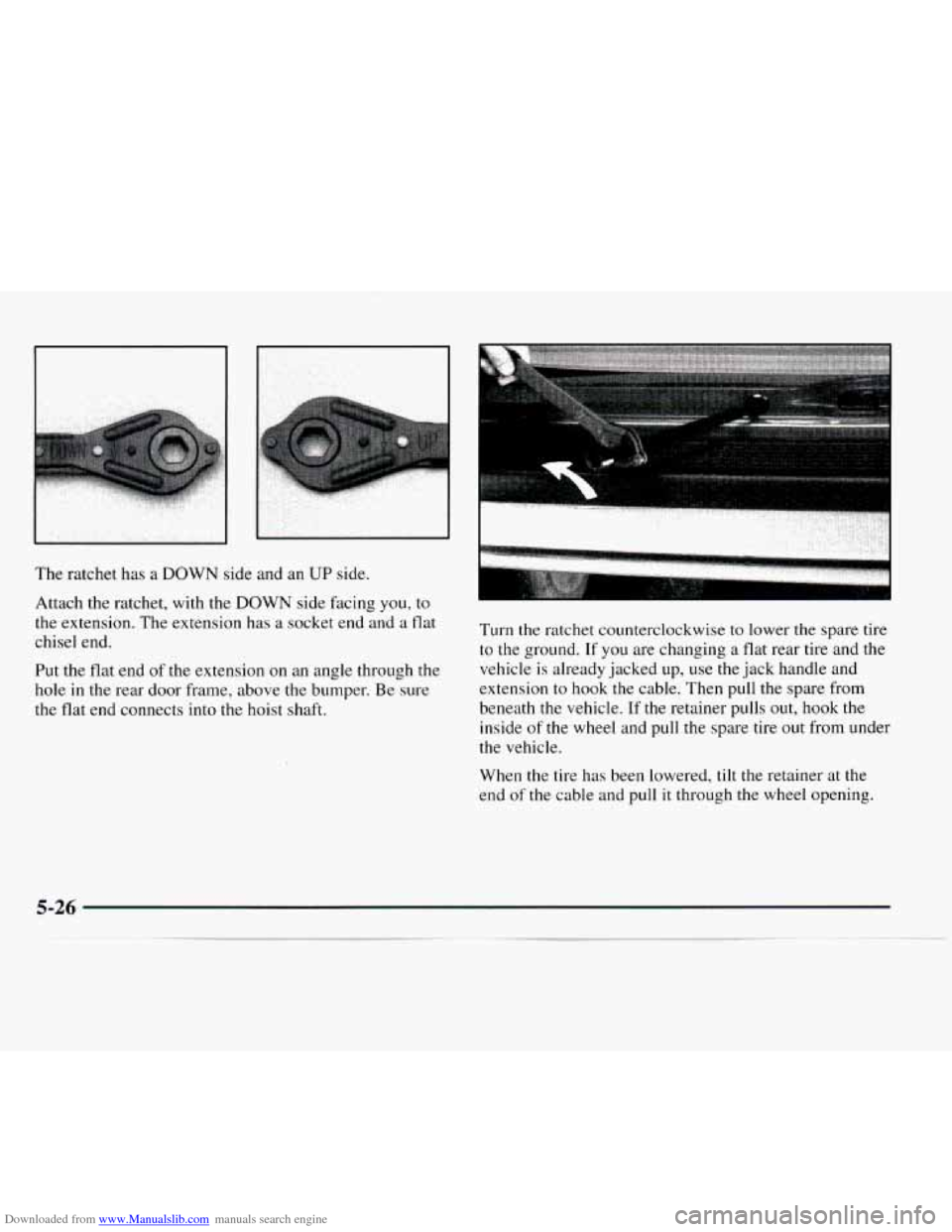
Downloaded from www.Manualslib.com manuals search engine The ratchet has a DOWN side and an UP side.
Attach the ratchet, with the
DOWN side facing you, to
the extension. The extension has a socket end and
a flat
chisel end.
Put the flat end
of the extension on an angle through the
hole in the rear door frame, above the bumper. Be sure
the flat end connects into the hoist shaft. Turn the ratchet counterclockwise
to lower the spare tire
to the ground. If you are changing
a flat rear tire and the
vehicle
is already jacked up, use the jack handle and
extension to hook the cable. Then pull the spare from
beneath the vehicle.
If the retainer pulls out, hook the
inside
of the wheel and pull the spare tire out from under
the vehicle.
When the tire has been lowered, tilt the retainer at the
end
of the cable and pull it through the wheel opening.
Page 223 of 386
Downloaded from www.Manualslib.com manuals search engine Removing the Flat Tire and Installing the
Spare Tire
1. With the DOWN side facing you, use the ratchet and
socket
to loosen all the wheel nuts. Don’t remove
them
yet.
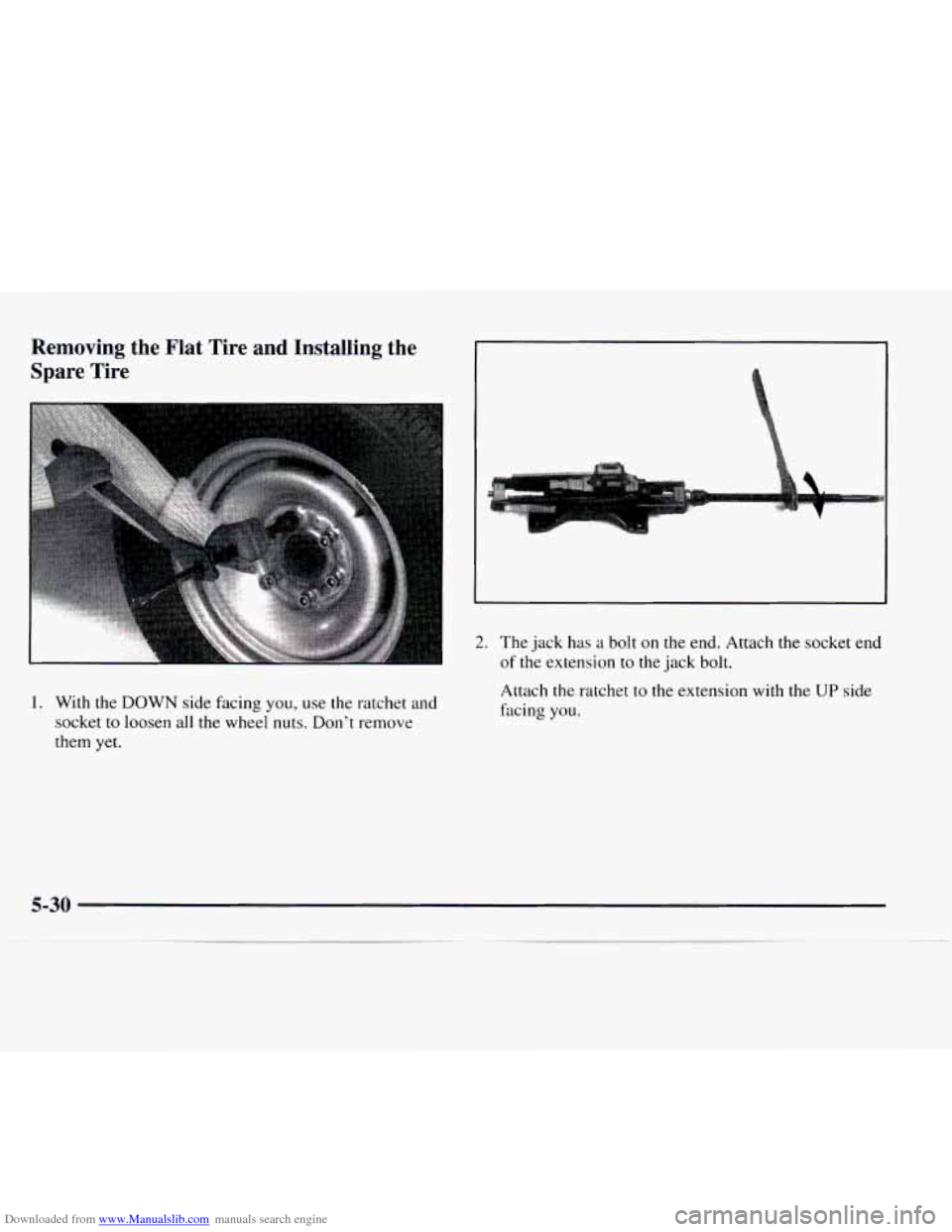
2. The jack has a bolt on the end. Attach the socket end
of the extension to thejack bolt.
Attach
the ratchet to the extension with the UP side
facing
you.
Page 225 of 386
Downloaded from www.Manualslib.com manuals search engine A CAUTION:
r
Raising your vehicle with the jack improperly
positioned can damage the vehicle and even make the vehicle fall.
To avoid personal injury and
vehicle damage, be sure
to fit the jack lift head into
the proper location before raising your vehicle.
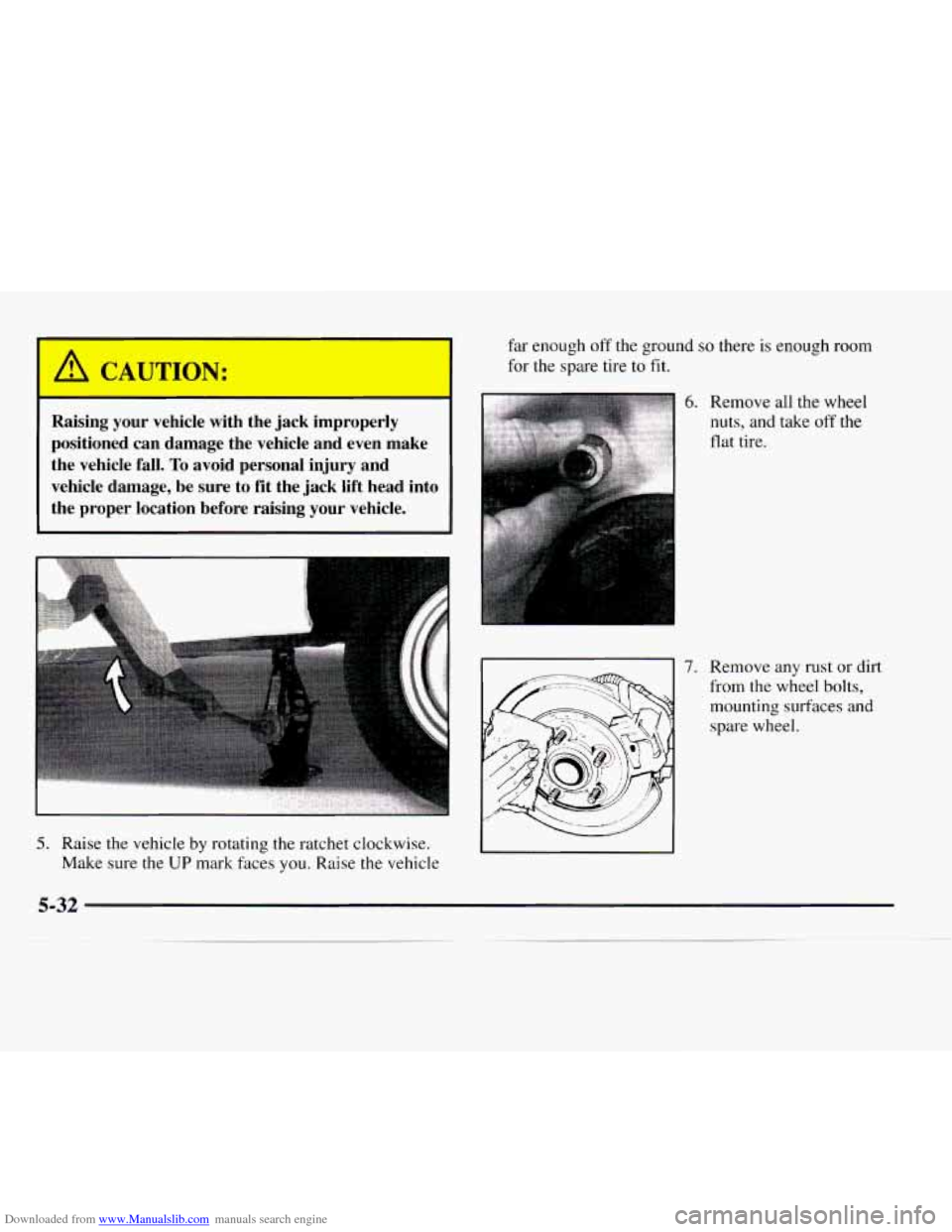
5. Raise the vehicle by rotating the ratchet clockwise.
Make
sure the UP mark faces you. Raise the vehicle far
enough off the ground
so there is enough room
for the spare tire to fit.
6. Remove all the wheel
nuts, and take
off the
flat tire.
7. Remove any rust or dirt
from the wheel
bolts,
mounting surfaces and
spare wheel.
5-32
Page 228 of 386
Downloaded from www.Manualslib.com manuals search engine Storing a Flat or Spare Tire and Tools
-m
Storing a jack, a tire or other equipment in the
passenger compartment
of the vehicle could
cause injury. In
a sudden stop or collision, loose
equipment could strike someone. Store all these
in the proper place.
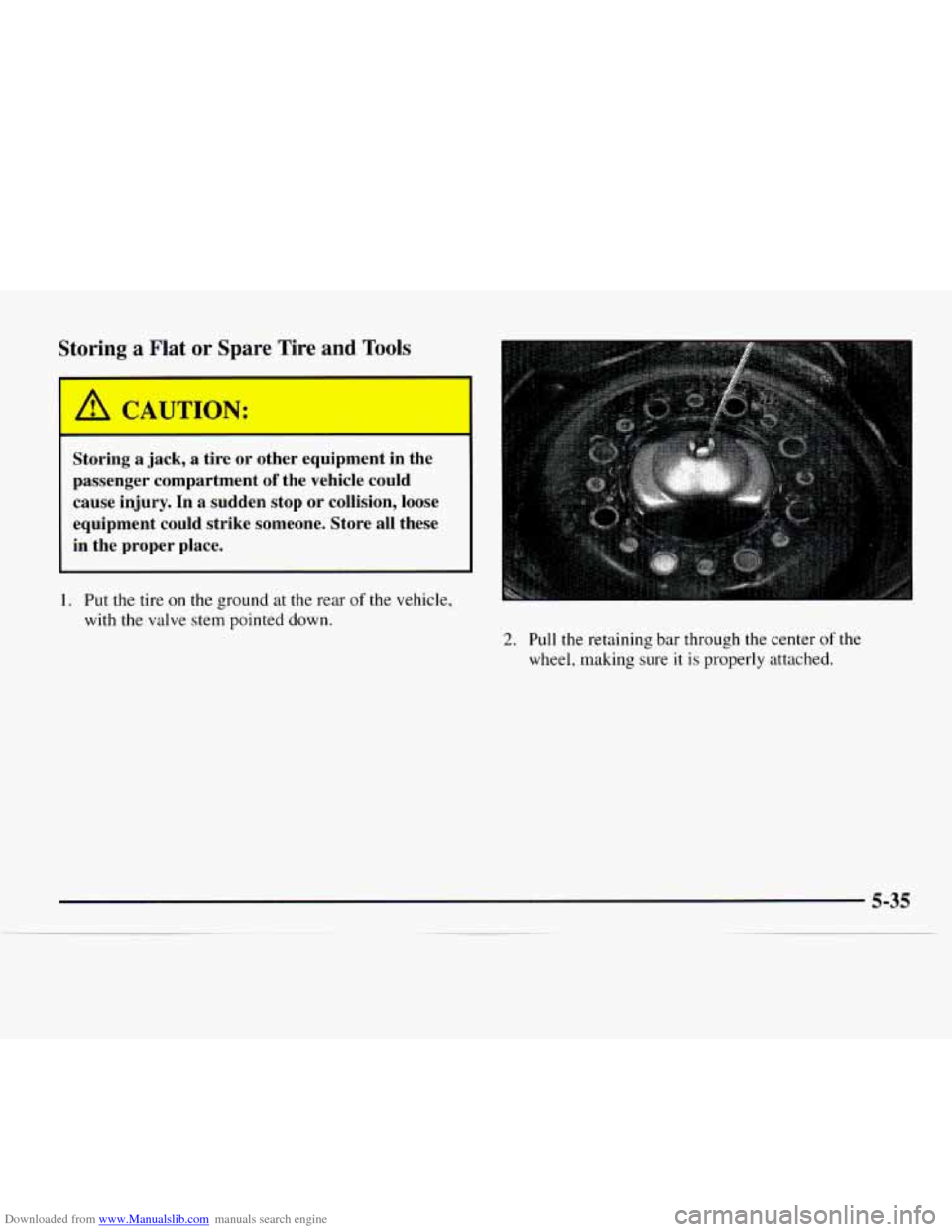
1. Put the tire on the ground at the rear of the vehicle,
with the valve stem pointed down.
2. Pull the retaining bar through the center of the
wheel, making sure
it is properly attached.
Page 230 of 386
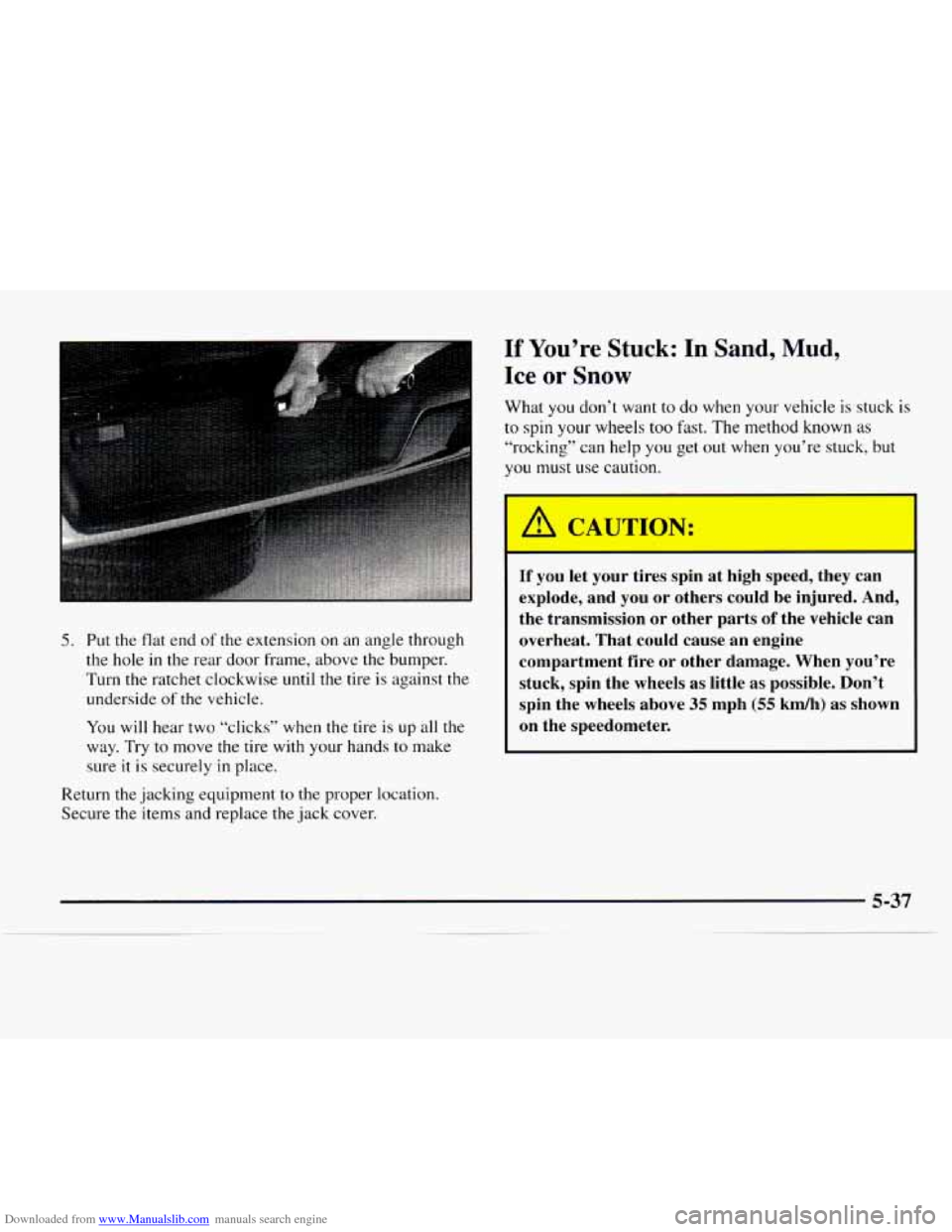
Downloaded from www.Manualslib.com manuals search engine 5. Put the flat end of the extension on an angle through
the hole in the rear door frame, above the bumper.
Turn the ratchet clockwise until the tire is against the
underside
of the vehicle.
You will hear two “clicks” when the tire is up all the
way. Try to move the tire with your hands to make
sure
it is securely in place.
Return the jacking equipment to the proper location.
Secure the items and replace the jack cover.
If You’re Stuck: In Sand, Mud,
Ice or Snow
What you don’t want to do when your vehicle is stuck is
to spin your wheels too fast. The method known as
“rocking” can help you get out when you’re stuck, but
you
must use caution.
I
A CAUTION:
If you let your tires spin at high speed, they can
explode, and you or others could be injured. And,
the transmission
or other parts of the vehicle can
overheat. That could cause an engine
compartment fire or other damage. When you’re
stuck, spin the wheels
as little as possible. Don’t
spin the wheels above
35 mph (55 kmk) as shown
on the speedometer.
Page 274 of 386

Downloaded from www.Manualslib.com manuals search engine 2.
3.
4.
5.
6.
7.
Press down on the blade assembly pivot locking tab.
Pull down on the blade assembly to release it from
the wiper arm hook.
Remove the insert from the blade assembly. The
insert has two notches at one end that are locked by
bottom claws of the blade assembly. At the notched
end, pull the insert from the blade assembly.
To install the new wiper insert, slide the notched end
last, into the end with two blade claws. Slide the
insert all the way through the blade claws at the
opposite end.
Be sure that the notches are locked by the bottom
claws. Make sure that all other claws are properly
locked on both sides of the insert slot.
Put the blade assembly pivot
in the wiper arm hook. Pull
up until the pivot locking tab locks
in the hook slot.
Carefully lower the wiper
arm and blade assembly
into the windshield.
Tires
Your new vehicle comes with high-quality tires made by
a leading tire manufacturer.
If you ever have questions
about your tire warranty and where to obtain service, see
your
GM Warranty booklet for details.
a
0
a
a
Poorly maintained and improperly used tires
are dangerous.
Overloading your tires can cause
overheating
as a result of too much friction.
You could have an air-out and a serious
accident. See “Loading Your Vehicle” in
the Index.
Underinflated tires pose the same danger as
overloaded tires. The resulting accident
could cause serious injury. Check all tires
frequently to maintain the recommended
pressure. Tire pressure should be checked
when your tires are cold.
Overinflated tires are more likely to be
cut, punctured or broken by
a sudden
impact
-- such as when you hit a pothole.
Keep tires at the recommended pressure.
Worn, old tires can cause accidents.
If your
tread is badly worn, or if your tires have
been damaged, replace them.
6-41