Page 52 of 386
Downloaded from www.Manualslib.com manuals search engine ."
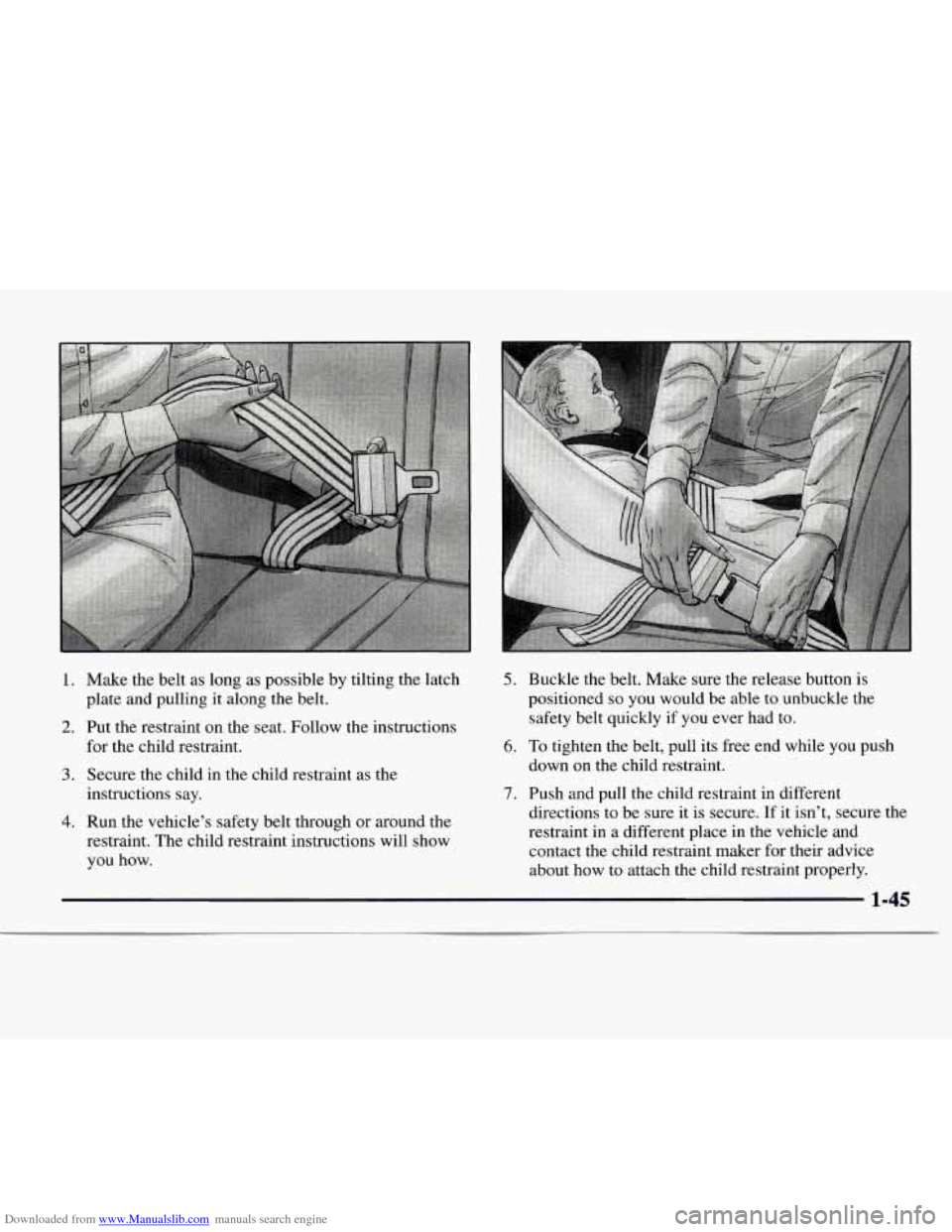
1.
2.
3.
4.
Make the belt as long as possible by tilting the latch
plate and pulling it along the belt.
Put the restraint on the seat. Follow the instructions
for the child restraint.
Secure the child in the child restraint as the
instructions say.
Run the vehicle's safety belt through
or around the
restraint. The child restraint instructions will show
you how.
5. Buckle the belt. Make sure the release button is
positioned
so you would be able to unbuckle the
safety belt quickly
if you ever had to.
6. To tighten the belt, pull its free end while you push
down on the child restraint.
7. Push and pull the child restraint in different
directions to be sure it is secure.
If it isn't, secure the
restraint in a different place in the vehicle and
contact the child restraint maker for their advice
about how to attach the child restraint properly.
1-45
Page 53 of 386
Downloaded from www.Manualslib.com manuals search engine To remove the child restraint, just unbuckle the vehicle’s
safety belt. It will be ready to work for an adult or larger
child passenger.
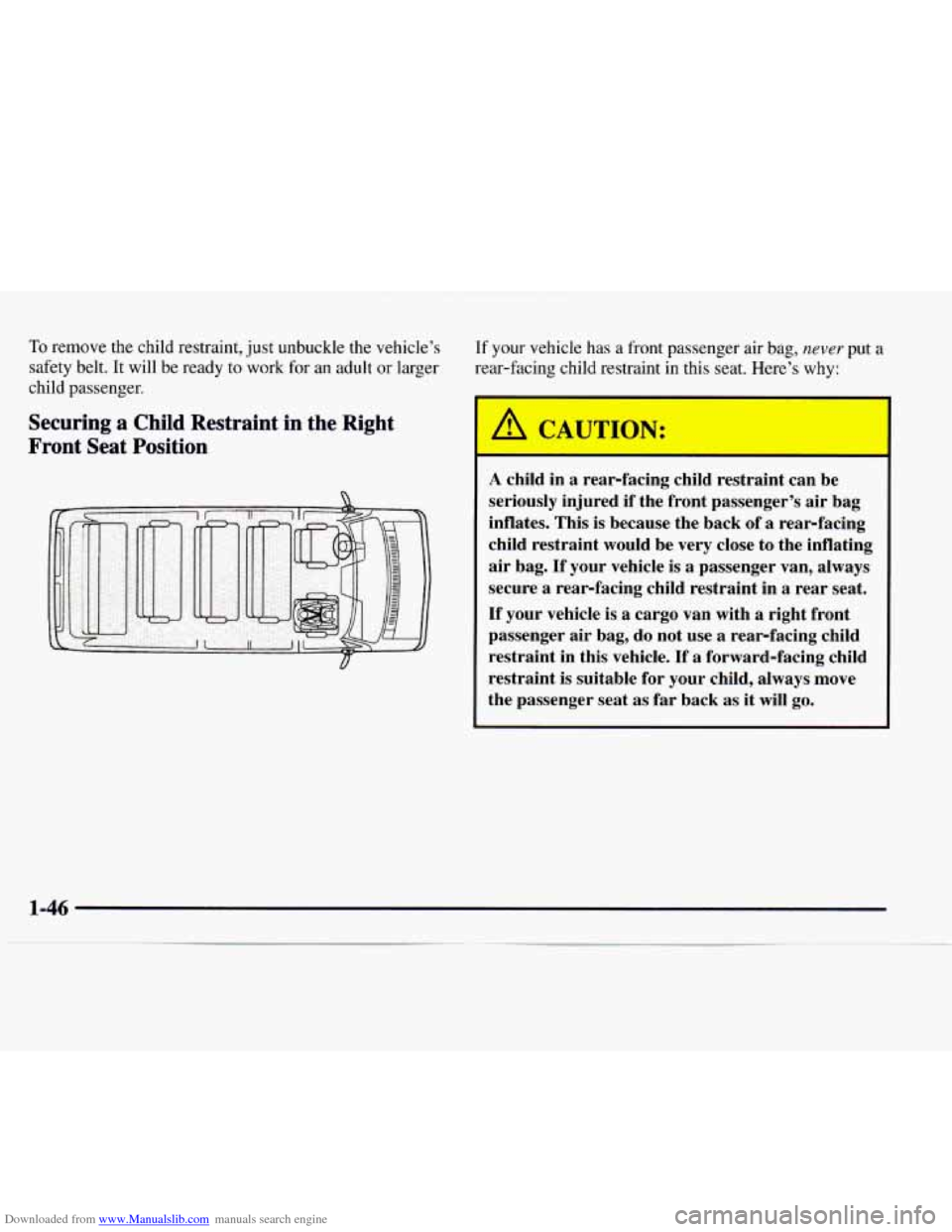
Securing a Child Restraint in the Right
Front Seat Position
If your vehicle has a front passenger air bag, never put a
rear-facing child restraint in this seat. Here’s why:
I A CAUTdN:
A child in a rear-facing child restraint can be
seriously injured if the front passenger’s air bag
inflates. This is because the back of
a rear-facing
child restraint would be very close to the inflating
air bag.
If your vehicle is a passenger van, always
secure
a rear-facing child restraint in a rear seat.
If your vehicle is
a cargo van with a right front
passenger air bag, do not use
a rear-facing child
restraint in this vehicle. If
a forward-facing child
restraint is suitable for your child, always move
the passenger seat as far back as it
will go.
Page 54 of 386
Downloaded from www.Manualslib.com manuals search engine You’ll be using the lap-shoulder belt. See the earlier part
about the top strap if the child restraint has one.
1.
2.
3.
4.
If your vehicle has a front passenger air bag, always
move the seat as far back as it will go before
securing a forward-facing child restraint. (See
“Seats” in the Index.)
Put the restraint on the seat. Follow the instructions
for the child restraint.
Secure the child in the child restraint as the
instructions say.
Pick up the latch plate, and run the lap and shoulder
portions of the vehicle’s safety belt through or
around the restraint. The child restraint instructions
will show you how.
If the shoulder belt goes in front of the child’s face or
neck, put it behind the child restraint.
.. 1
5. Buckle the belt. Make sure the release button is
positioned
so you would be able to unbuckle the
safety belt quickly if you ever had to.
1-47
Page 55 of 386
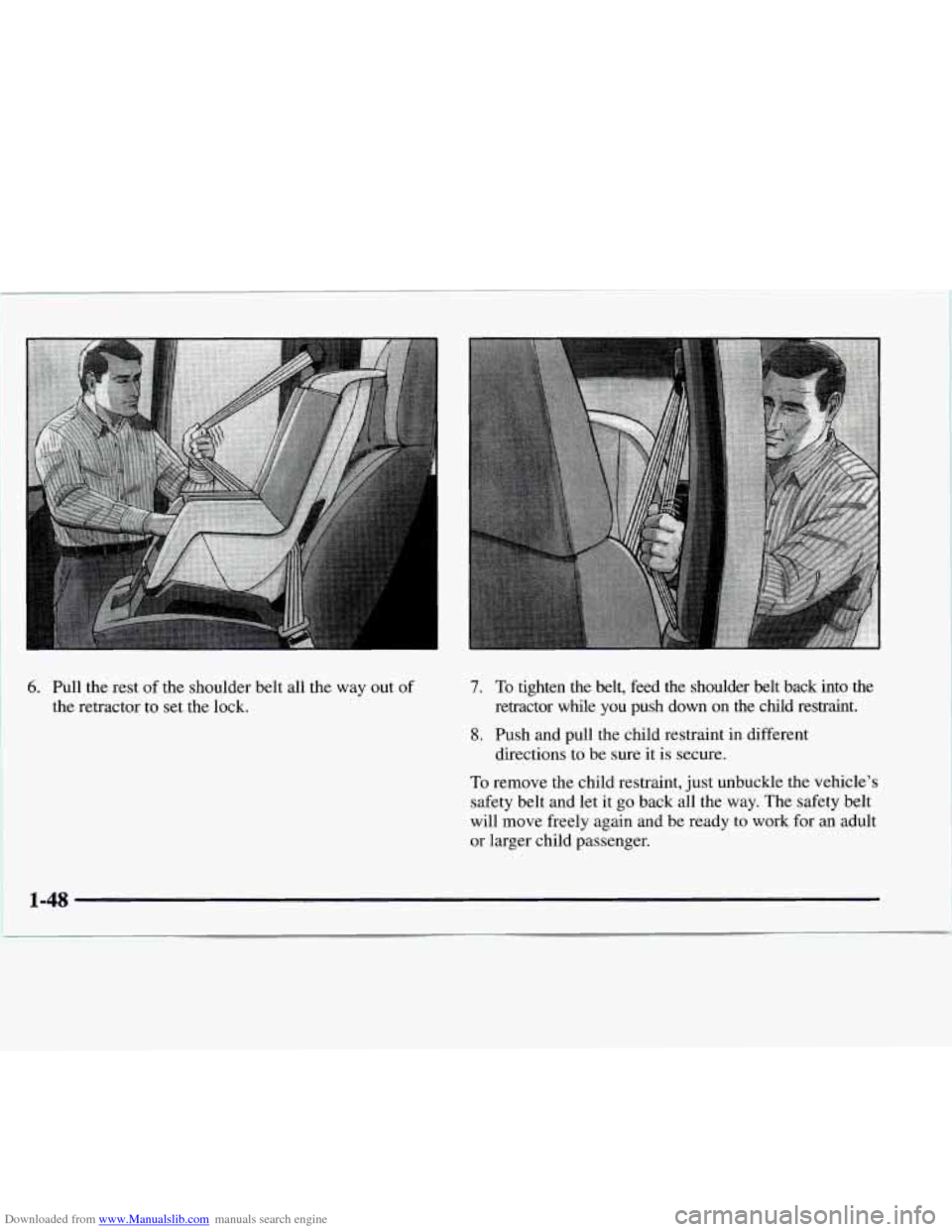
Downloaded from www.Manualslib.com manuals search engine 6. Pull the rest of the shoulder belt all the way out of
the retractor to set the lock.
7. To tighten the belt, feed the shoulder belt back into the
retractor while you push down
on the child restraint.
8. Push and pull the child restraint in different
directions to be sure
it is secure.
To remove the child restraint, just unbuckle the vehicle's
safety belt and let it
go back all the way. The safety belt
will move freely again and be ready to work for an adult
or larger child passenger.
1-48
I
Page 56 of 386
Downloaded from www.Manualslib.com manuals search engine Larger Children
Children who have outgrown child restraints should
wear the vehicle’s safety belts.
If you have the choice, a child should sit next to a
window
so the child can wear a lap-shoulder belt and
get the additional restraint
a shoulder belt can provide.
Accident statistics show that children
are safer if they
are restrained in the rear seat. But they need to use the
safety belts properly.
0 Children who aren’t buckled up can be thrown out in
a crash.
0 Children who aren’t buckled up can strike other
people who are.
1-49
Page 57 of 386
Downloaded from www.Manualslib.com manuals search engine Never do this.
Here two children are wearing the same belt. The
belt can’t properly spread the impact forces. In
a
crash, the two children can be crushed together
and seriously injured.
A belt must be used by
only one person
at a time.
Q=
A:
What if a child is wearing a lap-shoulder belt,
but the child is
so small that the shoulder belt is
very close to the child’s face or neck?
Move the child toward the center of the vehicle, but
be sure that the shoulder belt still is on the child’s
shoulder,
so that in a crash the child’s upper body
would have the restraint that belts provide.
If the
child is
so small that the shoulder belt is still very
close to the child’s face or neck, you might want to
place the child in a seat that has a lap belt, if your
vehicle has one.
Page 181 of 386
Downloaded from www.Manualslib.com manuals search engine The Certificatioflire label also tells you the maximum
weights for the front and rear axles, called Gross Axle
Weight Rating (GAWR).
To find out the actual loads on
your front and rear axles, you need to go
to a weigh
station and weigh your vehicle. Your dealer can help
you with this. Be sure to spread out your load equally
on
both sides of the centerline.
Never exceed the GVWR for your vehicle, or the
GAWR for either the front or rear axle.
And, if you do have a heavy load, you should spread
it out.
Do not load your vehicle any heavier than the
GVWR, or either the maximum front or rear
GAWR.
If you do, parts on your vehicle can
break, or it can change the
way your vehicle
handles. These could cause you to lose control.
Also, overloading can shorten the life of
your vehicle.
-
C *.UTION:
Things you put inside your vehicle can strike
and injure people in
a sudden stop or turn, or
in
a crash.
0 Put things in the cargo area of your vehicle.
Never stack heavier things, like suitcases,
Try to spread the weight evenly.
inside the vehicle
so that some of them are
above the tops of the seats.
0 Don’t leave an unsecured child restraint in
your vehicle.
When you carry something inside the
vehicle, secure
it whenever you can.
Don’t leave a seat folded down unless you
need to.
4-28
Page 375 of 386

Downloaded from www.Manualslib.com manuals search engine Brake Adjustment
.................................. 6-31
Fluid
....................................... 6-28
Master Cylinder
.............................. 6-28
Parking
..................................... 2-23
Pedal Travel
................................. 6-3 1
Replacing System Parts ........................ 6-3 1
System Warning Light
......................... 2-52
Trailer
...................................... 4-34
Transmission Shift Interlock Check
............... 7-47
Wear
....................................... 6-30
Brakes. Anti-Lock
............................... 4-7
Braking in Emergencies
........................... 4-9
Braking
........................................ 4-6
Break-In. New Vehicle
.......................... 2-16
Brightness Control
.............................. 2-38
Bulb Replacement
.............................. 6-32
BTSICheck
................................... 7-47
Canadian Roadside Assistance
.................... 8-7
Carbon Monoxide .................... 2-28.4-26. 4-34
Cassette Deck Service
........................... 7-45
Cassette Tape Player
....................... 3- 11. 3- 13
Cassette Tape Player Care
........................ 3-27
Center High-Mounted Stoplamp
................... 2-61
Center Rear Passenger Position
.................... 1-35
Certification Label
.............................. 4-27
CertificatiodTire Label
.......................... 4-27
Capacities
and Specifications
...................... 6-64
Center Passenger Position
........................ 1-35 Chains. Safety
................................. 4-34
Chains. Tire
................................... 6-49
Changing a Flat Tire
............................. 5-23
Checking Your Restraint Systems
.................. 1-52
Chemical Paint Spotting
.......................... 6-56
Child Restraints
................................ 1-40
Securing in a Rear Outside Seat Position ........... 1-42
Securing
in the Center Front Seat Position ......... 1-44
Securing
in the Center Rear Seat Position .......... 1-44
Securing in the Center Seat Position
.............. 1-44
Securing in the Passenger Seat Position ........... 1-46
Securing
in the Right Front Seat Position .......... 1-46
TopStrap
................................... 1-42
Where to Put
........................... 1-40. 1-41
Cigarette Lighter
............................... 2-45
Circuit Breakers and Fuses
....................... 6-60
Cleaner. Air
................................... 6-17
Cleaning Aluminum Wheels
..................... ....... 6-55
Fabric
...................................... 6-50
Glass
....................................... 6-53
InsideofYourGM
............................ 6-50
Instrumentpanel
............................. 6-52
Leather
..................................... 6-52
Outside
of Your GM ........................... 6-54
Special Problems
............................. 6-51
Stains
...................................... 6-50
Tires
....................................... 6-55
Vinyl
....................................... 6-52
Wheels
..................................... 6-55
Windshield and Wiper Blades
................... 6-53
9-2