1997 CHEVROLET EXPRESS Battery
[x] Cancel search: BatteryPage 121 of 386

Downloaded from www.Manualslib.com manuals search engine Voltmeter
u
VOLTS
When your engine is not
running, but the ignition is
on (in the RUN position),
this gage shows your
battery’s state of charge in
DC volts.
When the engine
is running, the gage shows the
condition of the charging system. Readings between the
low and high warnir,g zones indicate the normal
operating range. Readings
in the low warning zone may occur when a
large number
of electrical accessories are operating in
the vehicle and the engine is left at an idle for an
extended period. This condition is normal since the
charging system is not able to provide full power at
engine idle.
As engine speeds are increased, this
condition should correct itself
as higher engine speeds
allow the charging system to create maximum power.
You can only drive for a short time with the reading
in
either warning zone. If you must drive, turn off all
unnecessary accessories.
Readings in either warning zone indicate a possible
problem in the electrical system. Have the vehicle
serviced as soon as possible.
Electronic Road-Speed Governor
(Gasoline Engines) (Option)
This optional system automatically controls vehicle top
speed. The system controller receives a signal from the
vehicle speed sensor and reduces power when the
vehicle speed reaches
the maximum 65 mph (105 km/h)
governed speed.
Page 148 of 386
Downloaded from www.Manualslib.com manuals search engine NEXT (3): Press this button to advance to the next track
on the disc.
REV (4): Press and hold this button to quickly reverse
within a track.
As the CD reverses, elapsed time will
be displayed to help you find the correct passage.
FWD (6): Press and hold this button to quickly advance
within a track. As
the CD advances, elapsed time will be
displayed
to help you find the correct passage.
SEEK: Press the left arrow while playing a CD to go
back to the start of the current track. It will go back to
the current track if more than eight seconds have played.
Press the left arrow again
to go to previous tracks. Press
the right arrow to
go to the next higher track on the disc.
RANDOM: Press P.SCAN to enter the random play
mode. RANDOM will appear
on the display. While
in this mode, the tracks on the discs will be played
in
random order. If you press SEEK, PREV or NEXT
while in the random mode, the previous or next track
will be scanned randomly. Press P.SCAN again to
turn off RANDOM and return
to normal operation.
RECALL: Press this button to see what track is
currently playing. Press RECALL again within five
seconds to
see how long the track has been playing.
When
a new track starts to play, the track number will
also appear. Press RECALL a third time and the time
of day will be displayed.
TAPE AUX: With a disc loaded in the player and the
radio playing, press this button once to play the compact
disc.
To return to playing the radio, press AM-FM. If
both a cassette tape and CD are loaded, press TAPE
AUX to switch between the tape and compact disc.
EJECT Press this button on the remote player to eject a
compact disc. If you leave a compact disc in the player
while listening to the radio,
it may become warm.
Theft-Deterrent Feature
THEFTLOCK is designed to discourage theft of your
radio. It works by using a secret code to disable all radio
functions whenever battery power is removed.
The THEFTLOCK feature for the radio may be used or
ignored. If ignored, the system plays normally and the
radio is
not protected by the feature. If THEFTLOCK
is activated, your radio will not operate if stolen.
When THEFTLOCK is activated, the radio will display
LOC to indicate a locked condition anytime battery
power is removed. If your battery loses power for any
reason, you must unlock the radio with
the secret code
before it will operate.
Page 150 of 386
Downloaded from www.Manualslib.com manuals search engine If you enter the wrong code eight times, INOP will
appear
on the display. You will have to wait an hour
with the ignition
on before you can try again. When you
try again,
you will only have three chances to enter the
correct code before
INOP appears.
If
you lose or forget your code, contact your dealer.
Disabling the Theft-Deterrent Feature
Enter your secret code as follows; pause no more than
15 seconds between steps:
1. Turn the ignition to ACCESSORY or RUN.
2. Turn the radio off.
3. Press the 1 and 4 buttons together. Hold them down
4. Press MN and 000 will appear on the display.
until
SEC shows on the display.
5. Press MN again to make the last two digits agree
with your code.
with your code.
6. Press HR to make the first one or two digits agree
7. Press AM-FM after you have confirmed that the
code matches
the secret code you have written down.
The display will show
---, indicating that the radio
is
no longer secured.
If the code entered is incorrect, SEC will appear on the
display. The radio will remain secured until the correct
code is entered.
When battery power is removed and later applied to
a secured radio, the radio won’t turn
on and LOC will
appear on the display.
To unlock
a secured radio, see “Unlocking the
Theft-Deterrent Feature After
a Power Loss” earlier
in this section.
Understanding Radio Reception
FM Stereo
FM stereo will give you the best sound. But FM signals
will reach only about
10 to 40 miles (16 to 65 km). Tall
buildings or hills can interfere with
FM signals, causing
the sound
to come and go.
AM
The range for most AM stations is greater than for FM,
especially at night. The longer range, however, can
cause stations to interfere with each other. AM can pick
up noise from things like storms and power lines. Try
reducing
the treble to reduce this noise if you ever get it.
3-25
Page 180 of 386
Downloaded from www.Manualslib.com manuals search engine Run your engine only as long as you must. This
saves fuel. When
you run the engine, make it go a
little faster than just idle. That is, push the accelerator
slightly. This uses less fuel for the heat that
you get
and it keeps the battery (or batteries) charged.
You will
need a well-charged battery (or batteries) to restart the
vehicle, and possibly for signaling later
on with your
headlamps. Let
the heater run for awhile. If you have a
diesel engine you may have to run it at a higher speed
to get enough heat.
Then, shut the engine
off and close the window almost
all the way to preserve the heat. Start the engine again
and repeat this only when you feel really uncomfortable
from the cold. But do it
as little as possible. Preserve the
fuel as long as you can. To help keep warm, you can get
out
of the vehicle and do some fairly vigorous exercises
every half hour or
so until help comes.
Loading Your Vehicle
fii I
in
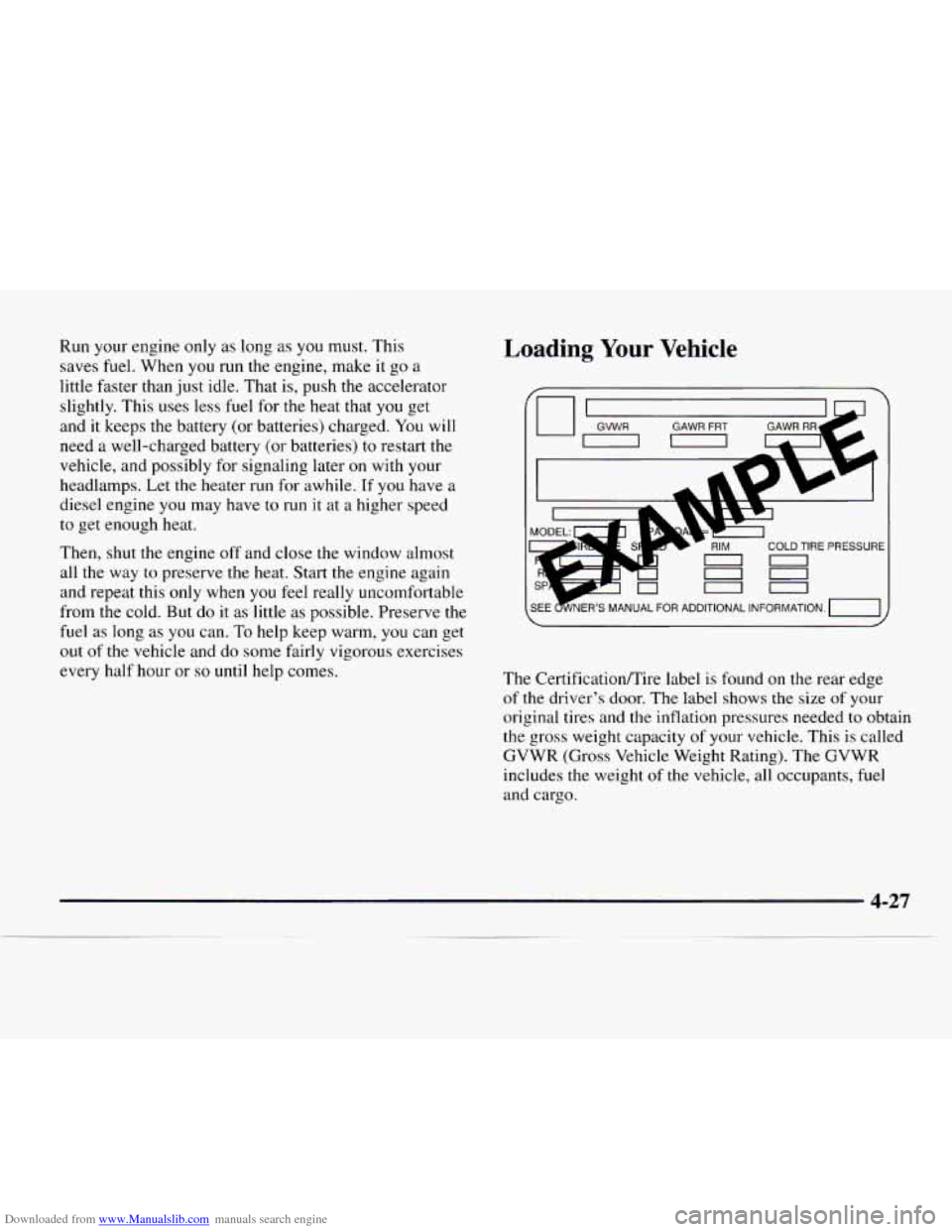
The CertificatiodTire label is found on the rear edge
of the driver’s door. The label shows the size of your
original tires and the inflation pressures needed
to obtain
the gross weight capacity of your vehicle. This is called
GVWR (Gross Vehicle Weight Rating). The
GVWR
includes the weight of the vehicle, all occupants, fuel
and cargo.
Page 196 of 386
Downloaded from www.Manualslib.com manuals search engine Other Warning Devices
If you carry reflective triangles, you can use them to
warn others. Set one up at the side of the road about
300 feet (100 m) behind your vehicle.
Jump Starting
If your battery has run down, you may want to use
another vehicle and
some jumper cables to start your
vehicle. But please follow the steps below
to do it safely.
I I
/1 CAJTION:
Batteries can hurt you. They can be
dangerous because:
They contain acid that can burn you.
They contain gas that can explode or ignite.
They contain enough electricity to burn you.
If you don’t follow these steps exactly, some or all
of these things can hurt
you.
NOTICE:
Ignoring these steps could result in costly damage
to your vehicle that wouldn’t be covered by
your warranty.
Trying to start your vehicle by pushing or pulling
it won’t work, and it could damage your vehicle.
1. Check the other vehicle. It must have a 12-volt
battery with a negative ground system.
NOTICE:
If the other system isn’t a 12-volt system with a
negative ground, both vehicles can be damaged.
If you have a diesel engine vehicle with two batteries
(or more)
you should know before you begin that,
especially in cold weather, you may not be able to
get enough power from a single battery in another
vehicle
to start your diesel engine.
Page 197 of 386
Downloaded from www.Manualslib.com manuals search engine If your vehicle has more than one battery, use the
battery that is under the hood of the vehicle
- this
will reduce the electrical resistance.
2. Get the vehicles close enough so the jumper cables
can reach, but be sure the vehicles aren’t touching
each other.
If they are, it could cause a ground
connection
you don’t want. You wouldn’t be able to
start your vehicle, and the bad grounding could
damage the electrical systems.
To avoid the possibility of the vehicles rolling, set
the parking brake firmly on both vehicles. Put your
automatic transmission in PARK
(P).
3. Turn off the ignition on both vehicles. Turn off all
lamps that aren’t needed, and radios. This will avoid
sparks and help save both batteries, and could save
your radio.
1 NOTICE:
If’ you leave your radio on, it could be badly
damaged. The repairs would not be covered by
your warranty.
4. Open the hoods and locate the batteries. Find the
positive
(+) and negative (-) terminals on each battery.
An electric fan can start up even when the engine
is not running and can injure you. Keep hands,
clothing and tools away from any underhood
electric fan.
Page 198 of 386

Downloaded from www.Manualslib.com manuals search engine I
Using a match near a battery can cause battery
gas to explode. People have been hurt doing this,
and some have been blinded. Use a flashlight
if
you need more light.
Be sure the batteries have enough water.
You
don’t need to add water to the Delco Freedom@
battery (or batteries) installed in every new
GM
vehicle. But if a battery has filler caps, be sure
the right amount of fluid is there.
If it is low, add
water to take care
of that first. If you don’t,
explosive gas could be present.
Battery fluid contains acid that can burn you.
Don’t get it on you. If you accidentally get it in
your eyes or
on your skin, flush the place with
water and get medical help immediately.
5. Check that the jumper cables don’t have loose or
missing insulation. If they do,
you could get a shock.
The vehicles could be damaged, too.
Before you connect the cables, here are some basic
things you should know. Positive
(+) will go to
positive
(+) and negative (-) will go to an unpainted
metal engine
part or a body metal surface. Don’t
connect positive
(+) to negative (-) or you will get a
short that would damage the battery and maybe other
parts, too. And don’t connect the negative
(-) to
negative
(-).
A CAUTION: 1
Fans or other moving engine parts can injure you
badly. Keep
your hands away from moving parts
once the engine
is running. -1
Page 199 of 386
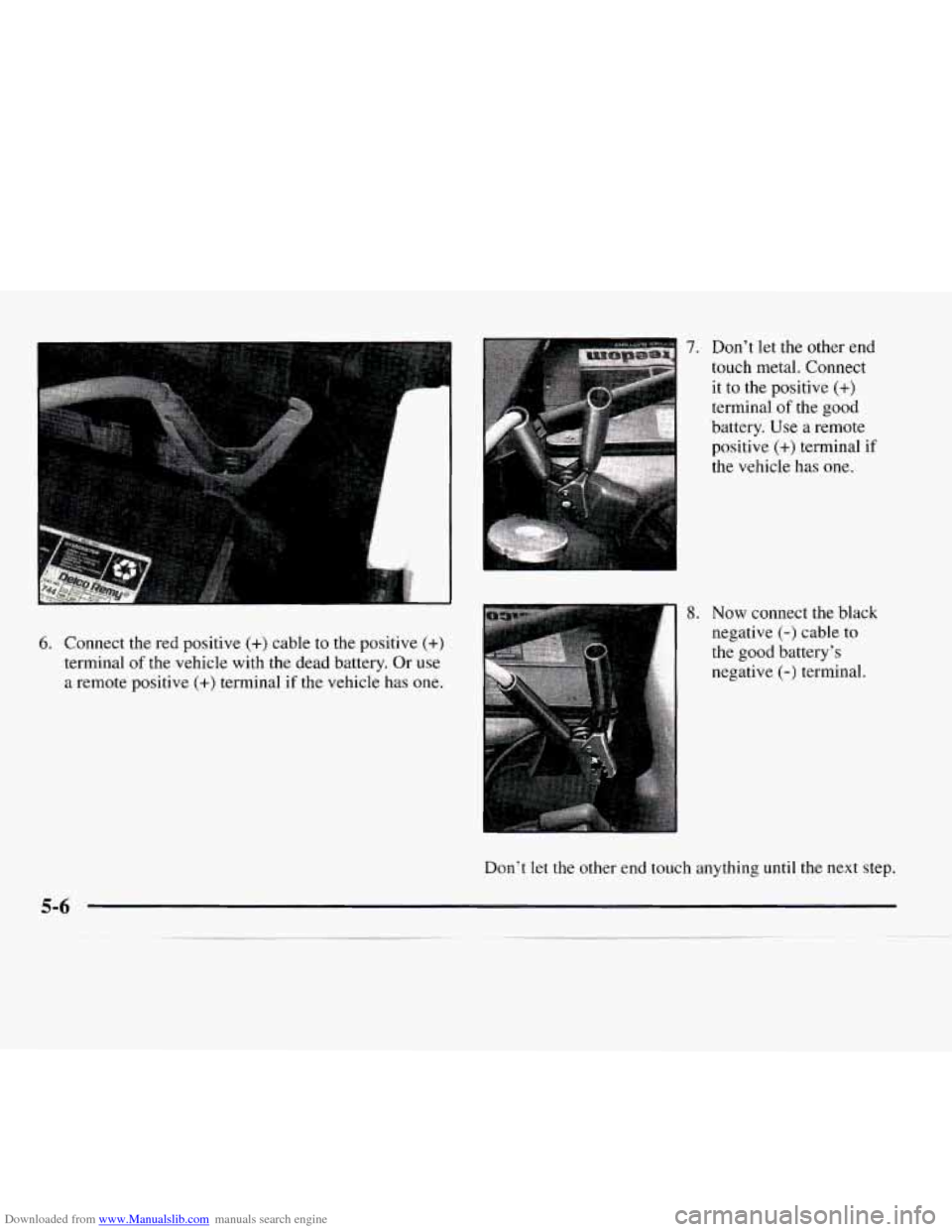
Downloaded from www.Manualslib.com manuals search engine 6. Connect the red positive (+) cable to the positive (+)
terminal of the vehicle with the dead battery. Or use
a remote positive
(+) terminal if the vehicle has one.
7. Don't let the other end
touch metal. Connect
it to the positive
(+)
terminal of the good
battery. Use a remote positive
(+) terminal if
the vehicle has one.
8. Now connect the black
negative
(-) cable to
the good battery's
negative
(-) terminal.
Don't let the other end touch anything
until the next step.
5-6
- ~ -.-.. cIL.-I___.PI--- --.___.. ______--.--_ ~~~