Page 155 of 388
Downloaded from www.Manualslib.com manuals search engine P.SCAN: Press this button to listen to each of your
favorite stations stored on your pushbuttons for
a few
seconds. The radio will scan through each of the stations
stored on your pushbuttons, except those stations with
weak reception. The
AUTO TONE setting stored for
that pushbutton will
be automatically chosen. Press
P.SCAN or one of the pushbuttons again to stop
scanning. P.SCAN will be displayed whenever the tuner
is
in the P.SCAN mode. The channel number (Pl-P6)
will appear momentarily just before the fi-equency
is displayed.
Setting the Tone
BASS: Press this knob lightly so it extends. Turn the
knob clockwise
to increase bass and counterclockwise to
decrease bass. When you use this control, the radio’s
AUTO TONE setting will switch to manual.
TREB: Press this knob lightly so it extends. Turn the
knob clockwise to increase treble and counterclockwise
to decrease treble. When you use this control, the radio’s
AUTO
TONE setting will switch to manual. If a station
is weak or noisy, you may want to decrease the treble.
Push these knobs back into their stored positions when
you’re not using them.
AUTO TONE: This feature allows you to choose preset
bass and treble equalization settings designed for
classical, news, rock, pop, country/western and jazz
stations.
C/W will appear on the display when you first
press AUTO TONE. Each time
you press it, another
setting
will appear on the display. Press it again after
JAZZ appears and the AUTO TONE display will go
blank. Tone control will return to the
BASS and TREB
knobs. Also, if you use the
BASS and TREB knobs,
control will return to them and the
AUTO TONE
display
will go blank.
Adjusting the Speakers
BAL: Press this knob lightly so it extends.
Turn the knob clockwise for the right speakers and
counterclockwise for the left speakers. The middle
position balances the sound between the speakers.
FADE: Press this knob lightly so it extends. Turn the
knob clockwise to adjust the sound to the front speakers
and counterclockwise for the rear speakers. The middle
position balances the sound between the speakers.
Push these knobs back into their stored positions when
you’re not using them.
3-19
Page 174 of 388
Downloaded from www.Manualslib.com manuals search engine An emergency like this requires close attention and a
quick decision. If you are holding the steering wheel at
the recommended
9 and 3 o'clock positions, you can
turn it a full 180 degrees very quickly without removing
either hand. But you have to act fast, steer quickly, and
just as quickly straighten the wheel once you have
avoided the object.
The fact that such emergency situations are always
possible is a good reason to practice defensive driving at
all times and wear safety belts properly.
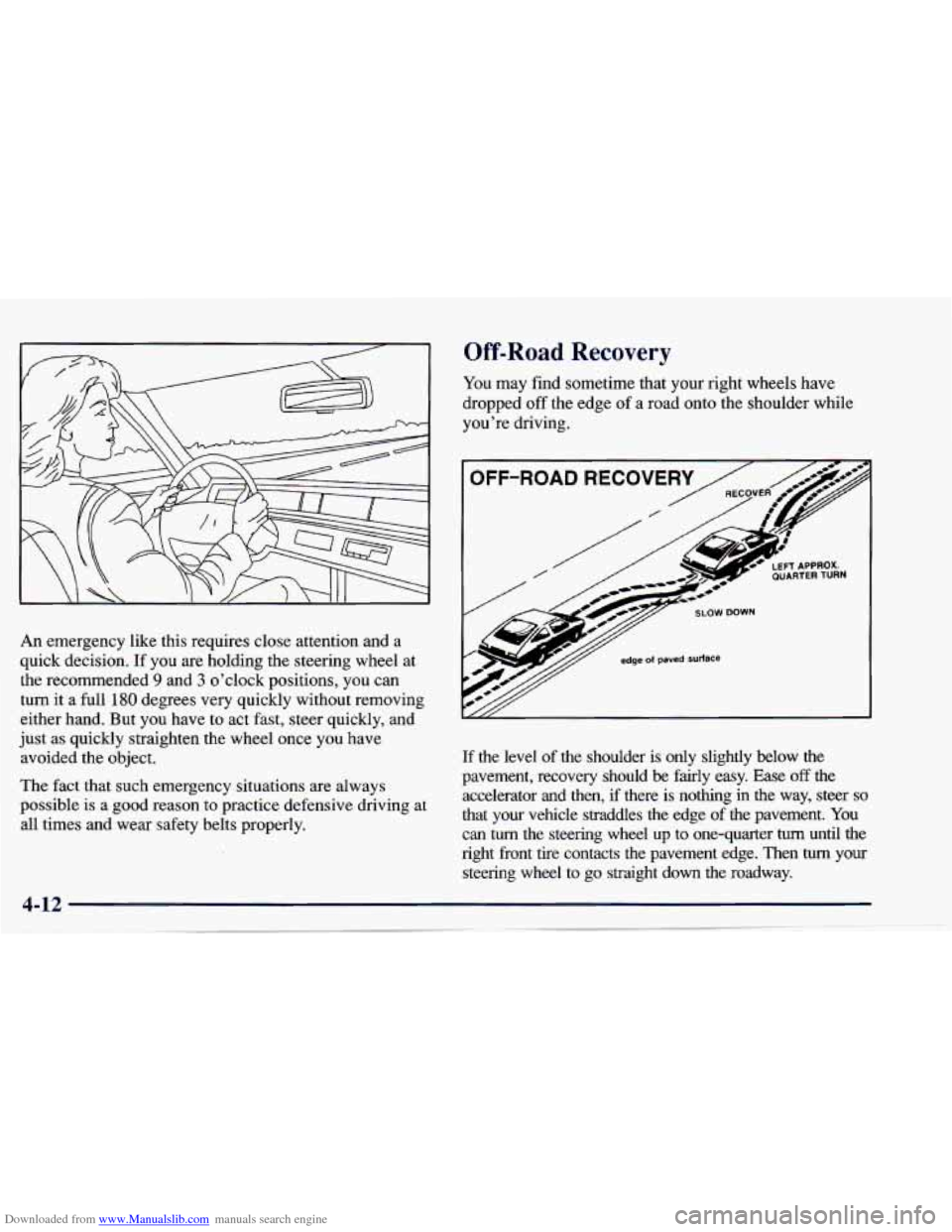
Off-Road Recovery
You may find sometime that your right wheels have
dropped
off the edge of a road onto the shoulder while
you're driving.
If the level of the shoulder is only slightly below the
pavement, recovery should
be fairly easy. Ease off the
accelerator and then, if there is nothing
in the way, steer so
that your vehicle straddles the edge of the pavement. You
can turn the steering wheel up to one-quarter turn until the
right front
tire contacts the pavement edge. Then turn your
steering wheel
to go straight down the roadway.
4-12
Page 231 of 388
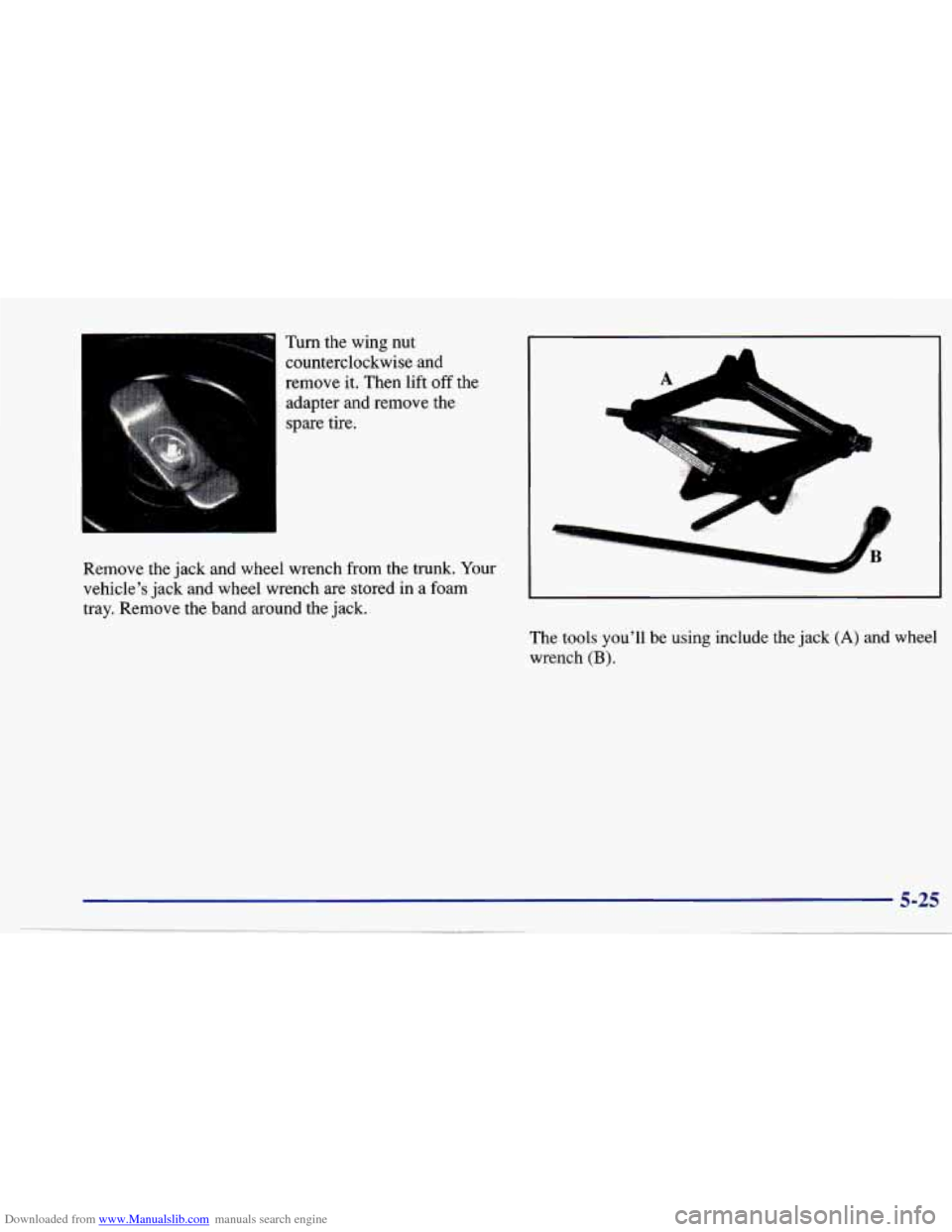
Downloaded from www.Manualslib.com manuals search engine Turn the wing nut counterclockwise and
remove it. Then lift off the
adapter and remove the
spare tire.
A A
..,
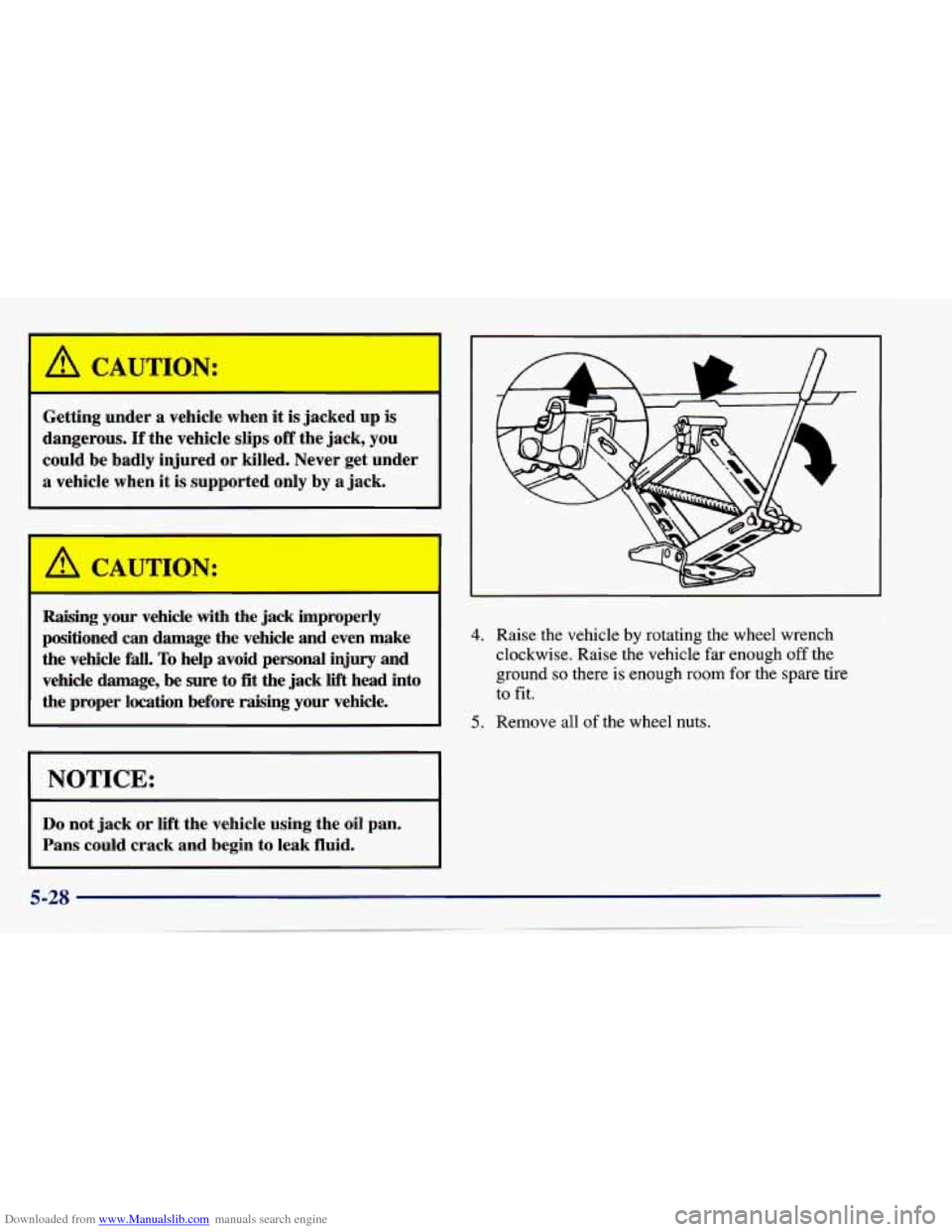
Remove the jack and wheel wrench from the trunk. Your
vehicle's jack and wheel wrench are stored in a
foam
tray. Remove the band around the jack.
The tools you'll be
using include the jack (A) and wheel
wrench
(B).
Page 234 of 388
Downloaded from www.Manualslib.com manuals search engine Getting under a vehicle when it is jacked up is
dangerous. If the vehicle slips off the jack, you
could be badly injured
or killed. Never get under
a vehicle when it is supported only by a jack.
Raising your vehicle with the jack improperly
positioned can damage the vehicle and even make
the vehicle
fall. To help avoid personal injury and
vehicle damage,
be sure to fit the jack lift head into
the proper location before raising your vehicle.
I NOTICE:
~~ ~~~ ~
Do not jack or lift the vehicle using the oil pan.
Pans could crack and begin to leak fluid.
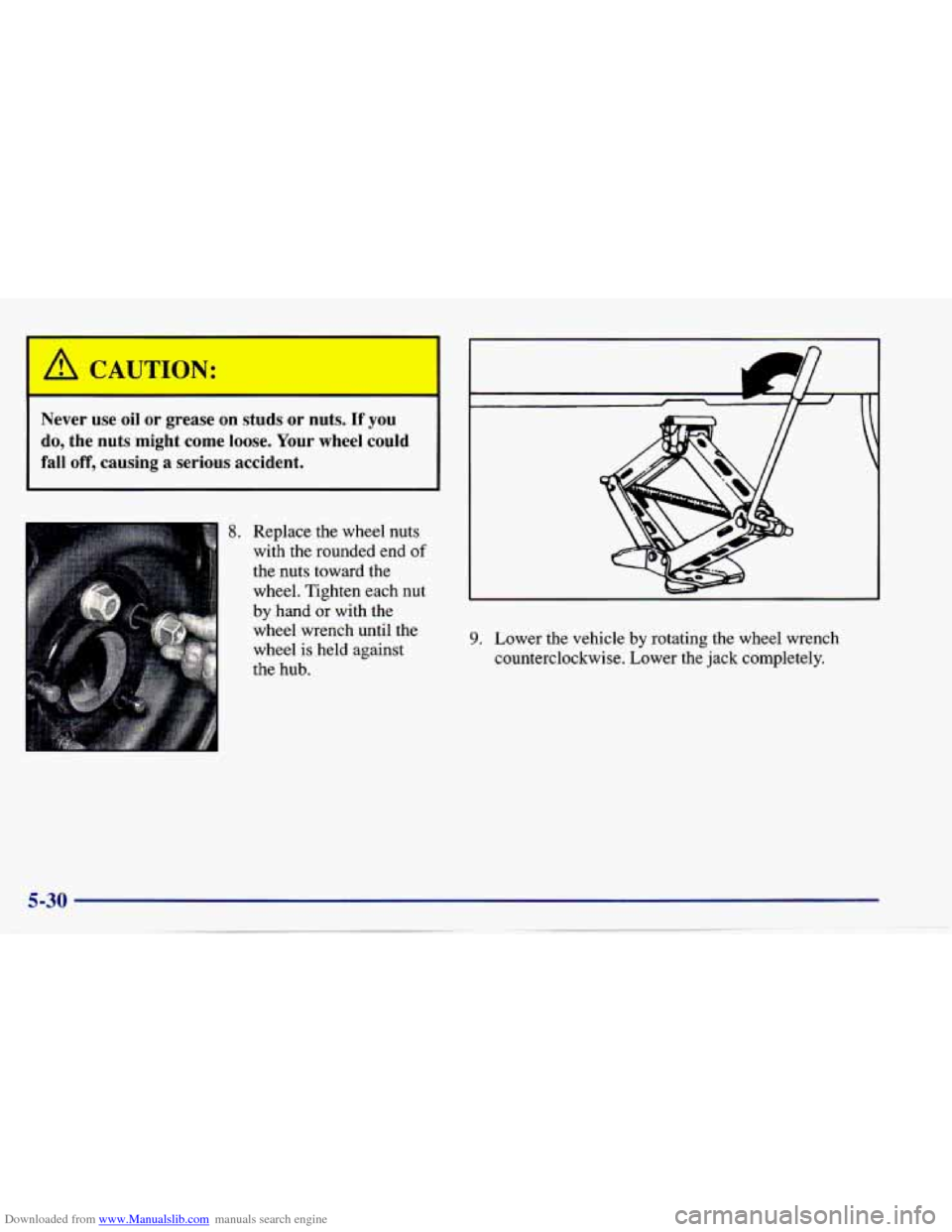
4. Raise the vehicle by rotating the wheel wrench
clockwise. Raise the vehicle far enough off the
ground
so there is enough room for the spare tire
to fit.
5. Remove all of the wheel nuts.
Page 236 of 388
Downloaded from www.Manualslib.com manuals search engine A (I JTION: I
I
Never use oil or grease on studs or nuts. If you
do, the nuts might come loose. Your wheel could
fall off, causing a serious accident.
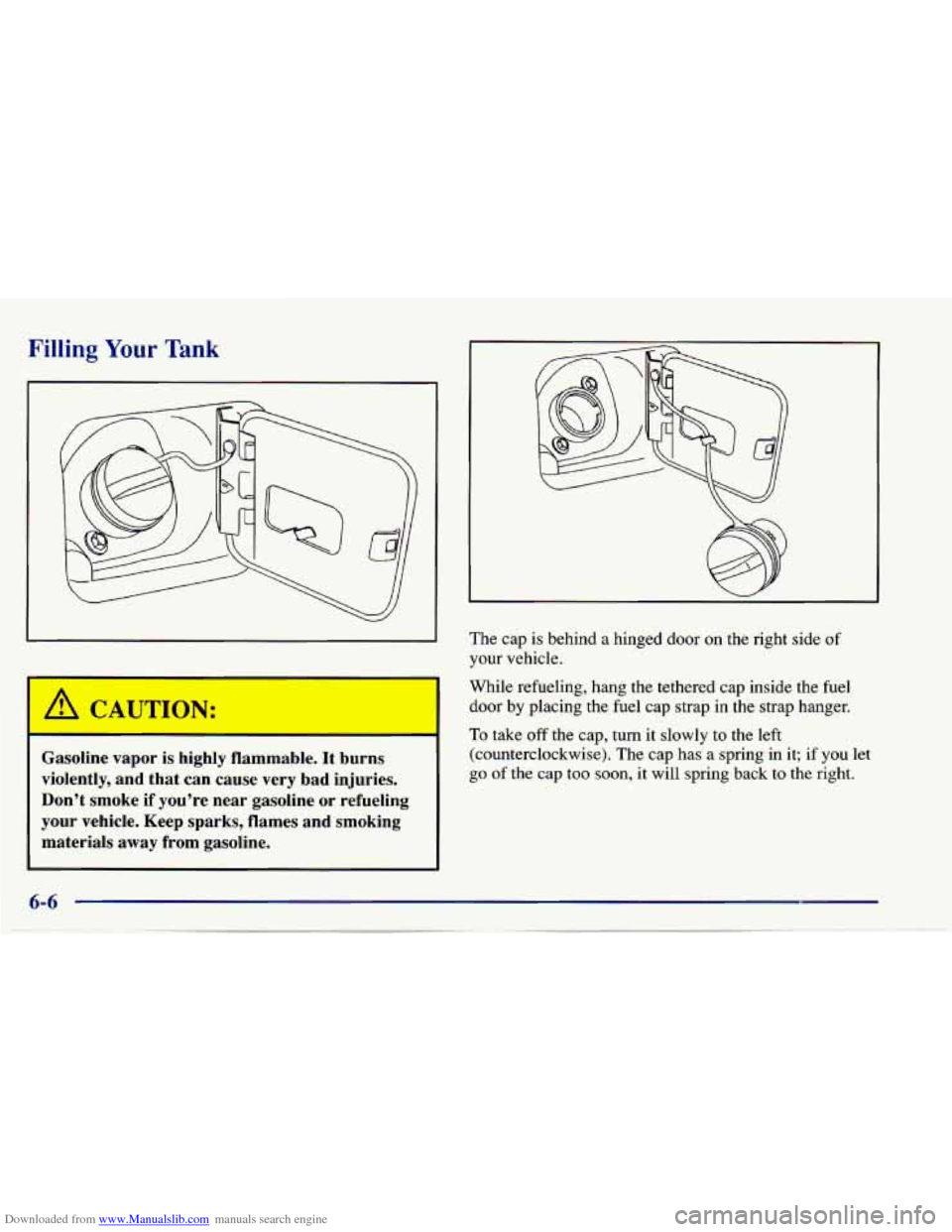
8. Replace the wheel nuts with the rounded end
of
the nuts toward the
wheel. Tighten each nut
by hand or with the wheel wrench until the
wheel
is held against
the hub. 9.
Lower the vehicle by rotating the wheel wrench
counterclockwise. Lower the jack completely.
Page 248 of 388
Downloaded from www.Manualslib.com manuals search engine Filling Your Tank
A CA, JON:
Gasoline vapor is highly flammable. It burns
violently, and that can cause very bad injuries.
Don’t smoke if you’re near gasoline or refueling
your vehicle. Keep sparks, flames and smoking materials away from gasoline.
The cap is behind a hinged door on the right side of
your vehicle.
While refueling, hang the tethered cap inside the fuel
door by placing the fuel cap strap
in the strap hanger.
To take off the cap, turn it slowly to the left
(counterclockwise). The cap has a spring
in it; if you let
go of the cap too
soon, it will spring back to the right.
Page 249 of 388
Downloaded from www.Manualslib.com manuals search engine A CAUTION:
If you get gasoline on yourself and then
something ignites it, you could be badly burned.
Gasoline can spray out on
you if you open the
fuel filler cap too quickly. This spray can happen
if your tank is nearly full, and is more likely in
hot weather. Open the fuel filler cap slowly and
wait for any “hiss” noise to stop. Then unscrew
the cap all the way.
Be careful not to spill gasoline. Clean gasoline from
painted surfaces as soon as possible. See “Cleaning the
Outside
of Your Chevrolet” in the Index. When you put the
cap back on, turn
it to the right
(clockwise) until you hear a clicking sound.
Make sure
you fully install the cap. The diagnostic
system can
determine
if the fuel cap has been left off or improperly
installed. This would allow fuel to evaporate into the
atmosphere. See “Malfunction Indicator Lamp” in
the Index.
NOTICE:
If you need a new cap, be sure to get the right
type. Your dealer can get one for you. If you get
the wrong type, it may not fit properly. This may
cause your malfunction indicator lamp to light
and your
fuel tank and emissions system may be
damaged. See “Malfunction Indicator Lamp” in
the
Index.
6-7
, .. .. .
Page 278 of 388
Downloaded from www.Manualslib.com manuals search engine Front Exterior
Headlamps
For the type of bulb to use, see “Replacement Bulbs” in
the Index.
To replace one of your headlamp bulbs, do
the following:
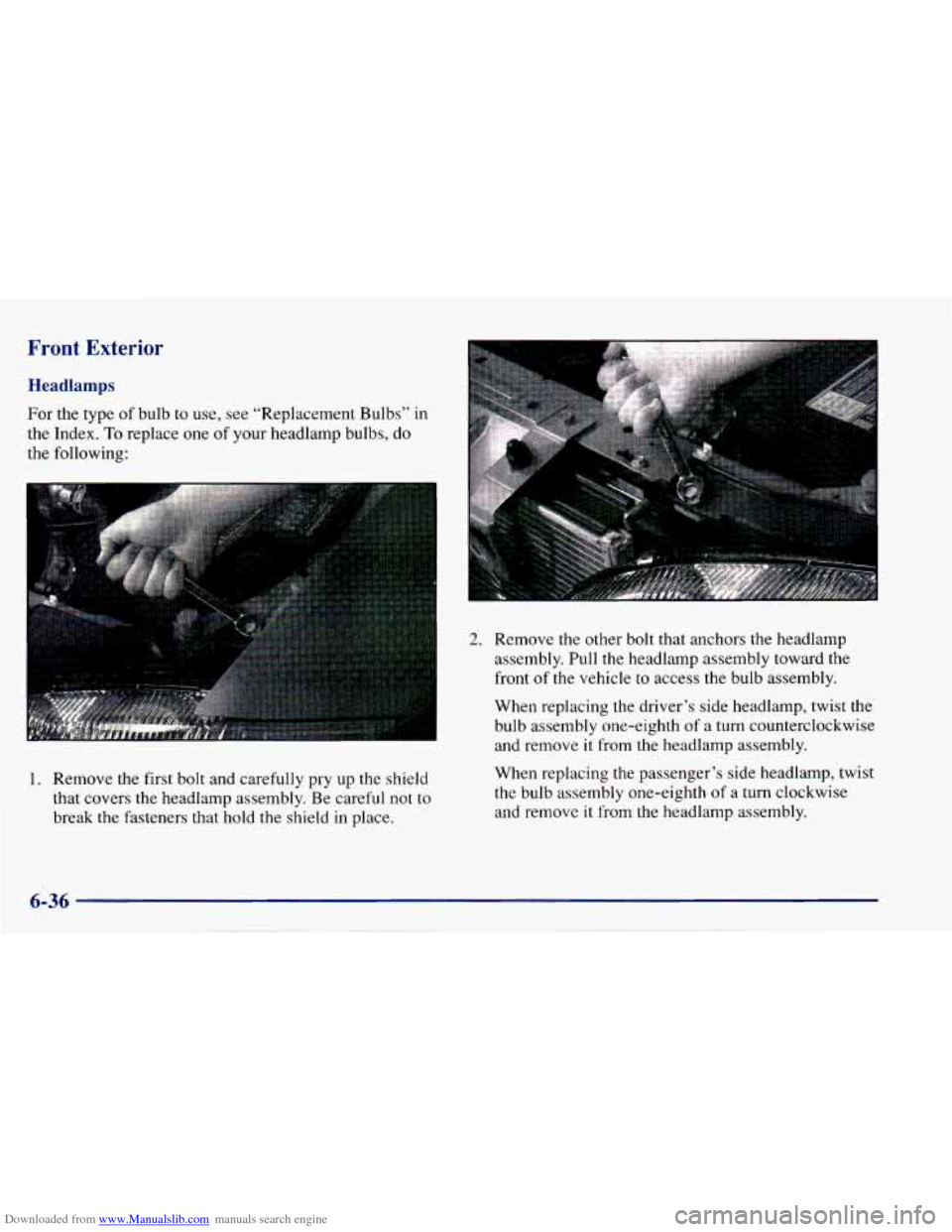
1. Remove the first bolt and carefully pry up the shield
that covers the headlamp assembly. Be careful not to
break the fasteners that hold the shield in place.
2. Remove the other bolt that anchors the headlamp
assembly. Pull the headlamp assembly toward the
front of the vehicle
to access the bulb assembly.
When replacing the driver’s side headlamp, twist the bulb assembly one-eighth of a turn counterclockwise
and remove it from the headlamp assembly.
When replacing the passenger’s side headlamp, twist
the bulb assembly one-eighth
of a turn clockwise
and remove
it from the headlamp assembly,
6-36